By the time Norah Daly was rejected for the seventh time, she had stopped expecting mercy from anyone in Red Bow.
Humiliation had a pattern in that town. It always began with lowered voices and ended with everyone hearing anyway. Men would avoid her eyes at first, as though kindness might soften the insult they were about to deliver. Then came the same careful words, wrapped in false regret. A farm needed strong children. A household needed a woman “fit” for company. A mother didn’t want grandchildren frightened by a scarred face at the breakfast table. A husband couldn’t be expected to choose hardship when prettier, smoother, whole girls still existed.
But Amos Weaver managed to outdo them all.
He said it in the general store, with Widow Higgins listening and half the town likely ready to hear it retold by supper. He crushed his hat to his chest, turned red from the neck up, and told Norah that his mother needed “a whole woman.” Then, with the helpless stupidity of a weak man repeating somebody else’s cruelty, he added that her burned hands looked more suited to frightening children than raising a family.
For one suspended second the room went still.
Norah looked at her hands.
They were ugly by any standard Red Bow respected. The left one was worst. Fire had twisted the skin into pale ridges that tightened whenever she clenched her fingers. The scars ran up her forearm too, disappearing under her faded sleeve. She had earned them the night her father’s house caught fire. She had dragged him through smoke while the rafters collapsed around them. She’d been seventeen, coughing blood and ash, hands blistering as she tried to pull him toward the open yard. She had made it out. He had not.
Red Bow remembered the scars. Nobody cared to remember the courage.
“Then tell your mother to buy a mare,” she said. “Maybe that would offend her less.”
Amos fled under the sound of the store bell and the laughter outside. Widow Higgins offered pity in the same tone other women used for gossip.
“You make it harder on yourself when you speak sharp.”
Norah paid for her oats and walked out before she said something worse.
The town had turned her life into a matter of practical concern. She was twenty now, orphaned, renting a room too small to stretch both arms in, earning scraps by laundering, mending, scrubbing floors, and doing whatever the church matrons deemed acceptable for a woman they did not want too near their sons. The marriage council had discussed her twice in public. She knew because people had told her what was said as if they were doing her a favor.
No dowry. No land. No close kin. Bad prospects. Winter risk.
As though she were livestock no one wanted to feed.
In the alley behind the boardinghouse, the rope holding the clean blankets snapped and sent all her work into the mud. Two cowboys laughed from a railing overhead. One called her the fire bride. Another asked if heat still followed wherever she went.
Norah didn’t answer. She bent down and lifted the blankets one by one. Her hands stung from lye and cold water. Her back ached. Pride had become a kind of armor by then, not because it protected her from pain, but because it was the only thing nobody had managed to take.
Then the alley darkened.
She looked up and found Gideon Cross watching her.
Every town keeps legends on the edge of itself. Men who come down from mountains or swamps or desert trails carrying weather with them. Gideon was one of those. He had ridden into Red Bow that morning with two mules loaded in hides and a coat made from wolf pelts. He was taller than any man in town, broad through the shoulders, bearded, hard-eyed, and silent in a way that made ordinary men suddenly aware of their own noise. Stories followed him like burrs. He trapped in the Bitterroots. He lived alone. He had once killed a grizzly with an axe. He had once killed a man and buried him in snow. He had no interest in church, town councils, or being liked.
Norah picked up her washing paddle.
“If you came to laugh,” she said, “don’t stand so far back.”
He looked at the paddle, then at her face. “I didn’t come to laugh.”
“Then speak.”
“A wife.”
For the first time that day she almost smiled, though it was a bitter thing. “That line would work better on someone foolish.”
“I’m not joking.”
“I heard enough jokes already.”
“I heard seven men refused you.”
“And you came to make eight?”
“No,” he said. “I came because those seven are cowards.”
The answer struck her harder than if he had insulted her. Not because it was flattering. Because it sounded like he believed it.
He said he needed someone who would not break when winter sealed the mountain passes. Someone who understood work, cold, silence, and surviving. Norah, raw from public humiliation and too tired for false hope, lifted her scarred arm for him to see.
“This is what everybody sees first.”
Without a word, Gideon rolled up his own sleeve. Long white scars crossed his forearm, deep and uneven. Not neat. Not old enough to have faded fully. They looked like the memory of teeth or claws.
“Marks don’t tell me what a body lacks,” he said. “They tell me what it lived through.”
Then he placed a leather pouch of coins on the washboard.
“That pays what you owe in town. My cabin is four days away. I have meat, firewood, tools, and a roof that holds. I also have wolves, blizzards, and a valley most people would die trying to reach. We leave at dawn.”
“You assume I’ll come.”
He turned and started toward the street. “You will.”
All evening she tried to tell herself he was mad, dangerous, or both. Widow Higgins warned her that men who lived alone in the mountains did so because civilized people wouldn’t have them. The boardinghouse owner hinted that if Norah disappeared, no one would think to search very hard. A stable boy claimed Gideon had once been seen with blood on his coat in the middle of summer.
But beneath the fear was something more unsettling.
No one in Red Bow had spoken to her as if strength were the first thing they noticed.
At dawn she packed three dresses, the skillet that had belonged to her mother, and the small Bible she hadn’t opened in months. Then she climbed onto Gideon’s spare mare and left everything else behind.
The road out of Red Bow felt less like escape than surrender to something unknown. The town dwindled into dust and then disappeared entirely. They traveled north and west through climbing country, where pines thickened and the air sharpened. Gideon did not fill the journey with questions. He never asked how she got burned, never offered meaningless sympathy, never treated her silence as an invitation to intrude.
He taught instead.
How to step where shale wouldn’t slide.
How to tell thin ice from safe ice by its color.
How to wrap a scarf over the lower face so lungs didn’t seize in bitter wind.
How to watch tree lines for signs of weather changing before the clouds gave it away.
When they camped, he built the fire but expected her to tend it. He handed her dried venison and black coffee, then slept lightly with one arm over his bedroll and one boot still on. There was no softness in him, but there was also no sneering patience, none of the careful condescension she had learned to expect from men who thought women existed to be managed.
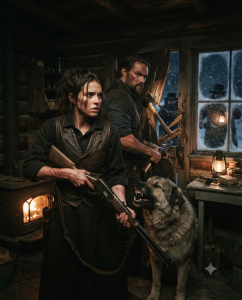
By the fourth day they reached a narrow valley hidden between ridges. The cabin sat in the center like it had been hammered into existence by stubbornness alone. Thick logs. Stone chimney. Tiny windows. A stout porch. A woodpile higher than the fence. It looked less like a home than a promise never to be easy prey.
Then the dog came.
The animal launched from under the porch in a blur of gray-black fur, enormous head low, teeth flashing. Norah froze only a heartbeat before Gideon’s command cracked through the air.
“Scrap.”
The dog went silent instantly but did not stop watching her.
Norah dismounted. She had learned long ago that fear excites some creatures and insults others. Scrap circled once, nose lifted toward her burned hands. Norah let him decide. After a tense second, she touched his neck. He snorted and leaned closer.
Gideon made a sound that might have been approval. “He likes you.”
Inside, the cabin was clean, sparse, and built for endurance. Iron pots, drying herbs, rifles over the hearth, shelves of tools, stacks of cured hides. One table. Two chairs. One bed.
Norah’s pulse stumbled at the sight of it.
Gideon saw where she was looking and answered the fear before she gave it a name. She would sleep on the wall side where it stayed warmer. He’d take the edge. He would not touch her unless she asked for it. Then, with maddening simplicity, he added that he expected her to help keep the place running and to shoot anybody who came through the door with bad intentions.
It was the strangest reassurance she had ever been offered. And somehow the most convincing.
The days that followed were harder than anything in Red Bow and easier than her life there in one important way: every hardship had purpose. Water had to be hauled before dawn. Wood chopped and stacked. Meat smoked. Traps checked. Snow knocked from the roof. Soap made. Clothes patched. Gideon expected competence, not perfection. If she didn’t know something, he showed her once. If she made a mistake, he corrected it without mockery. If she did something well, he nodded as though that were only natural.
No one had ever made her feel less like a burden.
The first time she cleaned a rabbit with her scarred hand and didn’t catch him watching, she realized what had changed. Gideon did not stare at the scars because he was no longer measuring her against what other women could do. He had already decided what mattered.
Winter came down fast in the mountains. One week the valley smelled of damp pine and old leaves; the next it was swallowed in white. The silence grew deeper with snow, but never gentler. Wind struck the walls at night. Ice formed on the inside corners of the window glass. Some mornings the door had to be forced open against drifts.
Norah discovered she liked the hardness of it. Out there, survival did not care who had once mocked her in a store. The mountain asked only whether she could endure.
She and Gideon settled into a rough rhythm. They shared meals, work, and practical words. Sometimes, late at night, he spoke a little more. He had trapped beaver and fox since he was fifteen. He’d served once as a scout in a border dispute nobody remembered properly. He trusted dogs more than men. He hated whiskey because it made fools loud and cowards bolder. He never spoke of family.
One evening Norah caught him watching the fire instead of eating.
“What happened to your arm?”
He looked at the scars a long moment before answering. “Men, not animals.”
The room quieted around them.
“Did you kill them?”
“No.”
Something in his voice made her put down her spoon. “Should you have?”
He met her gaze. “Probably.”
That answer stayed with her.
A week later, the storm came.
By sundown snow was driving sideways across the valley. Scrap paced the door, ears high. Norah was peeling potatoes when the dog gave a growl so deep it seemed to rise from the floorboards themselves. Gideon stood instantly, took the rifle from above the hearth, and darkened the lantern.
“Behind the table,” he said.
“Who is it?”
“That,” he said grimly, “is what I hoped you’d never hear.”
Then came the sound of boots outside.
Not one pair. Several.
A voice cut through the storm. “Cross! We know you’re in there.”
Norah saw something she had never seen on Gideon before: not fear, but regret.
“They didn’t follow me for hides,” he said. “They came for something I took.”
Before she could ask what, another shout slammed through the night.
“Open up or we burn the place down with both of you inside!”
Gideon handed her the smaller rifle. “Can you shoot?”
“Enough,” she said.
“Tonight it has to be better than enough.”
The first shot hit the cabin wall near the window. Scrap hurled himself at the door, snarling. Gideon motioned Norah toward the side slit they used to watch the woodpile. Through it she counted four men on the porch and at least two more by the shed. Their faces were wrapped in scarves. One carried a lantern shielded under his coat. Another held an oil can.
“Who are they?”
Gideon’s voice was flat. “Burl Sutter’s men.”
The name meant nothing to her.
“He runs the freight line over the north pass,” Gideon said. “Or he did until I opened one of his wagons last month.”
Norah turned sharply. “Opened it?”
“It wasn’t freight.”
Outside, a man struck the door with something heavy. The log frame shuddered.
“What was in the wagon?”
Gideon reloaded with practiced calm. “Girls.”
The word made her stomach drop.
He spoke quickly then, between impacts on the door. Sutter had been buying desperate women from mining camps, taking in runaways, widows, orphans, promising jobs in Spokane or Helena, then selling them farther west to brothels and work gangs. Gideon had intercepted one wagon after hearing a child cry where no freight should have made a sound. He’d killed the driver’s horse, broken the lock, and gotten three girls out alive. One was dead by morning anyway from cold and fever. The others he’d taken to a mission south of the pass. Sutter had sworn to find him.
“Why didn’t you tell me?”
“Because once people know you stand against men like that, they either use you or betray you.”
The door boomed again.
“And because,” he added, “I didn’t know if they knew about you.”
A voice outside shouted, “We only want the ledger, Cross!”
Gideon’s expression changed.
Norah saw it at once. “There’s a ledger?”
He hesitated a fraction too long.
“Where?”
Another hit shook the hinges. Gideon cursed under his breath. “Under the hearthstone.”
She stared. “You brought me into this house with that hidden under our feet?”
“I brought you here because I thought this valley could keep you safe.”
“And can it?”
The next sound answered for him: glass shattering as a lantern struck the outer wall and slid off into snow.
Gideon moved to the door brace. “If they get in, they come through narrow. Aim center chest. Don’t waste bullets.”
Then the bar splintered.
The fight happened too fast for thought. The door burst inward just enough for one man to jam his shoulder through. Scrap hit him first, dragging him down in a howl of fur and limbs. Another tried to fire through the gap and Gideon shot him from ten feet away. The blast deafened Norah. Smoke filled the room. A third man lunged in with a club, and Norah fired before she understood she had chosen to. He crashed backward into the snow.
Silence lasted less than a second. Then someone outside screamed, “Set the roof!”
Norah dropped the empty rifle and ran for the bucket line. Gideon kicked the broken door shut and shoved the table against it while Scrap tore at a hand that reached through the gap. Norah heard curses, boots, the scrape of men retreating along the porch.
“The roof!” she shouted.
They ran outside through the back into killing wind. Flames licked where oil had caught under the eaves. Norah plunged water onto the first tongue of fire while Gideon climbed the woodpile and hacked away the burning section with an axe. Snow helped. So did luck. Within minutes the worst was out.
One of Sutter’s men had tried circling to the shed. Norah saw movement, grabbed the wash pole leaning nearby, and swung with both hands. The blow caught him at the knee. He collapsed cursing. Gideon was on him before he could rise, boot in his throat, rifle at his face.
“Where is Sutter?”
The man spat blood into the snow. “South fork camp.”
Gideon pressed the barrel harder. “How many?”
The man laughed weakly. “Enough.”
They tied him in the shed until morning.
When dawn came, the valley looked like nothing had happened except for the black scorch along the eaves and the blood trampled into snow. Inside, Gideon pried up the hearthstone and pulled out a wrapped oilcloth bundle. Inside was a ledger packed with names, dates, payments, routes, initials, and notes in three different hands.
Norah recognized enough to feel sick.
Girls listed like livestock. Prices. Ages. Conditions.
Some were marked delivered. Some marked spoiled.
She looked up slowly. “This could hang him.”
“It could hang several men,” Gideon said. “Including one in Red Bow.”
Her mouth went dry. “Who?”
He tapped a page.
Widow Higgins.
Not as a buyer. As a recruiter.
Norah sat down hard.
The old woman’s fake pity, her obsession with “placing” girls before winter, the way she always knew who was desperate and who was alone—every rotten detail rearranged itself into truth. Norah remembered the boarders who had left suddenly. A widow from Missouri. A pale fifteen-year-old who cried at night. A seamstress who thought she had been offered work in a hotel farther west and was never heard from again.
“Why didn’t anyone stop her?”
“Because no one suspected a woman who quoted scripture and fed people soup after funerals.”
Norah closed the ledger, then opened it again just to make sure the name had not changed.
It had not.
“What do we do now?”
Gideon looked toward the storm clearing over the ridge. “We take it to the marshal in Helena.”
“And if the marshal is paid too?”
“Then we keep riding until we reach one who isn’t.”
She should have been terrified. Instead, beneath the shock, anger burned so clean it steadied her. All those years Red Bow had looked at her as if she were half-finished, unfit, pitiful. Meanwhile one of its most respectable women had been feeding girls into darkness and calling it charity.
They left the captive tied for the county riders to collect, set the cabin as secure as they could, and rode out that same afternoon. The road south was brutal, but Norah no longer felt like she was following Gideon into his life. She was riding beside him into a reckoning.
At the first settlement they found, the deputy warned them against accusing established names without proof. Gideon put the ledger on the desk. The deputy paled and sent for the territorial marshal himself.
The arrests began three days later.
Burl Sutter tried to run and was taken near the river crossing with forged papers and two girls hidden under canvas. Widow Higgins denied everything until one of the rescued girls identified her voice. Amos Weaver’s mother was questioned too; though not part of the trade, she had recommended “placement houses” without asking what became of the women sent there. Red Bow learned all at once that respectability and decency were not the same thing.
Norah returned to town only once, to testify.
The same street that had watched her humiliation now went silent when she stepped from the wagon. Men who once laughed looked away. Women who had pitied her pressed lips together and lowered their eyes. Amos Weaver stood outside the store as pale as flour, but she gave him nothing—not anger, not triumph, not even acknowledgment. He had taken enough from her already by making her believe his judgment mattered.
Inside the hearing room, Norah named what she knew. Widow Higgins stared at her with naked hatred, no sweetness left to hide behind.
“You were always ungrateful,” the old woman hissed as she was led away.
Norah held her gaze. “No. I was never for sale.”
That was the sentence Red Bow remembered.
When it was over, she expected some hollow feeling of victory. Instead what she felt was exhaustion, then clarity. The town she had once begged in her heart to accept her had been rotted in ways scars could never equal. Survival had not made her lesser. It had taught her to recognize the scent of danger even when it wore a polite face.
She returned to the mountain before sundown.
Spring found the valley slowly. Snow thinned, then retreated into shadowed places. Water ran louder in the creek. Scrap grew lazy in warm patches by the porch. The cabin roof was repaired. New herbs hung drying by the window. Norah’s dresses still bore lye stains and old patches, but the woman wearing them had changed.
One evening she sat on the porch sharpening a skinning knife when Gideon stepped out and handed her a folded sheet from Helena. The court had sentenced Sutter and two of his men to hang. Widow Higgins would serve life in prison due to her age and cooperation after the arrests began. Several families had come forward searching for daughters or sisters. Two had been found. Many had not.
Norah folded the paper carefully. “It isn’t enough.”
“No,” Gideon said.
She looked at the valley, at the long shadows, at the dog stretched near her boots. “But it’s something.”
After a moment he sat beside her. For a man made of caution, the movement held more trust than any speech. His hand rested on the porch between them, palm down, scarred and weathered. She placed her own beside it. Her fingers were marked. His were too. Neither hand looked gentle. Both had carried pain and done hard things. Both had failed to save some people. Both had saved others.
“I thought I brought you here to keep you safe,” he said quietly.
“You did.”
He shook his head. “No. I brought you here because I knew you were strong enough to face what followed.”
Norah considered that. In Red Bow, strength had always been treated like a flaw in a woman unless some man could claim credit for it. Here it was simply true.
She turned her hand over. After a pause, he did the same, and their fingers met in the narrow space between scars.
The mountain air was cold, but the porch held the day’s last warmth. Below them the valley lay silent, not empty now, but earned.
People would always argue about women like Norah. Some would say she was brave. Some would say foolish. Some would ask why she had gone with a stranger. Others would say a man like Gideon had no business asking any woman into a life so hard. Maybe all of them would miss the real question.
Not whether she should have been chosen.
Whether the world that rejected her had ever deserved her at all.