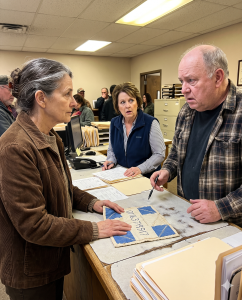
She walked into the county clerk’s office on a Tuesday morning in October, and the man who had buried her thirty years ago was standing at the counter signing his name.
He did not see her come in.
He was too busy leaning over the paperwork, pressing one palm flat against the worn laminate as though his signature still ruled the room. The overhead lights washed everything pale and official. Stacks of forms sat in wire trays. A wall clock hummed above a bulletin board crowded with notices no one ever read. It was an ordinary county morning in Harlan, the kind built from routine and dust and habit.
Then the air changed.
The woman behind the counter looked up first, her polite smile fading before she even seemed to know why. A man in a seed cap waiting near the door shifted his weight and glanced back. Another clerk stopped mid-stamp.
Gerald Combs felt the room tilt before he understood it. He slowed in the middle of his signature and began to turn.
Loretta Mae Combs was already halfway to the counter.
She did not hurry.
That was what people remembered later, more than anything else. Not her face, not Gerald’s reaction, not even the cloth she placed between them. They remembered the way she walked. Calm, upright, deliberate. Like a woman arriving exactly where she had always meant to arrive.
At first glance she looked older, of course. Anyone would after thirty years. Her hair, once a deep chestnut, was threaded with silver and pinned back simply. Her face held the fine lines of time and struggle and survival. But the bones were the same. The eyes were the same. And the stillness inside her was stronger than anything Gerald had ever counted on breaking.
When she reached the counter, she slipped her hand inside her coat and drew out a quilt square.
It was no larger than a man’s palm. Cream fabric bordered with cornflower blue, softened by time but still carefully kept. She laid it flat between them and smoothed it once with her fingertips.
Embroidered into the center was a number.
Gerald stared at it.
Then he stared at her.
The blood left his face so fast the woman behind the counter later said it looked like someone had opened a drain.
The pen dropped from his hand, rolled once across the counter, and fell to the floor.
Nobody moved to pick it up.
Loretta looked at him with a steadiness that made his age show all at once. “That,” she said, touching the quilt square, “is the deed number to my family’s farm.”
The clerk looked down at the cloth, then back at the file Gerald had been signing. Her mouth tightened. She drew the papers closer and read more carefully.
Gerald opened his mouth as if to explain, but whatever lie rose first got trapped behind the sight of his wife standing there alive.
His wife.
The woman he had persuaded the courts was dead.
The woman he had once watched taken away in a county car while he stood with his hands in his pockets and refused to meet her eyes.
The woman he had erased.
The thing about betrayal, Loretta had learned, was that it rarely begins where the world notices. By the time a judge hears about a woman’s instability, by the time neighbors lower their voices, by the time doctors begin using words that harden into legal records, the betrayal has usually already been under construction for some time.
Loretta had met Gerald when she was twenty-one and thought him steady. He was handsome in the broad-shouldered way mountain men often are, with an easy laugh in company and a quietness that could be mistaken for thoughtfulness. He worked enough to look respectable and talked often about family, responsibility, and building something lasting. He admired her grandfather’s farm the first time she brought him there. He walked the fence line as if he was memorizing it.
Back then she thought that meant love.
The land sat just outside Harlan County on acreage her grandfather had cleared by hand. He had built the first cabin himself and added to it board by board as seasons allowed. By the time Loretta inherited her share, the place had become a modest farmhouse with a deep porch, a kitchen garden, a springhouse, and enough open ground to matter. Not grand money. But land in the right place is its own kind of wealth, and men who do not build often learn quickly how to inherit through marriage.
Loretta loved the farm with the unshowy intimacy of daily labor. She knew where the soil turned stubborn. She knew which apple tree bloomed late and which hounds would scratch at the back step before dawn. She planted beans, canned tomatoes, mended screens, and swung barefoot on the porch in the blue hour while Biscuit and June slept under her chair.
For a while, married life passed in the ordinary rhythm of work and weather. There were bills. There were arguments too small to remember. There was hope for children, then disappointment, then more hope. Loretta believed, as many women did, that hardship weathered together made a marriage truer.
She did not yet understand that some men experience a woman’s grief not as something to comfort, but as something to use.
The miscarriage came in their eleventh year.
The loss itself was terrible enough. But what followed was stranger. Loretta mourned openly, then quietly, then in private rituals that made sense only to her: folding the baby blanket she had started, avoiding the spare room, standing at the garden gate after dark and saying nothing. She cried. She forgot small things. She slept badly.
All of that was grief.
Gerald called it instability.
At first he said it gently. He would sigh in front of people and say Loretta had been having a hard time. He would explain away her silence, her exhaustion, the moments she turned inward. Then the story sharpened. He told a doctor she seemed confused. He told a pastor she had spells. He told neighbors she frightened herself sometimes. Poor Loretta. Poor thing. He was doing his best.
And while he told one story at home, another was unfolding across county lines.
A woman in Bell County had been writing him letters.
Her name was Darlene Whitaker, a widow with more cash than tenderness and a taste for men who made themselves sound unlucky. Gerald gave her exactly what she wanted: a tragic marriage, a broken wife, a man tied to land but starving for understanding. Darlene wanted stability. Gerald wanted a future that did not include explaining the deed restrictions of property that had come through Loretta’s family.
Loretta found one of the letters by accident. Tucked into the pocket of Gerald’s work jacket, folded twice, perfumed faintly. It spoke not of guilt, but of plans. Of “when things are settled.” Of a life “once you’re free.” Loretta confronted him that evening in the kitchen.
He did not deny the woman.
He denied Loretta’s interpretation.
That was his talent. He rarely rejected facts outright when he could instead make her doubt her own reading of them. He told her she was overreacting. He asked whether she really thought clearly these days. He brought up the miscarriage before she did, weaponizing the wound and then acting sorry for having touched it. By the end of the argument, she had begun furious and ended shaken.
After that, she started paying attention.
She noticed meetings he would not explain, calls that ended when she entered the room, paperwork he kept in a lockbox. She noticed him watching her—not with concern, but with calculation. And once, only once, she heard him speaking on the porch after midnight to someone he thought was Darlene, saying, “It’ll be easier if the court believes she can’t manage on her own.”
That was when fear took root.
Loretta was not a lawyer. She did not know exactly what Gerald intended. But she knew enough to understand that truth on its own would not protect her if men in offices had already decided who sounded reasonable.
The morning they came for her, she was ready in the only way she could be.
The county car pulled into the yard just after eight. Two orderlies stepped out with papers. Gerald stood near the porch rail and would not meet her eyes. The language used inside the house was clinical, orderly, patient. “Temporary evaluation.” “Necessary care.” “Safety.” Loretta kept saying she was not dangerous, that her husband was lying, that there were letters, that the farm was hers by family line, that no one was listening.
No one was listening.
So before she let them take her, she slipped on her long winter coat—the tobacco-brown one she had lined herself years earlier—and reached inside the secret seam she had sewn the night before.
There, hidden between layers of cloth, was a small quilt square she had stitched in the dark.
In the center she had embroidered the farm’s deed number.
She did not have the deed itself. Gerald had locked away the household documents. But she had once copied the number during tax season and carried it in memory long enough to put it into thread. It was not proof of ownership by itself. But it was proof of knowledge only someone tied to that land should have. A breadcrumb. A marker. A thing that could connect her back to records if she ever found her way out.
She rode away from her home clutching the coat in her lap while Gerald stood in the yard growing smaller in the rear window.
He never came for her.
The psychiatric facility where Loretta first landed was a place of fluorescent fatigue and locked routines. She was evaluated, medicated, transferred, reassessed. Some staff were kind. Some were brisk. A few were cruel in the practiced way institutions sometimes produce—never dramatic enough to leave a scene, only relentless enough to wear down the person experiencing it. Because Gerald had done his work carefully, Loretta’s protests fit neatly into the very narrative used against her. She insisted there was a scheme involving her land. She insisted her husband wanted her gone. On paper, that sounded like paranoia.
Years slipped.
Facilities changed.
Administrators came and went.
Loretta learned when to speak and when silence protected more than pleading. She kept the coat. She kept the quilt square hidden. On nights when despair pressed hardest, she slipped her fingers into the lining and traced the raised numbers until she could almost see the pasture fence again.
Eleven years after her commitment, Gerald took the next step.
Using legal channels that relied on her absence, his account, and the state’s indifference to a woman without advocates, he had Loretta declared legally dead.
The process should have raised louder questions. It did not.
By then, many of the people who might have remembered details had retired, transferred, or simply forgotten. Records lived in separate drawers in separate buildings. Rural systems, when overworked and underchallenged, can be frighteningly easy to steer if the man doing the steering looks calm and speaks confidently. Gerald presented himself as a burdened husband who had exhausted every effort. His wife had long been gone from home. He needed closure. The paperwork moved.
Once the state accepted Loretta’s legal death, the farm became easier to consolidate. Gerald remarried not long after. Darlene moved into a house partially renovated with money drawn against land that had never been his in spirit, if not yet in law.
Loretta did not know all this immediately.
Her eventual release came not with fanfare or apology, but with bureaucracy. A doctor in a later facility reviewed old files with fresh skepticism. Another noted that the original grounds for indefinite retention seemed alarmingly thin. A social worker asked sharper questions than others had. The world that had once found it easier to contain Loretta now found it administratively convenient to discharge her.
Freedom, she discovered, was not the same as restoration.
She was older. Penniless. Half-forgotten. Some records named her, some did not, and the most important ones claimed she was dead. She spent the first months after release in a transitional residence, then a church-affiliated boarding home. She worked odd jobs where she could, cleaned rooms, folded laundry, and rode buses with manila envelopes clutched to her chest. She had to prove she existed before she could prove she had been wronged.
Four years passed before she uncovered the declaration of death.
A records clerk in Frankfort frowned over a mismatch between an identification petition and a county filing. Another office produced a certified copy that made her sit down hard in the hallway when she read it. Loretta Mae Combs, deceased.
She stared at her own name until the letters blurred.
The anger that rose then was different from grief. Grief caves inward. This did not. This straightened her spine.
She began learning the language that had been used to erase her. Commitment orders. property transfer. declaration of death. chain of title. She learned how records spoke to each other and how often they failed to. Another two years went by in that education. She copied dates. Circled names. Asked questions until clerks stopped dismissing her and started, reluctantly, helping.
The turning point came in Lexington.
A legal advocate named Naomi Mercer listened without interrupting. That alone nearly made Loretta cry. Naomi had spent years handling guardianship abuse and probate fraud, and she knew a predatory pattern when she heard one. She requested files. She compared signatures. She noted contradictions in the original commitment documents, including testimony that appeared suspiciously rehearsed and medical conclusions built almost entirely on Gerald’s statements.
When Naomi brought the matter before a circuit judge willing to look beyond the old labels, the room changed. The judge read the papers, removed his glasses slowly, and asked why a woman declared dead had never been independently verified by anyone outside the husband who benefited. That question, simple as it was, cracked the case open.
From there the process became methodical.
Records were subpoenaed. Gerald’s petitions were examined. Transfer documents were frozen. A hearing was scheduled to restore Loretta’s legal identity and challenge the validity of everything built on her disappearance. It took a year more. Justice moved with the heavy patience of a millstone. But it moved.
On that particular Tuesday in October, Loretta was in town for a separate signature connected to the restoration order. Naomi had told her the county clerk’s office had been notified of pending action affecting the title chain on the farm. Loretta expected paperwork and perhaps another delay.
She did not expect Gerald.
But Gerald had business of his own that morning. He had been trying to transfer a portion of the farm to cover a debt tied to an investment gone sour. Darlene’s money had thinned over the years. Taxes had risen. The land he had once coveted was now the only thing large enough to rescue him from his own bad decisions. He arrived irritated but confident, carrying the old swagger of a man used to systems bending for him.
He had no idea the system was done bending.
The clerk, a woman named Rhonda Fields, had already seen a note attached to the title file that morning. Pending judicial review. identity restoration order incoming. Do not finalize transfer until cleared. She was reading Gerald’s documents with growing suspicion even before Loretta entered.
Then Loretta walked in carrying thirty years of unfinished truth in her coat lining.
When Naomi Mercer stepped through the doorway seconds after Gerald’s pen hit the floor, Gerald’s composure broke for the first time.
Naomi set a leather folder on the counter. “This office has received notice,” she said evenly. “But here is the signed copy for immediate reference.”
Rhonda opened the folder and scanned the top page. Her eyes widened. “Order restoring legal identity and vacating prior declaration of death,” she read softly. Then she looked up at Gerald. “Mr. Combs, this transfer is suspended.”
Gerald found his voice at last. “This is some kind of mix-up.”
“No,” Loretta said.
It was the first time she had spoken his name in years when she added, “The mix-up was marrying a woman with land and thinking paper could keep her buried.”
The seed-cap man by the door let out a breath that sounded almost like a whistle. Rhonda shot him a warning look, but even she seemed unable to conceal the force of the moment.
Gerald recovered enough to try the old strategy. “She was ill,” he said, turning to Rhonda, then Naomi, seeking the nearest authority to charm. “Everybody knew it. I did what I had to do.”
Naomi’s smile was brief and cold. “You submitted affidavits that are now under review for fraud. You petitioned to declare her dead without independent confirmation. You executed transfers on land you may never have had lawful authority to control. So no, Mr. Combs. You did what benefited you.”
He looked at Loretta with naked hatred then, perhaps because rage was easier than fear. “You don’t know what you’re talking about,” he snapped.
Loretta held up the quilt square.
For a second, the whole room seemed to lean toward it.
“I know this number,” she said. “I stitched it before your friends came to take me. I kept it thirty years while you lived in my house and called me gone.”
The power of that moment was not legal. Not exactly. The cloth did not replace a deed book or a court order. What it did was something equally devastating: it made every lie suddenly visible. Only a woman attached to that land before her disappearance would have hidden that number in fabric. Only a woman expecting betrayal would think to preserve it like that. The tiny square turned Gerald’s version of events from plausible tragedy into deliberate theft.
Rhonda reached for the title index and cross-checked the embroidered digits with the parcel file in front of her. They matched.
Perfectly.
The room went still enough that the wall clock could be heard again.
Gerald saw then that he had lost the oldest battle of all—the fight over who would be believed.
Sheriff’s deputies were not summoned in some dramatic rush, though later Gerald would claim he had been publicly humiliated. The truth was slower and worse. Rhonda called the county attorney’s office for instruction. Naomi requested certified copies of everything in the file. Gerald was asked to step aside while the matter was documented. He refused once, then complied when he realized no one was with him. Not the clerks. Not the bystanders. Not the law.
Darlene arrived twenty minutes later after Gerald, in a final burst of panic, phoned her from the parking lot.
She entered briskly in a tailored jacket, already indignant, already prepared to defend her husband from local incompetence. Then she saw Loretta.
Her expression changed so abruptly it was almost painful to watch.
“You said she was dead,” Darlene whispered.
Gerald turned. “Darlene—”
“You said there was paperwork.”
“There was.”
Naomi stepped in before the argument could twist further. “There was fraudulent paperwork,” she corrected.
Darlene looked from Naomi to Loretta to the quilt square still resting on the counter like a witness. Whatever affection she had once held for Gerald seemed to recalculate itself in real time against the possibility of legal exposure and social disgrace. She took one slow step back.
“Did you lie to me too?” she asked.
Gerald did not answer quickly enough.
That was answer enough.
The hearings that followed were not easy, but they were decisive. Once the declaration of death was vacated, the transfer chain built on it began to unravel. The court found serious irregularities in the original commitment and substantial evidence that Gerald had manipulated proceedings for financial gain. Civil actions followed. Some criminal questions remained harder to pursue because of time, deceased witnesses, and institutional failures, but the property issue became clear. The farm, through a complicated but successful legal process, was restored to Loretta’s name.
When she returned to the land for the first time, late that winter, the porch swing was gone.
So were Biscuit and June, of course, long buried somewhere she would never know. The garden beds had gone ragged. One section of fence leaned. Darlene’s decorative mailbox sat by the road like an insult. But the ridge line was the same. The creek still bent shallow near the sycamore. The apple tree still bloomed late.
Loretta stood in the yard with the keys in her hand and cried harder than she had in the clerk’s office.
Not because all was restored. It was not. Thirty years cannot be returned by court order. Youth does not come back. Children not born do not reappear. Trust once weaponized does not heal into innocence.
But the land knew her.
That mattered.
She did not move back in all at once. The house needed repairs, and some rooms held too much history too tightly. Naomi helped her secure grants and local support for restoration. A church group rebuilt the porch steps. A retired carpenter fixed the kitchen cabinets for little more than materials once he heard the story. Two teenage cousins of a neighbor cleared brush for free and asked only for pie in return. In places like Harlan, scandal travels fast. So does righteous sympathy once the truth lands.
As for Gerald, he left county court one gray afternoon with his shoulders bent in a way Loretta had never seen. Darlene separated from him before the civil matter fully ended. Money tightened. Reputation shrank. Men who had once slapped him on the back at the feed store began nodding from a distance instead. He became, for a while, the story everyone lowered their voice to tell.
The man who tried to bury his wife with paperwork.
Loretta never visited him. She never sought a private apology. By then she understood that some people say sorry only when consequences corner them, and that is not the same as remorse. What she wanted was not his tears. It was the truth in daylight.
She got that.
In spring, she planted a small kitchen garden again.
The first time she pressed seeds into the soil, she paused and slipped the quilt square from her pocket. The fabric was more fragile now, thread thinning at the edges, but the numbers remained. She held it in her palm and thought of the woman she had been at thirty-four, frightened and unheard and already wise enough to hide proof in a place no one would value until too late.
Then she folded it carefully and carried it back inside.
Visitors sometimes asked whether she hated Gerald.
Loretta would consider the question before answering.
“Hate’s too expensive,” she said once, standing on the repaired porch as evening lowered over the hills. “I already paid enough.”
What stayed with people was not only what had been done to her, but what she had done in return. She had not stormed. She had not screamed. She had not begged to be believed. She had outlasted the lie. She had stitched memory into cloth and carried it through the machinery of erasure until the world was forced to look.
And perhaps that was the part that unsettled everyone most.
How close it had all come to working.
How easily a woman could disappear if the right man told the right story at the right desk.
How ordinary the office looked on the morning the dead came back for her name.
Years later, people still spoke about that Tuesday in October. About the pen rolling off the counter. About Rhonda’s face when the deed number matched. About Darlene asking, “You said she was dead.” About Loretta standing there with one hand on a quilt square like it was the pulse of her whole life.
Some said Gerald deserved prison. Some said the institutions were more to blame than one greedy husband. Some wondered whether Darlene had known more than she admitted. Others said the biggest red flag had been how readily everyone accepted Gerald’s version because it was easier than listening to a grieving woman insist on her own reality.
Loretta did not bother correcting every opinion.
She had her name back. She had her land back. She had mornings again on the porch her grandfather built.
That was enough to begin.
Still, on certain cold days, when the wind came down off the ridge and moved through the yard with the hush of memory, she would touch the small square of cream and blue she now kept in a cedar box by the bed.
Not because she feared being erased again.
But because she knew exactly what it had cost to return.