Sabrina had always hated sports fields.
It wasn’t just the heat or the noise, though there was plenty of both. It was the strange confidence of those places. The way other parents seemed to arrive already knowing where to stand, what to bring, when to clap, how to shout encouragement without sounding desperate or too loud. Folding chairs unfolded in perfect rows. Snack bags appeared at the right time. Fathers stood with their hands on their hips like they had been born on the edge of little league diamonds.
Sabrina had never belonged in places like that even before grief. After grief, she felt almost translucent in them.
But Eli was nine, and he had been asking for baseball since March.
Not every day. That would have been easier to dismiss.
Instead he asked in ways that kept catching her off guard. In the cereal aisle. In the car after school. While brushing his teeth.
“Dad said spring was for starting over.”
“Dad said this was the year.”
“Dad was gonna teach me how to slide, remember?”
Since Adam died in January, Sabrina had developed a terrible weakness for unfinished wishes. Anything that sounded like a plan he had once made seemed to glow with sacred urgency. She didn’t know if signing Eli up for baseball was brave or foolish. She only knew she couldn’t keep saying no to a child who was trying to keep his father alive through future tense.
So on a bright Saturday morning, she took him to the park.
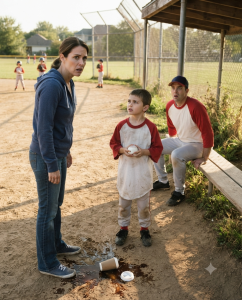
The field smelled like cut grass and sun-baked dirt. Children in oversized jerseys ran in clusters that ignored all adult instruction. A volunteer parent struggled with a pop-up shade tent. Someone was handing out granola bars like tiny peace offerings.
Sabrina stood near the fence holding a travel mug of coffee she didn’t want and told herself she was doing fine.
Then Eli saw the coach.
He stopped so abruptly Sabrina nearly bumped into him.
The coach was on the pitcher’s mound, tossing balls into a bucket while speaking to a line of boys. He was the kind of man who seemed immediately legible: late thirties, athletic without showing off, weathered cap, steady voice, patient eyes. A small-town baseball coach in the most ordinary sense.
Until he looked over and saw Eli.
He smiled and walked toward them.
“Hey there,” he said. “You Eli?”
Eli nodded once.
Then he asked, calm as still water, “Why didn’t you come to the hospital?”
The mug fell from Sabrina’s hand.
Coffee splashed over her sandals, but she barely felt it.
The coach didn’t move.
His face drained so fast the color simply vanished.
“What?” Sabrina asked, the word snapping out before she could soften it.
Eli kept staring at him. “Mom said Dad wanted baseball. But the lady in the red chair said you promised.”
The coach swallowed.
“What did you say?”
“She said you were scared.”
Sabrina grabbed Eli’s shoulder. “That’s enough.”
But Eli only looked confused. “I’m helping.”
The coach took off his cap. His hand was trembling.
Sabrina felt the mood around them change as sharply as weather. Nearby, practice continued. Parents laughed. A whistle blew on another field. But around the three of them, reality had shifted half an inch off its axis.
“Who told him that?” the coach asked.
“No one,” Sabrina said. “He has nightmares sometimes. He says things.”
The coach sat down hard on the dugout bench.
Then Eli said, “The red chair by the window.”
And Sabrina stopped breathing.
There had been a red chair in Adam’s palliative care room. It was horrible, vinyl and squeaky, wedged by the window where winter light slanted in during the afternoons. Adam used to joke about it when he was lucid enough to joke. “Nobody should die beside furniture this ugly,” he had muttered once, and Sabrina had laughed because the alternative was screaming.
Eli had almost never been in that room.
She had protected him from most of those last days. He couldn’t know that detail.
Unless someone had told him.
But who?
The coach pressed his hand to his mouth, then lowered it and said quietly, “My name is Wade.”
It meant nothing to Sabrina.
Not yet.
“What connection did you have to my husband?” she asked.
He looked at her for a long moment before answering. “I knew Adam.”
“That doesn’t answer me.”
“No,” he said.
Eli picked up a baseball from a practice bucket and rolled it between his palms. “The lady said you cry in your truck where nobody can see.”
Wade closed his eyes.
That was when Sabrina understood something terrible. He was not confused. He was not indulging a child. He was not searching for a polite explanation.
He looked caught.
When he opened his eyes again, they shone with tears. “Your husband’s sister told me he died.”
Sabrina felt her stomach drop. “Lena?”
He nodded.
“She told me not to come. She said Adam didn’t want me there. She said if I showed up, I’d only make things worse.”
By the time practice ended, Sabrina felt as though she had stepped into someone else’s life. She brought Eli home, fed him macaroni he barely touched, and listened to him talk about a woman in a red chair as casually as if he were describing a teacher’s aide.
“She comes in my room sometimes,” he said.
Sabrina went still. “What woman?”
“The one from the hospital.”
He twirled a noodle around his fork. “She said Dad was worried because you didn’t know everything.”
“What does she look like?”
“Old. Nice old.” He shrugged. “Like flowers that are already dry.”
Children’s grief was strange. It bent imagination and memory together until adults couldn’t tell where either one ended. Sabrina knew that. She knew it, and yet she couldn’t shake the chill moving through her.
Then Eli said, “She said Aunt Lena lied.”
That night, after he was asleep, Sabrina pulled down the hospital tote bag she had shoved into the hall closet in January and never opened again.
The contents smelled faintly of antiseptic and stale paper. Lotion, receipts, a charger, a packet of crackers, several folded pamphlets she had never read. At the bottom was Adam’s notebook.
She didn’t remember packing it.
She flipped through pages of dosage times, phone numbers, and half-finished thoughts. Near the back, tucked between two pages, was a folded sheet torn from the spiral.
On the outside, in Adam’s handwriting, was one word.
Wade.
Her chest tightened.
Inside was not a love letter. Not exactly.
It was a set of instructions.
If Lena keeps you away, tell Sabrina yourself. Don’t let her protect my reputation by lying to my wife. She deserves the truth, and Eli deserves more than secrets. You promised me. Don’t break this one too.
The room went cold around her.
Beneath that, in shakier handwriting:
Tell her I loved her. Tell her that part was never fake. Tell her I was a coward in more ways than one. Tell Eli I kept trying to think of how to leave him something useful, and all I could come up with was baseball and you.
At the bottom were two words that broke her open.
I’m sorry.
Sabrina sat on the hallway floor for a long time.
She thought of Adam in fragments now rearranging themselves into a pattern she had never seen while he was alive. The long garage phone calls he used to take and dismiss as work. The strange tension with Lena whenever certain names came up. The year before Eli was born, when Adam had gone quiet for weeks and then emerged with a fierce, almost desperate devotion to family life, as if building something solid could hold back whatever uncertainty haunted him.
She also thought of his hands. His laugh. The way he always warmed her side of the bed in winter before she climbed in. The way he had cried in the pantry after his diagnosis and then smiled at dinner ten minutes later so Eli wouldn’t worry.
People always wanted betrayal to erase tenderness. It almost never did.
The next day, she called Wade.
He answered on the second ring, sounding as if he had been waiting beside the phone.
“I found a note,” she said.
Silence.
Then a ragged exhale. “I wondered if he’d left one.”
They met that evening in the empty bleachers behind the field. Without the noise of practice, the place looked abandoned and honest.
Wade told her everything.
He and Adam had grown up together. Same street, same school, same truck rides to summer jobs. At seventeen, what had always looked like friendship shifted into something neither boy had words for in a town that had no room for it. They loved each other in secret, then in fragments, then at a distance. Fear shaped the rest. Wade left. Adam stayed. Years passed. Adam met Sabrina. Wade convinced himself the story had ended.
Then Adam got sick.
At first the calls were practical. Then emotional. Then unbearable.
“He told me he loved you,” Wade said. “Every time he talked about you, I knew he was telling the truth.”
Sabrina hated how much that mattered to her.
“He also told me,” Wade continued, “that loving you didn’t erase me. And loving me didn’t erase you. He said the worst thing he ever did was make both truths live in separate rooms until he was dying.”
She stared out at the field while he spoke.
“I should have come,” Wade said. “He called me three days before the end. I saw his name and panicked. I told myself I’d call back when I could speak clearly. Then Lena called first. She said he was gone and that he didn’t want me there. I believed her because part of me needed an excuse.”
Sabrina opened Adam’s note in her lap. “He wrote that if Lena tried to keep you away, you were supposed to tell me yourself.”
Wade shut his eyes.
“I know.”
“Why didn’t you?”
He let out a broken laugh. “Because cowardice doesn’t die just because someone else does.”
The words sat between them for a while.
Then Sabrina asked the question she hadn’t wanted to ask since the field. “Was he waiting for you?”
Wade looked down at his hands. “Yes.”
It hurt more than she expected. Not because it erased her, but because it didn’t. Because Adam had been waiting for Wade while still reaching for Sabrina’s hand. Because human beings could be that divided and that sincere at once.
“Aunt Lena knew?” Sabrina asked.
Wade nodded. “She knew about us years ago. She thought keeping it buried was loyalty.”
Sabrina almost laughed at the ugly precision of that. Loyalty. Protection. Dignity. Families used beautiful words for the violence of silence.
A week later, Lena came over when Sabrina asked.
They sat at the kitchen table after Eli went outside to throw a ball against the garage. Sabrina placed Adam’s note between them.
Lena read it once, then put it down very carefully.
“I was trying to protect him,” she whispered.
“From what?” Sabrina asked. “The truth? Or me?”
Lena’s eyes filled. “From how people would remember him. From what it would do to Eli. To all of us.”
“What it did,” Sabrina said, “was let him die waiting for someone he asked for.”
Lena flinched.
That was the first moment Sabrina saw that Lena had not acted from malice. But neither had she acted from love clean enough to defend. She had acted from fear disguised as care. It was an old family habit. Maybe an old town habit too.
“I thought if Wade came,” Lena said, “it would blow everything apart in the room. I thought Adam was confused from medication. I thought after he was gone, it would only cause pain.”
Sabrina looked toward the backyard window. Eli’s small figure was visible in flashes as the ball rebounded off the garage and back into his glove.
“It caused pain anyway,” she said.
Lena covered her face and cried.
Sabrina didn’t.
She had done enough of that in forms people recognized. What she felt now was sharper and harder to classify. Grief, yes. Anger too. But also a reluctant tenderness toward the dead man who had loved badly and imperfectly and still, somehow, genuinely.
In the weeks that followed, baseball became the strangest bridge Sabrina had ever crossed.
Wade stayed as Eli’s coach. Not because anyone declared it healing. Not because it was simple. It wasn’t. The first practices after the truth felt almost unreal. Sabrina watched Wade teach boys how to square their shoulders and keep their eye on the ball, and sometimes she could hear Adam in the background of memory saying the same things in the backyard.
Eli took to Wade quickly, though not in the way Sabrina had feared. It wasn’t replacement. It was recognition of effort. Wade showed up early, stayed late, remembered which cleats pinched, tied batting gloves, and never once acted as though his guilt entitled him to closeness.
One afternoon after practice, Eli climbed into the car and said, “Coach Wade throws like Dad.”
Sabrina gripped the steering wheel.
Then Eli added, “But not exactly.”
And somehow that made it bearable.
Near the end of the season, Sabrina told him the truth in the gentlest shape a child could hold. Not every adult detail. Not all at once. But enough. That Dad had loved people in complicated ways. That sometimes grown-ups hid parts of themselves because they were afraid. That Coach Wade had been someone important to Dad a long time ago. That none of it changed how much Dad loved Eli.
Eli listened with the grave concentration children reserve for moments they know matter.
Then he asked, “Did Dad break the promise or did Coach Wade?”
Sabrina looked out at the field before answering.
“Both a little,” she said. “And both were sorry.”
He accepted that more easily than most adults would have.
The final game of the season ended in the ordinary chaos of missed catches and proud parents with phone cameras. Eli’s team lost by three runs and celebrated as if they had won a championship anyway. Wade handed out orange slices. Parents folded chairs. The sun dropped low and kind over the dirt.
As everyone packed up, Wade walked over.
“I’m moving to assistant coach next season,” he said. “A father from the team is taking lead.”
Sabrina understood what he was offering: room, distance, no pressure.
“You don’t have to disappear,” she said.
He looked surprised.
“I’m not asking you to,” she added. “But don’t mistake being forgiven for being owed anything either.”
A sad smile touched his face. “I wouldn’t.”
She believed him.
Eli ran over then, cap crooked, cheeks pink with sweat. “Mom! Coach says I almost slid right.”
“Almost,” Wade said.
“That means I’m close,” Eli declared.
On the drive home, he fell asleep with dirt on his knees and his glove in his lap.
Sabrina glanced at him at a red light and felt that old familiar stab—Adam should have been here for this. But beside it, for the first time in months, was something else. Not peace exactly. Peace was too tidy a word for what remained.
What remained was fuller than that.
Adam had loved her. That was true.
He had also hidden a part of himself until hiding became one of the last things he did. That was true too.
Wade had failed him. Lena had failed him. Maybe even Sabrina, in ways she would spend years examining, had loved the version of her husband that was easiest to survive.
The terrible thing was that none of those truths canceled the others out.
That, Sabrina realized, was the hardest part of the aftershock. Not deciding who was monster and who was victim. Not separating the innocent from the guilty with some satisfying clean line.
It was accepting that the biggest red flag had not been one betrayal.
It had been how many people believed love could be protected by silence.