Martina had grown up in a world where disaster was always dressed in silk.
By the time she was twelve, she already understood that her family’s elegance was mostly camouflage. Their homes were beautiful, their dinners legendary, their charity galas photographed from every angle, but beneath the polished marble and imported flowers lived something meaner. Secrets moved quietly through those rooms. So did fear. Nobody raised their voice unless they wanted to make a point. Nobody apologized unless it served a strategy. And every lie was told with perfect posture.
Her father liked to say that business was a sea with no room for weak swimmers.
“In this world,” he often told his children over candlelit meals, “there are no victims. Only fools who didn’t see the wave coming.”
He said it like wisdom. Martina heard it as a warning.
She learned early that her father loved control more than he loved any of them. Her brother, Tomás, inherited his appetite for winning. Her mother inherited his silence. Martina inherited something far less useful in a family like theirs: attention. She noticed pauses, glances, contradictions, the pressure hidden inside pleasant words. She became the kind of person who could tell from the sound of a door closing whether someone on the other side had lost money, lost power, or lost patience.
That skill kept her alive in ways nobody ever acknowledged.
The family shipping company had ruled ports, routes, contracts, and politicians for decades. Their surname opened doors in three countries and closed investigations in five. But old empires rarely collapse all at once. They crack slowly, from the inside, while everyone keeps smiling.
By the time the fraud scandal surfaced, Martina already knew something had been wrong for years.
There had been closed-door meetings that lasted until dawn. Calls that made her father leave dinner without explanation. Accountants who disappeared from the company and were never mentioned again. A legal adviser who resigned and left the city. Her mother once burned a stack of correspondence in the garden fireplace herself, still wearing pearls.
Then the scandal finally bled into the open.
A tangled web of false insurance claims, vanished cargo declarations, manipulated debt structures, and a missing maritime file threatened to bring the company down. The press had enough to ask dangerous questions, creditors were circling, and for the first time in Martina’s life, her father looked like a man staring at water that had turned against him.
That was when Arturo Neves appeared.
He came with money, calm, and a proposal no one decent would have made aloud.
Arturo was introduced as a reclusive magnate with maritime interests and old European holdings. He was said to prefer privacy, to dislike publicity, to move carefully because of an old injury, and to have no heirs. He was older than Martina by enough years to make the room uncomfortable, but not enough for anyone in her family to reject the offer. Especially not after he agreed to pour enough capital into the company to keep it afloat.
His condition was simple: he would rescue the shipping line, but he wanted marriage into the family.
Her father accepted so quickly that Martina almost laughed.
Not because it was funny, but because there was something obscene in how little performance he felt he needed. He didn’t pretend to ask for her opinion. He didn’t even pretend regret. He framed it as necessity, as duty, as the burden of being born into a legacy.
“Families survive because someone is willing to make difficult choices,” he told her in his study, standing beside a portrait of her grandfather. “This is one of those moments.”
“You mean your moment,” Martina replied.
His expression sharpened. “Don’t be dramatic.”
He always said that when someone was telling the truth in a way he disliked.
Her mother tried a gentler approach. She sat beside Martina later that night, smoothing the fabric of her dress as though they were discussing a guest list rather than a transaction.
“Your father believes this will protect us,” she said quietly.
“Does he?”
Her mother’s fingers paused. “Sometimes survival is ugly.”
Martina turned to look at her. “And sometimes people call it survival when they mean cowardice.”
Her mother’s face changed then, just for a second. Shame. Pain. Recognition. But she said nothing. In that family, silence was often the only confession women were allowed to make.
The engagement moved forward.
Arturo Neves behaved exactly as everyone expected a discreet savior to behave. He was courteous but distant, formal but never cold enough to provoke gossip. He walked with a slight limp, carried a cane on some days but not others, and his right hand shook with a constant subtle tremor that made everyone around him speak to him more carefully, as though his body’s weakness added moral weight to his presence.
But Martina noticed things.
She noticed that the tremor appeared in company and vanished in reflections. She noticed that his limp worsened when her father was nearby and almost disappeared when Arturo thought himself alone. She noticed that he watched the household like a man measuring exits, loyalties, and weaknesses rather than admiring architecture.
Once, during a dinner at her parents’ home, she saw him through the mirrored back of a cabinet. Her father was telling a ridiculous story about weathering market instability while Arturo rested one hand on the stem of his glass.
Steady.
A second later he turned toward the table, and the tremor returned.
That was the moment she stopped believing he was what he claimed.
She didn’t confront him. Not yet. In her family, premature truth was a dangerous hobby.
The engagement celebration was staged on the family’s old yacht, a vessel her grandfather had once used to entertain ministers, investors, and men who preferred their negotiations surrounded by water. It had been restored for appearances, its decks polished, brass fittings gleaming, old wood varnished to a rich glow beneath strings of warm lights. The ship looked magnificent in the dark harbor, floating like proof that money could resurrect anything.
Martina thought it looked like a coffin with champagne service.
Guests drifted through the evening in silk and black tie. Music floated over the deck. Laughter came too quickly. Her father was radiant with relief. Tomás became louder with each drink, making jokes about legacy, power, and lucky timing. Even the board members who had looked half-dead weeks earlier suddenly had color in their faces again.
They believed the storm had passed.
Her brother lifted a crystal glass and announced, “To the future.”
Her father actually smiled at Martina as if she should be grateful.
And then her mother found her near the stern, away from the guests but not quite out of sight.
She adjusted the diamond necklace at Martina’s throat and whispered, “Be strong for one night.”
Martina froze.
It was such a small sentence. So polished. So practiced. But beneath it lay the whole hideous truth of what the family expected. Sign the papers. Smile through dinner. Go to the cabin. Accept what follows. Protect the arrangement.
In that instant, any final softness Martina still had for them burned away.
When the celebration ended and the guests began leaving the upper deck, she went to the main cabin without protest. Her heels clicked softly on the narrow corridor. The yacht moved beneath her with the slow confidence of dark water.
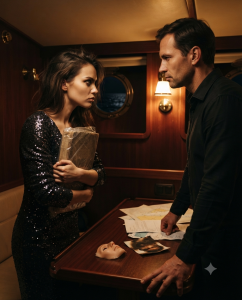
Inside the cabin, the air smelled faintly of cedar, sea salt, and old leather. Lamps cast a gold glow over polished wood and framed nautical charts. It was a room built to suggest tradition, authority, control.
Arturo entered behind her and closed the door.
The latch clicked.
Martina turned and faced him.
For a moment he said nothing. Then, with a slow exhale, he set down his cane.
He straightened fully.
The change was immediate and startling. His posture lengthened, his shoulders rolled back, and the age he had been wearing seemed to peel away before she had even seen his face clearly. His trembling hand stilled. Entirely. Not a trace remained. Then he reached to his cheek and removed a subtle prosthetic that had broadened part of his face and altered the line of his jaw.
The stranger underneath was younger by years.
His features were sharper, leaner, marked not by luxury but by endurance. There was anger in him, yes, but not wild anger. It was the kind that had been banked, fed, sharpened, and preserved.
Martina stared at him.
“Who are you?”
He held her gaze. “Iván Llorente.”
The name struck something buried in memory. She had heard it once from behind a half-closed study door. Her father had hissed it. Her grandfather had said it colder. Her mother had gone pale. Martina had walked in and the conversation had died.
“Llorente,” she repeated.
“My father commanded a cargo vessel your family insured,” he said. “At least on paper.”
He crossed to the table, unlocked a metal case, and opened it.
Inside were documents arranged with meticulous precision. Insurance policies. Bank transfer records. Route authorizations. Internal memoranda. Photos. Legal filings. Handwritten notes. Years of work compressed into a single box.
Iván began laying them out.
“The cargo was insured twice through shell structures tied to your company,” he said. “The route was altered after departure. The declared weather risk was falsified. The ship was sent where it could be lost, profitably.”
Martina felt ice crawl up her spine.
“My father discovered the fraud after the change order was issued. He threatened to expose everyone involved. The ship went down before he reached port. The official investigation blamed him for negligence and financial misconduct. Then one witness vanished. Another changed his story. A captain disappeared. Your family publicly mourned the tragedy while privately collecting.”
He slid a photograph toward her.
Its edges were burned as if someone had tried to destroy it and failed. In the surviving center stood her father beside a captain long believed missing. They weren’t strangers. They were standing close, relaxed, mid-conversation.
Her father had lied.
Not vaguely. Not defensively. Completely.
“He died before he could clear his name,” Iván said.
Martina looked up. “Your father?”
“He collapsed two years after the sinking.” Iván’s voice stayed flat, but something dangerous flickered under the control. “Officially from stress. Unofficially from watching his reputation rot while the men who ruined him kept signing contracts.”
“And you became Arturo Neves.”
“I became whatever your family would invite inside.”
He showed her the final document: the marriage agreement. Beneath its ceremonial language was an elegant legal mechanism that would convert the Neves rescue funds into leverage over the company’s hidden liabilities. Once triggered, it would force disclosure of debts, signatures, and indemnity structures linking the current owners to the old fraud.
It wasn’t a marriage.
It was a siege engine.
Martina should have been horrified.
Instead, she felt something much more dangerous: clarity.
“And you chose me because you thought I’d defend them?” she asked.
Iván said nothing.
The silence told her enough. He had selected her because she was close, useful, and underestimated. In a family like hers, daughters were often treated as extensions of strategy, never as strategists themselves.
Martina almost pitied him for that mistake.
Without breaking eye contact, she slid her hand inside the hidden inner lining of her dress. Iván shifted instantly, alert, ready. His stillness was the stillness of a man trained by necessity not to trust sudden movements.
She withdrew a small old notebook wrapped in transparent protective material.
His expression changed.
“This was in my grandfather’s private desk,” she said. “Hidden beneath the false base.”
She placed it on the table between them.
Iván stepped closer and stared.
It was an original ship’s logbook. Salt-marked. Handwritten. Real.
“The voyage they said went one way,” Martina said. “This is the route they didn’t want anyone to see.”
He looked at her with undisguised suspicion. “Why bring this here?”
“Because I knew something was wrong long before tonight. And because if you were willing to fake a limp and a tremor to get into this family, then you weren’t here for money.”
A faint pulse moved in his jaw. “And what are you here for?”
Martina laughed once, softly, without humor.
“My father sold me to save a company that was already built on corpses. My mother asked me to endure it. My brother toasted it. So let’s not pretend my loyalty came dressed in pearls.”
She pushed the logbook toward him.
“I’m here because I’m done being used as payment.”
Iván unwrapped the notebook carefully and opened it.
The pages were dense with coordinates, cargo codes, weather markings, and route corrections. Then he stopped.
“There,” Martina said.
A sequence had been violently scratched over, but not completely destroyed. The official route filed with insurers sent the vessel into one corridor. The handwritten entries beneath it placed the ship elsewhere entirely.
Iván read in silence, then again.
“This isn’t just insurance fraud,” he said quietly. “They diverted the ship before the reported storm window.”
“To where?”
He turned another page.
Folded inside was a sealed letter, old and brittle, bearing Martina’s family crest in dark wax.
Iván frowned. “This wasn’t logged as cargo.”
“It wasn’t meant to be found.”
He held the letter up to the light. The front was marked with a name.
Not Martina’s father.
Not her grandfather.
A customs prosecutor.
Both of them understood the implication at the same time.
Someone aboard that ship had been carrying proof. Not just of fraud, but of an arrangement meant to reach law enforcement. The sinking had not merely buried a debt. It had intercepted a delivery.
Iván broke the seal with careful fingers. Martina moved to his side without thinking, their shoulders almost touching over the pages.
Inside was a memorandum, unsigned but damning, referencing offshore policies, falsified manifests, and direct authorization from members of her family’s inner circle. Attached was a shorter note in different handwriting: If this reaches port, they cannot bury all of us.
Iván went very still.
“My father wasn’t only trying to clear his name,” he said. “He was trying to expose them before the ship ever disappeared.”
Martina felt sick.
Not because the truth was surprising anymore, but because each new piece revealed more deliberate cruelty than even she had imagined. This had not been opportunism after tragedy. It had been architecture. A disaster planned, timed, and cleaned.
“They killed the route,” she whispered.
“And everyone on it who became inconvenient.”
The air in the cabin changed. There was no going back now, not for either of them.
From above, faint footsteps crossed the upper deck. Someone laughed in the distance. The world outside the cabin still believed a marriage contract had been sealed. Still believed the Neves money had saved a drowning empire.
Inside, two heirs of the same crime scene were standing over the black box of its destruction.
Martina straightened first. “My father keeps copies of things he can use against people,” she said. “Not in the office. That’s where he keeps what he wants found. There’s a storage room at the Valencia terminal under the dry records archive. Private lock. Family access only.”
Iván looked at her. “How do you know?”
“Because I once heard him tell my brother that every dynasty needs a graveyard and a vault.” She met his stare. “I think that’s where he keeps both.”
By dawn, they had a plan.
They left the cabin separately. Martina returned to the role expected of her, pale and composed. Iván resumed the careful gait of Arturo Neves whenever anyone could see. Her father noticed nothing except survival. Tomás remained too drunk on restored status to sense danger. Her mother watched Martina once across breakfast and seemed to understand that something irreversible had happened, though she said nothing.
Later that afternoon, under the excuse of reviewing insurance binders, Martina gained access to the terminal office. Iván’s people, hidden behind the legal machinery of Neves Holdings, stalled an internal audit just long enough to give her a window.
The room beneath the archive was smaller than she expected. No grand vault. No theatrical chamber. Just steel shelving, sealed boxes, and labeled files in neat rows—the worst crimes often kept in the dullest places.
She found correspondence. Ledger copies. Satellite printouts. Quiet payments to intermediaries. Statements prepared for witnesses before investigators ever spoke to them. And then, at the very back, a folder bearing the Llorente vessel’s internal code.
Inside was the final wound.
A signed directive.
Her father’s signature.
Her grandfather’s countersignature.
Authorization to reroute the shipment under a secondary manifest and suspend distress escalation until confirmation of asset loss.
Martina stared at the words until they blurred.
Suspend distress escalation.
People had time. Maybe not much. But time. And her family had chosen money over rescue.
She took everything she could carry and photographed the rest.
When her father discovered the breach, he moved faster than she expected. By evening he had called an emergency family meeting in the main house. Tomás was furious. Her mother looked like someone attending a funeral she had long anticipated.
Her father stood at the head of the room with the retrieved folder in his hand.
“You had no right,” he said.
Martina laughed. “No right? That’s your defense?”
“You don’t understand what was at stake.”
“I understand exactly what was at stake. That’s the problem.”
His face hardened. “Everything you have exists because this family knew when to act.”
“People died.”
His voice rose. “Men die at sea.”
The sentence hung in the room like poison.
Tomás cut in, too quickly. “This is pointless. None of this changes anything unless it leaves this house.”
Iván stepped from the doorway before Martina could answer.
Not Arturo Neves. Not anymore.
No cane. No tremor. No limp.
Tomás went white first. Then her father.
Recognition tore across his face, followed by the cold animal panic of a man realizing a ghost had been invited to dinner.
“Iván Llorente,” her father breathed.
Iván looked at him with deadly calm. “You should have let my father keep his name.”
What followed was not the shouting Martina had once imagined. It was worse. Her father tried authority, then contempt, then negotiation. He called it wartime business. He called it impossible pressure. He called it necessary compartmentalization. He called the dead collateral to a larger survival. Each explanation made him smaller.
When the documents were placed in front of him—the letter, the logbook, the directive—he stopped denying the mechanics and started defending the logic.
That was the moment Martina understood he was beyond remorse. He had crossed that border years ago and built a house there.
Her mother finally spoke.
“You said no one would die.”
The room went silent.
Her father turned to her, startled less by the accusation than by the fact that she had voiced it.
She was crying, but her voice did not shake. “You told me the route would be empty by then.”
It hit all of them at once.
She had known.
Not everything. Maybe not enough to stop it. But enough to live with a piece of the truth all these years. Enough to understand why her silences had always looked like punishment.
Tomás stared at her in horror. Martina closed her eyes.
In the end, it was not Martina’s father who collapsed first. It was the mythology around him. Once the first confession slipped, the others followed. The prosecutor received the archive through channels Iván had been preparing for years. The insurers reopened the loss file. The old captain’s disappearance became a homicide inquiry. Financial crimes units descended on the company. Board members who had once sworn loyalty began naming names in exchange for distance.
The empire did not fall in one dramatic instant.
It split, buckled, leaked, and then drowned under the weight of everything it had buried.
Her father was arrested before dawn three days later.
Tomás tried to salvage control and only exposed his own role in later cover-ups. Her mother left the house without taking the jewelry. Reporters crowded the gates. Markets reacted. Former allies vanished. The shipping line that had ruled ports for generations became a cautionary case study in greed, fraud, and inherited corruption.
Iván’s father’s name was cleared six months later.
The official statement was brief. The public apology was inadequate. The legal victory could not resurrect the dead or return the years stolen from a family forced to watch a lie harden into history. But truth, once written into the record, had a different kind of permanence.
On the day the judgment was entered, Martina and Iván stood at the harbor without speaking for a long time.
The water was gray. Wind moved sharply across the docks. Cargo cranes stood like giant skeletons against the sky.
“You helped destroy your own family,” Iván said at last.
Martina kept her eyes on the sea. “No. I refused to keep helping them survive themselves.”
He looked at her, searching for triumph, regret, vindication. What he found instead was exhaustion.
“Do you regret it?” he asked.
She thought of her mother’s silence, her father’s certainty, her brother’s toast, the men who died waiting for a rescue order that never came.
“I regret that no one did it sooner.”
Iván said nothing.
The wind lifted a strand of her hair across her face. She tucked it back and finally turned toward him.
“You came for revenge,” she said. “Did you get what you wanted?”
He took longer to answer than she expected.
“I got the truth,” he said. “It turns out that’s not the same thing.”
Maybe that was the final wound. Not that revenge failed, but that it succeeded and still left ruins behind.
Her father had called victims fools. Her family had called sacrifice strength. Her mother had called endurance survival. Everyone had used beautiful language to disguise something monstrous.
In the end, the ugliest thing about the whole story wasn’t the fraud, or the staged sinking, or even the marriage bargain meant to chain Martina to her family’s rescue.
It was how many years so many people had looked directly at the rot and chosen not to name it.
And once you know that, it becomes impossible not to wonder what the first unforgivable act really was: the ship going down, the order to delay rescue, the lie that framed an innocent man—or the moment everyone still standing decided they could live with it.