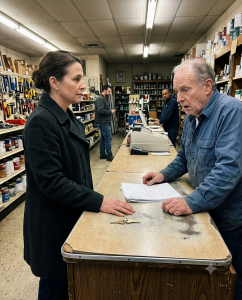
When Darlene Kowalski was fired from Hargrove Hardware in front of the whole store for “lacking potential,” she did not argue, cry, or even defend herself. She folded her apron, set it down, and walked out carrying a worn brass key on a plain ring.
Eighteen years later, she came back with that same key, placed it on the counter between herself and Gerald Hargrove, and watched his face drain of color as he realized the woman he humiliated now owned the company.
What Gerald did not know then was that Darlene had not only returned for the chain. She had returned for the truth his father had trusted her to keep.
Saturday mornings at Hargrove Hardware always had a rhythm. The contractors came first, in mud-streaked boots, impatient and practical. Then came homeowners carrying measurements folded in pockets and scribbled paint swatches from the walls they regretted choosing. By ten o’clock the aisles were crowded, the front registers backed up, and the store smelled like cut lumber, cardboard, fertilizer, and old coffee from the office pot that had been left on too long.
Darlene knew every inch of that store. At twenty-four, she moved through it with the confidence of someone who had learned not just where things were, but why they mattered. She knew which fittings failed under pressure, which contractor preferred galvanized over brass, which cashier was good with difficult customers, and which shelf labels were wrong because no one in management had bothered to fix them.
Customers trusted her because she knew what she was talking about.
Gerald Hargrove hated that.
He was the owner’s son, though by then he behaved as if the place had been handed to him by God instead of inherited from a father who had built it with discipline and restraint. Gerald liked displays of authority. He liked being listened to. He liked the sound of his own opinions, especially when they overruled someone more competent.
That morning, a customer came in carrying an old sump pump part in a rag. He needed a replacement fitting. Gerald happened to be nearby, wearing a blazer no one else in the store would dare work in, and inserted himself before Darlene could speak.
“You need this one,” Gerald said, grabbing a piece from the plumbing section and handing it over with a smile made for witnesses.
Darlene saw the problem instantly.
“That won’t hold under pressure,” she said, keeping her tone careful. “The thread’s wrong for that older housing. He needs the reinforced adapter from aisle nine.”
The customer turned to her. “You sure?”
“Yes,” she said. “If you use that one, you’ll be back here tomorrow with a flooded basement.”
The customer looked from her to Gerald, then placed Gerald’s part back on the counter. “I’ll go with hers.”
The exchange lasted less than ten seconds.
But Darlene saw Gerald’s expression shift. It was a small thing, almost invisible if you did not know what to look for. A smile that stayed too long. Eyes that cooled instead of warmed. He nodded at the customer and said nothing else, but his humiliation had already become a plan.
He waited.
He waited until the front registers were full, until the assistant manager was nearby, until enough staff were within earshot that the moment would leave a mark. Then he called Darlene to the center aisle near seasonal inventory and held a folded paper in one hand.
He did not discuss the incident privately. He did not warn her. He did not ask for her side.
He told her she had “an attitude problem.” He told her she needed to “learn her place.” Then, in a voice pitched just loudly enough to carry through the store, he said she was being let go because she “lacked potential.”
The words hung in the air like something foul.
Darlene could feel customers listening. She could feel the cashiers trying not to look at her and failing. Her face burned, but she kept her shoulders square. She had bills due, rent due, and no backup plan. Still, she would not beg for mercy from a man who enjoyed the performance of power more than the responsibility of it.
Gerald handed her the termination slip and added one last insult, saying she should be grateful he was “telling her the truth while she was still young.”
Darlene untied her apron.
Folded it carefully.
Set it on the counter.
Then, almost without thinking, she reached into her coat pocket and closed her fingers around the brass key she had carried for years.
It was old even then. Plain. Worn smooth around the head. To anyone else it looked like nothing. But it opened the deadbolt of the first tiny apartment she had rented on her own after leaving home, a place with crooked floors, cold windows, and a front door that stuck in rainy weather. It was not a key to wealth or comfort. It was a key to survival.
For one second she held it in her hand, hidden from everyone else.
Then she slipped it back into her pocket and walked out.
As she reached the back corridor on her way to the employee exit, someone called her name.
It was Arthur Hargrove.
Gerald’s father stood in the doorway of the office, one hand braced against the frame. He was older by then and already moving more slowly, but his eyes were clear. Unlike Gerald, Arthur did not raise his voice to prove a point. He looked tired, disappointed, and very aware of what had just happened.
“Come here a moment,” he said.
Darlene hesitated, then followed him inside.
The office smelled faintly of dust and ledger paper. On the wall hung old store-opening photographs, one of them from the first Hargrove Hardware location, when it had been only a single storefront and a handwritten sign.
Arthur closed the door.
“I’m sorry,” he said.
The directness of it nearly broke her composure more than Gerald’s cruelty had.
Darlene stared at him. “You should have stopped him.”
“Yes,” Arthur said. “I should have.”
He opened the top drawer of his desk and took out a sealed envelope with her name written across the front in his careful handwriting.
“What is this?” she asked.
“Something I hope you won’t need,” he said. “But I think you will.”
Darlene did not take it at first. Arthur’s expression darkened with a private sadness she did not yet understand.
“My son mistakes arrogance for strength,” he said. “He mistakes inheritance for ability. One day that may cost this company more than he realizes.”
He slid the envelope toward her.
“If that day ever comes, and only if it comes, bring this back.”
Darlene looked at the envelope, then at him. “Why me?”
Arthur let out a breath through his nose, almost a tired laugh. “Because you see this place clearly. Because you know how it works. Because you tell the truth when it would be easier not to. And because even after what he did, you are still standing here listening instead of throwing his words back at him.”
It was the strangest conversation of her life.
She took the envelope.
Arthur’s eyes dropped briefly to the key ring half-visible in her coat pocket. “Hold onto the things that remind you who you are,” he said. “Even the small ones.”
Then he opened the office door for her.
She walked out with two things: the brass key to the apartment she could barely afford, and an envelope she did not yet understand.
For the first year after being fired, anger was less useful than rent. Darlene took warehouse work, inventory shifts, shipping reconciliation, anything that paid. She learned fast because she had to. At night she took classes in operations and accounting, eating vending-machine dinners and reading case studies on buses home. She saw how businesses really failed—not all at once, but through vanity, waste, and denial. She noticed how often frontline workers already knew the answers executives paid consultants to rediscover.
The key stayed with her through all of it.
In bad apartments. In borrowed cars. In interviews where men read her résumé and asked whether she could “handle the pressure” of supervising older male employees. In meetings where she had to say the same smart thing twice before someone with a deeper voice repeated it and got credit.
Somewhere along the way, she started setting the key on tables and counters before difficult conversations. She never announced why. It became a ritual she barely explained even to herself. A reminder that she had lived with less, survived worse, and did not need anyone’s permission to sit in the room.
The strange thing was that people noticed.
Suppliers noticed. Bankers noticed. Prospective employers noticed. The key drew eyes, then questions. Darlene always answered lightly and moved on. But the gesture centered her. It kept memory close without letting memory control her.
Years passed. She built a reputation for solving problems other people ignored. A regional home-improvement company hired her into operations after she spotted inventory fraud no one else had connected. She helped modernize ordering systems, renegotiate supplier terms, and reduce shrink without gutting staff. When that company sold, she used her bonus to buy into a small materials group run by a practical investor named Neil Reddick, a former distributor who cared more about numbers than ego.
Neil liked Darlene because she could read a balance sheet and a loading dock with equal precision.
Together they acquired troubled properties, fixed what could be fixed, and sold what could not. Darlene became known for one unnerving habit: she always asked what the workers on the floor had been telling management for years. The answer was usually the map to the truth.
Meanwhile, Hargrove Hardware slowly decayed under Gerald’s leadership.
From the outside, it looked stable enough. Same name. Same storefronts. Same proud language about tradition and family ownership. But inside the books, rot spread.
Gerald promoted loyalty over competence. He delayed maintenance. He underpaid experienced staff, then complained that no one wanted to work. He rejected technology upgrades because he liked systems he could control personally. He treated vendor relationships as if old favors were the same as creditworthiness. By the time larger competitors expanded into the region and online ordering altered customer habits, Hargrove Hardware was exposed.
Arthur Hargrove died before the worst of it.
At the funeral, Darlene stayed in the back of the church. She had not spoken to anyone in the family since the day she was fired. She nearly left before the service began, but at the last moment she saw the old assistant manager from years earlier, and something kept her seated. Gerald delivered a eulogy that sounded polished and hollow. He spoke about legacy as if he understood the weight of the word.
Afterward, an older attorney approached Darlene in the parking lot.
“Mr. Hargrove asked me to confirm something,” the man said quietly. “Do you still have the envelope?”
Darlene felt the brass key in her pocket and, for a moment, the years seemed to fold in on themselves.
“Yes,” she said.
The attorney nodded once. “Then keep it sealed until there is reason not to.”
She did.
As time went on, the reasons gathered.
Hargrove Hardware closed two locations and called it strategic restructuring. It sold underperforming real estate to cover short-term debt. Vendor payments stretched from thirty days to sixty, then longer. Staff turnover rose. Customer reviews worsened. The chain took on financing against inventory and later against property. Gerald kept smiling in local business columns and speaking about resilience.
Darlene watched from a distance at first.
Then from across conference tables.
Neil’s group began buying distressed commercial debt. One file among many crossed her desk: Hargrove Hardware. She read it once in silence. Then again more slowly.
The numbers were worse than the market knew.
She did not force the deal. In fact, for several days she considered stepping back entirely. There was a difference between sound investment and personal history. But every analyst on the team reached the same conclusion. The chain was salvageable if leadership changed immediately. The real estate still mattered. The brand could survive. The current structure could not.
So Darlene disclosed her history to the partners. Neil listened without interrupting.
When she finished, he asked only one question.
“Can you make this decision cleanly?”
Darlene thought of Gerald’s voice in the center aisle. Of Arthur’s sealed envelope. Of the key she had carried into every room that mattered.
“Yes,” she said. “But I want governance airtight.”
“It will be,” Neil replied.
The acquisition moved through holding structures Gerald underestimated and legal channels he ignored too long. Debt was purchased. Voting rights consolidated. Emergency terms triggered. By the time Gerald understood he was dealing with more than temporary financing pressure, control was already slipping away.
The morning Darlene returned to the flagship store, the bell over the door gave its familiar tired jingle. Time had touched everything lightly and cruelly. The floor tiles were more faded. The shelving more worn. The place smelled exactly the same.
She paused just inside.
There are buildings that hold memory like heat in concrete. Hargrove Hardware was one of them.
A few long-time employees recognized her in fragments before fully placing her. The set of her shoulders. The scanning eyes. The contained stillness. Gerald emerged from the office with the impatience of someone expecting an ordinary interruption.
Then he saw her.
“Can I help you?” he asked.
Darlene walked to the counter and set down the brass key.
The metal made a soft click.
Gerald looked at it, then at her. “Your name?”
“Darlene Kowalski.”
He blinked. The memory surfaced in him like something unwelcome from deep water.
She opened her portfolio and slid the acquisition packet toward him.
At first he responded with offended confusion. Then disbelief. Then brittle laughter. “This has to be wrong.”
“It isn’t,” Darlene said.
“My board would never approve this.”
“They already did.”
His fingers turned pages too quickly. Cover letter. Debt transfer. Voting structure. Emergency review clauses. Management authority reassignment. The words resisted him because they were real.
Finally he reached the signature page.
He stared at the holding company name, then the signature beneath it.
Darlene said nothing.
Gerald Hargrove’s face went the color of old chalk. His mouth moved, but no words came.
The old instinct to dominate the room had left him. In its place was naked confusion, and beneath that, fear.
“Who do you think you are?” he managed at last.
Darlene rested two fingers on the key. “The person you said had no potential.”
The silence that followed was absolute.
Then Gerald noticed something else in the portfolio: a second sealed envelope, older than the papers beside it.
His eyes narrowed. “What is that?”
Darlene’s gaze held his. “Something your father gave me the day you fired me.”
That landed harder than the acquisition.
“My father?” Gerald whispered.
“He called me into his office after I was terminated,” Darlene said. “You were too busy enjoying yourself to see it.”
Gerald’s hand twitched toward the envelope. Darlene moved it back a fraction.
“No,” she said. “You don’t take this by force.”
Employees had drifted nearer without meaning to. Some remembered Arthur Hargrove well enough to know his silences mattered more than Gerald’s speeches ever had.
Darlene broke the seal carefully.
Inside was a folded letter, a notarized directive, and a single handwritten page in Arthur Hargrove’s unmistakable script.
She unfolded the handwritten page first and read aloud.
If this envelope is opened, then my judgment about my son has proven correct. Gerald may inherit title, but title and stewardship are not the same thing. If his vanity places this company at risk, then I want the bearer of this letter, Darlene Kowalski, to know that I trusted her instincts more than I trusted his pride.
Gerald made a strangled sound in the back of his throat.
Darlene continued, now opening the notarized directive. It was not a hidden deed or magical transfer. Arthur had been too practical for theatrics. Instead, it was a private option agreement and advisory instruction tied to an older tranche of founder’s shares he had quietly placed in trust before his death, contingent on specific debt and governance failure triggers. The trust did not give Darlene instant ownership by itself. But it did one crucial thing: it granted her the right of first call and recommendation authority if the company entered the exact kind of distressed restructuring Gerald had now forced.
Arthur had built a safeguard into the future.
He had not given Darlene a company. He had given her a door.
And eighteen years later, she had opened it.
Neil and the legal team arrived minutes later, having waited outside until Darlene was ready. Their presence ended Gerald’s remaining hope that this was some emotional stunt. The process moved from shock to procedure. Gerald was informed that pending review, he was being removed from operational control effective immediately. His access would be restricted. A forensic audit would begin. Executive compensation, vendor exposure, and deferred liabilities would all be examined.
Gerald tried anger next.
He accused Darlene of plotting this for years. He called her bitter. Opportunistic. Ungrateful.
Darlene listened.
Then she said, “If I had wanted revenge, I would have let you keep running it.”
Even Neil, who was not sentimental, looked at her with quiet respect after that.
The days that followed were uglier than the dramatic moment on the sales floor. Real consequences always are. The audit found what Darlene expected and worse than Gerald feared: manipulated reporting between locations, delayed liabilities disguised through timing games, improper related-party vendor contracts benefiting people close to Gerald, and compensation decisions that rewarded loyalty while punishing competence. Nothing cinematic. Just years of ego translated into damage.
Several longtime employees cried when they were finally asked honest questions.
One store manager admitted he had stopped reporting recurring issues because Gerald only yelled and ignored them. A cashier who had worked there for twenty-two years said Arthur used to ask her son about college whenever he came in, but Gerald never remembered her name. A warehouse supervisor confessed he had nearly quit five times because everyone on the floor knew the ordering system was broken, but management called complaints negativity.
Darlene did not save the chain with one speech. She saved it the slow way. She restored supplier trust. Closed one truly unsalvageable location. Rebuilt management training. Promoted from competence, not flattery. Modernized systems. Raised wages selectively where turnover was bleeding the business. She also made a point of changing one symbolic thing immediately: no employee discipline would ever happen on the sales floor again.
Months later, the flagship store felt different.
Not magical. Not perfect. Just healthier. Quieter in the right ways. Less frightened.
One afternoon, Darlene stood alone near the front counter after closing. The light outside had gone gold, and the store smelled of warm wood and dust. She set the brass key on the counter and looked at it for a long moment.
Neil approached from the office. “You ever going to tell me why that key matters so much?”
Darlene smiled faintly. “It opened the first place I lived after I was told I wasn’t enough.”
“That all?”
“No,” she said. “It also reminded me that survival is a door, not a destination.”
Gerald did not disappear dramatically. Men like him rarely do. He negotiated. Threatened. Postured. Then settled when the evidence left him no room to win. He kept some money, lost his authority, and found out too late that legacy cannot be inherited by signature alone. It has to be deserved.
The old assistant manager who had witnessed Darlene’s firing came into her office not long after the transition and apologized for staying silent that day.
Darlene looked at him for a long moment before answering.
“You weren’t the only one,” she said.
It was not full forgiveness. But it was not cruelty either.
As for Arthur’s letter, she had it framed privately, not for display in the office, but for herself. It was not proof that fate had chosen her. It was proof that at least one person had seen the truth before the damage became irreversible.
On the anniversary of the acquisition, Darlene unlocked her office door with a newer key but kept the old brass one in the top drawer. The hardware chain was profitable again. Staff retention had improved. Vendor trust was returning. Customers had noticed the difference even if they did not know the history behind it.
Sometimes she still took the old key into meetings and set it on the table before anyone spoke.
No one who knew the story ever asked why.
Because by then they understood. The key had never been about the apartment alone. It had been about memory, dignity, and the one thing Gerald never recognized until it was too late: the people he dismissed were the people holding up his world.
And that was the part that lingered long after the numbers improved.
Gerald had inherited a company his father built and nearly destroyed it trying to feel powerful inside it. Darlene had been thrown out of that same company in humiliation, then spent eighteen years becoming the one person capable of saving it. Arthur saw the danger in his son early, but he still let the damage begin before creating a safeguard. Maybe that was wisdom. Maybe it was cowardice. Maybe it was both.
What stays with people who hear the story is not just the reversal, though that is satisfying enough. It is the harder question underneath it.
When someone tells you that you have no potential, are they seeing your limits—
or protecting their own?