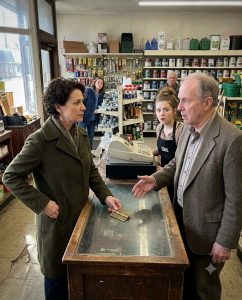
On a hot Friday afternoon in Mineral Springs, Ohio, Darlene Kowalski learned two things she would never forget.
The first was that public humiliation had a sound. It was not loud, not at first. It was the scrape of a toolbox dragged too fast across a wooden floor. It was the slap of a door shoved open hard enough to rattle the bell above it. It was metal hitting concrete and springing apart into a scatter of sockets, pliers, screwdrivers, and every ounce of dignity a person tries to keep hidden when a room full of people is watching.
The second was that some men only feel powerful when they believe someone else has no power to answer back.
At twenty-two, Darlene already knew Hatcher’s Hardware better than most of the men who claimed to run it. She knew which contractors never measured right the first time and came back pretending the lumber was cut wrong. She knew which old windows in town needed uncommon latches that had to be ordered from a supplier in Dayton. She knew that aisle six leaned slightly left because the floor under seasonal storage had taken water back in 1989. She knew where the backup keys were kept, which vendors padded invoices, and which customers needed their pride managed as carefully as their purchases.
She also knew Gary Hatcher hated being corrected.
He was not an incompetent man in the absolute sense. He could charm, posture, talk margin, shake hands with county commissioners, and tell stories about his father founding the first store as if the town itself had been built from his family’s receipts. But what made Hatcher’s Hardware run day to day had less to do with Gary’s speeches and more to do with the people behind the counters, in the aisles, at the loading dock, and in the cramped office where mistakes had to be fixed before they became expensive.
Darlene was one of those people.
That Friday, the mistake was simple. A contractor on Maple Street needed a shipment first thing Monday morning for a remodel that was already behind. The order should have gone in by noon. It had not. Darlene caught it when she checked the invoice stack and saw the purchase request still sitting unsigned under a coffee ring in Gary’s office.
She did not accuse him. She did not embarrass him on purpose. She simply found him at the counter, handed him the paper, and said, “If we call Columbus in the next ten minutes, they can still load it.”
A few customers overheard. Gary looked at the invoice, then at her, and in that brief pause something mean and brittle flashed across his face.
“You think you run this place?” he asked.
Darlene kept her voice calm. “I think if we wait any longer, we lose the order.”
There were better ways that moment could have gone. Gary could have grunted, made the call, and pretended later that he had intended to do it all along. He could have blamed a clerk. He could have ignored her and accepted the consequences. Instead, perhaps because the contractor was listening, perhaps because two local farmers were watching, perhaps because humiliation is often converted quickly into cruelty, Gary made a choice that would follow him for the rest of his life.
He stepped out from behind the counter, marched to the workbench, seized Darlene’s metal toolbox from beneath it, and carried it to the front door.
“You don’t work here anymore.”
The room froze.
Darlene thought at first he was bluffing. Then he threw the toolbox onto the sidewalk outside.
It burst open on impact.
One screwdriver spun almost into the gutter. A measuring tape bounced against the threshold. Her favorite adjustable wrench landed with a crack that made two women near the paint section flinch.
No one stepped in.
Gary pointed toward the street. “You always acted like you were too good for this place. Truth is, you’ll never amount to anything without my name over your head.”
The silence after that sentence was far worse than shouting. It was the silence of people deciding whether to witness or disappear.
Then Gary did one more thing, small enough that he probably never imagined it would matter. From the display near the register, he picked up a worn brass door hinge that had sat for years in a clearance bin nobody bothered to sort. He flicked it at her feet and said, “Take that too. Closest thing to value you’ll leave with.”
Darlene looked at the hinge on the floorboards, then at Gary, then through the window at the spilled remains of her toolbox on the sidewalk.
A different woman might have shouted back. Might have told the whole room exactly how many orders Gary forgot, how many customers she saved, how many times his own father had once said the store would collapse without people like her. Darlene did none of that. She walked outside under the eyes of half the town, crouched on the concrete, and repacked her tools one by one.
She picked up the hinge last.
It was warm from the room, scratched around the pin, darker at one edge where hands had touched it over years of being moved, ignored, put back, and forgotten. She closed her fingers around it and slipped it into her coat pocket.
Then she stood, lifted the toolbox, and walked away without looking back.
By evening the story had traveled all over Mineral Springs.
By morning it had grown.
Some said she cried in the parking lot. She had not. Some said she slapped Gary. She had not. Some said she stole from the register before she left. That was a lie Gary didn’t exactly invent but never bothered to correct because it made him feel safer about what he’d done. In a town that small, losing a job was never just about income. It became a reputation, a warning, a label that moved ahead of you into every conversation.
Darlene found that out within a week.
No one in Mineral Springs wanted to hire the woman Gary Hatcher said was difficult, ungrateful, and dishonest. So she widened the circle. She drove to Canton. Then Akron. Then Cleveland. She took temporary work in warehouse receiving, then in a building supply office where she learned procurement software faster than the manager who trained her. She spent nights studying inventory systems, contract language, cash flow, and logistics because she had discovered something essential on the sidewalk outside Hatcher’s Hardware: being good at the work was not enough if someone else owned the story of your worth.
She learned to own that too.
The first years were not glamorous. She rented small apartments with radiators that clicked all winter and windows that sweated in summer. She packed lunches. Repaired her own car when she could. Wore secondhand coats. When raises came, she saved them. When promotions came, she earned them by being the person who noticed what everyone else overlooked.
A vendor dispute others called minor became her first big opportunity. She discovered one regional supplier had been quietly overcharging dozens of independent stores through a buried freight adjustment. She documented it, presented the evidence without drama, and recovered more money for her employer in one quarter than two senior managers had found in two years.
People began to remember her name.
Not because she was loud. Because she was right.
Within six years she was running operations for a mid-sized home supply company. Within ten, she had equity. Within twelve, she was helping acquire distressed retail locations that larger corporations considered too small to matter. Darlene saw what the spreadsheets missed. Small-town stores did matter, if they were run by people who understood the community instead of feeding on it. They failed not because small towns were dead but because bad owners mistook inherited authority for ability.
Every step upward, she kept the hinge.
It lived in coat pockets, desk drawers, overnight bags, the glove compartment on hard days. She touched it before difficult calls, before interviews, before negotiations where men smiled as if they were indulging her until they saw she knew more than they did. It was not superstition exactly. It was evidence. A reminder that value thrown at your feet could still become leverage if you refused to leave it there.
Back in Mineral Springs, Hatcher’s Hardware aged badly.
Gary inherited confidence he had not built and a customer base he assumed could never leave. But time changed. Big-box stores opened within driving distance. Online ordering ate into convenience sales. Younger contractors compared prices and expected accuracy. The oldest employees retired, and the best younger ones didn’t stay. Gary managed by intimidation and nostalgia, both of which weakened under pressure.
The first store remained the town’s symbolic center, but beneath that symbolism things were fraying. The flooring curled near plumbing. Paint stock got inconsistent. Credit terms with vendors became strained. One warehouse delay turned into two, then three. Gary papered over problems with bluster, but suppliers noticed late payments. Bankers noticed debt service tightening. Staff noticed payroll anxiety before customers ever did.
Then, quietly, a regional acquisition firm started circling.
Not a giant corporation. The kind of buyer that specialized in underperforming chains with repairable bones. The first talks were discreet. Gary thought he could negotiate from strength because his family name still meant something locally. He did not understand how little family names matter in rooms where people read ledgers instead of newspapers.
By the time he realized a sale might be the only way to avoid a collapse that would expose everything, the process was no longer his to control.
The buyer’s identity remained confidential through most of due diligence. That bothered him more than the price. He kept imagining some polished man from Columbus or Cincinnati coming in to explain his own business to him. He rehearsed responses. He wore suits no one in the store had ever seen. He told people the partnership would be good for growth, as if he had engineered it.
When the final papers were nearly complete, word leaked through town that the new majority owner would visit the flagship store in person.
On that morning, Mineral Springs developed an unusual number of household emergencies requiring washers, mulch, furnace filters, and birdseed.
By noon the store was full of people pretending not to wait.
Gary polished the counter. Ordered the teenage cashier to smile. Snapped at an assistant manager for a stack of crooked flyers. Every few minutes he looked through the front window for a sedan, a consultant, some man he could size up and either flatter or resent.
The bell above the door rang.
A woman entered alone.
She wore a dark coat and sensible boots. Her hair was pinned back. There was silver at her temples now, and composure where younger people often carry apology. She did not pause to orient herself. She walked in like she knew the exact distance between every aisle cap and every load-bearing column.
Some of the older customers felt the familiarity first, before recognition found a name.
She moved past fasteners, paint, plumbing, seasonal. Her fingertips brushed the edge of a shelf here, the corner of a display there. Once she paused by the old lock board as if checking whether a thing she remembered had survived. More than once she slid a hand into her coat pocket and rested it there for a beat.
Gary approached with his salesman smile already in place.
“Afternoon,” he said. “Can I help you find something?”
She looked at him calmly. “Maybe.”
Something in the tone snagged at him, but not enough. He went on. “We’re expecting someone important, so if you need assistance one of the staff can help.”
“I know,” she said.
She continued toward the front counter.
The lawyer arrived behind her, briefcase clutched against his chest, too hurried to manage discretion. “Ms. Kowalski,” he said.
It landed like a dropped tray.
Gary blinked. The name crossed his face without meaning, then with disbelief, then with a dawning horror that visibly stripped blood from his skin. He had not thought of Darlene in years as a real person. He had thought of her as a finished event. A cautionary tale he told in a version that always protected him.
Now the event was standing in his store in a dark coat, owning more of it than he did.
“Well,” he said, trying on a laugh that cracked immediately, “I’ll be damned.”
No one helped him.
The lawyer introduced her formally anyway. Darlene Kowalski, lead investor and majority owner through a holding group that had just acquired controlling interest in the Hatcher chain. Transitional governance. Operational review. Personnel authority. Future restructuring. The language was dry, but the reality was simple enough for every person in the store to understand.
Gary’s name was still on the building. Darlene now owned the building.
People shifted to get a better look at her, at him, at the space between them where old power was beginning to realize it had become ceremonial.
To Gary’s credit, survival instinct kicked in. He smoothed his tie, stepped forward, and extended his hand across the counter with what he hoped resembled dignity.
“Well, Ms. Kowalski. Congratulations. I look forward to working closely together.”
Darlene did not take his hand.
Instead she placed something on the glass countertop between them.
A single worn brass door hinge.
The sound was soft. It might as well have been thunder.
Gary stared at it.
In an instant he was no longer a man managing a transition. He was a younger man at a doorway with an audience, watching a toolbox burst open on the sidewalk. The memory hit him so hard his fingers twitched.
“You told me this was the closest thing to value I’d ever leave with,” Darlene said.
The nearest customers heard every word. The rest understood enough from Gary’s expression.
“That was a long time ago,” he replied, and hated how weak it sounded.
“It was,” she said. “Funny how some things keep their shape.”
There were a dozen responses available to him then. Apologize. Sit down. Admit he had been cruel. Instead Gary reached for the last refuge of men like him.
“No need to make a scene.”
Darlene’s gaze did not change. “I didn’t. You did.”
The line moved through the room like current. A teenage cashier who had spent the past year being barked at went perfectly still. One of the church women who had gossiped about Darlene all those years ago lowered her eyes. Mr. Baines, ancient and stubborn, actually smiled into his beard.
The lawyer slid a folder onto the counter.
“This is the immediate management review packet,” he said.
Gary glanced down, annoyed to be interrupted, then froze again. On top was a personnel document regarding his own position—conditional retention pending investigation, financial review, and employee complaints. Clipped behind it were copies of correspondence from former staff, supplier notices, and records from the chain’s recent audit.
Darlene rested two fingers on the folder.
“Before we discuss whether you stay another day in this building,” she said, “there’s one thing I want answered. In front of witnesses. What happened to the employees who tried to warn me before I left, and why did their records disappear afterward?”
The question knocked the breath out of him because it was precise.
There had been two employees back then who tried, timidly, to tell Darlene that Gary had been setting her up as the scapegoat for inventory problems. One quit not long after. The other had his hours cut to almost nothing and left town. Their write-ups had vanished from personnel files years ago. Gary had always assumed no one would connect any of it now.
But Darlene had done more than come back with purchase agreements.
She had investigated.
The assistant manager standing nearby, a woman named Celia who had only worked there three years, looked from Gary to the folder and understood immediately that old rumors had roots. Gary saw it in her face and realized the building was no longer protecting him. Buildings never do. People do. And people had started stepping back.
He tried anger. “This is absurd.”
Darlene opened the file and removed a photocopy. “This is a payroll adjustment initialed by you after one of them filed a complaint.”
Another page. “This is a vendor note referencing inventory discrepancies you blamed on me.”
Another. “And this is testimony from a former clerk who watched you doctor the incident log.”
Gary’s mouth opened, but nothing came out. The town had spent years hearing his version of events. Now it was hearing dates, records, signatures.
When he finally spoke, it was the worst possible choice. “Everyone made mistakes.”
Darlene nodded once. “Yes. Some people paid for yours.”
Silence followed. Heavy, undeniable silence.
Then something unexpected happened.
Celia stepped forward. “I’ve got six written complaints from current staff in the office,” she said, not looking at Gary. “I never sent them higher because there was nowhere to send them.”
The teenage cashier swallowed and added, “He docks breaks if we ask questions.”
An older stockman near electrical said, “Vendor from Ashland stopped dealing with us because of him, not pricing.”
One voice turned into three, then five. Not chaos. Not shouting. Just people finally discovering that truth becomes easier to say when someone with actual authority is willing to hear it.
Gary looked around as if betrayal had appeared from nowhere. It had not. It had simply been waiting for permission.
He made one last attempt to recover. “You’re going to destroy the family business over old grudges?”
Darlene’s expression changed for the first time then. Not into rage. Into something sadder and more final.
“No,” she said. “I bought it so it could survive.”
That was the difference between them. Gary had always believed ownership was the right to dominate a place. Darlene understood it as responsibility for what a place could become after damage.
She turned to the lawyer. “Effective immediately, Mr. Hatcher is suspended from managerial duties pending review. Change the codes by close of business. Inventory the office. Notify all five locations.”
Gary actually laughed at that, a desperate sound. “You can’t do this to me in my own store.”
Darlene looked around at the shelves, the counter, the warped floor, the faded sign visible through the front window.
Then she met his eyes.
“That’s the first accurate thing anyone’s said all day,” she replied. “It isn’t your store.”
He left without dignity because there was no dignity left to construct. No dramatic removal, no shouting victory, no applause. Just a man gathering his coat while avoiding the eyes of people who had once deferred to him automatically. At the door he hesitated, maybe expecting someone to stop him, someone to insist this had gone too far.
No one did.
The bell rang when he pushed outside. It sounded exactly as it had fifteen years earlier.
After he was gone, the store stayed quiet for a moment, as if everyone needed to relearn how to stand in the same room without his voice filling it.
Darlene picked up the hinge from the counter and turned it in her fingers. Celia asked, softly, “You kept that all this time?”
Darlene almost smiled. “Apparently.”
“What are you going to do with the place?” the cashier asked.
She looked around. Really looked. At the broken systems, yes, but also the bones beneath them. The sturdy old shelving. The convenient loading access. The customer base that still came despite everything. The employees who had not yet given up.
“Fix what matters first,” she said. “Then the rest.”
And she did.
Within six months, late vendor accounts were settled, the ordering system overhauled, and staff schedules rebuilt by someone who understood that panic is not a management strategy. Darlene promoted Celia, rehired one former employee, and started calling older contractors herself to win back trust. She removed family portraits from the office wall, but not the history. She just stopped treating history like immunity.
At the flagship store, she left the original front bell in place.
She also had the sidewalk repaired where the concrete had cracked near the entrance. Not because she wanted to erase what happened there, but because she was done letting the worst moment of her life define the ground under everyone else.
As for Gary, the review uncovered enough financial negligence, retaliatory personnel conduct, and manipulated records to end any argument about his return. He retained a reduced passive interest only until the final settlement terms were completed, and even that became the subject of legal wrangling he no longer had the leverage to win. In town, some people said he got what he deserved. Others said public downfall was too harsh for a man whose family built jobs in the county. Both could be true in their own way. Damage and contribution often live in the same person. That does not cancel either one.
Months later, after closing one evening, Darlene stood alone near the front counter. The store smelled faintly of lumber and machine oil, the way it always had. Through the windows she could see the repaired sidewalk glowing under the streetlamps.
She took the brass hinge from her pocket and set it on the glass.
It looked smaller now than it had all those years ago. Less like a weapon, less like a wound. More like proof. Not that revenge was sweet, exactly. It wasn’t. Revenge had a sharp edge and a short life. What she felt instead was steadier than that.
She had returned to the place where someone once told her she had no value, and she had answered not by begging to be seen differently, but by becoming impossible to deny.
She picked up the hinge, turned off the front lights, and headed for the door.
The next morning, Mineral Springs would open as usual. Men would come in for bolts. Women would compare paint cards. Teenagers would pretend not to hate summer stock work. The bell would ring. Business would go on.
But in quiet moments people would still think about the day Darlene came back, set a small brass hinge on the counter, and changed the balance of a whole town with one simple act of memory.
And depending on who was telling it, the story meant something slightly different.
Some thought the biggest red flag had been the way Gary needed an audience to feel powerful. Some thought the real warning sign was how many people saw what happened years earlier and said nothing. Some insisted Darlene should have shown mercy the moment he recognized her. Others believed mercy without truth would only have protected the same rot all over again.
Maybe the hardest question was the one no one could answer cleanly: when someone finally gets the chance to return the hurt that shaped them, what matters more—the humiliation they could inflict, or the future they choose to build instead?
Darlene never answered that publicly.
She didn’t have to.
The store did it for her.