The silence began before anyone realized why.
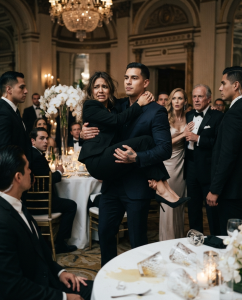
At first it was only a subtle shift inside the grand ballroom of the Imperial Reforma Hotel, the kind of room built to flatter powerful people into believing they were more elegant than they really were. Chandeliers dripped warm light over white tablecloths and polished silver. Imported orchids rose from the centerpieces like pale sculptures. A jazz trio played softly near the stage while servers moved in clean lines with trays of mezcal cocktails and appetizers no one finished.
From a distance, the gala looked flawless.
That was exactly how Mariana Robles had designed it.
At twenty-nine, Mariana was already one of the most trusted senior coordinators at Eventos Diamante, a luxury event agency that handled the kind of occasions where money needed to be seen, photographed, and admired. Senators held anniversary parties through them. Developers launched towers through them. Politicians renewed their vows through them. Foundations hosted charity auctions through them. If wealthy people in Mexico City wanted their guests impressed and their disasters hidden, Mariana was usually somewhere nearby making it happen.
No one in that ballroom noticed how much of the night was resting on her shoulders.
That was normal.
Mariana had learned long ago how to disappear while still controlling everything. She had a broad frame people judged before hearing her voice, and a face that could look serene even when she was solving six problems at once. Since childhood, she had endured casual cruelty disguised as concern, mockery disguised as advice, and the constant implication that her body entered a room before she did. It taught her to make herself useful, efficient, necessary. To move quietly. To fix things before anyone could blame her for them.
By eight-thirty that evening, she had already replaced a florist who sent the wrong orchids, settled a screaming match between a senator’s wife and the pastry chef, found a missing auction list, and rerouted a group of intoxicated guests away from a back corridor where cash deliveries were never supposed to be visible.
That last detail bothered her.
It bothered her more than she wanted to admit.
“Mariana, table six says the mole looks rustic,” her assistant, Carla, murmured through the earpiece. “They want more presentation.”
Mariana closed her eyes for one second and exhaled.
“Tell them Chef Esteban is adjusting it. And please make sure no one touches Mr. Salvatierra’s table unless I approve it.”
Carla lowered her voice. “You really think he’s coming?”
“He already checked in through the private entrance.”
That changed Carla’s face immediately. Everybody had heard of Rafael Salvatierra. Even people who pretended not to follow business gossip knew his name. Hotels, construction, transport, security, political connections no one could map cleanly—he seemed to be everywhere and nowhere at once. Officially he was a businessman. Unofficially he was the kind of man whose name made conversations pause.
Mariana had never met him.
She had seen him from a distance once at another event, surrounded by men who looked less like employees and more like decisions already made. Tonight he had requested a table in the back of the ballroom with a clear view of every exit, no photographers within five meters, and a bottle of private reserve tequila to be delivered personally.
That request alone was enough to make half the staff nervous.
When Rafael Salvatierra finally entered the room, Mariana understood why.
He wasn’t loud. He didn’t perform importance. He didn’t smile or shake hands or pretend affection with people he didn’t respect. He simply walked in wearing a black tailored suit and an unreadable expression, and the room adjusted itself around him. Men straightened. Women looked. Staff became careful.
He moved toward the private table at the rear with two bodyguards behind him and one ahead. Under the cuff of his right sleeve, Mariana noticed the edge of dark ink climbing his wrist. A tattoo. Somehow that made him seem even less polished and more dangerous in a room full of expensive polish.
At another table near the center sat Renata Cárdenas.
Mariana knew her by reputation before ever speaking to her. Daughter of banker Arturo Cárdenas, educated abroad, photographed often, praised by magazines for her style and by men with poor judgment for her charm. In practice, she was the sort of woman who treated staff as furniture until she wanted entertainment. All evening she had complained about temperatures, lighting, service speed, stemware, and even the facial expressions of the servers.
Now, seeing Rafael arrive, Renata transformed.
Her posture changed first. Then her smile. Then her entire orbit.
She crossed the ballroom with a champagne flute in hand and slid toward Rafael’s table with the confidence of someone who had never once in life considered the possibility of being unwelcome. He barely acknowledged her. That should have been enough to make anyone stop.
It only made her try harder.
Mariana watched for one beat too long, then forced herself back into work. There were more urgent problems: a donor demanding a different seat, a vendor who wasn’t answering his phone, and an increasingly tense request from the VIP section for the private reserve tequila.
One of the junior servers approached her with the tray and looked miserable.
“I can’t take this table,” he said. “They said it has to be you.”
Of course it did.
Mariana adjusted the bottle, straightened the crystal glasses, and lifted the tray herself.
As she crossed the ballroom, she could feel eyes sliding over her. Not admiration. Assessment. The kind reserved for service workers and women whose bodies did not fit the room’s preferred aesthetic. She ignored it. She had been ignoring that look all her life.
At Rafael’s table, Renata was leaning in, laughing at something he hadn’t said. One bodyguard stepped aside only after Mariana identified herself.
“The reserved tequila, Mr. Salvatierra,” she said.
She lowered the tray carefully.
Renata gave her a slow look, the kind that always arrived before cruelty.
“How brave of the agency,” she said lightly, “to send someone who takes up half the aisle.”
There it was.
The old heat rose into Mariana’s face, but she kept her tone neutral. “Excuse me.”
She reached to place the glasses.
Then pain tore through her ankle.
Renata’s heel had shot out under the tablecloth and hooked her foot with practiced precision. Mariana lost balance instantly. The crystal tray lurched. Tequila splashed across linen. Glass knocked against glass. Her body pitched forward, and for one sick second she knew exactly what was about to happen. She would hit the floor, people would laugh or pity her, someone would call it unfortunate, and tomorrow the story would be told as if gravity had embarrassed her all by itself.
But she never landed.
An arm caught her around the waist with startling force.
Rafael had moved so fast she barely understood what happened until she found herself pulled sideways and lowered directly onto his lap, one arm braced securely around her while the room stared in total shock.
Mariana froze.
Humiliation burned through her. “Sir, I’m sorry, I—”
“Don’t move.”
His voice was low, even, absolute.
She went still.
He looked down first at her ankle, already swelling, then up at Renata. The room was no longer watching a social slight. It was watching judgment.
“She didn’t trip,” Rafael said. “You tripped her.”
Renata laughed weakly. “That’s ridiculous.”
“Apologize.”
Her face hardened. “To her?”
By then Arturo Cárdenas had arrived, moving fast and sweating through his expensive composure.
“Rafael,” he said with forced calm, “my daughter’s had a bit too much to drink. Let’s not turn this into—”
“Into what?” Rafael asked without raising his voice. “A public display of what your family does to people it thinks don’t matter?”
Arturo’s expression changed.
That was the moment Mariana noticed something else in the room. Not everyone looked surprised. A few people looked afraid.
“It was an accident,” Renata insisted. “She should watch where she walks.”
Rafael’s gaze never left hers. “You have one chance to correct yourself.”
Arturo moved closer. “This isn’t the place.”
“No,” Rafael said. “But it is the witness list.”
A few guests quietly stepped back.
Renata’s bravado finally cracked. “Fine,” she snapped, looking at Mariana with open disgust. “I’m sorry I tripped you. It was cruel. I shouldn’t have done it.”
Mariana hardly heard the words. She was still trying to understand the impossible reality of being defended by the most intimidating man in the room while sitting on his lap in front of two hundred people.
Then a new voice cut through the scene.
“Mariana. Get up. Right now.”
Óscar Medina, director of Eventos Diamante, had arrived. He looked furious, but not at Renata. At Mariana.
She went cold.
“You’re making a fool of this company,” he hissed. “You’re fired.”
The words landed with the efficiency of a blade.
After all the years. The overtime. The impossible clients. The weekends sacrificed. The quiet fixes and public smiles. Fired, here, now, in front of everyone.
Rafael’s expression shifted only slightly, but Mariana saw it.
Contempt.
“How efficient,” he said.
Óscar turned instantly deferential. “Mr. Salvatierra, please accept our deepest apologies for this disruption. We will handle the employee.”
“She’s not your employee anymore,” Rafael said.
Óscar forced a smile. “Exactly.”
Rafael looked at him as if measuring whether he was worth crushing. “Be grateful I’m not in the mood to buy your agency tonight and close it before dawn.”
Óscar’s face drained.
Mariana, desperate not to cry in front of everyone, tried to stand. Pain exploded through her ankle and she nearly dropped again. Before she could protest, Rafael rose and lifted her into his arms.
Not awkwardly. Not theatrically. Easily.
She instinctively grabbed his shoulder. “Please put me down. I’m too heavy.”
That made him pause and look directly at her for the first time.
His eyes were dark, steady, and unexpectedly angry—not at her, but for her.
“Don’t use their cruelty to describe yourself,” he said. “It doesn’t make it true.”
Then he carried her through the ballroom.
Guests parted without being asked. Some stared openly. Others pretended to examine their phones while filming everything. Staff stood motionless, shock and secret satisfaction mixing on their faces. Carla covered her mouth with both hands as Mariana passed.
Outside the ballroom, the hotel corridors seemed colder. One of Rafael’s men opened the rear door of a black armored SUV waiting near the service exit. Rafael set Mariana carefully inside and slid in after her. The door shut with a dense, final sound.
For the first time all evening, there was silence.
No orchestra. No glass. No murmurs.
Only Mariana’s breathing.
She looked at him, shaken, embarrassed, confused, and suddenly very aware that she had entered a vehicle with a man whose reputation frightened entire industries.
“Why did you do that?” she asked.
Rafael tapped a built-in screen.
Live security footage filled it.
The front of the hotel.
Police vehicles.
Unmarked black units.
Agents moving into position.
Mariana stared. “What is that?”
“In less than ten minutes,” he said, “the prosecutor’s office enters the gala.”
Her stomach dropped. “Why?”
He pulled a folder from a compartment beside him and handed it over. Her full name was printed on the label.
Inside were contracts, invoices, vendor logs, event approvals.
Her approvals.
Her signature.
At least, it looked like her signature.
“The Cárdenas family has been laundering money through event logistics,” Rafael said. “Your agency is one of the channels.”
“No,” Mariana said instantly. “That can’t be right.”
“It is.”
She flipped through pages faster. At first the paperwork looked normal. Budget allocations. Vendor substitutions. hospitality charges. Then she saw duplicate contract numbers connected to different shell companies. Payments rerouted to service firms she had never heard of. Altered line items buried in event revisions.
Her signature was there.
On everything.
Ice spread through her chest.
“I never approved these.”
“You approved clean versions,” Rafael said. “Then someone altered the record trail.”
She looked up. “How do you know this?”
He didn’t answer immediately.
Instead he enlarged one document and pointed to a series of timestamps. “Your credentials were used after midnight on dates you were not even in the office. They built this carefully. When the investigation surfaced, they needed someone competent enough to be believable and low enough in the hierarchy to be expendable.”
She understood the implication a second before she could accept it.
“They were going to blame me.”
“They were going to hand you over,” he corrected. “And let the story explain itself.”
Her throat tightened. Images flashed through her mind: compliance officers, police questions, cameras outside her apartment, her mother fainting at the news, neighbors whispering, every sacrifice of the last decade collapsing under headlines she would never outrun.
“Why warn me?” she asked quietly.
Rafael looked out the tinted window for a moment before answering. “Because this operation wasn’t supposed to reach you.”
That answer opened more questions than it closed.
Before she could push further, his phone vibrated. He read the screen and swore under his breath.
“What happened?” Mariana asked.
He turned the phone toward her.
A photo filled the display—grainy but unmistakable. Two men in hotel service uniforms were hauling a hard equipment case down a side corridor toward an exit. On top of the case was a printed evidence tag.
Mariana Robles.
Her skin went numb. “What is that?”
“The final insurance policy,” Rafael said.
He zoomed in. The case had hotel transport stickers and a lock seal already attached. It looked official. Convincing. Damning.
“They were going to plant whatever the investigators needed to find with you,” he said. “Documents, drives, cash—doesn’t matter. Once your name was attached, the rest would follow.”
Mariana pressed a hand over her mouth.
Outside, the first group of agents entered through the hotel’s main doors. Even through the dark glass, blue and red lights pulsed across the SUV interior. She could almost feel the ballroom shifting from luxury to panic upstairs.
“Óscar knows?” she asked.
“Yes.”
“And Renata’s father?”
“He’s desperate enough to sign anything.”
Mariana thought of every late night, every event packet, every rushed revision Óscar had handed her with a smile and an apology about client pressure. She thought of all the times she had stayed after midnight because he said he trusted her more than anyone else.
He hadn’t trusted her.
He had used her.
Something inside her went hard.
“I want to go back.”
Rafael turned sharply. “No.”
“I want to know who else knew. I want to see Óscar’s face when he realizes I know.”
“You’ll see it later, under better conditions.”
“I’m not hiding while they decide what story to tell about me.”
His expression darkened, but there was something else there too. Respect, maybe. Or concern.
“You still think this is about pride,” he said. “It stopped being about that when they decided evidence would be found in your possession.”
A knock sounded against the driver’s side.
One of Rafael’s men spoke through the partially lowered front partition. “They’re locking the east garage. We need to move.”
Rafael nodded once, then looked back at Mariana. “There’s more.”
“There always is,” she said bitterly.
He took the folder from her, flipped several pages, and pulled out a photograph tucked between contracts.
It was old enough to have been printed, not downloaded.
Mariana frowned. The image showed a much younger woman standing beside a catering truck outside what looked like a hotel loading bay. The woman was smiling tiredly at the camera, hair tied back, apron stained at the hip.
Mariana’s pulse stumbled.
“That’s my mother.”
“Yes.”
She looked from the photo to him, confused. “Why do you have that?”
Rafael’s jaw flexed.
“Because fifteen years ago, your mother worked a banquet where the same people tested this exact scheme. She saw something she wasn’t supposed to see.”
Mariana felt all the air leave her lungs.
“She never told me that.”
“She wouldn’t,” he said. “She was paid to keep quiet. Then threatened to make sure she did.”
A thousand tiny memories began rearranging themselves in Mariana’s mind. Her mother’s fear of official envelopes. Her refusal to discuss certain jobs from years ago. The way she always told Mariana never to stay too late at luxury hotels, never to trust executives who praised loyalty, never to sign anything without reading every page twice.
Mariana looked at Rafael with dawning horror. “You knew my mother?”
For the first time that night, he hesitated.
“When I was younger,” he said, “I worked security for a man connected to the Cárdenas network. I saw what they did to people who became inconvenient. Your mother was on a list. I got her name removed.”
Mariana stared at him. “Why?”
He gave a short, humorless breath. “Because unlike most of the people around me back then, she was innocent.”
That answer hit her harder than any polished confession could have. It made him feel suddenly less like a legend and more like a man carrying old choices he couldn’t undo.
“And now?” she asked.
“Now,” he said, “you were supposed to be collateral damage in a case that should have ended years ago.”
Before she could respond, the SUV doors locked with a sharp internal click.
Rafael’s head turned instantly toward the window.
Someone outside had grabbed the rear passenger handle.
Then came a second pull. Harder.
One of the bodyguards reached for his earpiece in front. “We have contact.”
Mariana’s heart slammed against her ribs.
Rafael leaned slightly toward the tinted glass and watched the blurred figure outside try the handle again. Another shape moved into view behind it.
He reached across Mariana, not touching her, but placing one arm against the seat as if preparing to shield her if the window shattered.
His voice, when he spoke, was calm enough to terrify her.
“They found the car faster than they should have.”
The bodyguard in front turned halfway around. “Orders?”
Rafael never took his eyes off the door.
“Drive.”
The engine surged. Tires cut across the pavement. Outside, one figure stumbled back as the SUV lurched away from the curb and shot into traffic.
Mariana twisted to look behind them. In the mirror she saw the hotel entrance flashing with law enforcement lights, guests spilling into hallways, and two men near the curb already speaking urgently into phones.
Her phone buzzed.
Unknown number.
A message appeared.
We know where your mother lives.
Mariana went cold from scalp to spine.
Rafael saw her face change. “What?”
She turned the screen toward him.
He read the message once and his expression became something far more dangerous than anger.
He took out his own phone and made one call.
“Move the team to Doña Elena Robles now,” he said. “No lights. No uniforms. And if anyone gets there before us, don’t ask questions first.”
He ended the call.
Mariana could barely breathe. “This is because of me.”
“No,” Rafael said. “This is because they lost control.”
The SUV sped through late-night traffic, leaving the hotel and its collapsing lies behind, but Mariana no longer felt rescued.
She felt chosen.
By the wrong people.
By the wrong story.
And maybe by the only man in the city ruthless enough to stop what was coming.
She clutched the folder in both hands and looked at the message again, then at Rafael.
“Tell me the truth,” she whispered. “All of it. No more half-answers.”
He met her gaze as sirens echoed somewhere behind them.
Then, finally, he did.
By the time Mariana heard everything—the money, the dead witness, her mother’s silence, Óscar’s role, and why Rafael had been watching her for months—she understood two things with brutal clarity.
The first was that her life at Eventos Diamante had never been what she believed it was.
The second was that being publicly fired in that ballroom was the only reason she was still alive.
Hours later, after the raid had exploded across the news and arrests began rolling through the city, Mariana sat in her mother’s kitchen listening to Elena cry with relief in the next room while Rafael stood at the window watching the street.
Neither of them spoke for a while.
At last Mariana said, “You could have walked away.”
“Yes.”
“But you didn’t.”
“No.”
She studied him in the dim light. The feared man from the gala, the one who had silenced a ballroom with a glance, now looked tired in a way no rumor had ever described. Like someone who had spent too many years learning the price of being late.
“My mother always told me the most dangerous people are the ones who make cruelty look normal,” Mariana said.
Rafael glanced back at her. “She was right.”
Mariana thought about Renata’s smirk. Arturo’s panic. Óscar’s instant willingness to throw her away. She thought about how easily the room had almost accepted her humiliation as part of the evening’s entertainment.
Maybe that was the ugliest part of all.
Not just the crime.
The ease.
The elegance with which powerful people assumed someone like her could be blamed, mocked, discarded, and forgotten.
But they had miscalculated.
They had done it in front of a man who saw exactly what they were.
And for one impossible, life-altering moment, he chose not to look away.
By morning, Mariana’s name had been cleared from the first official statement. Óscar Medina had disappeared and then been found trying to leave the city. Arturo Cárdenas denied everything on camera before evidence crushed the performance. Renata’s apology never made the news, but her humiliation did. The gala became a scandal. The agency became an investigation. The people who once treated Mariana like part of the décor were suddenly learning what it felt like to be examined.
And Mariana?
She still didn’t know what came next.
She had lost her job, her certainty, and the clean version of the world she had worked so hard to survive in.
But she had also kept her freedom. Her name. Her mother. Herself.
Sometimes survival doesn’t arrive gently. Sometimes it looks like public ruin seconds before the truth. Sometimes it comes wearing a black suit and a dangerous reputation, lifting you out of the exact place where your life was about to be destroyed.
And sometimes the moment that feels most humiliating in front of everyone turns out to be the moment someone finally refuses to let you be sacrificed.
The unsettling part is not wondering whether Mariana should forgive the people who used her. That answer is obvious.
The unsettling part is this:
How many elegant rooms are still full of people smiling over crystal glasses while someone like Mariana is being chosen for the fall?