William Hayes was called a traitor before he had even finished filling the first barrel.
The insult came from behind him, sharp and ugly, carried on the dry Arizona wind.
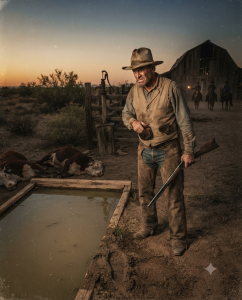
He ignored it at first. The barrel sat beside the wagon, and he kept pouring water into it from a bucket pulled up from the north well. Each splash sounded precious. In the summer of 1885, on land baked half to death by heat and drought, water was no longer just water. It was survival. It was money. It was the difference between a ranch still standing by winter and a ranch stripped bare by vultures and debt collectors.
Still, William poured.
The Apache waiting in the shade of the old barn were in no shape to care what names white men called each other. They were barely in shape to sit upright.
Hours earlier, William had found them beneath three dying cottonwoods in the bed of a dry creek. At a glance, he had expected danger. Everyone in that part of Arizona had been taught to expect danger the moment they heard the word Apache. But what he found was not a raiding party. It was exhaustion with human faces.
An old woman whose cracked lips were dark with blood. Two mothers with children hanging limp against them. Three boys so thin their wrists looked like bundled twigs. A little girl staring at him with the fixed, flat look of someone too thirsty to be afraid anymore.
The only one who rose to meet him was the leader, a hard-faced man whose pride had somehow survived the desert even as his body nearly had not. He did not ask for mercy. He did not speak. He only looked at William as if the entire world had narrowed down to the decision of one rancher standing in front of him.
Behind William, Tom Briggs had whispered, “Don’t do this.”
William had looked down and seen a child collapse into the sand.
That settled it.
Back at the ranch, there had been no debate. He gave orders and expected them followed. Four barrels of water. Food from the kitchen. Blankets from storage. Space in the old barn. The hands obeyed, though uneasily. Everyone on the ranch knew what the town would say if word spread.
Word always spread.
By dusk, Silas Mercer arrived with four other men, each angrier than the last.
Silas owned the general store in town and knew every debt, every weak spot, every secret grudge in the valley. He was one of those men who never raised his voice unless it helped him, and never smiled unless someone else was about to lose something. If the drought had hurt him, it didn’t show. He still wore polished boots. Still kept his beard trimmed neat. Still spoke like the whole territory was his to organize.
“Is it true?” he called from the front gate. “You’re harboring Apache?”
William had stepped onto the porch and answered plainly. “I’m giving shelter to thirsty people.”
Silas had laughed without humor. “You’re feeding the same people who’ve raided homesteads all through this territory.”
“Not these,” William said.
“You don’t know that.”
William did know one thing. The travelers on his ranch could barely lift their heads, much less launch an attack.
Silas had tried another angle. “When your cattle vanish, when your fences burn, don’t expect the town to lift a hand.”
William came off the porch then, descending with the slow calm of a man who had endured too much to be easily rattled. “On my land,” he said, “no one dies of thirst if I can stop it.”
The men behind Silas muttered. One spat in the dirt. Another warned him the town would stop buying Hayes beef. That one landed harder than the rest. Drought had already thinned the herd. A boycott could finish what the weather had started.
But William refused to bend.
He had become familiar with loneliness after his wife, Eleanor, died six years earlier. She had been the softer part of the ranch, the one who remembered birthdays, who spoke gently to skittish horses, who saw goodness in men William distrusted. Fever took her in three days. Afterward, he buried not just her, but most of the ease in himself. People called him stern after that. Cold, sometimes. But Eleanor had once told him there was a difference between hardness and cruelty.
He remembered that when he looked at the Apache children in the barn.
That night, he sat beside the well with a rifle across his lap. He did not trust the town. Not after the looks on those men’s faces. Near midnight, the Apache leader approached, moving quietly despite his weakness.
“Your kindness will cost you dearly,” the man said in halting Spanish.
William kept his eyes on the black mouth of the well. “Maybe. But not as dearly as turning away.”
The man’s gaze lingered on him. “Some debts are not paid with coins.”
Then he stepped back into the shadows.
At dawn, the travelers left as quietly as they had arrived. Before going, the leader set a small leather pouch on a stone near the well. Inside, William later found a carefully carved arrowhead and a thin strip marked with symbols. He could not read them. He kept them anyway, more out of instinct than understanding.
Three days later, he found seven cattle dead.
The smell hit first.
Then the flies.
Then the terrible stillness of large bodies collapsed beside the west corral trough. One steer lay with its tongue swollen from its mouth. Another had gone down on its side, hooves stiff in the dirt. The water in the trough held a strange cloudy film over the top.
“Poison,” one of the ranch hands breathed.
William crouched beside the trough without answering. He felt something cold settle inside him. This was not a random loss. It was deliberate. It was aimed.
By the time he rode into town that afternoon, the accusation had already taken shape and spread through every doorway.
The Apache did it.
That was what people said before William even spoke.
That was what Silas Mercer said loudest.
“You opened your gate,” Silas declared in front of his store, where half the town had gathered to listen. “Now decent people are paying for it.”
William dismounted slowly. “You saw those people. They could barely walk.”
Silas spread his hands. “Sick men can still hate. Hungry men can still steal.”
“And dying children poison cattle troughs?” William asked.
A few faces in the crowd shifted at that, uncertain. Silas noticed and moved quickly.
“You think because they left you a trinket, you know their hearts?” he said. “You put everyone here at risk.”
It was cleverly done. He had made William’s mercy sound like vanity, like foolish pride dressed up as principle.
The town wanted someone to blame. The drought had sharpened every temper and every prejudice. Crops were failing. Wells were sinking lower. Men who would normally keep ugly thoughts to themselves now wore them openly. Fear needed a target, and the Apache were an easy one.
But William’s doubts began to turn in another direction that night.
He returned to the dead cattle with a lantern long after the hands had gone to sleep. He studied the trough again. Whoever poisoned it had chosen the west corral, where the strongest breeding stock was watered. That alone suggested knowledge. Then he found a boot print at the edge of the mud.
Not just any boot.
A broad heel with a split edge worn into one side.
He had seen that pattern before, crossing Silas Mercer’s store floor more than once.
William stood still in the lantern glow, every sense suddenly sharpened.
He returned to the house and emptied the leather pouch onto the table. Arrowhead. Marked strip. He smoothed the strip flat and examined it again. What had seemed like meaningless symbols now looked more deliberate. He fetched an old survey map of the ranch and laid the strip beside it.
A line on the strip matched the dry wash beyond the south ridge.
A curved mark matched the west pasture.
And a small crossed notch—one he had ignored—sat exactly where an abandoned line shack stood on the far edge of his land.
This was no thank-you token.
It was a warning.
The Apache leader had tried to tell him something before leaving.
William did not sleep. Before dawn, he saddled his horse and rode alone to the old line shack. He found signs of recent use almost immediately. Ash in the fire pit. A rope still tied fresh around a post. A broken crate with markings from Mercer’s general store burned into the side.
Inside the shack, he found two empty sacks that had once held feed, a rusted canteen, and, shoved beneath a loose floorboard, a folded ledger page.
He unfolded it carefully.
It listed shipments.
Barrels. Salt. Dried goods. Powder.
And next to several entries were notes in Silas Mercer’s handwriting.
Deliver to ridge after dark.
No witnesses.
Paid by Fenton line.
William read it twice.
He knew the Fentons. Small cattle outfit east of town. Deep in debt, angry at anyone who still had standing with the bank. Angry enough, perhaps, to work with the sort of man who profited from chaos.
Suddenly, the pieces began to move.
Silas had not just blamed the Apache because it was convenient. He had likely been using fear of Apache raids for months—maybe longer—to control trade, squeeze ranchers, and move goods where no one would ask questions. If enough people were frightened, they bought more supplies, accepted harsher terms, and stopped asking whether the attacks and sabotage they feared were always what they seemed.
William thought back to the warning: Some debts are not paid with coins.
The Apache leader had seen men watching the ranch. Maybe he had seen the line shack being used. Maybe he knew the real threat wearing the valley down did not come from starving travelers at all.
William rode straight to the sheriff in town.
Sheriff Nolan was an old, careful man with tired eyes. He listened without interrupting as William laid the ledger page on his desk and explained what he had found.
When he finished, Nolan exhaled slowly. “You understand what it means if you’re right.”
“It means Mercer has been stirring panic for profit,” William said.
“It means half this town may prefer the lie.”
William held his gaze. “Then they can say so to my face.”
Nolan agreed to ride with him, but quietly. By then they both knew that accusation without proof would only turn the town uglier. They needed to catch Mercer or his men in the act.
The chance came that very night.
From a rise above the west pasture, William, Nolan, and two deputies watched shadows move below. Three riders slipped through the fence line toward the corral. One carried a can. Another dismounted near the barn wall and struck a match.
The sudden flare of light revealed his face for one clear second.
Tom Briggs.
William felt the shock like a punch. Tom, who had warned him not to help the Apache. Tom, who had worked his ranch for two years. Tom, who had stood beside him over the dead cattle and cursed the people he now meant to frame.
The rider with the can was one of the Fenton boys.
And the third, sitting a little back in the dark as if he expected others to do the dirty work for him, was Silas Mercer.
Nolan gave the signal.
The deputies came down fast, shouting. Horses reared. Someone fired wild into the air. Tom dropped the match and ran for the fence, but William cut him off before he made it ten yards.
“Why?” William shouted, dragging him from the saddle.
Tom hit the ground hard, face twisted with panic and shame. “Because Mercer said you were finished anyway,” he snapped. “Said the drought would take the place and he’d see to it no bank saved you. Said there was money if I helped.”
Silas tried to talk his way free even with a deputy’s pistol at his chest.
“This is a misunderstanding,” he said. “Hayes is making stories out of dust.”
Nolan held up the ledger page. “Looks like dust learned to write.”
The truth came out in pieces over the next two days.
Silas had been buying desperate men with credit and cash, then using them to stage thefts, poison stock, and plant signs that would be blamed on Apache raiders or rival ranches. Each act drove fear higher. Each rumor sent more people into his store for supplies on credit. Each loss pushed smaller ranchers closer to selling out cheap—to men connected to him.
He had turned the valley’s prejudice into a business.
Tom confessed. So did one of the Fentons after a night in jail. Under pressure, even men who had defended Silas began remembering things that did not fit the stories they had swallowed so easily.
The town did not apologize all at once. Towns never do.
Some people avoided William for weeks because facing him meant facing what they had been willing to believe. Others came around slowly. A few brought business back to his ranch in silence, as if money exchanged cleanly enough could erase what they had said.
It could not.
Then, nearly a month later, just after sunset, riders appeared again at the edge of the Hayes property.
The hands tensed at first. William stepped out onto the porch and recognized them before anyone else did.
The Apache leader had returned, this time with only two others.
They approached openly. No weapons raised. No fear.
The leader dismounted and handed William a wrapped bundle. Inside was dried meat, herbs, and a small carved figure made of cottonwood root.
“For the house that gave life,” the man said.
William looked at him. “Your warning saved my ranch.”
The older man shook his head once. “Your choice saved it first.”
There was no grand ceremony after that. No speech. No perfect reconciliation that washed away the bitterness of the valley. But something had changed, and everyone who mattered could feel it.
The next time travelers came through in need of water, no one in town stopped William from helping.
A few even helped him haul the barrels.
Years later, people still told the story differently depending on who they were and what they wanted to admit. Some said William Hayes was reckless. Some said he was brave. Some insisted he got lucky.
But the truth sat in a quieter place.
A thirsty child had fallen in the sand.
A rancher had to choose between fear and conscience.
And the men who called him traitor turned out to be the ones poisoning their own land.
Even after Silas Mercer was gone, that part of the story stayed with people the longest. Not the arrest. Not the scheme. Not the ruined cattle or the ledger page or the midnight ambush by the corral.
It was the harder question left behind.
How many lies had the valley believed simply because mercy looked suspicious to those who had none?
And if William had ridden past that dry creek bed like everyone expected him to, would anyone ever have learned where the real danger had been standing all along?