Jenna Mercer had spent most of her adult life learning how to look calm while something essential was coming apart.
She could do it in a courtroom hallway with opposing counsel smiling too pleasantly. She could do it in a conference room when a senior partner asked a loaded question in a neutral tone. She could do it in front of her ex-husband’s mother, Mallory Hale, who had mastered the art of saying cruel things with perfect posture and a silk scarf.
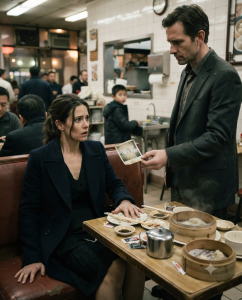
What she had never learned to do was sit across from a sun-faded photograph of her nineteen-year-old self holding a newborn and feel her pulse stay steady.
The dumpling restaurant went blurry around the edges.
Adrian’s hand stayed on the table, not touching the photo, not touching her, just close enough to make it clear he wasn’t going to snatch it away or force the next sentence before she could breathe.
At the sinks near the back, Owen was still washing his hands with the seriousness of a child stretching a task because he knew adults were talking in a tone he wasn’t supposed to interrupt.
Jenna swallowed. “Tell me exactly how you know Claire.”
Adrian nodded once. “Exactly, then.”
He sat back down.
“My wife volunteered at a legal aid clinic when she was in graduate school,” he said. “Pregnant students. women trying to avoid predatory adoption agencies. girls with no family support. She didn’t tell me names. She took confidentiality seriously. But every once in a while, she’d come home furious because a case wasn’t just sad, it was tilted. Pressured. Stacked. She told me once there was a nineteen-year-old who kept saying she just wanted one chance to think, and nobody around her seemed interested in giving her time.”
Jenna could hear Claire’s voice before she could stop herself. Soft, careful, impossible to rush. Here, drink this first. Sit down. No one gets your signature while you’re shaking.
“You were that girl,” Adrian said.
Jenna looked at the photograph again.
She remembered the concrete bench outside the student health building. The October cold. The ache in every muscle after thirty-six hours of labor and panic. The baby so new she still smelled like hospital soap and warm milk. Claire crouching in front of her with a borrowed Polaroid camera because Jenna had whispered, “Please, just one picture. I think they’re going to make this feel like I imagined it.”
At nineteen, Jenna had been pregnant, terrified, and almost entirely alone.
The baby’s father had vanished at the exact moment permanence entered the conversation. His last text had been I need time. Then nothing. Later Jenna learned his parents had known. They had intercepted letters, blocked calls, and quietly solved the problem with money and reputation the way powerful families always thought they could.
Not the Hale family. That came later.
Another family. Another chapter. But the lesson had stuck: when rich people panic, women become paperwork.
Claire had been the only person who looked at Jenna like she was not a complication to manage.
“She told me the agency was pushing you hard,” Adrian said. “Too hard. She tried to slow it down. She got overruled.”
Jenna laughed once, without humor. “That’s a generous description.”
The agency had called it a private placement. The counselor had called it a loving solution. The lawyer had called it standard.
Jenna had called it impossible.
She had signed anyway.
Because she was nineteen. Because she had no money. Because the baby’s father had disappeared. Because every adult in the room spoke the language of certainty while she was still bleeding and shaking and asking whether she could have forty-eight more hours. Because nobody tells frightened girls that pressure can be dressed like concern.
“What Claire discovered later,” Adrian said, “is that some of the paperwork in cases from that agency was irregular. Missing witness signatures. backdated forms. medical consent pages bundled incorrectly. She didn’t have proof of fraud in your case then, only suspicion. But she kept what she could.”
“The photo.”
“The photo. Notes. A copy of your first intake sheet with the agency crossed out and rewritten in her handwriting because she didn’t trust them.”
Jenna closed her eyes.
For twenty years she had forced that part of her life into a locked room in her head. Not because it hurt less there, but because opening it threatened everything around it.
Then she had met Peter Hale.
He had been older, polished, attentive, and patient in all the ways her nineteen-year-old boyfriend had not been. By then she was in law school, ferocious and exhausted, and Peter made steadiness look like devotion. She married him. She became Mallory Hale’s daughter-in-law. She had Owen. For a while, she thought maybe life had circled back to repay what it had taken.
Instead Peter accumulated hidden debt, hid investments, lied with the serene confidence of a man who believed cleanup was a wife’s job, and let tabloids feast on the divorce when his family thought public pressure might force a friendlier settlement.
After that, Jenna stopped trusting charm entirely.
It was why she had brought Owen to the museum.
Why she had turned her son into a test.
Why the shame of Adrian naming it still sat hot under her skin.
As if reading her thought, Adrian said gently, “I’m not pretending tonight started in a clean place. It didn’t. On either side.”
Jenna looked up sharply. “What does that mean?”
He held her gaze.
“When a mutual friend suggested I meet Jenna Mercer, the name hit me. Claire had finally told me your full name during her last year. She said if life ever put you in front of me, I was supposed to give you this.” He tapped the photo. “But only if I was sure it was you, and only if it was private enough to matter.”
A bitter smile touched Jenna’s mouth. “So I tested you, and you arrived carrying a ghost.”
“Something like that.”
She should have been furious.
Instead she was too tired for anything but honesty. “Did you agree to meet me because you were interested, or because your wife left instructions from beyond the grave?”
Adrian answered without hesitation. “Both. I just didn’t know whether either one would survive the evening.”
That should not have made her chest hurt, but it did.
Owen returned then, drying his hands on too many paper towels. He looked at the photo on the table and then at Jenna’s face.
“You okay?”
Jenna folded the picture over before he could see. “Yes.”
He didn’t believe her, but he climbed back into the booth because children learn very young when adults are trying to keep the ceiling from falling in.
Adrian signaled for dessert menus and shifted the conversation with almost surgical care. He asked Owen whether dumplings counted as a superior food because they were efficient or because they were portable. Owen launched into a serious answer. Jenna sat there hearing almost none of it, every nerve still pinned to the folded paper in her hand.
When they got outside, the river wind cut sharp between the buildings.
Adrian opened the back door of a car waiting at the curb, then paused. “There’s more,” he said. “But not in front of him. Can I come by tomorrow?”
Jenna should have said no.
She said, “Ten a.m. Owen has chess at noon.”
Adrian nodded once and left her with the photo in her coat pocket and a second folded paper she was too frightened to open in the car.
She waited until Owen was asleep.
Then she sat alone at her kitchen table under the weak yellow light above the stove and unfolded it.
Inside was a letter in Claire’s handwriting.
If you are reading this, Adrian found you, which means two things are true: fate has a mean sense of timing, and you are finally close enough to the truth that I can stop keeping part of it for you.
Jenna had to put the page down twice before she finished.
Claire wrote that years after the placement, she quietly tracked down enough records to confirm the baby had not been lost, harmed, or trafficked. She had been adopted legally enough to withstand challenge, but only after Jenna had been pushed through a process that almost certainly violated waiting-period standards. Claire had wanted to tell her earlier but could never justify reopening the wound without something real to offer.
Then, nineteen years later, something changed.
A young woman named Sophie Bennett had contacted the clinic through an intermediary asking whether anyone knew how to find her birth mother. She had not been looking to sue anyone. She had not wanted money. She wanted medical history, answers, and one terrible clarification.
Had her mother really chosen not to know her?
Claire never lied in writing. Her letter said only this: I told her your silence did not prove indifference. I told her there are women who are denied a fair choice and then punished for surviving the choice they were left with.
Jenna cried with one hand over her mouth so she wouldn’t wake Owen.
The next morning Adrian arrived with coffee, no flowers, and a file box old enough to have outlived several moves.
He sat at the same kitchen table where Jenna had signed divorce papers, school forms, and power-of-attorney documents, and he opened the box like it contained explosives.
Inside were copies of agency records, Claire’s notes, and a recent envelope postmarked Milwaukee.
“That’s where she grew up?” Jenna asked.
Adrian nodded. “Mostly. Her adoptive parents were Martin and Elena Bennett. Elena died two years ago. Martin’s health is failing now. Sophie found more papers while helping him move.”
Jenna pressed a hand to her ribs. “Does he know?”
“Yes. He told her the truth when she was seventeen. Apparently he and Elena always planned to tell her at eighteen, but Elena got sick, then died, and he couldn’t bring himself to blow apart what was left of the house.”
“Does she hate me?”
Adrian didn’t soften. Jenna appreciated that more than comfort.
“She doesn’t know you. She resented you. Then she resented herself for resenting you. Then Claire gave her context, and now she mostly seems tired.”
Tired. Jenna almost laughed.
That, at least, could be inherited honestly.
At the bottom of the file was a recent photograph.
A young woman on the shore of Lake Michigan in a denim jacket, hair blown across one eye, chin tilted with the same stubborn angle Jenna saw in her own mirror when she was angry. She looked nothing like Owen. She looked devastatingly like Jenna at twenty-two.
Jenna sat down because her knees gave out.
“That’s her,” she whispered.
Adrian said nothing.
“She’s real.”
“She’s real.”
For three days Jenna carried the photo folded inside her legal pad and accomplished almost nothing at work except pretending to function. She drafted a motion, forgot to send it, snapped at a junior associate, apologized too quickly, and spent half a deposition staring at the witness’s tie because if she looked at his face she might start thinking about eyes.
On the fourth day, she told Owen she needed to take a drive and asked her sister to stay with him.
On the fifth day, she called the number Claire had preserved.
No answer.
Sophie called back that night.
Jenna stood in her dark kitchen while the dishwasher hummed and her hands trembled so badly she had to brace her elbow against the counter.
“Hi,” the young woman said, and her voice was careful in exactly the way Jenna imagined it would be. “This is Sophie.”
For one horrible second Jenna could not speak.
Then she said, “I’m Jenna.”
A long pause. Not empty. Just full.
“I didn’t know if you’d call,” Sophie said.
“I didn’t know if I deserved to.”
“That’s not really why I reached out.”
They spoke for twenty-three minutes.
Not long enough for history.
Long enough for damage to become human.
Sophie asked whether Jenna had wanted to keep her.
Jenna told the truth. “Yes. Desperately. But wanting and being allowed aren’t always the same thing.”
Sophie cried quietly and did not try to hide it.
She asked whether her father knew.
Jenna said she had no idea where he was now and no interest in protecting him from his own absence.
She asked whether Owen knew about her.
“Not yet.”
“Is he kind?”
The question struck Jenna almost harder than anything else.
“Yes,” she said. “Very.”
A week later they met halfway between Chicago and Milwaukee at a botanical garden because Sophie said restaurants felt too performative and Jenna said she might actually pass out in a coffee shop.
Sophie arrived first.
She was taller than Jenna expected. Less fragile. More guarded. She wore no makeup and no visible smile, but when she turned at the sound of Jenna’s footsteps, something flickered across her face that was so painfully familiar Jenna had to stop walking.
For a second they only looked at each other.
Then Sophie said, “You kept the same nose.”
Jenna laughed through tears.
Sophie laughed too, sudden and helpless, and that broke the glass between them enough to let the first embrace happen.
It was awkward.
Then fierce.
Then brief, because neither of them trusted it yet.
They walked for two hours among summer roses and wet stone paths.
Jenna told her everything that belonged to Sophie and nothing that didn’t. The clinic. Claire. The pressure. The signatures. The years of pretending not to wonder what month she lost her first tooth, whether she liked music, whether anyone held her when she had fevers.
Sophie listened with her arms folded tight across herself at first. Then less tightly. Then not at all.
“My mom loved me,” she said at one point. “My adoptive mom, I mean. I need you to know that before this becomes a tragedy in your head.”
Jenna nodded immediately. “I’m glad she loved you.”
Sophie studied her face for a long moment, as if testing whether gratitude could coexist with grief.
Apparently it could.
When they sat on a bench near the conservatory, Sophie pulled out her phone and showed Jenna photographs: Elena Bennett with flour on her cheek at Christmas, Martin Bennett asleep in a recliner with a dog in his lap, Sophie at thirteen missing two front teeth, Sophie at sixteen in a marching-band jacket, Sophie at nineteen standing beside a rusted pickup truck with an expression that said she had opinions about everything and wasn’t afraid to use them.
Jenna looked at every image as if oxygen lived inside the pixels.
“You can hate me for some of this,” she said finally.
Sophie’s mouth tightened. “I don’t think hate is the useful word.”
“What is?”
Sophie thought about it. “I think I’m grieving a person who was alive.”
That landed clean and brutal because it was true.
Jenna nodded. “Then I’m sorry for the years I wasn’t in the room.”
Sophie looked out at the water. “I’m still deciding what to do with that.”
“Fair.”
By the end of the afternoon, Sophie asked whether she could meet Owen someday.
Not yet, Jenna said. Soon, but not yet. She needed to tell him first in a way that did not make him feel like an afterthought or a doorway someone had used.
That conversation happened on a Sunday with pancakes, because Owen accepted difficult truths better when butter was involved.
Jenna told him he had an older half-sister. She told him the version a ten-year-old could carry without being crushed by the adult failures inside it. She said there had been a baby before he was born, and that Jenna had not been able to raise her, and that the girl had found them.
Owen was silent for nearly a full minute.
Then he asked, “Does she like train maps?”
Jenna made a noise halfway between a sob and a laugh. “I don’t know yet.”
“Okay,” he said, processing. “That seems important.”
The first meeting between Owen and Sophie happened three weeks later at Jenna’s apartment with pizza and a board game no one actually finished. Owen was shy for eleven minutes, then asked whether Milwaukee’s transit system was better than Chicago’s, and Sophie answered with enough seriousness to earn his loyalty on the spot.
Jenna stood in the kitchen doorway watching them disagree about buses like this was the most ordinary miracle in the world.
Adrian came by later that night to return a file Jenna no longer needed to hide in a drawer.
Owen had gone to bed. Sophie had driven home. The apartment felt fuller than it had in years.
Jenna handed Adrian a glass of water.
“For what it’s worth,” she said, “you were right.”
“About?”
“Owen not being a stress test.”
Adrian tilted his head. “That sounds painful. I’d like credit.”
She smiled despite herself. “Don’t push it.”
He leaned against the counter, looking not triumphant, not cautious, just present.
“Claire would have liked today,” he said.
Jenna nodded. “I think about her every time I look at Sophie’s face.”
“So do I.”
That was the strangest mercy in all of it: the dead woman between them was not a threat, not a comparison, not a wound one of them needed the other to step around. Claire was the bridge. The witness. The reason truth had survived long enough to be returned.
Jenna looked toward the hallway where Owen slept and imagined the road ahead with Sophie. Not smooth. Not cinematic. No sudden rewriting of twenty years. There would be birthdays to miss on purpose and later honor awkwardly, stories told twice because memory shifted under emotion, anger arriving late, tenderness arriving earlier than expected, and the permanent fact that love could begin after damage without erasing damage.
But for the first time in a long time, Jenna did not feel like the worst version of herself had gotten the final word.
Sophie had not forgiven a fantasy. She had met a flawed woman and chosen, cautiously, to keep the door open.
Owen had not lost his place. He had expanded it.
And Adrian, who had walked out of a gala carrying a photograph and a grief he never turned into theater, had done something rarer than charm: he had told the truth at the exact moment truth cost him something.
Later, after he left, Jenna found herself staring at the old Polaroid again.
Nineteen years old. Terrified. Holding a baby she believed had vanished into a sealed life she would never touch.
She touched the corner of the photograph and thought about the smallest red flags that become entire futures: people rushing signatures, people calling pressure protection, people mistaking a frightened woman’s silence for consent.
Then she thought about the quieter things that save lives: one witness who keeps a copy, one person who says wait, one daughter who makes the call anyway.
She still didn’t know whether forgiveness was the right word for any of it.
But she knew this much.
The child in the photograph had grown into a woman with her mother’s eyes, her own history, and enough courage to ask a question no one had ever answered honestly.
And this time, Jenna had answered.