Caleb Mercer stopped trusting the sound of churches the day he buried his wife.
It was not the prayers that unsettled him, and it was not the sermons. It was the way grief behaved in those rooms. In ordinary places, pain stayed close to the body. In churches, it multiplied. A single sob rose into the rafters and came back heavier. A whispered hymn seemed to gather all the names of the dead and carry them in its throat. Even silence felt amplified, stretched wide enough to make a person hear everything they had lost.
So after Claire’s funeral, Caleb stayed away.
He still believed what Claire believed. Or tried to. He still bowed his head when Willa asked him to pray over dinner. He still said thank you out loud when life offered a mercy too precise to dismiss. But he wanted no part of pews, organs, fellowship halls, or candlelight services. Faith was one thing. Echoes were another.
The only reason he crossed the church threshold again that spring was his daughter.
Willa was seven, all thin elbows and bright eyes, and music lived inside her in a way Caleb had never fully understood. Claire used to say some children learn songs, but others are born already listening to them. Willa was the second kind. She sang while brushing her teeth, while buttoning sweaters, while lining up toy animals across the windowsill. She made up tunes for the dog, for the moon, for the spoon she dropped under the stove and mourned like a lost friend.
After Claire died, music became even more important. Caleb noticed that Willa only stopped humming when adults entered a room with grief on their faces. Then she would go quiet and watch, as if trying to figure out whether joy was still permitted. It broke him every time.
So when the church announced that children could join the spring choir, Willa looked up at him with such aching hope that he could not find a reason to say no.
“It’s just practice on Wednesday nights,” she told him. “And only until the spring program.”
He nodded. “Only until the spring program.”
He did not say what he was really thinking: that he could survive one hour a week in the sanctuary if it meant hearing her sound like herself again.
The first rehearsal came on a wet Wednesday evening. Rain slid down the windshield as Caleb parked outside the church. The building looked exactly as it always had — old brick darkened by weather, white steeple cutting into a bruised sky, warm light glowing behind stained glass. He sat in the car longer than necessary, hands still on the wheel.
“Daddy?” Willa asked from the back seat. “You forgot to get sad before we went in.”
He turned and looked at her.
She wore black leggings, a yellow sweater Claire had bought the previous fall, and silver-star sneakers she refused to outgrow. Her music folder was clutched against her chest like treasure.
Caleb forced a smile. “Maybe I’m trying something new tonight.”
She accepted that without question and hopped out into the drizzle.
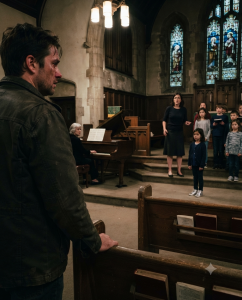
Inside, the old sanctuary smelled like wood polish and rain-soaked coats. Parents clustered in the back pews. Children gathered near the front risers, whispering, giggling, twisting around to wave at whoever had brought them. The pianist arranged sheet music with brisk efficiency. At the front stood Henry Locke, the church’s choir director.
Henry had directed music there for decades. He was one of those men small towns seem to produce naturally: gentle, dependable, familiar enough to be trusted without effort. He had seen people through funerals, weddings, Christmases, memorials, and all the other ceremonies where music does the emotional labor words cannot. His wife, Margaret, had died several years earlier, but he still wore his wedding ring. Claire used to say some people continue loving out loud, and Henry was one of them.
He greeted Willa warmly. “You must be Claire’s girl.”
The words struck Caleb harder than they should have. He had become accustomed to hearing Willa called his daughter, their daughter, sweet Willa. Claire’s girl was different. Truer, maybe.
Willa nodded. “I know all the pancake songs.”
Henry blinked, then smiled with real surprise. “Do you now?”
“She used to sing when she cooked,” Willa explained.
Henry’s expression softened. “Yes. She did.”
Rehearsal began simply. Scales, breathing exercises, posture reminders, half the children forgetting to stand still. Willa took it seriously. She watched Henry’s hands, copied the older kids, and sang with a focus that made Caleb’s throat tighten. Claire had always sung like that — not dramatically, not to impress, but with the full attention of someone who believed music deserved honesty.
Then the pianist set a familiar hymn on the stand.
Caleb recognized it before the first phrase finished.
Claire loved that hymn. She sang it in the kitchen while making pancakes, in the car when rain hit the windshield, under her breath while folding towels. She favored the alto line instead of the melody because, as she once told Caleb, “The harmony says what the tune is too shy to admit.”
He had laughed then and kissed flour off her cheek.
Now, in the sanctuary, the memory nearly knocked the air out of him.
The children reached the end of the hymn. Henry gave a few notes. The pianist flipped pages. The room entered that harmless, transitional pause between one song and the next.
And Willa began to hum.
It was quiet. Absent-minded. The way children continue music after the adults believe it has ended.
Henry turned abruptly.
The pianist froze.
Willa kept humming, unaware that anything had changed.
Caleb felt something in the room shift before he understood why. Then he knew.
The melody was Claire’s unfinished arrangement.
Months before her death, Claire had become consumed by a new piece built around that old hymn. She would sit at the upright piano after dinner, play a phrase, stop, write in the margins of bulletins and grocery lists, then begin again. She called it “the song inside the song.” More than once she told Caleb she wanted to surprise Henry with it once she found the right ending.
“I’ve got the beginning,” she had said one night, tapping her pencil against the keys. “I just don’t have the homecoming yet.”
“Homecoming?”
“The place where the whole thing finally knows where it belongs.”
He had laughed because he had no idea what she meant.
She never found it. Or so he thought.
Now their daughter was humming it in a church full of people.
“Willa,” Henry said, his voice thin.
She looked up. “Yes?”
“Where did you learn that?”
She shrugged with childlike impatience. “Mommy sings the rest right.”
The sanctuary went perfectly still.
Caleb stood. He did not remember deciding to do it. “Willa.”
She turned to him, puzzled by his tone.
Henry came down from the risers one measured step at a time. Without the distance of the platform, he looked older. Frailer. His face had gone bloodless.
“That ending,” he said, “Claire never played for me.”
Caleb swallowed. “I know.”
It was true. Claire had been specific about that. She wanted the arrangement finished before Henry heard it.
Willa frowned as though the adults had made things unnecessarily complicated. “She did in the hallway.”
Caleb felt ice move through his chest.
There was no hallway except the narrow upstairs corridor in their house — family pictures on one wall, laundry basket usually abandoned near the linen closet, one board that creaked if stepped on too hard. Claire used to pass through it at night on her way to Willa’s room.
“Honey,” Caleb said carefully, “when did Mom sing that?”
“When she came to fix my blanket,” Willa replied.
Claire had always fixed the blanket the same way. One corner, then the other. Smooth the edge. Humming under her breath all the while. After she died, Willa fought sleep for months if Caleb tucked her in differently. He assumed it was grief attaching itself to ritual. He never pushed.
Henry removed his glasses. His eyes were wet.
“I wrote the first half with her,” he said quietly. “I’ve never heard anyone sing an ending because one didn’t exist.”
The pianist whispered, “Let her do it again.”
Caleb should have stopped it. He felt that even then. But curiosity, fear, hope, and something more primitive kept him silent.
Willa hummed the melody a second time. Longer. Clearer. It rose and settled with uncanny certainty, each note landing exactly where it should. Caleb knew nothing technical about composition, but he knew resolution when he heard it. The line did not sound invented. It sounded discovered.
Henry made a strangled sound and sat heavily in the front pew, staring at the floor.
“Mr. Locke,” Caleb said, more sharply now, “what aren’t you telling me?”
Henry looked at Willa, then at Caleb, and said the sentence that changed everything.
“Claire came to me the week before she died and asked me to keep a recording hidden until your daughter sang that exact note back to me.”
For a moment Caleb could not process it. He heard each word individually but not together. Claire. Recording. Hidden. Daughter. Exact note.
“What recording?”
Henry’s hands shook. “I promised her.”
“Promised her what?”
But before Henry could answer, Willa tugged on Caleb’s sleeve and said, “Mommy said you’d cry before you played it.”
The pianist covered her mouth. Henry shut his eyes.
No rehearsal continued after that.
Parents quietly collected their children. The sanctuary emptied in low murmurs and uneasy glances. Henry asked the pianist to lock the music cabinet and leave. When the last family was gone, only four people remained: Caleb, Willa, Henry, and the hush of rain against the stained glass.
Henry led them down the side hallway behind the sanctuary to the choir archive room. Caleb had barely noticed the space before. It held decades of church life in stacked boxes — Christmas programs from the nineties, photo albums, old choir robes sealed in plastic, cassette tapes with labels fading into illegibility.
From his pocket, Henry removed a small brass key.
“There’s something else,” he said without turning around. “The night she gave me the tape, Claire told me if Willa ever sang the ending, it would mean she had come back for the part you weren’t supposed to hear until after.”
“After what?” Caleb demanded.
Henry’s shoulders sagged. “She never finished the sentence.”
That did not help.
He opened a metal cabinet in the corner. From a locked box on the second shelf, he withdrew a cassette in a clear case and a folded envelope with Caleb’s name written across the front in Claire’s unmistakable hand.
Caleb forgot how to breathe.
He took the envelope first. His fingers would not cooperate. He opened it carefully and unfolded the page.
Caleb,
If Henry is opening the box, then Willa has carried home the note I could not keep. That means one of two things: either God is stranger than I understood, or truth has its own timing and refuses burial.
Please listen before you decide what to believe about me.
I love you. I need you to remember that first.
By the time he reached the last line, the room had tilted.
“What is this?” he whispered.
Henry had already set up a small cassette player on the table. He slid the tape in with the care of a man handling evidence.
“I only heard the first minute,” Henry said. “She made me stop. She said the rest wasn’t for me unless Willa brought the ending.”
“Why Willa?”
Henry looked sick. “Because Claire believed children hear what adults protect themselves from.”
He pressed play.
Static filled the room first. Then the thump of a piano bench, the tiny room-noise of someone settling in, a breath close to the microphone.
Then Claire.
“Henry, if you’re hearing this with Caleb in the room, then Willa sang it back. I hoped she would never need to. I also knew hope is not always the same as wisdom.”
Caleb grabbed the edge of the table.
Claire continued, voice calm but strained in a way he had never heard when she was hiding nothing.
“I finished the arrangement three nights ago. Not by skill. By interruption. I woke after midnight because I heard someone singing the final line from the hallway. I thought it was Willa, but when I reached her door, she was asleep. The blanket had just been tucked in.”
Caleb’s skin went cold.
“I know how that sounds,” Claire said on the tape. “If grief can arrive before death, maybe haunting can too. But that isn’t why I’m recording this. I’m recording because when I came downstairs, I found the study light on. Caleb, you were asleep. I checked. But someone had been inside the desk where you keep the county files.”
Caleb stared at the speaker.
He had recently begun consulting part-time for the county on land access issues. It was dull work, mostly. Survey maps, permits, title transfers, property disputes. He kept the files at home because no one cared enough to make them secret.
Claire’s voice sharpened.
“I thought I was imagining things until I saw what had been moved. The Mercer farm boundary survey. The old cemetery tract. The church expansion deeds. All of it separated from the rest.”
Henry inhaled slowly through his nose.
Then Claire said the words that made him understand Henry’s guilt.
“Henry, you told me six months ago there had been a mistake in the church records from decades back. You said some land was transferred quietly to protect a family from scandal. You asked whether Caleb had ever seen the original survey because you were afraid of what would happen if the county corrected it. I need you to hear this: someone else knows.”
Caleb looked at Henry as if seeing him for the first time.
Henry’s face folded inward. “I never thought—”
“Don’t,” Caleb snapped.
The tape rolled on.
“I didn’t tell Caleb because I didn’t know enough yet, and because you begged me to wait until after Easter while you looked for the papers. I should have told him anyway.”
Caleb felt physically ill.
Claire had been keeping something from him. Henry had too. And whatever it was had tangled the church, the county, and land near the old cemetery.
On the recording, Claire played several measures of the unfinished arrangement. Then she stopped.
“If anything happens to me before I tell him myself, Caleb needs to know this: the corrected boundary gives part of the church lot back to the Mercer family. Not as a gift. As restitution. It was taken under another name after the fire in 1964, and the records were buried to protect a donation that built the education wing.”
Caleb’s hand slipped from the table.
This was impossible.
And yet the date.
The study files.
The subtle tension with which the county clerk had recently told him to “leave the old maps old.”
Claire’s voice trembled for the first time.
“I don’t know whether what happened tonight was a warning, a mercy, or my own exhausted mind. But I know this: if Willa ever brings the ending to Henry, it means the truth didn’t stay with me.”
There was a pause on the tape, then a softer sound, as if Claire had turned toward the microphone more intimately.
“Caleb, I am sorry I didn’t tell you sooner. I wanted proof before I brought trouble into our house. Maybe that was pride. Maybe fear. If I’m gone when you hear this, do not let shame or loyalty keep anyone quiet. Not Henry. Not the church board. Not yourself.”
Another pause.
Then, almost gently: “And for the record, the ending belongs after the suspended fourth measure. I was overthinking it.”
Henry made a broken laugh that dissolved into tears.
The piano returned. Claire played the full arrangement, and for the first time the melody completed itself. It was exactly what Willa had hummed in the sanctuary.
When the song ended, the tape clicked softly but did not stop.
Claire spoke one final time.
“If our daughter knows the note, then she heard me somehow. I don’t need anyone to explain that. I only need Caleb to trust what comes next.”
The tape ended.
No one moved.
Willa leaned against Caleb’s side and asked, in the smallest voice yet, “Was that Mommy?”
He dropped to his knees and gathered her so tightly she squeaked. “Yes,” he whispered. “Yes, baby. That was Mommy.”
Henry sat down on a storage box and cried without restraint.
The weeks that followed burned through the town like a fuse.
Caleb took Claire’s letter and the tape to a lawyer before he took them to the church board. The old surveys were recovered from county archives and matched against a set of documents Henry finally surrendered from a locked file in his house. The truth came out in layers: decades earlier, after a fire damaged part of the church property, a quiet boundary revision had folded a slice of Mercer family land into the church lot under a different parcel name to secure a donor-funded expansion. The men involved had told themselves it was temporary, then necessary, then too embarrassing to correct.
Henry had discovered the discrepancy years later while cataloging music archives stored with old administrative records. He admitted he had delayed exposing it, first out of loyalty to dead men, then out of fear that the church would fracture under scandal. When Claire noticed inconsistencies in the documents Caleb brought home, Henry confided in her, hoping for help and secrecy at the same time. He got neither. Claire had intended to tell Caleb everything once she confirmed the evidence.
The aneurysm took her before she could.
Or almost before she could.
In the end, the church publicly acknowledged the concealed transfer, the county restored the parcel, and the board issued an apology that sounded far too small for the years involved. People chose sides. Some said Henry had preserved the church as long as he could. Others said he had protected theft because it wore a polite face. Caleb listened to all of it with the numb focus of a man who had already survived the worst room in the world and no longer cared for performance.
He never stopped replaying the tape.
Not for the land.
Not even for the truth.
For Claire.
For the sound of her breathing between sentences.
For the dry humor in the line about overthinking the fourth measure.
For the unbearable tenderness of hearing her speak directly into a future she knew she might not reach.
And for the mystery he could neither prove nor dismiss: that Willa had somehow learned the final phrase from the woman who died before recording it publicly and before sharing it with anyone else.
Months later, on the night of the rescheduled spring program, Caleb returned to the sanctuary again.
This time the acoustics were no kinder.
But they were different.
The church was full. Some came for worship. Some for spectacle. Some because scandal draws attendance better than flyers ever do. Willa wore a cream dress and the same silver-star sneakers. Henry, after offering his resignation to the board and agreeing to remain only through the concert, stood at the front with red-rimmed eyes and a humility Caleb had never seen in him before.
Near the end of the program, Henry stepped aside and invited Willa to sing the special arrangement “completed by Claire Mercer.”
The sanctuary held its breath.
Willa looked out once, found Caleb, and smiled.
Then she sang.
Not like a ghost.
Not like a sign.
Like a child carrying a song she had been trusted with.
When she reached the ending, the same ending that had cracked open the room on rehearsal night, Caleb did not feel fear. He felt Claire’s absence and her presence at once — the cruel, impossible mathematics of love after death.
People cried. Henry cried hardest. Caleb did too, though more quietly.
Afterward, standing in the aisle while families gathered coats and folded programs, Willa slipped her hand into his and asked, “Do you think Mommy knows I remembered it right?”
Caleb looked toward the dim stained glass, the worn pews, the front steps where grief had once become unbearable.
“Yes,” he said. “I think she knew before we did.”
That should have been the end of it. In practical ways, it was. The land returned. The church changed. Henry left the choir the following summer. Life resumed its ordinary cruelties and small mercies.
But Caleb still thought about Claire’s words.
Not bad. Just late.
He had learned that truth does not always arrive when it is deserved. Sometimes it arrives when a child hums in the wrong room at exactly the right moment. Sometimes the people who love us fail us by waiting too long. Sometimes they still love us while they fail.
And sometimes the biggest red flag is not malice, but the quiet confidence of people who believe they can postpone honesty until it becomes convenient.
Caleb never found a clean answer to what happened in the hallway outside Willa’s room. He stopped trying to force one. Some things fit better in music than in argument.
What he did know was this: Claire had spent her last days trying to protect her family from a truth she feared would outlive her, and in the end, it was their daughter — sleepy, certain, and still young enough to trust a nighttime melody — who brought that truth home.
Whether that was grace, memory, or something stranger, he could not say.
He only knew that the song found its ending.
And so, finally, did the lie.