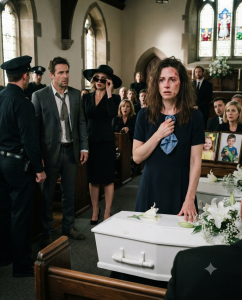
Daniel laughed at the funeral of his own children while their two tiny white caskets stood in front of the altar.
For a moment, nobody in the chapel seemed to understand what they had heard. The priest went silent in the middle of a sentence. A woman near the front dropped her rosary. Someone in the back inhaled sharply, as if the room itself had suddenly turned too cold to breathe in.
The caskets were white, painfully white, too small for what they represented. Lilies were arranged around them in neat sprays that smelled sweet enough to make Claire feel sick. Beside each casket sat a framed photograph. In one, Lily smiled with a yellow bow pinned into her hair. In the other, Noah grinned while hugging a green plastic dinosaur so tightly it looked like he’d refused to put it down even for the picture.
They were both five years old.
Three weeks earlier, both had died in what police initially called a tragic weather-related crash on a wet road outside the city.
Claire stood between the caskets like someone carved from stone. Her left hand rested on Lily’s coffin. In her right hand, she clutched a faded blue handkerchief Noah used every night to sleep. People around her had been whispering for days that she didn’t cry normally, that maybe the grief was too deep, maybe she was numb, maybe she was breaking in some invisible way.
She was breaking.
Just not in front of them.
Because grief had not softened her. It had done something stranger and far more dangerous. It had stripped everything unnecessary away.
At the back of the chapel, Daniel Mercer stood with Vanessa Cole at his side.
Vanessa wore dark sunglasses despite being indoors. Her black dress was expensive and tailored, the sort of thing a woman wore when she wanted to look immaculate in every photograph. She didn’t pretend to cry. She didn’t even lower her head. She stood there with a composed expression that Claire had come to understand all too well over the past week—an expression that said she believed she had survived the worst and was already stepping into the life she wanted.
Then Daniel laughed again.
Low. Brief. Ugly.
Claire slowly turned her head.
He adjusted his tie and walked down the aisle between the pews, past relatives, past neighbors, past coworkers who had shown up expecting a broken father and instead saw a drunk man smiling during the burial service of his own children. The smell hit before he reached her—whiskey covered badly by expensive cologne.
“Enough, Daniel,” Claire said quietly. “Not today.”
He leaned close enough for only her to hear.
“God took them,” he whispered, “because He knew what kind of mother you were.”
The words hit her harder than the slap that came a second later.
That slap cracked through the chapel like split wood. Claire’s head snapped sideways. Her temple struck the polished edge of Lily’s casket. Gasps exploded around the room.
Before anyone could pull him away, Daniel grabbed a fistful of Claire’s hair and yanked her face toward him.
“Challenge me again,” he muttered, his voice thick with contempt, “and you’ll end up with them.”
Near the front, attorney Evelyn Shaw stood so abruptly her chair scraped backward. A few mourners shouted. But the moment fractured even further when the chapel doors opened and several figures entered at once.
Two detectives.
Three uniformed officers.
And Evelyn again—only now she was returning from outside carrying a sealed evidence box against her chest.
Daniel released Claire so quickly she nearly fell to her knees.
Detective Mateo Ruiz walked straight down the aisle. His face showed no drama, no anger, only the measured control of a man who knew exactly how much the next sentence would detonate.
“Daniel Mercer. Vanessa Cole,” he said clearly, “you are under arrest for conspiracy, insurance fraud, and two counts of aggravated homicide.”
The chapel erupted.
People stood. Someone began to sob. A cousin pulled out a phone with shaking fingers. Vanessa tore off her sunglasses. Daniel’s expression drained of color as though his body had finally realized what his mind still refused to accept.
He stared at Claire.
“What did you do?”
A thin line of blood traced down from Claire’s temple. She touched it, looked at the red on her fingertips, then raised her eyes to him.
“What you never thought I would,” she said. “I listened.”
The story of what happened in that chapel did not begin there.
It began the day the cameras came.
Two days after the crash, Daniel stood on the front steps of their home and gave interviews. He wrapped one arm around Claire and pressed a handkerchief to his face with the other. He told reporters their nanny, Marisol, had been driving too fast in dangerous rain. He said no one could have predicted the road conditions. He said the family was shattered and begged for privacy.
He looked convincing.
He even cried on cue.
But Claire, standing under his arm like a prop, noticed details nobody else did. Daniel’s tears came only when cameras were close. He squeezed her shoulder a little too tightly whenever she seemed likely to speak. And when the interview ended, his grief vanished so quickly it made her skin go cold.
At first she told herself she was being cruel. Suspicion can grow in the soil of grief. She knew that. Trauma distorts memory. Despair looks for targets.
Then she saw the insurance packet on his desk.
It was only a glimpse. A logo on the corner, legal language, two policy numbers she recognized immediately because she handled nearly every major family document in the house. Daniel noticed her eyes move toward it and closed the folder too fast.
That night, while he slept, Claire checked the online records.
Her pulse began pounding before she finished the first page.
The life insurance policies for Lily and Noah had each been increased from fifty thousand dollars to two million dollars exactly twelve days before the crash.
The beneficiary had also been changed.
Claire Mercer’s digital signature appeared on the authorization.
She had never signed anything.
She didn’t confront him.
Instead, she felt something old wake up inside her.
Before she left her career to stay home with the children, Claire had spent twelve years as a forensic accountant for the state prosecutor’s office. She understood fraud at the microscopic level. She knew how people disguised theft with timing, layered transactions, duplicate authorizations, and small enough lies that no one bothered to look closer. She knew honest paperwork had a rhythm. Corrupt paperwork had desperation.
Daniel’s paperwork was desperate.
Over the next several days, Claire built her case in silence.
On day five, Vanessa moved into the guest house under the excuse that she was “helping with arrangements.” Claire said nothing.
On day eight, Claire discovered the joint account had been quietly emptied into a corporate shell she’d never heard of. Claire said nothing.
On day ten, Daniel filed a petition requesting temporary control over Claire’s family inheritance, claiming she was mentally incapacitated by grief and unable to manage her financial affairs. That filing told Claire everything she needed to know about what he thought of her.
A grieving mother.
A broken woman.
A convenient obstacle.
He forgot she had once made a career out of proving men like him were not nearly as clever as they believed.
Claire copied policy changes, bank transfers, filing timestamps, and metadata from altered PDFs. She forwarded everything to Evelyn Shaw, an old college friend who now specialized in financial crimes. Evelyn reviewed the documents and called Claire immediately.
“This is bad,” Evelyn said.
“I know.”
“No,” Evelyn replied, her voice tight. “I mean criminally bad. Sloppy. Greedy. He escalated too fast after the children died. Men who think they’ve won always get careless.”
That same night, on Evelyn’s advice, Claire contacted Detective Mateo Ruiz.
Ruiz didn’t promise miracles. He didn’t tell her he could arrest anyone immediately. He told her to preserve every document, avoid confrontation, and call him if Daniel made any sudden moves. He also asked one question before ending the call.
“Do you think this started with fraud,” he asked, “or do you think the fraud came after something worse?”
Claire answered without hesitation.
“Something worse.”
She still didn’t know how much worse until three nights later.
It was just after midnight when she walked past Daniel’s study. The door was nearly shut. Light leaked into the dark hallway in a thin golden line. She would have kept walking if she hadn’t heard Vanessa’s voice from inside.
“You said the nanny would take the blame.”
Claire stopped so abruptly the floorboard beneath her creaked. Inside, the room went quiet. She pressed herself against the wall and barely breathed.
Then Daniel answered.
“She already did.”
Vanessa sounded less triumphant than Claire would have expected. More frightened.
“And if they pull vehicle data?”
“They won’t.”
“And if they do?”
“It’s handled.”
Claire felt her heart slam against her ribs.
Vanessa lowered her voice. “You told me the children were asleep.”
“They never knew what was happening,” Daniel snapped.
There are moments when a human being crosses a line internally, a moment so clean and final they can feel their old self ending. Claire stood in that hallway and understood, with terrifying certainty, that her children had not died in a random accident. They had been part of a plan. A plan tied to money. A plan discussed like logistics. A plan in which Marisol, their nanny, had been chosen to absorb blame because she was dead too and therefore unable to defend herself.
Claire slipped away before they opened the door.
For the rest of the night, she sat on the bathroom floor shaking so violently she had to hold a towel between her teeth to stop herself from making noise.
By morning, the grief was still there, but something colder had settled over it.
Purpose.
Ruiz moved faster after that call. Search warrants were requested. Digital subpoenas went out. Evelyn coordinated document chains. Quietly, carefully, a timeline emerged.
The insurance increases had been authorized from an IP address routed through Daniel’s office.
Vanessa had researched child fatality insurance claims weeks earlier.
A second phone registered to a shell account had exchanged encrypted messages with Daniel during the hours leading up to the crash.
Most devastating of all, recovered maintenance records suggested the SUV had been serviced two days earlier—by a mechanic later identified as working for one of Daniel’s private holdings. Brake response inconsistencies had been logged and then erased from the customer file.
Ruiz still needed enough evidence to hold up publicly and withstand Daniel’s attorneys. So they waited.
Claire agreed to wait until the funeral.
Partly because there was no cleaner way to guarantee Daniel and Vanessa would both be present.
Partly because Claire wanted him arrested in front of witnesses.
And partly because she wanted to watch his face when he realized the woman he had humiliated for years had been the one quietly dismantling him.
The funeral gave him one last chance to pretend.
Instead, he laughed.
By the time officers led Daniel and Vanessa out of the chapel in handcuffs, the story had already escaped the room. By evening it was all over local media. The grieving father narrative collapsed. Old photographs of Vanessa surfaced. Financial records were rumored. Former employees began contacting investigators with stories of threats, coercion, and cash movements that had never felt right.
But the most important evidence had not yet fully surfaced.
That evening, Detective Ruiz met Claire and Evelyn in a private evidence review room. On the metal table sat the sealed box Evelyn had carried into the chapel.
Ruiz opened it carefully.
Inside were printed records, a secondary phone taken from Vanessa’s apartment, fragments of vehicle telemetry recovered from a manufacturer server, and a damaged audio file extracted from the SUV’s onboard system. The file had been partially corrupted, but the forensic unit had managed to salvage enough to identify voices and time markers.
Ruiz hesitated before pressing play.
Static crackled.
Then came Noah’s crying.
Claire’s entire body went rigid.
Next came Lily’s voice, small and uncertain.
“Why is Daddy angry?”
Claire shut her eyes.
Then another voice entered the recording—a woman’s voice, tense, unfamiliar.
“This wasn’t the plan.”
Ruiz stopped the playback.
Claire looked up slowly. “That’s not Marisol.”
“No,” Ruiz said. “We don’t believe it is.”
Which meant Daniel had lied not only about the cause of the crash, but about who had been in the vehicle before impact. Marisol, according to the official narrative, was driving alone with the children. But the recording suggested someone else had been there in the final minutes. Someone whose identity Daniel had concealed because her presence would destroy his account completely.
The next break came from somewhere no one expected.
Late that night, unable to sleep, Claire wandered into the nursery. The room still held the shape of her children’s lives. Books stacked crookedly. Tiny socks in a laundry basket. A nightlight shaped like a moon. She stood there holding Noah’s dinosaur and finally allowed herself to cry the way everyone had expected her to weeks earlier—silently, violently, with her shoulders folding inward as though she were being crushed from the inside.
When she bent to set the toy down, something slid from beneath the crib and tapped the floor.
A memory card.
Claire stared at it for a long second before picking it up.
Then she remembered.
A few weeks before the crash, Lily had proudly shown Claire a “tiny treasure” she’d pulled from Daniel’s dashboard camera because she thought it looked like robot food. Claire had laughed, taken it away, and, in the chaos of family life, forgotten all about it.
She drove it straight to Ruiz.
The contents changed everything.
The memory card held archived dashboard footage Daniel believed had been deleted. The file from the day of the crash began ordinarily—rain on the windshield, wipers squeaking, muffled voices. Then the camera angle shifted as the vehicle started moving. Marisol was in the front passenger seat, not the driver’s seat. She looked panicked.
Vanessa was behind the wheel.
In the back seat, Lily and Noah were buckled in.
Daniel appeared outside the vehicle for several seconds before departure, leaning in through the driver’s side window. The audio was imperfect, but the enhancement team later isolated enough.
“You know what to do,” Daniel said.
Marisol answered, “This is insane. The kids are here.”
Vanessa snapped, “It’s too late.”
Then the doors shut. The SUV pulled away.
Seven minutes later, according to vehicle logs and roadway reconstruction, the brakes failed during a curve slick with rain. But that was only part of it. The footage showed Vanessa arguing with Marisol before the system cut out. Marisol reached for the wheel. Vanessa screamed. One of the children started crying.
It was not an unavoidable accident.
It was a staged collision that spiraled out of control.
Vanessa had agreed to help Daniel create a crash dramatic enough to kill Marisol and support an insurance narrative. According to prosecutors, they likely believed the children would not be in the vehicle when the final act occurred. But texts recovered from the second phone suggested a timing change. Daniel, impatient and certain he could still make the story work, had ordered Vanessa to proceed.
That decision killed all three.
When confronted with the footage, Vanessa broke first.
Within forty-eight hours, she accepted a preliminary cooperation deal and gave a statement. She admitted the affair had been going on for almost two years. Daniel had mounting business losses hidden behind aggressive borrowing. He discovered that Claire’s family inheritance was locked behind restrictive trust structures he could not access directly while she remained mentally competent and the children were alive as equal future beneficiaries. The insurance policies, the inheritance petition, the financial restructuring—everything was part of a broader plan to remove obstacles and seize control.
Vanessa claimed she never meant for Lily and Noah to die.
Claire almost laughed when Ruiz repeated that line to her.
People involved in evil often think intention is a form of innocence. As though helping build the fire excuses them because they didn’t personally choose every victim.
Daniel did not cooperate.
He denied everything, then blamed Vanessa, then blamed Marisol, then claimed the audio and dashboard footage were manipulated. But prosecutors had too much. The metadata on the files matched manufacturer archives. Financial records showed motive. Policy changes showed planning. The inheritance filing showed urgency. The recorded threats at the funeral, captured by multiple phones, destroyed any remaining image of him as a grieving husband.
The trial lasted nine days.
Claire attended every one.
She sat upright while defense attorneys tried to imply grief had distorted her judgment. She watched them soften Daniel’s cruelty into “marital stress.” She listened as they described Vanessa as emotionally manipulated, as though ambition and fear erased moral choice.
But facts are stubborn things.
The jury returned guilty verdicts on all major counts against Daniel: two counts of aggravated homicide, conspiracy to commit murder, insurance fraud, coercive control, witness tampering, and multiple financial crimes. Vanessa was convicted on reduced homicide charges and conspiracy after her testimony, though her cooperation spared her the sentence Daniel received.
When the judge spoke Daniel’s sentence aloud, the courtroom stayed silent.
Daniel turned once, as if searching for someone to save him.
No one did.
Afterward, outside the courthouse, reporters shouted Claire’s name. Cameras flashed. Microphones pushed toward her. She stopped only once, not because she owed the public a speech, but because she wanted one sentence on record.
“My children were not a tragedy,” she said. “They were loved. What happened to them was greed.”
Then she walked away.
Months later, when the house was finally sold and the legal process was over, Claire visited Lily and Noah’s graves alone. She brought yellow flowers for Lily and left Noah’s green dinosaur at the base of his stone. The wind moved softly through the cemetery. For the first time since the funeral, the silence around her felt different. Not empty. Not healed. But honest.
She knelt there longer than she planned to.
Long enough to understand that justice is not the same as peace.
Justice punishes.
Peace is harder. Peace asks what to do with the years still left after the truth arrives too late.
Claire did not have that answer yet.
What she did have was this: Daniel had laughed in a chapel because he thought grief had made her powerless. He thought pain had blinded her. He thought two white caskets meant the story was over and the witnesses who mattered were gone.
He was wrong.
Pain had taught her where to look.
And in the end, that was the detail that destroyed him.
Not the affair.
Not the money.
Not even the lies.
It was the simple fact that he mistook a silent woman for a helpless one.
Anyone hearing the story later had the same uneasy reaction. Yes, Daniel had planned. Yes, Vanessa had helped. Yes, greed had driven the whole thing forward with astonishing cruelty. But one question lingered after all the evidence was laid out, after the sentencing, after the cameras went home.
At what point does a red flag become a warning so large that ignoring it becomes its own kind of danger?
For Claire, that question would never fully disappear.
Neither would the memory of the funeral—the lilies, the tiny caskets, the sound of Daniel laughing before the handcuffs snapped shut.
Some people said she was strong.
Some said she was patient.
Some said they could never have stayed calm long enough to uncover the truth.
Claire never argued with any of them.
Because the truth was much simpler.
She had not stayed calm because she was fearless.
She had stayed calm because two children deserved to have the right monster buried.