The day Rodrigo Altamirano was released from prison, he expected silence, awkwardness, maybe even pity. He expected the long drive back to the estate to feel unreal. He expected the gate to groan the way it always had, the courtyard to smell faintly of dust and coffee, and the house to stand exactly as he’d held it in memory during the worst nights of his sentence.
He did not expect to find his wife living among chickens.
He stepped off the bus with a canvas bag over one shoulder and the stale taste of prison still clinging to him. Puente Grande had taken three years from his life for a fraud he had never committed, and by the time the final paperwork cleared, the people who had promised to fight for him had gone quiet one by one. No one waited at the roadside when he was released. No familiar truck. No son. No wife. No lawyer racing in with apologies.
Just a hot road, a weak sun, and the cruel knowledge that the world had kept moving while he had been locked inside it.
By the time he reached the family estate, evening light had turned the fields gold. For one brief moment, standing outside the old iron gate, Rodrigo let himself believe he had survived the worst of it. The house still stood. The jacaranda tree still leaned over the wall. The stone pillars still flanked the drive.
Then he saw the paper nailed to the front door.
EVICTION NOTICE.
The words blurred for a second. He thought he had read them wrong. This house was his father’s legacy. The place where Rodrigo had been born, where he had married Elena, where their son Ignacio had taken his first steps across cracked terracotta tile.
He moved closer, pulse pounding, and then heard the chickens.
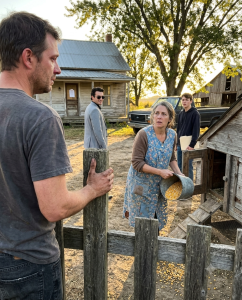
The sound came from behind the barn, sharper than he remembered, restless and crowded. He followed it around the side of the house, and that was where he saw Elena.
She stood beside a sagging coop with an old bucket in one hand, scattering feed onto the ground. Her blue apron was faded almost white at the edges. Her hair, once dark and thick, was threaded heavily with gray. Her hands looked swollen and cracked. Behind her, the door of the tool shed stood open. Inside, Rodrigo saw a cot, a lantern, two folded blankets, and a plastic basin.
For a moment he truly thought his body might fail him.
“Elena,” he said.
She froze as though someone had called her back from the dead.
The corn slipped through her fingers.
When she turned, her face did not shatter the way he feared it would. She just stared at him with exhausted stillness, and somehow that hurt worse. Tears would have been easier. Anger would have been easier. But what he saw in her expression was a woman who had suffered so long that shock no longer had any strength left.
“You came back thinner,” she said.
Rodrigo tried to smile and could not. “What happened here?”
Elena looked down at her hands. “The same thing that happened to you. They just did it in daylight.”
He took a step toward her, then another. He wanted to hold her. Instead, he stopped when he realized she had flinched—not from him exactly, but from the memory of being touched only when someone wanted something from her.
That was when the black pickup rolled into the drive.
Elena grabbed his arm. “Don’t let them see you yet.”
“This is my property.”
“Not according to the papers.”
Rodrigo followed her gaze and saw Victoriano Ríos climb out of the truck.
His half-brother had always worn charm like polished shoes. Their father used to say Victoriano could smile with his mouth while stealing with his hands. Rodrigo had laughed at that line when he was younger. He did not laugh now.
Victoriano wore a pale suit and sunglasses despite the dimming light. Beside him stepped Ignacio.
Rodrigo stopped breathing.
His son was taller now, no trace left of the skinny teenager Rodrigo had hugged the night before his arrest. The boy’s face had sharpened into a young man’s. But what struck Rodrigo most was not the height or the broadening shoulders. It was the caution in him. Ignacio moved like someone who had learned every room could turn dangerous without warning.
Victoriano leaned close, talking in his ear as they crossed the yard.
“He told Ignacio you were guilty,” Elena whispered. “He said you ruined us. Said he stepped in to save the estate.”
“Did our son believe him?”
Elena’s silence was answer enough.
Rodrigo stared at Ignacio and felt prison hit him for the first time as a true loss. A stolen house was one thing. A forged signature was another. But somebody had taken his son year by year and filled the empty space with poison.
Victoriano stopped near the front steps and pointed toward the coop. Ignacio glanced over with visible discomfort. Elena instinctively moved behind the ash tree, and the sight of her hiding on her own land filled Rodrigo with a cold fury he had never known.
“Why stay?” he asked.
Elena lifted her chin. The old steel was still there beneath the fatigue.
“Because the only thing that can clear your name is buried under that coop.”
She led him inside the enclosure, knelt, and pulled up a loose board. From a hidden hollow she drew out a metal box wrapped in plastic. Rodrigo opened it with shaking hands.
Inside were the original deeds, a notarized copy of his father’s will, signed tax receipts, an account ledger, and a USB drive.
“Your father didn’t leave the estate to Victoriano,” Elena said. “He left it to both of us. Victoriano forged the transfer after you went to prison.”
Rodrigo’s vision narrowed on the signature. He knew his father’s hand as well as his own. The document was real. It had been hidden for years beneath a chicken coop while lawyers, banks, and county officials processed the forged version that had stripped his family of everything.
“Who knows?” Rodrigo asked.
“Don Aurelio. And Camila Sotelo.”
Camila had run the estate books for nearly a decade. If anyone could prove financial manipulation, it was her.
“Where is she?”
Elena pointed toward the main house.
At that moment Ignacio emerged carrying a folder. Victoriano snatched it from him and slapped him across the face. The crack echoed through the yard.
Rodrigo lurched forward on instinct.
“Not yet,” Elena hissed, clutching his sleeve.
Then Ignacio looked up and saw him.
The world seemed to go still.
Father and son stared at one another across the yard. Rodrigo saw disbelief tear through the story Ignacio had been told. He saw hope flare and fear crush it back down. The boy looked as if he wanted to run forward and backward at the same time.
Victoriano turned, followed Ignacio’s stare, and smiled.
“Well,” he called. “The convict came back.”
Rodrigo stepped into the open.
This time he did not hide.
“Elena,” Victoriano said lazily, “I thought I told you not to bring strays onto the property.”
“This is his property,” she shot back.
Victoriano laughed. “That’s a touching fantasy.”
He reached into his jacket. Rodrigo tensed, but Victoriano only pulled out a folded legal notice and waved it toward Ignacio.
“Tell him what happens at noon tomorrow.”
Ignacio’s face drained. Rodrigo crossed half the yard before Elena caught up to him.
“What is he talking about?”
Victoriano answered for his son. “Possession transfer. Final stage. Everything cleared. You lost.”
Elena spoke under her breath. “He moved the debts into my name.”
Rodrigo whipped toward her. “What?”
“They forged my signature on loans, taxes, feed contracts, repairs. Camila found discrepancies. By then no one would listen.”
Victoriano smiled wider. “Poor Elena. Such terrible bookkeeping.”
Before Rodrigo could answer, the front door opened.
Camila Sotelo stepped out first, clutching a thick file to her chest. Even from a distance Rodrigo saw bruising beneath her makeup. Behind her came Don Aurelio Fuentes, the estate’s former foreman, older and stooped but still carrying himself with the authority of a man who had seen too much and remembered every detail.
Victoriano’s smile flickered.
“Camila,” Rodrigo called. “Did you keep records?”
Camila’s eyes darted to Victoriano, then to Ignacio, then finally to Rodrigo. “I copied everything before they seized the office.”
“Everything?” Victoriano asked, voice suddenly sharper.
Camila swallowed. “Everything you changed.”
Silence swallowed the yard.
Don Aurelio took one step forward. “Your father knew what Victoriano was. That’s why he split the estate. He wanted witnesses on every paper.”
Victoriano scoffed. “The old man barely knew his own name at the end.”
“That’s a lie,” Don Aurelio said.
Ignacio stared from face to face, the foundations of his world visibly cracking.
Rodrigo held up the original will. “You forged the transfer.”
Victoriano’s expression hardened. “And who’s going to prove that? A convict? A woman living in a shed? A drunken old foreman? A bookkeeper no one can find on payroll anymore?”
Camila slowly raised the folder in her hands. “I can.”
Victoriano lunged toward her.
Ignacio moved first.
He stepped between them with a force that surprised everyone, even himself. Victoriano stopped short, eyes blazing.
“Move,” he snapped.
Ignacio didn’t.
“You told me he abandoned us,” Ignacio said, voice shaking. “You told me my father signed everything away.”
Victoriano lowered his voice. “I saved this family.”
“No,” Elena said. “You isolated us. You starved us. You made me sleep beside feed sacks while you sold pieces of this land behind our backs.”
Rodrigo looked at Camila. “What’s on the drive?”
She drew a breath. “Copies of bank transfers. Shell companies. Payment records tied to the fraud case that sent you to prison.”
Rodrigo felt the ground tilt beneath him. “You’re saying he set me up.”
“I’m saying the money trail leads back to companies connected to him.”
Victoriano laughed, but there was panic in it now. “This is pathetic.”
“Then why are you afraid?” Don Aurelio asked.
For the first time, Victoriano dropped the polished act.
His face tightened into something bitter and old. “Because all of you worshipped Rodrigo,” he said. “That’s why. Father gave him the land, the respect, the wife, the son, the life. I was always supposed to stand to the side and clap while he inherited everything.”
“You inherited your own choices,” Rodrigo said.
Victoriano’s gaze snapped to him. “And you inherited a name you didn’t deserve.”
Ignacio looked physically ill. “You lied to me.”
Victoriano softened his voice instantly and reached for him. “I raised you when he wasn’t here.”
“You poisoned him,” Elena said.
Victoriano’s mask broke completely. “I made him strong.”
“No,” Rodrigo said. “You made him lonely.”
Something in Ignacio’s face changed then. The anger that had protected him for three years gave way to grief. He stepped back from his uncle and looked at Rodrigo, really looked at him.
“Did you do it?” he asked.
It was the question Rodrigo had imagined hearing from strangers, reporters, judges. Never from his son.
“No,” Rodrigo said. “I did not.”
Ignacio’s eyes filled, but he fought the tears. “Why didn’t you come back for us?”
Rodrigo nearly laughed at the cruelty of it. “I never stopped trying.”
Camila opened the folder and pulled out copies of visitation requests, returned letters, blocked transfer forms, and notices Rodrigo had never received. All intercepted. All redirected through accounts and offices Victoriano controlled after taking over the estate’s legal matters.
Elena covered her mouth.
“He kept your letters,” Ignacio whispered.
Rodrigo could only nod.
The next hour blurred into police calls, frantic denials, and the arrival of two municipal officers who were at first openly skeptical of a recently released inmate accusing a well-dressed businessman of fraud. Then Camila handed them the ledger. Then the original will. Then the USB drive. Then Don Aurelio testified about witnessing Rodrigo’s father sign the documents. Then Ignacio, pale and shaking, admitted he had seen Victoriano burn boxes of records months earlier behind the machinery shed.
That was enough to stop the eviction on the spot.
It was not enough to arrest Victoriano immediately, but it shattered his confidence. He tried to leave. The officers stopped him. He demanded lawyers. Camila provided transaction copies. Rodrigo provided dates from the original business accounts. Don Aurelio named two laborers who had seen Victoriano meet with the same outside contractors tied to the company on the truck.
The turning point came from Ignacio.
“I know where he hid the rest,” he said.
Victoriano spun toward him. “Be careful.”
Ignacio flinched, then straightened. “No. You be careful now.”
He led the officers to the old chapel behind the house, where the ground near the rear wall had been recently disturbed. Buried in sealed containers were more files, hard drives, and payment slips linking Victoriano’s companies to the fraudulent transactions that had sent Rodrigo to prison.
By dawn, Victoriano was in custody.
The legal battle that followed was long, ugly, and public. Rodrigo’s conviction was formally reviewed when the financial trail proved manipulated evidence and falsified records. Camila testified. Don Aurelio testified. Elena produced the original documents she had hidden under the coop. Ignacio testified too, voice unsteady but clear, and with every word he seemed to pull himself out of the cage his uncle had built around him.
Months later, Rodrigo’s record was cleared.
The estate was returned.
The debts in Elena’s name were voided as fraudulent.
Victoriano was charged with forgery, fraud, coercion, and evidence tampering, among other counts that kept unfolding the deeper investigators dug. In the end, what destroyed him was not one grand mistake, but years of smaller cruelties he believed no one would ever connect.
The house itself took time to heal.
So did the people inside it.
Elena moved out of the shed only after the locks were changed and the last court order was signed. The first night back in her own bedroom, she stood in the doorway for a long time as if asking the walls whether they still knew her. Rodrigo did not rush her. He had learned that love could survive many things, but it could not be forced to return to its old shape overnight.
Ignacio struggled most openly. He kept apologizing to Rodrigo for believing the lies, for the coldness in his letters that Rodrigo had never received, for all the moments he had looked at Elena and seen only weakness when she had really been the one holding the truth together with bleeding hands.
Rodrigo forgave him before Ignacio finished the first apology.
“There are things adults should have protected you from,” he said. “That failure isn’t yours.”
Still, forgiveness did not erase the lost years. Sometimes father and son would sit on the porch in silence, not speaking, each aware of the empty space between sixteen and nineteen, of birthdays and arguments and ordinary mornings that had been stolen. But slowly, silence became easier. Then came conversation. Then one morning Rodrigo found Ignacio repairing a section of fence without being asked, and Elena watching from the kitchen window with tears she did not bother hiding.
Camila stayed on long enough to help untangle the estate books. Don Aurelio, stubborn as ever, returned to supervising the fields despite everyone telling him to rest. The chicken coop remained where it was, though Rodrigo offered to tear it down.
Elena refused.
“Leave it,” she said.
He looked at her in surprise.
“That place kept the truth alive,” she said. “I won’t forget that.”
So they repaired it instead.
Not because any of them wanted to remember the humiliation of those years, but because memory mattered. Because there had to be some witness left standing to what had nearly been taken. Sometimes suffering leaves scars that beg to be hidden. Sometimes it leaves markers that must remain in plain sight.
On the first morning the family drank coffee together again in the old stone kitchen, sunlight came through the window exactly the way Rodrigo remembered. Elena stood at the stove, stronger now, though the gray in her hair remained. Ignacio leaned against the counter half-awake, pretending not to smile. Rodrigo looked at both of them and felt gratitude so sharp it almost resembled pain.
He had come home expecting ruins.
Instead, he found something harder and more honest.
Not the old life restored untouched, but a family that had been broken, lied to, humiliated, and almost erased—and had still chosen to stand together when the truth finally came into the light.
Even later, when the story spread and neighbors argued over who had really been blind, who should have spoken sooner, and whether blood should ever have been trusted over evidence, one fact remained impossible to ignore.
The strongest person on that estate had not been the man who survived prison.
It had been the woman who endured everything outside it, hid the proof under a chicken coop, and waited long enough for the right person to come home and open the box.
And maybe that was the part that stayed with them most.
Not just that Victoriano had done what he did.
But that for three years, the people he hurt most had been forced to decide whether love was still worth protecting when every official paper, every closed door, and every whispered lie insisted they had already lost.