Her husband accepted her as part of a transaction, warned her not to shame him, and expected obedience to be enough.
What he did not expect was that the woman everyone dismissed would be the first person to see the trap closing around them.
And what he could never have imagined was that the truth waiting inside the fire had been tied to her life long before he ever signed his name beside hers.
In the interior of imperial Brazil, the Alvorada estate was dying slowly and without dignity.
From a distance, the place still carried traces of old importance. The main house sat high enough to command the fields, its balconies broad, its columns elegant, its name still spoken with the residue of former prestige. But anyone who came close could see the decay. The tiles on the roof had shifted and cracked. Rain entered rooms through seams no one had repaired in years. The coffee groves, once the family’s pride, had withered into brittle rows of neglected branches. The fences leaned. The storage sheds sagged. Workers had long since stopped pretending Alvorada would recover.
Debt had drained the estate so thoroughly that even the silences sounded hollow.
Inside that house, however, there was one thing heavier than ruin.
Isabela.
Not because of who she was, but because of what her mother had taught the household to believe she represented.
At twenty-two, Isabela had already spent years learning how contempt moved through a room before anyone spoke. She knew the slight pause when her mother introduced her to visitors. She knew the way women lowered their voices after looking her over. She knew the false kindness of distant relatives who praised her “gentle nature” as though gentleness were the only quality left to an unmarried woman whose body did not please society.
She also knew her own worth far better than any of them suspected.
She knew how to repair ledgers. How to calculate losses. How to stretch a kitchen through scarcity without humiliating the staff. How to identify when a merchant’s numbers were false. How to mend clothing so finely that seams vanished. How to watch people and remember exactly what they revealed by accident.
But none of that mattered to Dona Beatriz.
To her mother, Isabela was a problem that refused to disappear.
On the afternoon Baron Afonso de Albuquerque was expected to arrive, Isabela sat under the weak shade of a mango tree, mending a simple dress. It was the kind of work that calmed her—small, exact, useful. Her fingers moved steadily. Her mind did not.
She already sensed something had been decided without her.
Then her mother stepped into the yard with that familiar stiffness that always meant performance.
“Put that away,” Dona Beatriz said. “The baron will be here soon. You cannot receive him looking like a servant.”
Colonel Alberto followed, his expression exhausted, his hat twisting in his hands. Once, he had ruled Alvorada with easy authority. Debt had stripped him down to apology and shame.
“Your mother is right,” he murmured. “This is our last chance.”
Isabela looked from one to the other and felt the truth settle coldly inside her.
A man was coming to inspect her.
“And if he does not want me?” she asked.
Dona Beatriz’s answer came too quickly.
“This is not about being wanted. It is about obedience. Smile. Say little. And do not embarrass him.”
Then came the added cruelty, almost casual in its precision.
“Wear the blue dress. And hide what you can.”
It was astonishing, Isabela thought, how often the deepest wounds came from voices that had once sung you to sleep.
She did not cry. She had done enough of that in previous years to understand its complete uselessness.
Her father finally met her eyes. “If he refuses, Alvorada is lost.”
Not you, she thought. Not my happiness. Not my future. Alvorada.
Still, she stood. “I will do what is necessary. But do not ask me to pretend I am less than I am.”
By the time the carriage arrived, Isabela was dressed in dark blue silk, her hair pinned carefully, her posture straight enough to bear the weight of judgment. The drawing room had been aired, polished, and staged for dignity. Yet even there, under portraits of ancestors who had never imagined their descendants would barter daughters for solvency, desperation clung to every surface.
Baron Afonso de Albuquerque entered as if all rooms belonged to him the moment he stepped into them.
He was younger than Isabela expected. Thirty, perhaps. Tall, composed, handsome in the severe way of men who have learned that money sharpens even ordinary features into authority. His eyes were dark and unreadable. Beside him came Dr. Pedro, thin, discreet, carrying a leather folder.
Afonso greeted the colonel and his wife. Then he looked at Isabela.
The glance lasted barely a second.
But contempt, when finely trained, does not need longer.
“Miss Isabela,” he said. “I understand your family seeks a swift solution.”
Her father began speaking at once—about her skills, her competence, her character—but Afonso stopped him with an upraised hand.
“I require clarity, not decoration. I settle your debts, assume control over the estate, and preserve your family’s standing. In return, I receive a wife who is discreet. A woman who causes neither scandal nor embarrassment.”
There it was. Cleanly said. Coldly meant.
Isabela felt something inside her go still.
Dr. Pedro opened the folder and began to read the terms as if reciting inventory.
The marriage would take place in three weeks.
She would transfer residence.
The baron would oversee the relevant properties and legal matters.
“And where,” Isabela asked, “is my will included in those terms?”
The question changed the air in the room.
Afonso looked at her more closely.
“It exists when you sign.”
She held his gaze. “Then listen before my name is worth more to you on paper than my voice is in this room. I know exactly what you see when you look at me. I know what they all see. But I will not be handled like furniture bought to cover a debt. I can work. I can count. I can preserve a house better than many men who inherited one and mistook luck for merit.”
Her mother nearly stopped breathing.
Her father looked horrified.
Afonso’s expression did not soften, but it changed. Beneath the coldness, something sharper flickered—interest, perhaps, or challenge.
“Interesting,” he said. “You are less discreet than I was led to believe.”
“And you are less noble.”
The bargain went forward anyway.
The wedding, when it came, was exactly the kind of event society relishes: expensive enough to impress, cruel enough to entertain. Flowers filled the church. Lace shone. Candles burned. The pews gleamed with expectation. And from behind fans and lowered lashes came the small vicious pleasures of women relieved not to be the one on display.
Isabela felt every eye on her as she walked toward the altar in an ivory gown. Not because she was beautiful—though she was, in a way too real for that room to appreciate—but because the crowd had decided in advance what sort of bride she must be. Ridiculous. Lucky. Grateful.
Afonso waited in formal black, immaculate and expressionless. When the vows were spoken, his voice did not shake. Neither did hers.
At the reception, the cruelty became less subtle.
A woman from one of the old families approached Isabela with a smile bright enough to cut.
“Baroness,” she said, letting the title linger with fake sweetness, “what a generous match. Not every gentleman would accept so much… presence.”
The nearby guests listened without pretending otherwise.
Isabela smiled back with perfect calm.
“You are right. It takes a very secure man not to fear the size of a woman. And a very small woman to think elegance can be measured by a corset.”
A hush spread outward like spilled ink.
Then Afonso stepped beside her and said, loud enough for all to hear, “My wife has shown more intelligence in one sentence than many people in this room manage in a lifetime.”
It was the first time he had openly chosen her side.
It should have meant something. But Isabela had lived too long among polished cruelty to trust a single gesture.
Her instincts proved right before the night was over.
As the musicians played and guests turned toward the next dance, Dr. Pedro moved close to Afonso and murmured, “Tomorrow, you should take her to the old estate. If she fails there, at least the contract is already secure.”
He had intended discretion.
He failed.
Isabela heard every word.
The old estate he referred to was Santa Helena, an abandoned sugar property near the river that had come tied to old losses and older whispers. Years earlier, a mill fire there had killed three men. Since then the place had been left to rot. Workers avoided it. Locals crossed themselves when they mentioned it. Children were warned away from its grounds.
To hear Pedro speak of it as a test told Isabela exactly what kind of marriage she had entered.
Afonso said nothing to defend her.
And that silence was answer enough.
The next morning, they rode out together.
The road to Santa Helena ran through dry fields and stretches of scrub where even birds seemed reluctant to settle. In the carriage, the distance between husband and wife felt greater than the width of the seat.
At last Afonso spoke. “You heard Pedro.”
“Yes.”
“He talks too much.”
“He said what he thought you already believed.”
Afonso did not deny it. “I wanted to know whether your confidence yesterday was performance.”
She turned toward him. “So you decided to test me in ruins.”
“I decided to see whether you can do more than speak sharply.”
The insult might once have hurt. Now it only clarified matters.
When they arrived, Santa Helena looked less abandoned than murdered. The main house had cracked shutters and vine-choked walls. Outbuildings leaned at dangerous angles. The chapel stood open to the weather. And in the distance, blackened against the sky, rose the skeletal shape of the old mill.
Afonso stepped down first and offered no hand.
Isabela descended on her own.
“This place,” he said, “has consumed money, labor, and patience. The books disappeared years ago. The overseers stole what they could. The remaining workers fled after the fire. I was told no one could restore it.”
She studied the grounds, the structures, the pathways.
Then she asked, “Did you bring me here to prove I would fail—or to let everyone enjoy watching?”
Afonso’s jaw tightened. “I brought you because everyone insists you are capable. I wanted proof.”
“Then watch closely.”
She walked past him.
Inside the main house, dust coated surfaces, but not evenly. In the kitchen, the ash bins were too clean for a place supposedly untouched. In the courtyard, the well rope was worn but damp. Near the stable, she found fresh scuffs pressed into dirt old wind should have erased. Not many. Enough.
“This estate is being used,” she said when Afonso joined her.
He looked unconvinced. “By whom?”
“That is what you should have asked before bringing me here.”
She continued toward the mill.
The structure stood partly intact, partly ruined, the memory of fire trapped in every beam. Soot darkened the rafters. Burn scars spread across the interior walls. The place smelled of old ash, mold, and something else.
Oil.
Isabela stopped just inside the doorway.
Not much. But enough to disturb her.
Along the rear wall, nearly concealed behind broken crates, thin dark trails ran over wood that should have been dry. Freshly poured, then half hidden.
“Baron,” she said.
He stepped beside her. “What is it?”
She pointed.
His face changed.
Before either could say more, there came a sound from above them. A footstep. Slow. Deliberate.
Both looked up.
The upper loft was crossed by narrow planks and heavy shadows. For one suspended second, neither moved.
Then Isabela saw something near the staircase—a strip of blue fabric caught on a nail.
Her breath left her.
It was a shade she knew too well.
The servants’ uniforms at Alvorada had been cut from exactly that blue cloth years earlier, before poverty forced the household into whatever fabric could be afforded. No outsider would notice. Isabela did.
Someone connected to her family had been there.
Afonso saw her expression. “What is it?”
She stepped closer, staring at the torn strip as though it had reached out from the past.
“This did not come from your estate,” she said quietly. “It came from mine.”
Then came the smell.
Stronger now.
Smoke.
Not lingering soot from years before. New smoke, thin and rising.
Afonso turned sharply toward the loft.
“Out,” he said at once.
But Isabela was already moving toward the stairs.
He caught her arm. “Have you lost your senses?”
She pulled free. “No. I may have just found them.”
Because with the fabric, the oil, and the hidden movement above, the truth had begun arranging itself in her mind in a pattern too terrible to ignore. Santa Helena had not simply been neglected. It had been prepared. Someone knew they were coming. Someone had expected them to stand exactly where they now stood.
And someone linked to Alvorada had come before them.
Smoke thickened overhead.
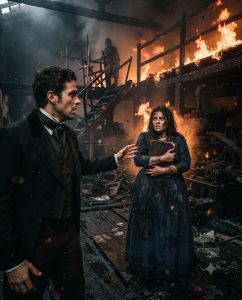
Afonso swore and moved ahead of her, but she followed anyway. The staircase groaned beneath their weight as they climbed into the loft. Heat pressed down from the roof. Through gaps in the boards they could see fresh kindling stacked in corners where no one repairing a property would ever put it.
This was arson waiting for a match.
At the far end of the loft stood a figure.
At first, the light made him shapeless. Then he moved, and the years fell away from Isabela all at once.
Her brother.
Tomás.
Her mother had buried his name in the house like a crime.
Everyone in the district had been told he died two years earlier during an outbreak upriver. A closed coffin had returned. Prayers had been said. Mourning had been performed. And afterward, Alvorada’s debts had mysteriously worsened, records had gone missing, and her parents had become even more desperate, even more secretive.
Now he stood in front of her, alive, thinner, harder, his face sharpened by resentment.
Afonso stopped in disbelief. “Who is this?”
Isabela barely heard him.
Tomás gave a smile without warmth. “You always were the clever one.”
The words dragged memory behind them. Tomás stealing from their father’s desk. Tomás leaving at night with men no servant trusted. Tomás whispering that he would save the family in ways no one else had the courage for. Then his sudden reported death. Her mother’s refusal to let the coffin be opened.
“You are supposed to be dead,” Isabela whispered.
“That was your mother’s idea,” he said. “A dead son earns sympathy. A living one with creditors at his throat does not.”
Afonso looked from one sibling to the other, and the entire foundation of the marriage he had engineered began to crack. “Your family knew?”
Tomás laughed. “Enough of them did.”
The smoke thickened. Somewhere below, fire caught with a hungry rush.
Afonso moved toward him. “You lured us here.”
“To end what should have been ended long ago,” Tomás said. “The baron takes the land, the debts vanish into his books, and if tragedy happens before questions can be asked…” He spread his hands. “Ruined estates are dangerous places.”
Isabela stared at him. “You would burn us alive?”
“I would save myself,” he snapped, and for the first time the mask slipped. “Do you know what Father owed? Do you know what Mother hid? I borrowed. I gambled. I lost. They covered it until they could not. Then they sold you and called it sacrifice.”
The words struck like stones, not because Isabela had never suspected she was being used, but because hearing the ugliness stripped bare by her own brother made it impossible to soften.
Afonso looked at her then, really looked at her, and whatever pride had kept him distant seemed suddenly obscene.
“You knew none of this,” he said quietly.
“No,” she answered. “I was only the payment.”
Below them, flames found the oil.
Fire spread faster than reason. Heat rolled upward. Smoke crowded the loft. Tomás backed toward the far window, desperate and wild.
“There is no way down that isn’t burning,” Afonso warned.
Tomás’s gaze darted to the ledger tucked under a loose board near his feet. Isabela saw it before Afonso did.
The missing books.
Evidence.
Not only of the debts, but of the thefts, the false accounts, the secret transfers that had helped destroy Alvorada and lure the baron into a poisoned marriage.
Tomás saw her notice.
He lunged for the ledger.
So did Isabela.
“Isabela!” Afonso shouted.
But she was already through the smoke, moving with a force he had never imagined in her. She reached the ledger first and clutched it to her chest. Tomás grabbed her wrist. Heat roared below. The loft boards shook.
“Give it to me!”
“No.”
He pulled harder. For one sickening instant, Isabela nearly lost her footing. Then Afonso crossed the distance between them and tore Tomás away. The two men slammed into a support beam. The old wood cracked.
“Go!” Afonso shouted at her.
She did not.
Because the far side of the loft had begun to collapse, and if Afonso stayed to fight Tomás, all three of them would die.
So Isabela did the one thing neither man expected.
She seized a hanging canvas tarp, yanked it free, and threw it over the nearest flames climbing through the floor gap. Fire hissed, buying seconds. Then she grabbed the heavy iron hook from an abandoned pulley line and swung it into the loft window frame.
Afonso stared in disbelief. “What are you doing?”
“Saving us,” she said. “Something you should have learned before marrying me.”
With the ledger strapped under one arm, she kicked out the remaining glass and forced the warped shutters wide. A narrow sloped roof stretched below the window, then the lower storehouse, then open ground. Risky. But possible.
Tomás coughed, half-blind from smoke. Afonso held him back only long enough for Isabela to climb through.
Then the beam behind them split with a terrible sound.
There was no more time for pride.
Afonso dragged Tomás toward the opening and shoved him out first. Tomás landed badly and rolled down the roof with a cry. Afonso followed, then turned back just in time to catch Isabela when the board beneath her foot broke.
For one suspended heartbeat, she hung between fire and empty air.
Afonso gripped her wrist with both hands.
The cold man who had once told her not to shame him now looked terrified of only one thing—that he might lose her.
“Hold on,” he said.
She looked up through smoke and said with fierce, shaking calm, “Do not let go.”
“I will not.”
And he didn’t.
He pulled her onto the roof, and together they slid down the hot tiles to the ground as flames exploded through the loft behind them.
By the time workers from nearby fields came running, Santa Helena was ablaze.
Tomás tried to flee. He did not get far.
The ledger survived.
So did Isabela.
And by nightfall, with soot on her skin and burn marks on the hem of her dress, the full shape of the betrayal had finally emerged.
Tomás had not died. He had gambled away enormous sums, falsified accounts, and used the confusion of Santa Helena’s earlier disaster to hide theft inside disaster. Dona Beatriz had helped spread the lie of his death to preserve what remained of the family’s public standing. Colonel Alberto had known enough to be guilty, though not enough to control the damage. When the debts became impossible to bury, they arranged Isabela’s marriage to Afonso not only as rescue—but as shield. If the baron absorbed the estate, the records could disappear into his management and Tomás’s crimes might never surface.
The trip to Santa Helena had been Tomás’s answer. Kill the baron. Kill the sister. Burn the evidence in the same fire.
It had almost worked.
That night, Afonso returned with Isabela to his own house, not as a triumphant husband but as a man forced into a painful kind of honesty.
He stood in the doorway of the sitting room while she held the salvaged ledger in smoke-blackened hands.
“I owe you an apology,” he said.
She looked at him without softness. “You owe me several.”
“Yes.”
Nothing in his voice resembled the man from the contract meeting. Pride was still there, but stripped raw.
“I thought I was purchasing order from chaos,” he said. “I thought your family was desperate, vain, and weak—and that you were simply the quiet cost attached to what I wanted. I was wrong about many things. Most of all, I was wrong about you.”
She said nothing.
He continued anyway. “Today, you saw what I did not. You understood what I did not. You walked into danger while I was still naming it. And you risked your life for the truth when everyone around you had spent years trying to bury it.”
“At least now you know I was never the shame in that family.”
His face tightened. “No. You were the only honest thing in it.”
Silence settled between them, but for the first time it was not cruel.
It was difficult.
Real.
In the weeks that followed, Tomás was handed over to the authorities. Colonel Alberto, broken by exposure and humiliation, signed what remained of the estate into legal settlement and withdrew from public life. Dona Beatriz stopped receiving visitors entirely. Society, which had laughed so easily at the wedding, discovered that scandal tastes different when the woman you mocked emerges from a burning mill carrying the books that prove everyone else was rotten.
As for Afonso, he did not transform overnight into tenderness. Men like him did not learn humility in a single afternoon.
But he changed in ways people noticed.
He no longer introduced Isabela as though she were an obligation. He asked her judgment before making decisions on household and estate matters. He placed the recovered ledgers in her keeping. When guests came, he watched carefully for any hint of mockery and cut it down before it could flower. Not because she needed rescue, but because he had finally understood the cost of underestimating her.
And Isabela?
She did not become softer to comfort anyone.
She became freer.
She oversaw the restoration of Santa Helena, not as a monument to pain but as proof that ruin could be named, faced, and rebuilt without lies. She hired workers back at fair rates. She reopened accounts with records no one could manipulate. She turned a place prepared for her death into the clearest evidence of her strength.
People spoke of her differently after that.
Some called her brave.
Some called her sharp.
Some called her dangerous.
None of them called her a burden again.
Months later, standing on the repaired veranda of Santa Helena at sunset, Isabela watched the light catch in the fields and thought about the strange cruelty of the world: how quickly people decide what a woman is worth, how easily they confuse softness with weakness, and how often the ones calling themselves protectors are the ones most willing to trade her away.
Afonso came to stand beside her.
After a while, he said, “I do not expect forgiveness simply because I finally learned how wrong I was.”
“No,” she replied. “You do not.”
He accepted that.
Then she added, after a silence neither easy nor bitter, “But learning too late is still better than never learning at all.”
He looked at her then with a kind of respect that had cost him dearly to earn.
The fire at Santa Helena had exposed more than a crime.
It had exposed every person who had mistaken Isabela’s body for her weakness, her silence for surrender, her kindness for lack of power.
In the end, the greatest red flag had not been her size, or her sharp tongue, or even the cold marriage contract everyone whispered about.
It had been how many people found it natural to use her before they ever bothered to see her.