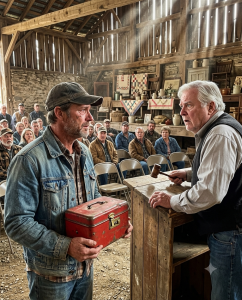
When Dale Merritt walked into the old livestock barn on a gray Saturday morning, nobody greeted him.
A few people recognized him. He could see it in the quick double-takes, in the way whispers traveled from one folding chair to the next. But eleven years was long enough for a man to become a rumor in the county he was born in. Dale had left Harlan County lean and angry at thirty-two. He came back at forty-three with weathered hands, a beard gone rough at the chin, and the kind of silence that made people wonder what they’d missed.
He kept his cap low and took a seat in the back.
At the front of the barn, card tables had been lined up with numbered tags, coffee-stained clipboards, and a metal cash box. Sunlight leaked through the warped boards and caught in the dust. The smell was old wood, machine oil, mothballs, and damp canvas. The room looked temporary, but the damage being done there felt permanent.
Complete estate sale. Four-bedroom farmhouse, fourteen acres, all contents.
He could still see the newspaper listing in his mind. Patsy had texted him a photograph of it two nights earlier with one word beneath it.
Come.
No explanation. No warning. Patsy had always known when words would only get in the way.
Dale had driven overnight from Knoxville, where he’d been staying the past week with a friend while chasing dead ends on courthouse records and unreturned calls from lawyers. By dawn he was parked a quarter mile down from the old farm, staring through fog at the roofline he knew better than his own face. He hadn’t gone up the drive. He couldn’t bear to see strangers carrying his family’s life out in cardboard boxes.
So he waited until the sale started.
Then Earl stepped to the front with a microphone clipped to his collar and a gavel in his hand.
That was when Dale understood what Patsy hadn’t put in the message.
This wasn’t some estate company handling a disputed property.
Earl was running the auction himself.
Dale sat very still, but something in him changed shape.
He hadn’t seen his brother up close in over a decade, not since the winter their father had the stroke. Earl looked older, broader through the middle, silver showing at his temples, but the expression was the same one Dale remembered from every hard year of their lives: jaw set, eyes flat, body angled as though he was prepared to walk away before anybody could stop him.
He welcomed the crowd in a practiced voice.
“Morning, folks. Appreciate everybody coming out.”
As if this were ordinary. As if the chairs, tools, cookware, quilts, and framed photographs around them were just merchandise instead of the remains of a family.
The first lots moved quickly. Windsor chairs. A brass lamp. Toolboxes. Mason jars. Dale watched hands go up and numbers get called and the gavel strike down in neat little bursts of finality. Every item was a memory turned into cash.
Then came the cast-iron skillet.
His mother’s skillet.
Dale remembered the exact sound it made when she set it on the stove. He remembered the smell of bacon grease kept in a chipped white mug beside it. He remembered being ten years old and stealing the corner off a pan of hot cornbread while she pretended not to notice.
“Eighteen dollars,” Earl said. “Sold.”
Dale looked down at his hands.
He had not come back planning to make a scene. For eight months he had tried to do things the lawful way. After hearing by accident that his father had been dead for half a year, he had started calling attorneys. A probate dispute, he explained. Possible coercion. Suspicious will. Maybe fraud. He sent copies of documents. He described the timing. His father had a stroke. Communication stopped. A new will surfaced weeks later. Then Dale was kept away from the house, from the funeral, from everything that came after.
At first a few lawyers seemed interested.
Then, one by one, they cooled.
One said there wasn’t enough evidence.
One said that challenging a signed will without substantial medical testimony would cost more than the estate was worth.
One said, very carefully, “I believe I may know the family you’re speaking of, and I don’t think I’m the right fit.”
That one told Dale more than all the rest.
Everybody in that county knew something. Nobody wanted to say it first.
Then Patsy called.
“Your daddy didn’t trust Earl near the end,” she’d said. “I can’t prove a blessed thing, but I know it in my bones.”
“Why didn’t you tell me before?”
“I tried. Earl answered the house phone. After that, folks started acting like getting a message to you was some kind of crime.”
There had been a pause.
Then Patsy said, “Listen to me close. Your daddy locked something away. I saw him with it one afternoon after your mama died. He told me not to ask questions. If that red box is still in that house, don’t leave without it.”
Now Dale sat in the barn and waited for the box like a man waiting for a name to be called from a jury list.
The quilt went next.
His mother had made it by hand from flour sacks, old Sunday dresses, and pieces of a denim work shirt that had belonged to his father when he was young. Dale remembered her bent over it in lamplight, pushing a needle through with the side of her thumb because arthritis had swollen the knuckles. A woman in a yellow cardigan bought it for sixty-five dollars and didn’t even open it.
That almost broke him.
But he stayed where he was.
Then the helper carried a small dented red tin box to the front table.
Dale forgot how to breathe.
The box looked exactly as it had on the porch that summer evening years ago. A little smaller maybe, because grief did strange things to distance. But unmistakable. The faded red paint. The bent corner. The ugly welded hasp. The cheap brass combination lock.
Earl took it from the helper, and for one unguarded second his face changed.
Fear.
Not grief. Not irritation. Fear.
Then the smile snapped back into place.
“Curious little piece here,” he said into the microphone. “Old tin recipe box. Decorative. Lock’s been modified and won’t open, but it’s got some character. Let’s start at five dollars.”
Decorative.
Dale rose from his chair.
He didn’t remember deciding to do it. One second he was sitting in the back row, the next he was walking down the aisle with the eyes of half the county on him. Nobody spoke. Even the auction helper stepped back.
When Dale reached the front, he put his hands on the box and lifted it from the table.
Earl looked up.
The brothers stared at each other over dented tin and years of rot.
“Daddy told me what’s inside this,” Dale said quietly. “Did he tell you?”
The change in Earl was immediate. His hand tightened around the gavel. The color left his face. He glanced, not at the crowd, but at the lock.
That was enough.
Whatever was in the box, Earl had never seen it.
“Set that down,” Earl said, his voice low and dangerous.
Dale held the box against his chest. “You buried him without calling me.”
“You left.”
“I came back.”
“At the wrong time.”
Dale laughed once, harsh and unbelieving. “You changed the locks.”
Murmurs rippled through the room. Earl straightened, remembering the audience.
“This item belongs to the estate,” he said more loudly. “You don’t have authority to interfere.”
“Then let’s stop pretending this sale is legal because you’re using a microphone.” Dale set the box on the table between them. “Daddy gave me the code.”
Somebody in the front row gasped.
From the third row, Patsy stood up. Her voice cut through the room like a wire. “Then open it.”
Earl shot her a murderous look. “Sit down, Patsy.”
She crossed her arms. “No.”
Dale touched the dial.
The first number clicked into place.
Memory arrived sharp as summer heat: his father on the porch, one hand wrapped around a sweating glass of sweet tea, eyes fixed on the road as if he knew trouble was coming from it.
Don’t open it till I’m gone.
The second number clicked.
And don’t you tell your brother.
The third number clicked.
“Dale,” Earl said, stepping around the podium. “You open that and there’s no going back.”
Dale looked at him. “There wasn’t any going back after you kept me from saying goodbye.”
Then he turned the final number.
The lock sprang open with a small metal snap that seemed louder than the gavel ever had.
Earl lunged.
Dale caught the box before it toppled, and the two men nearly collided. Chairs scraped. Somebody cursed under their breath. The helper backed into a table of glassware and rattled every piece on it.
“Don’t touch me,” Dale said.
Earl stopped.
He was breathing hard now, all polish stripped away. The crowd saw it. So did Dale. This was no longer a composed executor handling business. This was a man watching a sealed room in his life split open in public.
Dale lifted the lid.
Inside, tied with a blue string, was a stack of recipe cards. His mother’s handwriting on the top one. Corn chowder. He barely saw it.
There were two sealed envelopes beneath the cards.
One had Dale’s name on it in his father’s hand.
The other had Earl’s.
Earl’s envelope was thicker.
Beneath both sat a folded legal document on heavy paper with a blue border and the county seal.
Dale pulled it out.
His eyes caught the heading first. Warranty Deed.
Then the property description. The farmhouse. The fourteen acres.
Then the name of the owner.
Not Harold Merritt, their father.
Not Earl.
The land was vested, by deed filed three years before the stroke, in the name of Lorraine Merritt.
Their mother.
For a moment Dale simply stared. Lorraine had died before Harold. Everyone in the county knew that. But as he scanned the next lines, his heartbeat changed. The deed hadn’t been alone. Attached behind it was a notarized transfer-on-death affidavit. On Lorraine’s death, the property had passed not to Harold, but to both sons jointly, equal shares, by her separate inheritance line. Harold had life use of the home while living, but he had never owned the property outright.
Which meant he could not have legally willed the land to Earl alone.
Which meant the entire estate sale had been built on a lie.
The room felt suddenly too bright.
“What is it?” Patsy asked.
Dale looked up at Earl.
Earl didn’t say a word.
His face said enough.
Dale handed the deed to Patsy. She read the names, then read them again. “Oh my God.”
“What?” someone called from the back.
Patsy’s voice shook, but it carried. “This farm wasn’t Harold’s to leave. It belonged to Lorraine. After her death, title passed to both boys.”
The room erupted.
Not loudly at first. Just a crackle of shocked voices, people turning toward each other, recalculating everything they thought they knew. Then louder. The Knoxville dealer swore. The woman in the yellow cardigan clutched the quilt to her chest as if it might suddenly become evidence.
Earl slammed the gavel down once. “Everybody calm down.”
Nobody listened.
Dale picked up the envelope with his own name and broke the seal.
Inside was a letter on lined yellow paper.
Son,
If you are reading this, then I have failed to fix what I should have fixed while I still had the strength. That is on me. Your mother left this farm in a way I did not tell either of you because I thought I could keep peace by holding the middle. I was wrong.
Earl has debts I did not understand at first and then understood too late. He begged me more than once to sign things over. I refused. After my stroke, I fear he may try another way.
That sentence alone made the blood drain from Dale’s hands.
He kept reading.
You need to know this: the will he wanted me to sign is not my will. The witnesses are men from out of county he met through that auction outfit in Pine Ridge. I told him no while I still could speak plain. If he brings you a paper saying I cut you out, don’t believe it.
At the bottom of the letter was one final line, pressed hard enough to nearly tear the page.
The proof is in his envelope.
Dale lowered the letter and looked at his brother.
Earl had gone still in a way Dale had never seen before. Not angry. Not defensive. Defeated.
“Open it,” Patsy whispered.
Dale broke the seal on Earl’s envelope.
Out slid a stack of overdue notices, loan papers, and photocopies of forms with Harold Merritt’s signature attempted over and over in shaky blue ink. Practice sheets. Page after page of Earl trying to copy their father’s name.
The nearest woman put her hand over her mouth.
Then came a notarized statement, unsigned, drawn up but never completed. It transferred authority over Harold’s finances to Earl alone. Tucked behind it was a letter from a regional bank threatening foreclosure proceedings against a business loan secured, in part, by equipment Earl didn’t fully own.
And then the last item.
A folded note in Harold’s hand.
Earl,
A son can ask his father for help and still be a man. A son who steals from him becomes something else. I am giving you this chance to stop. Tell the truth to your brother. Call off the sale. Let the farm pass the way your mother intended. If you do not, I will make sure what you tried is known.
Dale finished reading and the barn went quiet again.
This time the silence wasn’t suspense.
It was judgment.
Earl looked around at the faces he had known his whole life. Men he’d gone to school with. Women who’d fed him after basketball games. Neighbors who had borrowed tools from their father and returned them with pie. Nobody was with him now.
“You don’t understand,” Earl said at last, and his voice sounded small. “I was trying to save it.”
“By forging papers?” Dale asked.
“I was in trouble.”
“So you sold his life before the ground over his grave was settled?”
Earl’s throat worked. “I thought once it was done, there’d be no way to undo it.”
Patsy gave a bitter laugh. “That was the plan, then.”
The Knoxville dealer set his bidder card on the table. “I’m out.”
The woman in the yellow cardigan walked to the front and laid the quilt down carefully, almost reverently. “This belongs with the family,” she said.
One by one, people who had bought things began bringing them forward. The skillet. The lamp. A box of tools. Not all of them, but enough that the tide shifted in a visible way. Shame had entered the room, and in a small county shame traveled fast.
Somebody near the door said they were calling the sheriff.
Earl didn’t protest.
Dale stood there with the two letters in his hand and realized the fight he had imagined for eight long months was over in an entirely different way than he had expected. He had planned for lawyers, hearings, and documents whispered over in offices. He had not planned for truth to explode in public where it could no longer be softened or denied.
By noon the sale was shut down.
A deputy arrived, then another. Statements were taken. Documents were photographed. The auction company would be investigated. The deed and letters were logged. Buyers who had already paid were told the transactions were void pending review. Earl was not handcuffed that day, but only because there was so much paperwork still to untangle that even the law seemed winded by it.
He sat on an overturned bucket outside the barn while the deputy talked to him, looking at the dirt.
Dale came out a little later with the red tin box under his arm.
For a while they said nothing.
The farm spread out beyond them in low green folds. The fence line was half fallen in places. The porch on the house sagged. The smokehouse leaned. Time had not been kind to any of it.
Finally Earl said, “He told me he was going to leave proof.”
“Then why didn’t you stop?”
Earl gave a short, broken laugh. “Because I kept thinking I could get ahead of it. Fix one debt. Then another. Then another. By the time I knew how deep it was, I was already lying every day.”
Dale looked at his brother’s hands. They were trembling.
“You should’ve called me.”
Earl nodded, but didn’t look up. “I know.”
That didn’t repair anything. Some things did not bend back once broken. But it was the first honest sentence Earl had offered him in years.
The legal mess took months to settle.
The forged will was voided. The county records confirmed what the deed had shown: the farm had passed through Lorraine’s line, and Harold had held only a lifetime right to live there. Earl’s auction papers collapsed under scrutiny. Charges were filed related to attempted fraud and falsified documents. Because nothing had been fully transferred and because Earl eventually cooperated, the punishment was lighter than many expected—but not light enough to leave him untouched. His name changed in the county after that. So did the way doors opened for him.
Dale did not send him to prison alone. Earl’s choices did that.
As for the farm, the court recognized it as jointly owned by both brothers.
People assumed Dale would force a sale.
He didn’t.
The first thing he did was put the quilt back on his mother’s bed.
The second was hang the cast-iron skillet where it had always hung.
The third was sit at the kitchen table with the red tin box open in front of him and read every recipe card his mother had ever saved. Meatloaf with cracker crumbs. Green tomato relish. Chess pie. Corn chowder. On the bottom of the stack he found one more card in his father’s writing. No recipe. Just four numbers.
The lock code.
As if Harold had wanted one final proof that he had trusted the right son to remember.
Dale lived on the farm for the next year while the house was repaired. He fixed fences. Cleared brush. Repainted the porch. Some weekends Patsy came by with biscuits and gossip. Some evenings neighbors stopped to return things they’d nearly bought and no longer wanted to keep. Not everybody had been innocent, but enough had been decent when it counted.
Earl came by only once.
It was late fall. The maples were turning. He stood at the bottom of the porch steps and kept his hat in his hands.
“I’m not asking for my half,” he said.
Dale waited.
Earl swallowed. “Sell it, rent it, keep it. I signed what the lawyer drew up. I don’t want the land.”
“You’re still blood,” Dale said.
Earl looked past him into the house, where the quilt could be seen through the open door folded across the back of a chair. “Blood didn’t stop me, did it?”
No answer came easy after that.
At length Dale said, “Daddy gave you chances.”
“I know.”
“And I’m not him.”
Earl nodded as if he had expected nothing else. He set something on the porch step and turned away.
After he left, Dale picked it up.
It was an old photograph in a cracked frame. Two boys standing barefoot in a creek, grinning, shirts off, hair dripping, a fish stringer tangled between them. Dale had forgotten the picture existed. On the back, in their mother’s handwriting, were four words:
My boys before pride.
Dale sat with that for a long time.
People later said different things about what happened. Some said Earl was a thief who finally got caught. Some said Harold had made a mess by trying to keep peace instead of choosing a side early. Some blamed Dale for staying gone so long, as if distance excused deceit or softened betrayal. In a county like that, everyone liked a simple villain because it saved them from admitting how often families fail in smaller, quieter ways first.
But the truth was uglier than that.
A father had tried too late to leave proof behind because he couldn’t make his sons trust each other.
One son had let hurt turn into distance.
The other had let desperation turn into greed.
And a dented red recipe box had done what pride, grief, and law had not. It had forced the truth into the open where everybody could see it.
Sometimes Dale stood on the porch at dusk with a glass of sweet tea and the box beside him on the rail, just as his father once had. He would look down the road and think about the years lost to stubbornness, the funeral he was denied, the brother he no longer knew how to forgive, and the mother who had somehow seen the shape of disaster long before any of them did.
The farm was still standing.
The truth was finally known.
And yet the question that lingered hardest was not whether Earl deserved mercy, or whether Harold should have spoken sooner, or whether Dale should have come home before everything rotted.
It was this:
At what point does a family stop being something you can save and become something you can only survive?