“Take everything off.”
The command slammed into the one-room cabin before Micaela Valdés had even finished taking in the smell of smoke, resin, and damp leather. For a heartbeat she forgot the fire, forgot the cold, forgot the pain burning through her leg. She heard only the words. Hard. Flat. Unforgiving.
And in that instant, standing in the Sierra Tarahumara with frozen mud on the hem of her dress and another woman’s face still hanging like a crime between her and her new husband, Micaela was certain she had made the worst mistake of her life.
She had crossed half of Mexico to marry a man she had never met.
She had lied to him before he ever saw her.
And now the mountain had shut behind them.
The winter of 1891 had arrived early in Batopilas. The mining settlement crouched in the cold like something half-starved, clinging to smoke and silver and prayer. Men worked until their lungs burned. Women mended what could not really be mended. Children learned early that hunger could wait patiently at the edge of every season.
Micaela knew hunger well. So did humiliation.
Her father had died years earlier, leaving her and the crumbling remains of a respectable family to the management of her stepmother, Doña Remedios de Valdés. Respectable had become poor so gradually that at first it still wore lace cuffs and talked about better days. Then the furniture began to go. Then the silver. Then the servants. Then the lies.
By the time Micaela was twenty-nine, there was nothing left in the house except debt, bitterness, and Doña Remedios’s constant voice.
Too large.
Too awkward.
Too plain.
Too old to be chosen.
At first those words had wounded. Then they had settled into Micaela’s bones and begun speaking in her own head.
So when the final creditors came, and it became clear there would be no rescue, only options, they were offered to her as one might offer scraps to a dog. She could enter service in a textile mill where women coughed themselves thin under lint-filled air. Or she could write to one of the northern men who placed notices asking for wives willing to endure hard country.
She chose the letters.
Hilario Cruz’s reply had been the least flattering of them all.
He did not call her beautiful. He did not claim loneliness in flowery language. He did not promise a life of ease. He wrote like a man making inventory.
I have land in the high sierra. Winters are severe. A wife would need to work, keep stores, know hardship, and not scare easily.
That bluntness should have insulted her. Instead, it calmed her.
For the first time, a man was not asking her to pretend the world was kinder than it was.
They wrote for three months. About flour, candles, mules, dried beans, snow damage, roof repairs, goats, and what one must do if storms trapped a household for days. He answered every question she asked. Never warmly. Never cruelly. Simply honestly.
Then came the request for a photograph.
Micaela had held her own likeness in her hand for a long time. She looked exactly as Doña Remedios had always described her—broad-shouldered, solemn, too visible. Beside it lay a card portrait of her cousin Aurelia, all softness and fine lines and easy grace.
Shame made the choice for her.
By the time regret arrived, the photograph was already gone.
Still, she came.
And when she saw Hilario at the station in Batopilas, she nearly turned and fled.
He looked carved out of the same mountains where he lived. Tall enough to shadow other men. Broad enough to make doorways seem narrow. A scar crossed one eyebrow. His coat and boots were practical, not handsome. His eyes were pale, direct, and impossible to fool for long.
They searched the crowd for Aurelia’s face.
Then found Micaela instead.
She confessed at once. Or tried to.
But Hilario cut her off with a raised hand and told her the judge was waiting. If they did not marry that day, they would not marry at all. So she followed him to the registry office in a blur of cold and dread and signed her name beside his, convinced that any reckoning he had prepared for her would come later.
The reckoning did come later.
Just not in the form she expected.
The road up to his cabin was brutal even before the wagon lurched into the icy rut. The wood plank split her stocking and drove a jagged splinter into her calf. Pain flashed white behind her eyes. She bit the inside of her mouth to stop a cry and tasted blood. Hilario drove on, unaware.
At the station, before they had left town, a drunk miner had also tried to grab her as she climbed into the wagon. She had twisted away, but not before his hand clamped brutally above her knee. She had stumbled sideways in revulsion, and that was when her leg struck the splintered board. The miner laughed. Hilario had been arguing with the freight clerk and never seen it happen.
Micaela said nothing.
Silence had always been her safest habit.
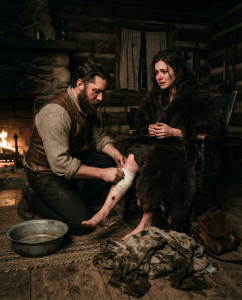
By the time they reached the cabin, she was half-frozen and dizzy from blood loss. Hilario carried her inside more out of necessity than tenderness, and when he ordered her to undress, every old fear she possessed rose up at once.
But when she obeyed, it was not lust she found in him.
It was urgency.
He covered her with a heavy bearskin before she could fold fully into shame. He heated water. He knelt. He cleaned the wound with medicinal bark and boiled cloth, his rough hands astonishingly careful as they moved over torn flesh.
No man had ever handled her with such restraint.
No one had ever looked angry because she was hurt.
When she apologized for the false photograph, Hilario barely reacted.
“I asked for a wife who could live here,” he told her. “Not a decorative object.”
The words struck deeper than a compliment ever could have. Because they were not kind in the polished way men used when they wanted something. They were practical, almost irritated, and all the more powerful for it.
Then he noticed the bruise above her knee.
He knew at once it had not come from the wagon.
When she finally told him about the miner’s hand, the room changed.
Hilario finished bandaging her with the self-control of a man holding a storm behind his ribs. He crossed to the door, opened it a crack, and listened to the mountain dark.
Soon the sound came: hoofbeats rising toward the cabin.
Then fists on the door.
“Cruz,” a voice shouted. “We know she’s in there.”
Micaela’s blood went cold.
Hilario took the rifle from above the hearth and lowered the lamp flame until the room glowed dim and amber. “Behind the grain chest,” he said.
She obeyed without argument, clutching the bearskin around herself as she crouched behind the heavy wooden box. From there she could see only part of the room: Hilario’s boots planted on the floorboards, the fire throwing jagged light against the walls, and the door trembling under the next pounding blow.
“Open up,” another voice called. “We only came for what’s owed.”
“What’s owed?” Hilario’s voice came back like iron. “You came to the wrong house.”
A laugh sounded from outside. “Your bride was promised before you bought paper for her.”
Micaela stared, confused. Promised? Owed? She had never seen these men before.
Hilario’s shoulders tightened almost imperceptibly. “You’ve got one chance to ride away.”
Instead, something heavy struck the door.
The latch held once. Not twice.
When the wood cracked inward, the first man stumbled through on his shoulder, followed by another carrying a lantern. Snow swirled around them. Micaela recognized the second one instantly—the miner from the station, now sober enough to be cruel on purpose. He grinned the moment he spotted a scrap of her discarded dress near the chair.
“There she is,” he said.
He never got another word out.
Hilario moved with shocking speed for a man his size. He slammed the rifle stock into the first intruder’s throat, drove him backward into the table, then swung hard enough to send the lantern flying from the second man’s grip. It shattered against the dirt floor in a burst of oil and flame, but Hilario stamped it out before it could catch.
The miner lunged.
Hilario met him halfway.
The sound of fist against jaw cracked through the cabin. The miner hit the wall so hard a hanging pan fell beside him. He tried to rise. Hilario caught him by the coat, dragged him upright, and threw him bodily through the broken doorway into the snow.
The first man scrambled for a knife.
Micaela gasped.
Hilario pivoted, seized the man’s wrist, and twisted until the blade dropped. Then he drove his elbow into the intruder’s chest and knocked him flat to the floor. The man wheezed, rolled, and crawled toward the open door, deciding all at once that whatever business had brought him up the ridge was not worth dying for.
Outside, the miner spit blood into the snow and looked up with hatred.
“This isn’t over,” he rasped.
Hilario stepped into the doorway, filling it completely. “It is if you want to keep breathing.”
Something in his face convinced them. Both men got to their feet, mounted in stumbling haste, and rode off into the dark.
For a long moment Hilario remained standing there while snow blew around him. Then he shut the door, dropped the splintered beam into place as a temporary brace, and turned back toward the fire.
Only then did Micaela see the blood on his knuckles.
“You’re hurt,” she whispered.
“It isn’t mine.”
He said it as if that settled the matter.
Her body had started shaking again, but not only from the cold. Hilario crossed the room, crouched in front of her, and studied her face the same way he had studied her wound—carefully, without possession.
“Did they touch you beyond that bruise?” he asked.
“No.”
“Did they threaten you before tonight?”
“No.”
He nodded once, a grim movement. “The one from the station works for Esteban Luján.”
The name meant nothing to her.
Hilario must have seen that. He sat back on his heels and explained in the blunt, spare way he seemed to explain everything. Esteban Luján controlled supply wagons, mule routes, and loans in that stretch of the sierra. Men who owed him did not always pay in coin. Sometimes they paid in labor. Sometimes in favors. Sometimes by helping him take what he decided he wanted. Hilario had refused to let Luján buy a strip of his upper land the previous autumn. Since then, there had been threats. Petty theft. Missing feed. A dead goat left near his fence with its throat cut as a message.
“And now?” Micaela asked.
“Now he knows I’ve got something to lose.”
The words should have frightened her.
Instead, she felt the shape of them settle somewhere deep in her chest.
Something to lose.
No one had ever put her in that category before.
Hilario rebuilt the fire, reboiled the water, and made her drink a cup of bitter willow bark tea for pain. Then he fixed the damaged door as best he could and dragged a heavy chest in front of it. Only after every task was done did he spread his own bedroll near the hearth for her and lay a second blanket over the bearskin.
“Sleep,” he said.
“Aren’t you going to?”
He leaned against the wall beside the rifle. “Later.”
“You think they’ll come back.”
“I think men like that don’t like being humiliated.”
The truth of it chilled her more than the mountain air ever could.
She should have slept from exhaustion alone, but every time her eyes closed she heard the pounding at the door again. Near dawn she woke to find the fire stirred, fresh wood laid beside it, and Hilario still awake, his gaze fixed on the window slit where the sky was turning gray.
The next days taught Micaela more about him than all the letters had.
He spoke little, but he noticed everything. He knew exactly when her bandage needed changing before she admitted the wound had begun throbbing again. He built a stool so she could sit while working instead of standing too long on the leg. He cooked badly but fed her first. He did not ask for gratitude. He did not ask for obedience beyond what survival required. When he went outside, he checked the ridgeline and tree line before chopping wood. At night he barred the door twice.
Gradually she learned the rhythms of the place. Where the dried herbs hung. Which shelf held flour. How snow was melted for washing. Which goat kicked. Which hen preferred to lay under the porch rather than in the nesting box. Hilario taught by showing, not praising. Yet every small task he entrusted to her felt like a kind of respect she had never known.
And because life rarely allows peace to settle for long, that was when Esteban Luján came himself.
He arrived just before sunset, alone, on a black horse with silver tack too fine for mountain work. He was handsome in the polished way Hilario was not—trim mustache, expensive gloves, a coat lined with fur. His smile was worse than an open threat.
Hilario was in the shed splitting kindling when Micaela first saw the rider.
“Señora Cruz,” Luján called from the yard as if they were old friends. “I came to welcome you.”
Micaela stood in the doorway with the bread knife still in her hand. “You are not welcome here.”
His smile widened. “So he has already told you stories about me.”
“No stories. Enough.”
Before he could answer, Hilario emerged from the shed carrying the axe. He did not raise it. He did not need to.
“Ride away,” Hilario said.
Luján’s gaze moved from the axe to Micaela, then back again. “You always were stubborn. I offered good money for that strip of land.”
“And I told you no.”
“You should have sold. Men who live alone in winter shouldn’t make enemies they can’t watch every hour.”
Hilario took one step forward. “Leave.”
Luján’s expression cooled. “I hear your wife is not exactly what was advertised.”
Micaela felt the old shame lurch up in her throat.
Then Hilario answered without taking his eyes off the other man. “No. She’s better.”
The words hit all three of them at once.
For the first time since arriving in the sierra, Micaela forgot to feel small.
Luján saw it happen. Some ugly understanding flashed across his face. He had expected a frightened stranger he might unsettle. Instead he had stumbled onto a bond already forming, stronger for having been built without illusions.
He spat into the snow.
“This mountain doesn’t protect fools,” he said, turning his horse. “Remember that.”
Hilario watched him ride away until he disappeared below the ridge.
That night, Micaela did not wait for silence to swallow her thoughts.
“Why didn’t you care?” she asked suddenly while he repaired a harness strap by the fire.
He glanced up. “About what?”
“The photograph.”
He was quiet long enough that she thought he might refuse to answer. Then he set the leather down.
“My first fiancée died before the wedding,” he said. “Fever. I’d seen one picture of her and met her once. After that, people kept trying to interest me in women by describing their faces as if beauty could keep a roof standing in February.” He looked toward the fire. “I stopped listening.”
Micaela did not know what to say.
He continued, more slowly now. “Your letters asked the right questions. Not easy questions. Real ones. I figured either you were practical, or you were desperate. Maybe both. That made more sense to me than any photograph.”
“And when you saw me?”
“I saw someone terrified and too proud to collapse in public.”
A laugh escaped her before she could stop it. To her shock, the corner of Hilario’s mouth shifted in answer.
That was the first moment she understood that his severity was not emptiness. It was restraint. A man who spent words carefully because life had taught him the cost of waste.
The second attack came a week later.
This time it was not fists at the door but smoke.
Micaela woke coughing to the bitter smell of something burning wrong. Hilario was already moving. He yanked the door open and found the woodpile stacked against the outer wall ablaze, flames licking up toward the roof where the dry eaves could catch in seconds.
“Snow bucket!” he shouted.
She ran barefoot to the barrel. Together they hauled slush and water until the fire died in a hissing storm of steam. Tracks led away downhill in the half-dark.
Luján had escalated.
At dawn Hilario saddled the mule.
“Where are you going?” Micaela asked.
“To Batopilas.”
“For help?”
“For witnesses.”
He returned that evening with two older men from neighboring ranches and the town alcalde’s deputy. The deputy was lazy-eyed and irritated at being forced up the ridge, but not stupid. He saw the charred wall, the broken door from the first attack, and the tracks still visible under crusted snow. The neighbors swore they had heard rumors of Luján boasting that Cruz would surrender his upper parcel before spring. Faced with three witnesses instead of one stubborn landowner, the deputy finally agreed to carry formal notice back to town.
Luján, it turned out, was brave only when his power went unquestioned.
A week later he was arrested on charges tied not only to the threats against Hilario but to falsified debts, stolen ore, and coercion against several miners too frightened to speak until someone else finally had. Once one man talked, others followed. The miner from the station disappeared before he could be questioned, but his name was given freely by those who had worked with him.
When the news reached the cabin, Micaela sat down hard on the stool and stared at Hilario.
“That’s it?” she asked. “After all that?”
“That’s not all,” Hilario said.
He stepped closer, awkward for the first time since she had met him.
“What now?” she asked softly.
“Now I ask properly.”
He held out her own photograph.
Not Aurelia’s. Hers.
Micaela took it in confusion. It was the old card portrait she had nearly sent weeks before, the one she had hidden among her things. She looked solemn in it. Defensive. Braced against judgment.
“I found it in your trunk when I was looking for clean cloth after the first night,” he admitted. “I should’ve told you.”
Her face burned. “And?”
“And I kept it.”
She looked up.
Hilario swallowed once, as though this required more courage than facing armed men. “I married you because winter was coming and I needed a wife. I stayed because leaving you to face this alone was impossible. But somewhere between the bandages and the bread and you scolding the black hen like she understands Spanish, that changed.”
Micaela could not speak.
He went on, voice low and rough. “So I’m asking now without urgency, without a judge waiting, and without any lies between us. If you decide in spring that this mountain is too hard, I’ll take you back down myself. But if you stay, I want you to stay because you choose me.”
For most of her life, love had been described to Micaela as a prize granted to prettier women. Tenderness had been something she watched happen to others.
Yet here it was, standing in front of her in worn boots, with split knuckles and a scarred brow and a face incapable of graceful speeches.
And it was hers to answer.
She reached out and placed her hand over his.
“I crossed half the country for a husband,” she said. “It seems I found one after I got here.”
Hilario let out a breath that almost sounded like a laugh. Then he touched her cheek with such cautious reverence that she nearly wept from the contrast between this moment and the terror of that first night.
When he kissed her, it was not like a claim. It was like a question she had already decided to answer yes.
By spring the snow had begun to retreat from the high ridges. The land Hilario had refused to sell turned green in stubborn patches. Micaela could walk without pain. She knew how much salt to cure goat meat, how to judge weather from the pines, and how to tell from the set of Hilario’s shoulders whether he was worried, angry, or secretly amused.
People in Batopilas still glanced at them when they came into town together. Some remembered the photograph story. Some remembered the fight. Some simply stared because Hilario Cruz walked like a man carved from granite and looked at his wife like she was the only softness he had allowed the world to leave him.
As for Micaela, she no longer flinched from being seen.
The strange truth was this: the worst moment of her journey had sounded like cruelty.
Take everything off.
Those were the words she had feared would mark the beginning of her humiliation.
Instead, they had marked the first moment someone saw her pain before her flaws.
Years later, when she thought back to that night, what stayed with her was not the command itself, nor the bruise, nor even the pounding at the door. It was the impossible gentleness in Hilario’s hands when he lifted her injured leg and realized she had been suffering in silence.
That was the real beginning.
Not the registry office. Not the letters. Not the false photograph.
The beginning was the moment a woman who had been taught she was too much discovered that, to the right man, she was exactly what strength looked like.
And perhaps that is what lingers longest in any story like theirs—not who lied first, or who was harder, or who deserved more blame in the beginning, but how quickly a life can change when one person finally sees you clearly and does not turn away.