Walter Pike had spent thirty-two years carrying other people’s lives through weather.
He carried wedding invitations in June heat, tax notices through April mud, and condolence cards in January snow so cold it turned breath to needles. He knew which dogs only barked and which ones lunged, which houses left Christmas tips taped inside storm doors, and which widows waited by the window for the pension check as if the week could not begin until he came up the walk. In a town like Maple Hollow, Vermont, a mail carrier was part messenger, part witness, part furniture. Useful, familiar, mostly ignored until he was late.
Then one day he retired.
Everyone had congratulated him like he had reached shore.
Walter thanked them all, smiled in the diner, posed for the photo with a cake shaped like a mailbox, and drove home with a card signed by half the town. For a few weeks he enjoyed sleeping past four-thirty. He enjoyed drinking coffee in a chair instead of a truck cab. He enjoyed not wrestling frozen packages out of the back in sleet.
Then the silence began.
It settled over the house in layers. No route to sort. No names to memorize. No one waiting for him at the end of a road. His wife had been gone six years by then. His daughter, Emily, lived far enough away and called rarely enough that the phone had become an object of suspicion. Retirement, Walter discovered, did not feel like rest. It felt like having been quietly removed from the machinery of ordinary life.
That was why he kept drifting back to the post office.
Not every day. Just enough to pretend it was practical. He needed stamps. He needed to drop a payment. He needed milk from the market next door. Small reasons. Excuses, really. The smell of paper and damp wool steadied something in him.
On a gray Tuesday in March, when the parking lot was slick with thawed mud and old snow, he stepped inside and saw the young woman at the counter.
She was trying hard to stay composed.
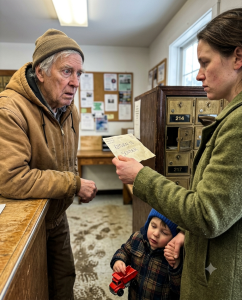
A little boy, maybe four, hung heavy on one hip in a blue knit hat with one pom-pom missing. She had a stack of unopened envelopes tucked under her arm and the look of someone running on too little sleep and too much worry. Linda, the clerk, was speaking in that soft but official tone post office employees perfected.
“The box fee is past due again,” Linda said. “I can hold it until Friday, but after that I’ll have to close it.”
The young woman nodded. “I understand.”
“I’m sorry.”
“It’s all right.” But it clearly wasn’t.
She set the envelopes down and reached into her pocket. Walter expected cash, a debit card, maybe change counted out slowly. Instead she pulled out a folded rectangle of paper so worn at the creases it looked cloth-soft. She opened it in her palm and smoothed it flat with her thumb.
Walter caught only a glimpse.
Blue ink. A hand-drawn border. The words Return to Sender.
Not printed. Written.
She stared at it as if checking herself against a promise. Then she folded it carefully and tucked it away again. When she asked Linda for a few more days, her voice did not crack, but Walter heard how close it came.
She thanked the clerk, bounced the sleepy child higher against her shoulder, and headed for the door.
Walter moved before he had time to overthink it.
“I’ll pay it,” he said.
Linda blinked. “What?”
“The fee,” he said. “Put it on mine.”
The young woman had already stepped outside and didn’t hear. Walter lowered his voice. “No name. Don’t tell her who. Just say there was an adjustment, or a credit, or whatever keeps her from refusing.”
Linda stared at him for a second, then rang it up. Maple Hollow was too small a town to be shocked by kindness, but private kindness always looked suspicious at first.
Walter paid, took his change, and walked out into the cold.
A green Subaru with one patched rear window pulled away just as he reached the curb. The woman never looked back.
He told himself the whole thing would disappear from his mind by supper.
It didn’t.
The next week he returned with no real errand. He stood near the community bulletin board pretending to read a flyer about a church supper while watching the row of post office boxes in the corner. The same woman came in, this time with her little boy half asleep against her shoulder, and went straight to her box.
Walter felt the number before he fully recognized it.
For thirty years, numbers had lived in him like songs. Some routes faded after retirement, but certain addresses never did. Box 214 belonged—had belonged—to the Harrow place on Brindle Road.
He was certain.
The old farmhouse sat at the edge of town where the woods thickened and the road narrowed. White paint peeling. Red barn listing. Maple tree out front split by lightning years before. Walter had delivered there through every season, long enough to remember the family in fragments: Mrs. Harrow’s laugh, the older girl who came running for college mail, the smell of wood smoke in winter, then later a silence that seemed to gather room by room.
And then the fire.
Even now, years later, people in Maple Hollow did not discuss it directly. They referred to “what happened at the Harrow place.” A tragedy. An awful winter. A bad time. Stories blurred in small towns, not because people forgot, but because they protected themselves by sanding the edges off pain. Walter remembered the fire trucks, the blackened snow, the official cars, the weeks of whispers. After that, the house became a place children dared one another to look at after dark. Then the route changed, roadside delivery took over for outlying homes, and Walter stopped handling that address.
He had assumed the house was empty.
Yet here was a young mother opening Box 214 like it was the most ordinary thing in the world.
Before she turned the key, she took out that same worn label and smoothed it flat against her palm again. The gesture was small, but it carried weight. Ritual. Memory. Dependence.
Walter’s curiosity sharpened into unease.
He began asking around without making it obvious. At Mabel’s Diner he mentioned Brindle Road as if he’d driven past by accident. Mabel wiped a cup and said she’d heard someone moved into the farmhouse cheap. Earl at the hardware store snorted and said the place should have fallen in by now. June Farnsworth said she’d seen smoke from the chimney in February and thought the dead had finally tired of being cold.
By Wednesday Walter had heard enough to get in his truck and drive out there.
Brindle Road had gotten narrower. Brush leaned in hard on both sides, and potholes held brown water deep enough to swallow a tire. At the turnoff, the old roadside mailbox had rusted almost completely through, but the lane beyond was plowed. That alone startled him.
Then he saw the house.
It was still battered, still tired, but not abandoned. A downstairs window had been replaced. Someone had cleared the porch. Thin smoke rose from the chimney. A child’s red ball lay half-hidden in the dead grass.
Walter sat behind the wheel staring at it, feeling the past press closer.
He had delivered every kind of envelope to this house. Catalogs. Birthday cards. One letter postmarked from a university in New Hampshire that the teenage girl had nearly snatched from his hand. A condolence card bordered in black after the tragedy. One official state envelope nobody opened for weeks. The house had once been full of movement and later of silence so thick even a mail carrier could feel it from the road.
The front door opened.
The young woman stepped onto the porch, exactly as he had seen her at the post office, the little boy peeking from behind her legs this time. She spotted Walter’s truck and stopped cold.
He nearly backed out then. Instead he raised a cautious hand in greeting.
She did not respond.
Walter drove away feeling like an intruder.
Still, two days later he found himself back at the post office. She was there again. The little boy sat on the tile floor rolling a toy truck along the baseboard while she sorted a handful of envelopes from Box 214. Walter stood beside the stamp rack too long. At last he said, “That box used to belong to the Harrow place.”
The woman looked up sharply. Her face was young, but there was an oldness in the eyes that came from too much surviving.
“You know that house?” she asked.
“I delivered there for years.”
She studied him. “Then you probably know more than I do.”
The answer landed oddly. Not defensive. Not accusing. Just true.
Before Walter could ask what she meant, Linda called the woman over to sign for a certified letter. She did, then came back to Box 214 with the envelope in one hand. The little boy tugged on her coat and asked when they were going home.
She looked at Walter without quite meeting his eyes. “My mother told me never to throw this away,” she said softly, taking the folded label from her pocket. “She said if I ever got desperate, I should bring it back where it belonged.”
Walter frowned. “Back where what belonged?”
She glanced toward Linda, then toward the door. “Not here.”
She left before he could ask more.
That night Walter slept badly. He kept thinking of names. Names were the shape of his old life. Printed names, typed names, signatures, corrections, crossed-out last names after divorce, shaky names on cards from people too sick to hold a pen. He thought of the teenage girl from the Harrow place, though he could no longer remember if she had been a daughter or a niece. He thought of Emily too, his own daughter, because memory had started tugging in strange directions and he did not know why.
Emily had left town years before after a season Walter never fully understood. There had been fights, grief, accusations around the old fire at the Harrow property, whispers that reached farther than facts. Father and daughter survived it, but not gracefully. For a long time their contact came in thin, careful installments. A card at Christmas. A birthday call that ended too quickly. An address change from another state. Emily did not speak about Maple Hollow.
The next morning Walter drove out to Brindle Road again.
The young woman was on the porch waiting.
She let him in without smiling.
The house was colder inside than it should have been despite the stove going in the front room. There were unpacked boxes against the wall, a folded mattress, a child’s crayons gathered in a coffee mug, a blanket draped over a chair to block a draft. The place looked like someone had moved in not because they wanted to, but because there had been nowhere else to go.
“My name is Nora,” she said.
Walter gave his.
Her son, Benji, peered at him from behind a doorway, then returned to a book on the floor.
Nora explained in pieces. Her mother had grown up in Maple Hollow but almost never talked about it. Near the end of her life, sick and running out of time, she had given Nora the old hand-drawn label and a key on a string. She told her there was a post office box attached to a house on Brindle Road and that if things ever became impossible, she should go there. Someone might still be leaving the truth behind.
“The truth about what?” Walter asked.
Nora shook her head. “She never said it straight. Just that things were sent away after the tragedy. Hidden. Misaddressed. Buried in plain sight.”
Walter felt a chill that had nothing to do with the drafty windows.
Nora placed the label in her palm and smoothed it again. Up close, Walter could see how old it really was. The paper had yellowed. The ink had faded. Yet the writing was careful, deliberate, almost tender.
“My mother carried this in her wallet for years,” Nora said. “She told me not to ask questions until I opened Box 214 and started receiving what was meant for me.”
Walter stared at her. “You’ve been getting mail there?”
She nodded toward a stack on the table. “Every Thursday. Something new. Sometimes copies of old letters. Sometimes photographs. Once a receipt. No return address on any of it.”
“Have you opened everything?”
“Not all at once.” She hesitated. “I was afraid if I understood too quickly, I’d also understand why my mother ran.”
The room went quiet except for Benji humming in the hallway.
Nora lifted a larger envelope from the table—the certified letter from the post office—and set it between them. “This one came yesterday.”
Walter reached toward it, then stopped. “Do you want me to open it?”
“I want you to tell me whether any of this means what I think it means.”
That was not an answer, but it was close enough.
Before touching the envelope, Walter looked again at the label in her palm. Something about the slant of the writing had been needling him since the first glimpse at the counter. Familiar, but buried under years.
“Nora,” he said carefully, “your mother’s name?”
She gave it to him.
Walter did not recognize it.
“Maiden name?”
When she answered, his pulse kicked.
The Harrow place. Not a renter then. Blood. Family.
The older girl from the farmhouse had not disappeared so completely after all. She had become a mother elsewhere, raised a daughter, kept a label in her wallet, and sent that daughter back only when desperation stripped away every other choice.
“Show me,” Walter said.
Nora turned the label fully over.
There, beneath the hand-drawn Return to Sender, was another line in smaller blue letters, the kind someone might add after hesitating a long time before deciding to tell the truth. The moment Walter saw the shapes of the letters, his breath snagged.
He knew that hand.
The y curved too low. The capital E leaned slightly left. The last stroke of every t dragged just a little too far, as if the writer had started the next thought before finishing the first. He had seen it on thank-you notes, school permission slips, one awful letter after a fight, and the Christmas cards that came after too much silence.
Emily.
His daughter.
Walter grabbed the back of the chair because his knees threatened him. Nora’s face changed as she watched recognition spread across his.
“You know her,” she said.
He couldn’t answer immediately. His mind had already begun assembling impossible arrangements of the past. Emily, who had refused to talk about Maple Hollow. Emily, who had once been the same age as the girl waiting barefoot at the Harrow mailbox. Emily, who vanished right around the time the old tragedy became everyone’s favorite unspoken topic. Emily, whose version of several things he had never fully heard.
“She’s my daughter,” he managed.
Nora went pale.
Benji looked up from the hallway as if he sensed the room had altered shape.
Walter picked up the certified envelope with unsteady fingers. There was no return address. Nora’s full name was written on the front in the same careful hand. Emily’s hand. No doubt now.
He opened it with a butter knife from the kitchen because neither of them trusted themselves not to rip whatever was inside.
A folded letter slid out. So did a photocopy of an old incident report and a photograph cut unevenly from a larger print.
Walter read the first line and felt the floor drop away.
If you’re reading this, he never told you the fire wasn’t an accident.
Nora sat down hard in the chair opposite him. “Who is he?”
Walter didn’t answer. He was staring at the photocopy now. It was a county report from twenty-three years earlier. Cause of fire: undetermined. Structure: rear outbuilding. Notes: evidence insufficient. Witness statements attached but incomplete.
Incomplete.
That word lit up old, dim corners of his memory. The sirens. The sheriff on the property. Emily coming home ashen-faced that week. The Harrow girl gone not long after. Walter himself asking questions and getting only fragments.
He unfolded the photograph.
It showed the side of the old barn before the collapse. Two figures stood at the edge of the frame, but their faces had been cut away. On the back, in Emily’s handwriting, were four words:
Look at the window.
Walter turned it over again. He and Nora leaned close. In the upper pane of the outbuilding’s side window, reflected faintly in the glass, was a third figure. Not clear enough for a face. But clear enough for posture. A man watching from where no one had claimed to be standing.
Walter’s mouth went dry.
“Who had reason to lie?” Nora whispered.
He thought of the old rumors then, stripped suddenly of their gossip and left bare as motive. The insurance payout disputes. The property fight after Mr. Harrow’s death. The way one local man—relative by marriage, always too involved, always too smooth—had inserted himself into the aftermath and somehow come out with temporary control over paperwork nobody else wanted to touch. Walter remembered distrusting him on instinct and then, like everyone else, allowing time to bury the feeling.
The next few Thursdays brought more.
A copy of a letter from Nora’s mother begging someone named Elsie not to send “the child” back there.
A receipt for repair supplies purchased two days before the fire.
A note in Emily’s handwriting explaining that she had seen an argument near the outbuilding and had lied about the time because she was afraid.
A church bulletin with a name circled in pen.
Walter and Nora spread everything over the kitchen table and pieced together a story more terrible for how ordinary its beginning had been. There had been money problems. Threats over the property. A fire set not to kill, perhaps, but to frighten or force a sale. Only it had gone wrong. Someone had been where they were not expected to be. One death shattered the house, and afterward the adults chose silence over scandal, denial over truth. Nora’s mother had fled carrying a child and a secret. Emily had carried guilt for years because she had stayed quiet under pressure from people older and louder than she was.
“Why send it now?” Nora asked one night, looking at Emily’s notes spread under the lamp.
Walter had been asking himself the same thing. He finally called Emily.
She answered on the fifth ring.
At first she sounded ready to hang up. Then he said Nora’s name.
The silence that followed was not confusion. It was surrender.
Emily told him she had spent years trying to leave Maple Hollow behind. But when she learned Nora’s mother had died and that the farmhouse might pass out of the family for good, she panicked. She still had copies of things. Notes. Photos. Fragments she had hidden when she was young because no adult seemed interested in the truth unless it served them. She had wanted to come herself. She had driven as far as Montpelier twice and turned back both times.
“I thought if I mailed it,” Emily said, voice thin with shame, “I could do one decent thing without having to stand in front of everyone I failed.”
Walter listened, hand tight around the receiver.
“You failed nobody,” he said, though part of him knew it was not that simple. Emily had been young. Afraid. So had Nora’s mother. So, truthfully, had he been. He had seen more than he admitted and asked fewer questions than he should have.
“There’s one more thing,” Emily said. “The man who pushed the lie hardest? He’s still there.”
Walter knew before she said the name.
He was older now, but still in Maple Hollow, still treated at church suppers and town meetings like a harmless relic of old local history. The kind of man who survived because people preferred discomfort to disruption.
Emily came home three days later.
Not to Walter’s house. To Brindle Road.
The sky was low and silver, the kind of afternoon that made every branch look black. Walter stood on the porch beside Nora as Emily’s car pulled in. He had not seen his daughter in eleven months. She got out more slowly than he expected, as if stepping into the old town required physical force.
For a second nobody moved.
Then Benji, who had never met her, waved from the doorway because children often did the merciful thing first. Emily laughed once through tears, and the sound nearly broke Walter.
Inside, they spread the documents over the table and filled the holes together. Emily admitted she had witnessed part of the confrontation near the outbuilding all those years ago. Nora’s mother had witnessed another part. After the fire, both young women were pressured into softened statements that made the event look tragic and vague instead of deliberate and criminal. Nora’s mother left town pregnant and terrified. Emily stayed and was slowly smothered by guilt. The older adults, eager to preserve reputations and avoid scandal, let the story calcify into rumor.
“You were a kid,” Walter told Emily.
“I was old enough to know a lie when I repeated one,” she said.
That night they took everything to the county investigator in the nearest larger town, because Maple Hollow had too much memory and too little objectivity. The case was old, fragile, and probably impossible to prosecute fully after so many years. But the point had changed. This was no longer only about punishment. It was about record. About refusing to let a life be summarized as unfortunate when it had been manipulated into danger.
News traveled quickly anyway. It always did.
The man at the center of it denied everything. Called the papers old nonsense. Claimed grieving women had built fantasies from smoke. But the new statements matched too neatly. The receipt placed him at the hardware store. The photograph challenged his original account. A retired deputy admitted off the record that pressure had come from “well-connected local voices” to let the fire investigation fade. What had once been rumor hardened into public doubt.
For Maple Hollow, that was seismic.
For Nora, the change was quieter. She walked through the farmhouse room by room as if reclaiming oxygen. She stopped flinching at every car on the road. She opened Box 214 without bringing dread to it. Benji turned the front yard into a child’s kingdom of toy trucks and muddy boots. Walter found himself out on Brindle Road more often than anywhere else, fixing a hinge, checking a draft, carrying groceries up the porch. No one called him a mail carrier anymore, but he had somehow become a messenger again.
Emily stayed longer than she planned.
She and Nora were not instantly easy with one another. Shared grief and inherited secrets did not produce fast intimacy. But they recognized each other as fellow survivors of other people’s cowardice. Some evenings Walter would hear them talking low in the kitchen after Benji fell asleep, comparing what they had been told, what they had guessed, and what damage silence had done to both their lives.
One late spring morning, after the mud had finally given up and the first green haze touched the maples, Walter stood beside the repaired porch rail while Nora opened a final envelope from Box 214.
There was no dramatic revelation inside. Just a short note from Emily.
No more hiding. If there’s anything left, we say it out loud.
Nora read it twice, then smiled in a way Walter had not yet seen from her—unguarded, almost young.
By summer, the old Harrow place no longer looked haunted. It looked weathered, yes, but inhabited. Which was always the better fate.
People in town still argued over details, as towns do. Some said justice had come too late to matter. Others said the dead were owed truth regardless of timing. Walter had his own opinion. Truth did not arrive on schedule. It came when people were finally less afraid of it than of themselves.
He sometimes thought back to that first moment in the post office: the tired young mother, the overdue box fee, the little boy with one mitten missing. He had paid the bill on impulse because he could not bear watching someone lose one more foothold. He had no idea he was paying to reopen a sealed room in his own life.
What stayed with him most was not the scandal that followed or even the exposure of the old lie.
It was the label.
That worn scrap of paper had passed from one frightened woman to a daughter, from a daughter to a mailbox, from a mailbox to a table where the past was finally unfolded. Return to Sender. Such ordinary words for something that powerful. Because in the end, the truth had done exactly that. It had come back, battered and delayed, to every person who had once tried to send it away.
And if Walter wondered whether forgiveness was deserved—for Emily, for Nora’s mother, for himself—that question remained harder than any official report.
Fear had made liars of young women who should have been protected.
Silence had made accomplices of people who should have asked more.
Maybe the biggest red flag had not been the fire at all, but how eagerly everyone accepted the version of events that asked the least of them.
Walter knew only this: a dead address had answered back, and the people still standing had one last chance to tell the story properly.
This time, they did.