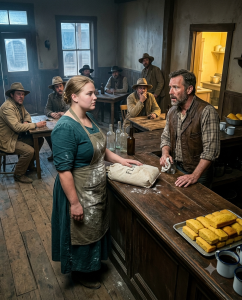
When Clara Schmidt stepped off the stagecoach in Duskwater, she knew exactly what kind of town it was before anyone said a word.
It was in the way people paused before pretending not to stare. In the way the dust seemed to cling to every building as if even the wind had given up. In the way men outside the general store leaned against the posts and let their eyes travel over her body with that same smug, lazy cruelty she had known in every place where a woman was measured before she was heard.
Duskwater sat near the border, close enough to trade routes to stay alive, far enough from decency to go unnoticed. Wagons rolled through. Drifters stopped for whiskey. Cattlemen spent money on bad liquor and worse decisions. It was the kind of town where news moved fast and mercy moved slowly.
By the time Clara reached the Rowan Saloon with her suitcase in one hand and a flour sack in the other, half the street already knew she was the mail-order bride Thomas Rowan had sent for.
And by the time she pushed through the batwing doors, the other half was inside waiting to see what would happen next.
Thomas Rowan looked even more tired than he had sounded in his letters.
He was taller than she expected, broad in the shoulders, with a face that might once have been handsome before grief and hard work sharpened it into something closed off. His shirt sleeves were rolled. His jaw was rough with stubble. There were lines at the corners of his eyes that did not come from smiling.
For one suspended second, he simply stared at her.
Then he looked her up and down in front of fifteen men and said, “I asked for a wife, not a disgrace with a suitcase.”
A few men laughed. Others looked at their drinks. One old ranch hand near the window stared at Thomas like he had said something rotten even by local standards.
Clara felt the insult land. She felt the old sting of it, the familiar pressure in her chest that came from being judged before she had even opened her mouth.
But humiliation had stopped frightening her a long time ago.
She crossed to the bar, laid down the flour sack, removed her gloves, and said, “Then show me your kitchen.”
That ended the laughter more effectively than tears ever could.
Thomas tried to send her away. Clara forced him to explain why. He could not say the truth plainly, so she said it for him: she wasn’t the woman he had pictured.
What he had wanted, though he had not been honest enough to write it, was a helper who would also flatter his wounded pride. Someone sturdy enough to work, attractive enough to impress the town, and quiet enough not to challenge him.
What stood in front of him instead was Clara Schmidt of Stuttgart by birth and St. Louis by hardship: twenty-three years old, plus-size, practical, educated, unafraid, and carrying more skill in one flour-dusted hand than most men in the room had carried in their entire lives.
Her father had taught her the bakery trade. Her mother had taught her how quickly the world punished women for taking up space. By the time Clara was sixteen, she knew how to knead dough, track inventory, calculate margins, extend credit, and listen very carefully when men assumed she was too soft to notice what they were really saying.
She asked to see the kitchen.
He let her.
The room behind the saloon broke her heart a little.
Not because it was ruined beyond saving. It wasn’t. That would have been easier. No, what hurt was that it had once been loved. The stove was good. The worktables were sturdy. The shelves were sensibly placed. And against the back wall sat a beautiful brick oven, built by skilled hands and left unused so long it felt almost insulted.
“Who built it?” Clara asked.
“Eleanor’s father,” Thomas said.
That name changed the room.
Eleanor had been Thomas’s wife, dead for two years. Clara understood immediately that the kitchen had not closed only because money was short. It had closed because grief had frozen the place around the memory of the woman who used to stand in it.
Still, grief did not pay suppliers.
Clara checked the pantry. Thin stock, but enough to start. She told Thomas she could serve breakfast at six.
He said he had not agreed to keep her.
She replied that she had not asked to be paid yet.
That night, while the saloon floor cooled and the last drinkers staggered out, Clara set the place back in motion. She cleaned. Sorted. Measured. Planned. She mixed dough and let it rise near the warmth of the rekindled oven. She soaked beans. She brewed a coffee strong enough to pull men out of self-pity by the collar.
When the first customer arrived at dawn, the room smelled different.
Alive.
Ed Puit, the old ranch hand who had looked disgusted by Thomas’s insult, stepped through the door and stopped dead.
“Lord,” he murmured. “That smells like somebody remembered how to care.”
He ate cornbread hot from the pan, thick beans, and onions cooked low until sweet. He asked for more coffee. He paid without complaint. And then he did the most important thing any customer in a town like Duskwater could do: he walked out and told everybody else.
By midmorning every table was taken.
Men who had come to witness Clara’s failure stayed to order a second plate. Teamsters spread word at the livery. Two deputies from the sheriff’s office came in on the excuse of patrol and left with grease on their fingers. A widow from across the road sent over for bread before noon. By evening, Clara had sold out.
Thomas stood behind the bar and watched his dead business move like it had suddenly remembered its own pulse.
When the rush finally eased, Clara sat down with pencil and paper and wrote out the day’s figures.
Sales. Cost of ingredients. Remaining cash. Needed purchases. Waste kept low.
Thomas stared at the numbers. “Where did you learn all this?”
“My father’s second bakery almost failed in St. Louis,” Clara said. “He survived because my mother stopped him from lying to himself. I learned from both of them.”
That might have been the start of something softer between them, but Duskwater was not the kind of town that allowed easy beginnings.
Silas Crowe came in before sunset.
Even before Clara knew his name, she understood his type. He moved with the confidence of a man who had spent years making other people flinch first. He dressed better than the town around him. His smile never reached his eyes. He looked over the room with immediate calculation, spotting not just what had changed but what it might be worth.
“Well,” Crowe said, glancing at Clara. “Looks like Rowan finally made a purchase that pays.”
Thomas’s face hardened. Crowe reminded him of the debt—four hundred dollars due by August—and lightly suggested he would not mind taking the saloon if the payment failed to arrive.
After he left, the room felt dirtier.
Thomas followed Clara into the kitchen and muttered that bread would not defeat a man like Silas Crowe.
“No,” Clara said as she pulled the ledger toward her. “But arithmetic might.”
What began as a simple review turned into something far worse.
Crowe had loaned Thomas money after Eleanor’s death, when the saloon was collapsing and Thomas had been too broken to negotiate carefully. The agreement on paper was ugly but survivable. The actual sums Crowe had been collecting were something else entirely.
Clara found the discrepancy in minutes.
The stated rate and the charged rate did not match. Month after month, Crowe had been inflating the amount owed, counting on exhaustion, grief, and poor bookkeeping to keep Thomas blind. Then she found a second irregularity.
Payments recorded under Eleanor Rowan’s name after the date of Eleanor’s death.
Thomas went pale when he saw them.
“She was gone by then,” he said.
“I know,” Clara replied.
The entries were small enough not to attract notice. That was what made them chilling. Whoever had inserted them wanted the books to look natural at a glance. To a practiced eye, though, they were wrong in rhythm, wrong in spacing, and wrong in the kind of handwriting used for official records. It was forgery used like dust—thin, constant, meant to settle everywhere.
Before they could say more, Clara noticed a figure in the alley beyond the back window. One of Crowe’s men. Standing still. Watching.
From that moment on, Duskwater shifted.
Business boomed over the next days. Clara added biscuits, hand pies, and a border stew that sold out before dusk. She offered coffee at dawn and fresh loaves for workers heading home at dark. Women who had never set foot in the Rowan Saloon came to the back entrance with baskets and coins. Clara treated them fairly, which in a town like Duskwater was enough to become legend.
But with the growing business came growing attention.
Not all of it welcome.
Crowe’s men started appearing more often, sitting too long over one drink, listening more than speaking. Supply orders went mysteriously delayed. A sack of flour split open in transit because somebody had cut it. Twice, someone tampered with the oven flue. Once, Clara found the back gate unlatched after locking it herself.
Thomas wanted to confront Crowe directly.
Clara stopped him. “A man like that survives because angry people react before they think.”
“And what do you suggest?”
“We learn first. Then we make it impossible for him to wriggle free.”
Ed Puit became their unlikely ally. Old, overlooked, and present in every room where men forgot to lower their voices, Ed carried news the way other men carried pocketknives. He remembered who owed what, who had drunk where, who had worked for whom, and whose stories changed when repeated.
It was Ed who told Clara that Eleanor Rowan had not trusted Silas Crowe near the end of her life.
It was Ed who remembered seeing Crowe at the saloon twice in the week before Eleanor died.
And it was Ed who reluctantly shared the rumor nobody liked to say too loudly: that the sheriff in Duskwater signed papers Crowe wanted signed.
That mattered because two days later a deputy entered the saloon with a seizure notice.
Thomas saw only the county stamp and nearly lost his temper on the spot. Clara looked instead at the signature on the bottom.
She had seen that handwriting before.
Not on a legal document.
On a half-finished letter tucked into a drawer upstairs among Eleanor’s things.
Thomas had shown Clara the room only once, reluctantly, when she asked for space to mend linens. Eleanor’s belongings were mostly untouched. Clara had not gone there to pry, but careful women often notice what careless grief leaves lying around. Folded between recipes and church circulars had been a page in Eleanor’s hand, never mailed, describing fear about “the books” and “the sheriff’s office.” The page broke off mid-thought, but one line had remained clear in Clara’s mind:
If Silas and Hale continue together, we will lose more than the saloon.
Sheriff Hale.
The signature on the seizure notice was his.
That night Clara told Thomas everything. He reacted first with disbelief, then anger, then the hollow quiet of a man who had begun to realize his wife’s death might have taken secrets with it.
“You think Eleanor found out Crowe was using the sheriff?”
“I think Eleanor found out enough to frighten someone,” Clara said.
Thomas turned away. “She was sick at the end.”
Clara understood what he meant. Sick people were easy to dismiss. Their fears could be called confusion. Their certainty could be called weakness.
“Was she wrong often?” Clara asked.
He didn’t answer.
That was answer enough.
Clara’s plan formed in layers. She did not need to prove everything at once. She needed one clean, undeniable thread that would force the rest into daylight. First, she copied the false numbers from the ledger. Then she compared them with supply deliveries, tax slips, and every scrap of paper Thomas had thrown into drawers instead of filing properly. She discovered that Crowe had been charging interest on inventory that had never arrived and collecting penalties on dates that did not match the original contract.
More importantly, she found that several other businesses in Duskwater had closed after similar loan arrangements.
A blacksmith. A boarding house. A stable.
Each failure had quietly strengthened Crowe’s hold on the town.
The problem was getting anyone to care before Crowe or the sheriff shut them down.
The answer came from the bread.
By now Clara’s baking had become the center of half the town’s routine. Men who would not listen to a sermon or a warning would wait in line for warm loaves. Women traded recipes and information at the back entrance. Teamsters passing through carried gossip to neighboring settlements.
So Clara used the kitchen as cover.
A ledger page copied and folded into a flour order. A question asked casually over pie. A name mentioned where the right ears could carry it. She never accused. She simply let people notice the pattern themselves: Crowe lent money, Crowe collected more than agreed, Crowe ended up owning what others lost, and Sheriff Hale signed whatever made it official.
The pressure built.
Then Crowe made his mistake.
He came to the saloon after closing, alone except for one man waiting outside. He found Clara scrubbing a worktable and Thomas stacking chairs. He smiled that polished smile and told Thomas he would forgive a portion of the debt if Clara left town by sunrise.
Thomas went still.
Clara kept scrubbing. “You flatter me,” she said.
Crowe’s voice hardened. “You read too much for a woman who came here to knead dough.”
She set down the rag and met his eyes. “And you steal too much for a man who pretends he only lends money.”
Thomas stepped between them, but Crowe ignored him. He looked only at Clara.
“Do you know what happens to people who misjudge how small this town really is?”
Clara’s pulse kicked once, hard. But fear was a luxury she had trained herself not to display.
“No,” she said. “Do you know what happens when a whole town learns who has been feeding on it?”
Crowe’s expression changed then—not to panic, not yet, but to irritation. He was used to controlling conversations by making others doubt themselves. Clara gave him nothing to work with.
He left without another word.
The next morning the brick oven flue was blocked completely, almost causing a kitchen fire.
That was enough for Thomas.
He wanted to ride straight to the sheriff. Clara forbade it. Instead she sent Ed Puit to fetch Reverend Bell, the schoolteacher Mrs. Vance, and two merchants Crowe had also squeezed over the years. If Crowe intended to act in darkness, Clara meant to drag him into a crowded room.
By sunset the saloon was packed.
Not with drunks. With witnesses.
Clara stood beside the bar in a clean apron. Thomas stood next to her, tense but steady. On the counter lay the original debt contract, Clara’s copied calculations, tax slips, delivery mismatches, and the strange entries in Eleanor’s name.
Sheriff Hale arrived with Silas Crowe at his side.
That alone told the room everything it needed to know.
Hale tried to dismiss the gathering as disorderly nonsense. Crowe tried to laugh. Then Clara began walking through the numbers one line at a time.
She did not dramatize. She did not raise her voice. She simply explained.
How the interest rate had been altered in practice. How the debt was inflated. How dead Eleanor’s name had been used to legitimize false payments. How missing inventory was still counted against Thomas. How other businesses suffered the same pattern. How Hale’s office had approved seizures built on falsified totals.
Silence spread through the room as she spoke.
This time it was not the silence of mockery.
It was the silence of people realizing they had lived beside corruption so long they had started calling it fate.
Crowe interrupted twice. Clara answered with documents. The sheriff accused her of lying. Mrs. Vance stepped forward and produced receipts from her brother’s shuttered stable that matched Clara’s pattern exactly. One merchant did the same. Then another.
Ed Puit, voice shaking with age and fury, told the room that Eleanor had confided she was afraid Crowe and Hale were binding the whole town in paper no honest man could untangle.
That was when Thomas finally spoke.
He looked at the sheriff, then at Crowe, and said, “You used my wife’s death to rob me.”
There are moments when power changes hands so quickly the air seems to break around it.
This was one of them.
Crowe reached for the papers on the bar. Thomas grabbed his wrist. Chairs scraped back. Hale barked for order, but no one moved to help him. The deputies hovering near the door looked less certain than before. Crowe tried to bluster, but his confidence had slipped. He was no longer the only man in the room with documents.
And then Clara delivered the final blow.
From the pocket of her apron, she unfolded Eleanor’s unfinished letter.
She read aloud the line about Silas and Hale.
The sheriff stepped forward and called the letter meaningless.
Clara raised her eyes and said, “Then perhaps you can explain why Mrs. Rowan’s signature appears on county-approved payment records dated six months after her burial.”
That question hit the room like thunder.
Hale had no answer.
One of the deputies—young, red-faced, and clearly sick of what he suddenly saw before him—asked to inspect the papers himself. Then the second deputy did too. Their expressions changed as they compared dates and signatures.
Crowe understood, finally, that the performance was over.
He lunged for the back door.
Ed Puit tripped him with his cane.
Crowe crashed into a table, and the room erupted.
No guns were drawn. No one needed them. Three ranch hands pinned Crowe down before he could stand. Sheriff Hale tried to force his way through the crowd, but Reverend Bell blocked him long enough for the deputies to take the papers out of his hands and place him under arrest pending review by the circuit judge from the county seat.
It was messy. Loud. Undignified.
It was also the first honest thing Duskwater had seen in years.
The investigation that followed dragged on for months, but the result was decisive. Crowe had built his power through inflated loans, forged records, collusion with county authority, and pressure against vulnerable businesses. Hale lost his post. Crowe lost the properties he had seized through fraud. Several owners—or their surviving family members—were compensated in part.
Thomas did not become a different man overnight. Grief and shame do not vanish because truth wins in public.
But he did change.
The first real apology he gave Clara happened before sunrise one morning while she was scoring loaves for the oven. He said he had mistaken her in every possible way. He said he had looked at her and seen only what his own fear allowed him to see. He said Eleanor would have despised how he had greeted the woman who ended up saving the place she once loved.
Clara listened.
Then she told him an apology mattered only if it changed the man giving it.
He nodded. And to his credit, it did.
He stopped treating the saloon as a graveyard with walls. He repaired what needed repairing. He learned the books instead of hiding from them. He deferred to Clara where Clara knew better, which was often. When customers made jokes at her expense, he shut them down before she had to. Not because she could not handle herself, but because respect given late is still owed.
As for Duskwater, the town changed one loaf at a time.
The Rowan Saloon stopped being merely a drinking house. Under Clara’s hand it became the best kitchen on the border road. Teamsters planned their routes around her breakfast. Families came through the back for fresh bread and soup. Traveling merchants carried stories of the German woman who had arrived insulted, stayed furious, and fed an entire town into honesty.
Months later, a painted sign went up.
ROWAN HOUSE
Food. Coffee. Bread at Dawn.
Clara laughed when she saw the word “House” instead of “Saloon.”
Thomas said, “That place stopped being only mine the day you lit the oven.”
People in town still argued over what the real turning point had been. Some said it was the morning Clara served cornbread to men who came to laugh at her. Some said it was the night she exposed Crowe in front of witnesses. Ed Puit insisted it was the moment she answered humiliation with, “Then show me your kitchen.”
He was probably right.
Because the truth was never just that Clara saved a crumbling cantina with bread.
It was that she walked into a town determined to measure her by her body and forced it to reckon instead with her mind, her nerve, her discipline, and her refusal to bend. She turned nourishment into strategy. Domestic labor into power. A kitchen into a courtroom. A loaf of bread into proof that care and competence could rebuild what greed had hollowed out.
Whether Thomas deserved her in the end remained a matter of opinion.
Some said no man who had greeted her that way should have been forgiven. Others said people ought to be judged by what they become after being confronted with their worst self. Clara never answered the question directly. She simply kept baking, kept balancing the books, and kept running the place like someone who understood exactly what hunger looked like—hunger for food, for dignity, for a life wider than the one others tried to assign.
But almost everyone agreed on one thing.
The biggest red flag had not been Thomas’s first insult, awful as it was.
It had been the whole town’s willingness to laugh along until Clara made them choke on it.