On the morning of her wedding, Evelyn understood two things with terrifying clarity.
First, no one in her family was going to save her.
Second, they had already decided she was the price worth paying.
The house was full before noon. Florists moved through the halls carrying white roses imported from somewhere expensive enough to impress people who would never notice the difference. Staff rushed silver trays from room to room. Her mother drifted through it all in silk and diamonds, correcting candle placement, scolding a caterer, reminding everyone that the Vale marriage would “stabilize the family” as though that phrase made it noble.
Evelyn sat in front of a mirror while a stylist pinned her hair into an arrangement she had never asked for. Every time she looked at herself, she felt more like a display piece than a bride.
Her mother entered without knocking.
“You still look pale,” she said, standing behind her reflection. “At least try to look grateful.”
Evelyn stared at the mirror. “Grateful that you sold me?”
Her mother’s mouth tightened for only a second. “Don’t be dramatic.”
“Is that what this is?”
“This,” her mother said, smoothing an invisible wrinkle in her sleeve, “is survival.”
Evelyn let out a soft, humorless laugh. “For who?”
Her mother didn’t answer directly, which was answer enough.
The family business had been unraveling for over a year, though the truth ran deeper than ordinary mismanagement. Her father had taken out loans against projects that didn’t exist yet, then borrowed again to cover the interest. Marcus, charming and reckless and treated like a future king despite ruining everything he touched, had siphoned funds from reserve accounts to cover gambling debts. When creditors began circling, they lied. When banks pressed harder, they lied better. And when the lies finally stopped working, a solution appeared in the form of a rich, private widower named Alden Vale.
He wanted a wife.
He wanted discretion.
He wanted the wedding quickly.
In exchange, he would inject ten million dollars into the company, settle urgent debts, and keep the family estate from being seized.
It was disgusting. It was transparent. It was somehow still dressed up as opportunity.
Her father had not asked if she agreed. Marcus had mocked her when she protested. Her mother had wrapped coercion in the language of duty until the whole arrangement sounded less like trafficking and more like tradition.
By the time the dress was zipped and the veil lowered over her hair, Evelyn felt hollow.
Marcus came in carrying a velvet box.
“I figured Mother would forget this,” he said, opening it to reveal a diamond necklace that looked cold enough to cut. “Put it on.”
“No.”
He smiled in that lazy, contemptuous way she had hated since childhood. “This is not the day to test our patience.”
“Our patience?”
He stepped behind her and fastened the necklace himself. “You owe this family. Don’t pretend you don’t know it.”
“Owe you for what?” she snapped. “Being blamed every time one of you destroys something?”
He leaned closer to the mirror, his voice dropping. “One uncomfortable night and we keep the house. Try to think beyond yourself for once.”
Evelyn looked at his reflection and felt something inside her go cold.
“You’re all afraid,” she said quietly.
Marcus’s smile faded.
“That’s why you’re cruel today. Because deep down, you know this won’t save you forever.”
He straightened, annoyance flashing across his face. “Just get through the ceremony.”
Then he walked out, leaving the scent of cologne and contempt hanging in the room.
The chapel had been decorated like a performance of innocence. Candles glowed. Musicians played softly. Guests murmured behind polite smiles, pretending not to know the family was hosting a wedding because scandal had become more expensive than shame.
When Evelyn reached the aisle, she saw Alden Vale clearly for the first time.
He stood with a silver cane and the patient stillness of an old man used to being obeyed. His gray hair was neatly combed back. His skin looked thin and marked with age. He wore black gloves despite the warmth in the room. His face carried the stiffness of someone who had learned to ration movement.
There was something eerie about him, but not for the reason everyone else assumed.
It was his eyes.
Blue, direct, and intensely alive.
Her father took her arm and started walking. He did not look at her once.
At the altar, Alden inclined his head. Up close, the illusion was flawless. The wrinkles held. The spotted skin looked real. The breathing even seemed slightly labored. Yet when he took her hand during the vows, his grip told a different story. His fingers were strong. His pulse was controlled. Nothing in him trembled.
She looked up sharply.
He met her gaze for half a second—just enough for something unreadable to pass between them—then lowered his eyes again like a careful old man protecting his energy.
By the time the ceremony ended, Evelyn no longer knew what frightened her more: the marriage itself, or the possibility that the groom was not what he seemed.
The reception was a theater of relief. Her father drank like resurrection had arrived in a champagne flute. Marcus laughed with investors who had avoided him for months. Her mother floated from table to table in a halo of false grace, accepting congratulations as if arranging her daughter’s sale proved her brilliance rather than her moral collapse.
At one point, her mother pulled Evelyn aside beneath a staircase lined with flowers.
“Enough with the funeral face,” she murmured. “People are watching.”
“I hope they choke on the show.”
Her mother’s smile sharpened. “Careful.”
“Why? There’s nothing left for you to take.”
Her mother leaned closer and kissed her cheek for appearance’s sake. Against Evelyn’s skin, she whispered, “Be obedient. Men like him replace wives very easily.”
Then she stepped away before Evelyn could respond, leaving behind perfume and the final proof that maternal affection had always been conditional.
By the time the last guest was gone, the mansion was quiet enough to feel haunted.
Vale Manor sat outside the city, vast and old and almost offensively elegant. The bridal suite was larger than Evelyn’s entire childhood wing, but all that space only made her feel smaller. Fire burned in the hearth. Heavy curtains muffled the night. On a polished table waited a silver tray with untouched cognac.
Alden closed the bedroom door and turned the lock.
Evelyn’s pulse jumped. She backed toward the fireplace.
“Please,” she said. “Don’t hurt me.”
He watched her.
Then he smiled.
Not with lust. Not with pity. With certainty.
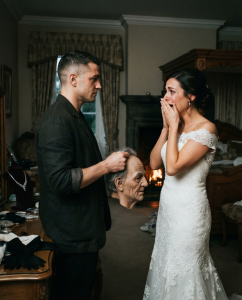
He removed his gloves first, placing them neatly on the table. Then he lifted both hands to his jawline and pulled at the sagging skin there with practiced ease.
Evelyn stared, unable to understand what she was seeing until the entire illusion came loose.
The old face peeled away.
The wrinkles disappeared.
The age spots vanished.
The false cheeks and throat came off in one unnervingly perfect piece, leaving a younger man beneath—dark-haired, broad-shouldered, hard-featured, with a scar carved through one eyebrow and eyes she now recognized fully: not tired, not weak, not elderly, but focused and furious.
Her knees nearly gave way.
He laid the mask on the dressing table beside her diamond necklace.
“You were never my target,” he said. “Your family was. Tonight, my revenge begins.”
She should have screamed for help.
Instead, she heard herself ask, “Who are you?”
“Adrian Cross.”
The name landed with no immediate meaning, then opened like a trapdoor under her feet.
Cross.
She had heard it once, years ago, in a late-night argument behind her father’s office door. Heard it again in a clipped conversation Marcus abruptly ended when she entered. It had always floated around the edges of the family’s secrets, never explained, never welcomed.
Adrian crossed to the desk, opened a leather folder, and spread out documents with unnerving calm.
“Ten years ago,” he said, “my parents owned a coastal development firm. They were bidding on the waterfront project your father’s company eventually got. They had financing, permits, designs, and a safety model that would have changed the entire region.”
He looked up.
“Then your father and brother made sure none of it survived.”
Evelyn moved closer despite herself.
He continued. “Reports were falsified. Inspectors were bribed. Investors were quietly redirected. My parents were accused of negligence based on documents they never created. The project collapsed before construction began. My father lost everything. Weeks later, he killed himself.”
The room seemed to shrink.
“My mother never recovered,” Adrian said. “She still wakes up screaming some nights, convinced she’s hearing his voice in the next room.”
His tone stayed level, but that control made the grief more devastating, not less.
Evelyn looked down at the papers. They were contracts, transfer records, internal memoranda, account schedules—too detailed to be bluff, too damning to ignore.
“Why marry me?” she asked again, because that was the part she still couldn’t understand.
“Because your family signs anything when they smell money.”
He turned one contract toward her. It laid out the truth in merciless legal language. Ten million dollars transferred through layered entities. The family company’s controlling shares listed as collateral. The estate itself pledged against default. Hidden accounts referenced in coded attachments. Penalty clauses designed to trigger ruin if specific conditions were breached.
Her father had not merely agreed to the marriage.
He had leveraged everything.
It was not rescue. It was surrender disguised as strategy.
Adrian watched her closely. “I expected denial.”
“I’m not denying anything.”
“I expected you to defend them.”
At that, something bitter almost made her smile.
Instead, she lifted her hands to her throat, unclasped the diamond necklace Marcus had fastened there, and set it beside the discarded old face.
“You picked the wrong daughter to frighten.”
For the first time, Adrian seemed caught off guard.
Evelyn turned, reached into the hidden lining of her handbag, and withdrew a flash drive no larger than a fingertip.
His eyes dropped to it immediately.
“What is that?”
“Insurance.”
“For who?”
“For me,” she said. “Because I knew one day I might need proof of what this family really is.”
She placed the drive on the desk between them.
For three years, while her family dismissed her as difficult, ungrateful, and decorative, Evelyn had been building a life in secret. She had enrolled in remote night courses in forensic accounting under a scholarship her father never bothered to read about because he thought practical intelligence was beneath old family money. She had studied financial trails, false reporting, shell corporations, concealment patterns. It started as an act of self-preservation. Then, as she began noticing missing funds and altered statements in her father’s office, it became something else.
A private investigation.
Not because she wanted to save the family.
Because she wanted to know how bad they really were.
“Marcus ordered records deleted,” she said. “I copied them first. My father moved cash through maintenance vendors that don’t exist. There are offshore transfers disguised as project expenses. And your family’s case?” She met Adrian’s stare. “It wasn’t a one-time act of panic. It was coordinated.”
Adrian took a step forward. “You can prove that?”
“I can prove enough to destroy them if the right people look.”
He studied her for a long moment, recalculating everything.
In his mind, she could almost see the old assumptions falling away. He had built a revenge plan around a spoiled heiress trapped in a corrupt family. Instead, he had married the family’s most neglected witness—the one person both inside the house and outside their trust.
“Why tell me?” he asked.
Evelyn laughed once, softly, without joy. “Because they sold me.”
Silence.
“Because they expected gratitude,” she said. “Because they smiled while handing me over. Because every time they ruined something, they needed someone smaller to blame. And because tonight proved what I’ve suspected for years.” She looked toward the locked door. “I was never their daughter. I was their asset.”
Adrian’s face did not soften, but his attention changed. It became less predatory, more precise.
He picked up the flash drive at last. “What’s on it?”
“Ledgers. Emails. snapshots of internal accounts before they were altered. Payment schedules tied to false contractors.” She hesitated. “And one more thing.”
He waited.
“My mother.”
That made him still.
“What about her?”
Evelyn drew in a breath. “My father and Marcus handled the overt theft. But my mother made sure the right people stayed quiet. She cultivated relationships with inspectors’ wives, donors, board members, charity committees. She knew exactly who could be manipulated socially and who needed money routed indirectly. She called it maintaining influence.”
Adrian’s expression hardened.
“She wasn’t just aware,” Evelyn said. “She was useful.”
He looked down at the drive again as if it now weighed more than plastic and metal.
“There’s also a name,” Evelyn said.
“A name?”
“Someone close to your family. Someone who didn’t just betray your parents once but passed information to mine over a long period.”
Adrian’s gaze sharpened instantly. “Who?”
Evelyn hesitated. This was the detail she had never fully understood because the files she copied had fragments, not full explanations. A codename on one transfer. A private note from her mother. A reference to meetings arranged through an intermediary with a surname that now, looking at Adrian, made terrible sense.
“When I was reading the records,” she said slowly, “I thought it might be coincidence. But after seeing you…” She lifted her eyes to his. “I don’t think it was.”
“Say the name.”
“Claire Merrin.”
Adrian’s face drained of color.
That told her everything.
“She was my aunt,” he said after a stunned pause. “My mother’s sister.”
Evelyn felt the air shift. “Then you didn’t know.”
“No.” His voice had changed, roughened by something deeper than rage. “Claire disappeared from our lives after my father died. We were told she couldn’t handle the scandal.”
“She handled it very well,” Evelyn said quietly. “There are references to payments through one of her foundations. Access notes. Internal schedules that match your family’s private meetings. She fed them information.”
Adrian turned away, one hand braced against the desk.
Revenge had sustained him for years. Clean, focused, righteous revenge aimed outward. But betrayal from within is a different kind of wound. It doesn’t sharpen grief. It poisons it.
For a long moment, neither of them spoke.
Then Adrian straightened.
“What do you want?” he asked.
It was the first truly honest question anyone had asked Evelyn in a very long time.
She considered it.
“I want the truth on record,” she said. “Not whispered behind doors. Not hidden in settlements. Public. Precise. I want them unable to charm their way out of it.”
“And after that?”
She looked at the wedding ring now sitting on her hand like evidence rather than promise.
“After that, I want my life back.”
Adrian nodded once, slow and deliberate.
The alliance formed in that moment was not romantic. It was not tender. It was two survivors standing in the wreckage left by other people’s greed and deciding, with clear eyes, that the wreckage would no longer remain hidden.
The next forty-eight hours moved with surgical speed.
Adrian’s legal team, already prepared for the financial ambush, began working through the materials on the flash drive before dawn. Two forensic auditors were brought in through a private channel. Evelyn spent most of the night identifying names, explaining family habits, decoding euphemisms used in internal communications. By morning, the shape of the conspiracy was larger than even she had feared.
Her father had manipulated debt structures for years.
Marcus had laundered losses through dummy subcontractors and private betting accounts.
Her mother had used charity networks and social influence to facilitate meetings, suppress rumors, and quietly reward people who protected the family’s interests.
And Claire Merrin—Adrian’s aunt—had indeed passed confidential information from the Cross family into their hands during the original waterfront battle.
It was enough.
Three days later, the first blow landed.
Emergency injunctions froze the company’s operating accounts. Creditors, alerted to concealed liabilities, moved immediately. A regulatory inquiry opened. Journalists began asking questions after anonymous packages containing verified documents reached two major financial publications and one local investigative desk.
The family mansion became a cage.
Evelyn was present the day the investigators arrived.
Her father was in the study, shouting into a phone that no one had answered for the last ten minutes. Marcus looked like a man discovering that charm cannot negotiate with evidence. Her mother descended the staircase in cashmere and pearls, still trying to wear dignity like armor.
Then she saw Evelyn.
At first there was confusion. Then disbelief. Then horror.
“You,” her mother whispered.
Evelyn stood in the entry hall with Adrian a few feet behind her and two officials near the front door. She had never felt calmer.
“Yes,” she said.
Her father stormed forward. “What have you done?”
“What you should have feared years ago,” Adrian replied. “Told the truth.”
Marcus’s gaze flicked between them, comprehension dawning too slowly to save him. “This is because of the marriage? You planned this?”
Adrian said nothing.
Evelyn answered. “You planned it first. You just assumed I’d stay silent.”
Her mother recovered enough to straighten. “Whatever you think you know, family matters are not handled like this.”
Evelyn laughed in her face. It surprised them all, including herself.
“Family?” she said. “You sold me to cover your crimes.”
Her father pointed at Adrian. “This man tricked us.”
“No,” Evelyn said. “He gave you exactly what you wanted. Money. And you signed before reading the cost.”
Marcus lunged verbally, if not physically. “You ungrateful little—”
One of the investigators cut him off and asked him to sit down.
What followed was not dramatic in the way films imagine justice. No one delivered a monologue that changed hearts. No one fell to their knees. Consequences arrived in binders, warrants, freezes, seizures, and questions that could no longer be dodged.
Her father’s face seemed to age ten years by evening.
Marcus cycled from rage to bargaining to threats and back again.
Her mother tried composure until Adrian quietly said Claire Merrin’s name.
That was the first time she broke.
“You don’t understand,” she said, her voice cracking. “It was never supposed to go that far.”
Evelyn stared at her. “Which part? Destroying his family? Or selling your daughter?”
Her mother began to cry then, but it was too late. Maybe it had always been too late.
Over the next weeks, the story spread. The Cross case was reopened in practical terms through related fraud findings. Claire Merrin, tracked through financial records and foundation transfers, was found living under another name overseas. Depositions followed. Settlements collapsed. The old narrative about a failed business rivalry dissolved under documented proof of conspiracy.
Adrian visited his mother before the full case became public. He told Evelyn afterward that she wept for an hour when she learned her husband had been betrayed not only by competitors but by her own sister. Yet beneath the grief there was relief too—the terrible kind that comes when truth is unbearable but finally precise.
And Evelyn?
She moved out before the estate was formally seized.
Not back to her family. Never back.
She took a modest apartment with bare floors, one bookshelf, and windows that opened onto an ordinary street. It felt more luxurious than the mansion ever had. She finished the certification she had nearly abandoned. She testified. She read every filing before signing her own statements. When interviews were requested, she declined most of them.
She did not want fame.
She wanted clean air.
Her marriage to Adrian remained legally complicated for a while, an irony neither of them enjoyed. What had begun as a weapon between two damaged family histories could not be neatly categorized afterward. They spoke often during the proceedings, then less when the case was closing, then carefully again once there was room for conversation that wasn’t built entirely around evidence and ruin.
He apologized once.
Not for exposing her family. For underestimating her.
She accepted.
Months later, when the final judgments were entered and the family company was dismantled piece by piece, Evelyn drove past the old estate only once. The gates were open. Movers carried out furniture that had outlasted every lie. The house looked smaller than she remembered.
She did not stop.
People later asked versions of the same question in quieter rooms: Did she regret it? Turning on her family, helping Adrian, setting the whole structure on fire?
The honest answer was complicated.
She regretted that any daughter could be cornered into choosing between blood and truth.
She regretted the years she spent hoping love would appear in people who only understood leverage.
She regretted that Adrian’s revenge began because no one had protected his family when it mattered.
But she did not regret speaking.
Because the ugliest thing her family ever did was not the fraud, or the bribery, or even the wedding contract.
It was teaching her that loyalty meant silence while they fed her to the wolves.
They were wrong.
Sometimes loyalty to yourself is the first moral act left.
Sometimes the person called ungrateful is just the first one brave enough to stop lying.
And sometimes the wedding meant to bury a woman becomes the day everyone else is finally exposed.
The only lingering question was the one people kept arguing over after the scandal ended:
Who was worse—the man who built an elaborate revenge to punish a corrupt family, or the family who made revenge possible by treating their own daughter like collateral?
There was no easy answer.
But anyone who looked closely could see the clearest red flag of all had appeared long before the wedding, long before the contract, long before the mask came off.
It was the moment a mother told her daughter to smile while selling her future—and expected obedience to look like love.