She didn’t mean to notice him at first.
Marge Calloway had only come to Tillamook Bay Diner because Christmas Eve had a way of turning silence into something with teeth.
At seventy-eight, she knew the difference between solitude and loneliness, and she had learned the hard way that people romanticized the first because they had not yet survived enough of the second. Solitude was choosing your own company. Loneliness was heating soup for one in a cottage built for two, hearing the wind scrape along the lighthouse bluff, and still turning your head toward the empty chair because some part of your body had not accepted what your mind already knew.
Harold had been gone twelve years. Long enough for casseroles to stop coming. Long enough for neighbors to stop checking in with concern and start speaking to her in that soft congratulatory way people used for the elderly who had managed not to die yet. Long enough for everyone to assume she had made peace with it.
She had not made peace with anything.
That afternoon, the weather had rolled in hard off the water, and the cottage felt full of ghosts. So she put on her good wool coat, cursed at the hearing aid that had been acting up for a week, and drove through sleet to the diner, wanting only warmth, chowder, and the comfort of human noise.
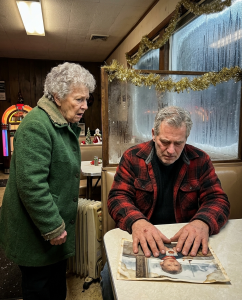
The diner looked exactly as it always had: yellow light in the windows, salt-blurred glass, a neon sign that flickered on the second letter, and Christmas tinsel taped around the pie case with more optimism than skill. Dorothy was behind the counter pouring coffee. Linda was barking an order toward the kitchen. The jukebox stood in the corner like a relic that had outlived better decades.
And in the booth by the front window sat a man who looked like grief had hollowed him clean through.
His plate was untouched. His coffee was untouched. His hands were pinned to something on the table.
A photograph.
Marge noticed because noticing was what she had always done best. You did not spend forty-one years with a lighthouse keeper without becoming sensitive to tiny wrongnesses. Harold used to say she could detect trouble in weather before the gulls could.
The man’s jacket was faded red flannel. His hair was gray at the temples. He sat with the stillness of someone who had burned through every ounce of energy except what was needed to remain upright. But his thumb moved in slow repetition, stroking the photograph as if it were alive.
Marge looked away, then looked back.
Still the same.
Later, after Dorothy put his meal on Marge’s tab, after “O Holy Night” drifted thinly through the diner, after snow scraped sideways against the windows, Marge walked over and wished him a merry Christmas.
When he looked up, she felt a jolt in her chest.
There was a vacancy in his face she recognized instantly. Not common sadness. Not fresh sorrow. This was older. Permanent. The expression of a person whose life had been divided into before and after, with no bridge between them.
“You didn’t have to do that,” he said when she told him she had covered the meal.
“I know,” Marge replied. “That’s why I did.”
Then she saw the photograph more clearly.
A diner window.
A child’s face against the glass.
She might have dismissed it as coincidence if Linda had not stopped her at the door minutes later and whispered the words that changed everything.
“It’s this diner,” Linda said. “The night of the flood. Nineteen eighty-nine.”
Marge felt the old memory open beneath her feet.
Everyone in town remembered the flood of 1989. Rain for three straight days. Tide surging in at the wrong time. Streets becoming channels of black water. Cars lifted and shoved. Men tying ropes around themselves before stepping into currents strong enough to buckle a knee. The bay roaring like something alive.
Tillamook Bay Diner had been caught in the middle of it.
And there had been a little girl.
Five years old, maybe six. Depending on who told the story. Trapped inside when water slammed the front door and jammed the back. People had shouted through the window. Someone tried to break the glass. The current got too strong. The power failed. The details varied after that. Memory always softened itself where it could.
The one thing that never changed was the end.
She died there.
Marge had not thought about that child in years.
Now a stranger sat in the corner booth holding a photograph from that night, and in blue ink along the bottom were five words:
I came back like she asked.
Linda had one more detail.
“He asked me this morning if this was still the same booth,” she said. “Then he asked if the girl still waits there when it floods.”
So Marge went back.
She crossed the diner through a silence she could feel even if she couldn’t hear every part of it. The man watched her come with tired, unsurprised eyes, as though he had been waiting for exactly one person to sit down.
She slid into the booth across from him.
“Who was she?” Marge asked.
His gaze dropped to the photograph. For a second she thought he might ignore her. Then he said, “My daughter.”
The words struck harder than she expected.
He pushed the picture toward her.
It had once been a Polaroid. The glossy surface was bubbled from old water damage, the edges curled and brown. The image showed the front of the diner lit up against darkness and rain. Inside the window, barely visible, was a little girl in a yellow raincoat. Her hands were pressed to the glass. Her mouth was open in a shape the photograph could not fully preserve but the imagination could.
“My wife took it half an hour before the flood got bad,” the man said. “She thought our daughter looked cute in the coat. She sent me to pick her up.”
His name was Eli Mercer.
He had been thirty-two that winter, working maintenance at the cannery. Overtime. Double shifts. Christmas a day away and money still tight. His wife, Susan, had dropped their daughter, Annie, at the diner with Linda’s mother for an hour while she ran an errand. Eli was supposed to collect her before the tide turned.
He was late.
At first the reasons sounded ordinary enough to insult the scale of the tragedy that followed. His truck wouldn’t start. He borrowed jumper cables. A downed branch blocked the road. By the time he found another route, the storm had worsened. The radio was giving flood warnings. He kept thinking he was minutes away.
“Ten minutes,” Eli said, staring at the picture. “Maybe twelve. That was all. I spent thirty-seven years trying to understand how twelve minutes can become the whole shape of a life.”
When he reached the diner, emergency lights were already there. Water was tearing through the street. Someone held him back. Someone told him the current inside was too strong. Someone else told him they had tried.
He remembered Susan screaming his name. He remembered glass breaking. He remembered the smell of fuel and tide and wet insulation. He remembered seeing the yellow raincoat once, only once, before the water swallowed the line of sight.
He never forgave himself for being late, and Susan never forgave him either.
Their marriage lasted less than a year after Annie died. Not because they did not love each other, Eli said. Because grief made them dangerous to one another. Susan needed someone to blame, and Eli needed someone to punish him. They provided both.
She left Oregon. He stayed.
He searched the shoreline for days after the flood. Weeks, if you counted the times he went back after dark and stood in the mud pretending he was still searching. The photograph was found snagged in reeds near the bay. Susan mailed it to him with no return address and one sentence written on the envelope: You keep what you failed to save.
Marge sat very still while he spoke.
Around them, the diner continued in muffled holiday motion. Plates came and went. Someone laughed near the pie case. A toddler fussed. The ordinariness of it made the story feel even sharper.
“Why come back now?” she asked.
Eli’s right hand tightened around something in his pocket before he brought it out and placed it on the table between them.
A tiny silver bell.
The sort sewn onto children’s mitten cuffs.
Tarnished, old, wet.
Marge looked up.
“I checked into the Harbor Motel last night,” Eli said. “Couldn’t bring myself to come here in the dark. Thought I’d do it in the morning, sit here a while, leave the picture, maybe say what I should’ve said years ago. Around midnight I heard ringing outside my room. Real soft. Like someone moving their hand back and forth.”
He tapped the bell with one finger.
“When I opened the door, nobody was there. Just this on the mat.”
Marge’s skin prickled all the way down her arms.
“Annie wore a pair of red mittens with bells on the cuffs,” he said. “Susan stitched them herself. One came off when they were trying to pull me back from the water that night. I found it in my truck the next day. I kept it for years. This is the other one.”
“How do you know?”
He gave a hollow laugh with no humor in it. “Because Susan sewed one silver thread through the right cuff after Annie tore it. Said she’d never mix them up again.”
He turned the bell to show her the frayed stitch.
There it was. A single strand of silver trapped in old thread.
Marge had no easy explanation for that.
“Maybe someone found it,” she said, though even to her own ears it sounded weak.
“After thirty-seven years? Wet this morning?” Eli asked.
She had no answer.
Then she noticed the window.
The pane beside their booth had begun to mist over in a perfect pale circle, though the rest of the glass remained clear except for the storm outside. It was fogging from the inside, not the out. Slowly, as if warmed by breath.
Marge stared.
A shape appeared in the condensation.
Five small lines.
Finger marks.
The suggestion of a child’s hand.
Eli saw it too. His face emptied completely.
Linda came from behind the counter carrying a coffeepot, saw where they were looking, and stopped dead. Dorothy turned. A teenager bussing dishes nearly dropped a tray.
Nobody said anything for a few seconds.
Then Eli stood so fast the booth rattled against the wall. “Annie?”
The room seemed to contract around the name.
The handprint vanished.
Not faded. Vanished, all at once.
People began talking over one another. Linda swore softly. Dorothy crossed herself. One customer laughed the strained laugh of someone frightened enough to become rude. But Eli was already moving.
He went to the door and stepped outside into the storm before anyone could stop him.
Marge was on her feet after him, cursing her knees.
By the time she reached the doorway, he was in the parking lot turning in a full circle, snow and sleet whipping around him. The lights from the diner cast a dim yellow haze over the asphalt and the pooling water at the curb.
Then the bell in his hand rang.
Not because he shook it.
Because something tugged it.
Marge heard that much even through her failing ears. A high, delicate chime under the wind.
Eli’s head turned toward the side alley between the diner and the bait shop.
There, in the weak wash of security light, stood the outline of a small figure in a hooded coat.
Yellow.
Marge’s breath caught.
The figure did not move like a child exactly. It stood too still for that. But one hand lifted, a tiny beckoning motion, then disappeared around the alley corner.
Eli ran.
Marge shouted after him. Linda shouted too. The younger busboy sprinted out from behind the counter to follow, but by the time any of them reached the alley, Eli had stopped halfway down it, chest heaving.
There was no child.
Only sleet. Trash cans. Old pallets. Water coursing toward the street drain.
And caught on a rusted nail at eye level, fluttering in the wind, was a strip of red wool.
Mitten fabric.
Eli took it down with shaking hands.
The sight of him standing there with that scrap of red cloth, breaking open in the middle of the alley while Christmas lights from the diner blinked weakly behind him, did something to Marge that had been sleeping for a long time. She stepped closer, put one hand on his arm, and felt him trembling so hard it reached her bones.
“Come inside,” she said. “You’re freezing.”
He let them guide him back.
Once seated again, soaked and pale, Eli finally drank his coffee. Linda locked the front door early. Dorothy turned the OPEN sign to CLOSED. The remaining customers either left quietly or gathered near the counter, too unsettled to pretend nothing had happened.
Marge sat with Eli while the storm deepened.
Sometimes the best thing an old woman can offer is not wisdom. Just company that does not flinch.
It was nearing eight when another knock came.
Three soft taps on the diner’s front window.
Every head turned.
No one was outside.
But on the sill, just beyond the glass, sat a small object no one could explain.
Linda opened the door carefully and brought it in wrapped in her apron to keep it dry.
A child’s plastic hair clip. Pink. Butterfly-shaped.
Eli’s mouth fell open.
“She wore that in her school picture,” he whispered.
Marge looked from the clip to the photograph, and then to the tiny bell and red wool on the table. A trail. Not random objects. Not scattered memories. It felt deliberate. Intimate. As if something—or someone—were leading him somewhere he had refused to go for nearly four decades.
“Was there anywhere she used to hide?” Marge asked. “Somewhere she liked?”
Eli pressed his fingers hard against his brow. “After church she’d crawl under the front counter and say nobody could see her shoes.” He swallowed. “At home she’d hide in the cedar chest at the foot of our bed, but Susan hated that.”
Linda froze.
“What?”
“There used to be a storage hatch under the old front counter,” Linda said slowly. “Before we remodeled in the nineties. My mother kept paper goods down there. We boarded it over.”
Eli stared at her.
The whole diner stared at her.
Without another word, Linda fetched a flashlight from the kitchen and led them to the counter. Behind the current register stand, beneath years of cheap paneling and repainting, was a rectangular outline Marge had never noticed before.
The busboy got a screwdriver. Eli used his bare hands.
It took less than a minute to pry the panel loose.
Cold air rolled out.
Inside the cavity, tucked deep against the back wall where flood mud had hardened long ago and then dried into dark ridges, was a small metal lunchbox covered in faded cartoon sailboats.
Eli made a sound Marge would remember for the rest of her life. Not a cry. Not exactly. More like a person being struck by hope after years without it.
“That was hers,” he said.
His hands shook so badly Marge had to help lift it free.
The latch was rusted. Linda used a butter knife to coax it open.
Inside were three things: a waterlogged drawing of a lighthouse under a yellow sun, a plastic seashell bracelet, and a folded note sealed in wax paper gone brittle with age.
The note was addressed in a child’s careful printing.
DADDY
No one moved.
Eli unfolded it with an agonizing slowness, terrified of tearing it.
The writing inside was uneven and full of reversed letters, the spelling patched together by a child who trusted that love mattered more than correctness.
Daddy,
I hid my treasure box like a game.
Mommy said you always find me.
If the water gets in, dont be mad.
I was brave.
I waited by the window a long time.
I knew you were coming.
I love you bigger than the bay.
Love Annie
Eli did not sob immediately. For a moment he only stared, as if his mind could not absorb what his eyes were seeing. Then his face collapsed and thirty-seven years of held-back grief finally broke loose.
Marge wrapped both hands around one of his.
No one in that diner looked away.
Later, much later, when the storm had eased and people had begun to breathe normally again, Eli told them something he had never told another soul. In the years after Annie’s death, he had built his life around one unbearable certainty: that she had died believing he abandoned her.
That belief had poisoned everything. His marriage. His work. His sleep. His ability to pray. The shape of every Christmas after.
But the note destroyed that certainty in a single page.
She had waited.
She had believed he was coming.
And somehow, impossibly, she had wanted him to know.
Marge drove home after midnight with tears drying on her face and the storm finally breaking apart over the bay. For the first time in years, the silence in the cottage did not feel cruel when she opened the door. It felt occupied. Not by ghosts exactly. By the strange comfort of knowing that love did not always end where people thought it did.
Eli stayed in town through New Year’s. He arranged with Linda to frame the photograph, the bell, and a copy of Annie’s note in a shadow box that now hangs near the diner’s front booth. Not as a spectacle. As a memorial.
The original note he kept.
Susan called two months later.
Linda always swore that was the last unexplained thing. Eli said he had not heard her voice in twenty-nine years. She had found him through the motel after dreaming of Annie three nights in a row, each time in the same yellow coat, each time saying, Tell Daddy I waited.
They met in spring on a bench overlooking the bay.
No miracles followed. Nothing so neat. Old wounds did not vanish because of one note, and grief did not turn beautiful just because it finally changed shape. But they talked. For hours. Then again the next month. Then again. Not to restore the marriage they had lost, because some things could not be rebuilt. Only to bury the war.
Marge liked that part best.
Not redemption. Not magic. Just the ending of unnecessary punishment.
On the next Christmas Eve, she went back to Tillamook Bay Diner and asked for the corner booth. The space heater still rattled. The coffee was still bad. Snow stitched itself across the dark window in thin white threads.
She looked at the framed note near the wall and thought of Harold. Of Annie. Of Eli. Of all the people who spend years trapped inside one terrible moment because they think love failed them there.
Sometimes it had.
Sometimes it hadn’t.
Sometimes the cruelest thing grief did was lie.
And if Marge had learned anything worth keeping, it was this: the biggest red flag in sorrow was the story it told too confidently. The one that said you know exactly what the dead felt, exactly what they meant, exactly how much they blamed you. Maybe some people deserved that blame. Maybe others had only been carrying it because pain needed somewhere to live.
She sat a long while with her chowder and the warm clatter of other people’s lives around her.
Then she touched the edge of the table once, lightly, like a greeting, and whispered into the Christmas hush, “He came back, Annie. Just like he said he would.”