She was already wearing the rope mark when Merrick Bane shot the noose in front of all of Copper Ridge.
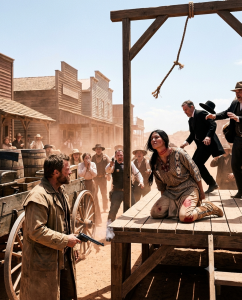
The shot split the noon air so violently that for one stunned second the whole town forgot to breathe. The rope snapped above the scaffold. The condemned woman crashed to the wooden planks instead of hanging from them, and the sound of her body striking the gallows seemed to shake the red dust loose from the entire square.
People lurched backward in a wave.
Otto Pell, the executioner, stumbled away from the lever with both hands shaking so badly he nearly fell. Women gasped. Men swore. A boy in the front let out a frightened cry before his father yanked him behind a barrel.
On the platform, the Apache woman stayed on her knees.
Her wrists were tied behind her back. A bullet wound had soaked one side of her buckskin dark. Blood ran steadily down her thigh, but she gave the crowd nothing—not a scream, not a plea, not even the trembling satisfaction they had come to witness. She only raised her head and looked at them with a bruised throat and a face so calm it felt like defiance.
Merrick Bane lowered his smoking Colt.
He had come to town for coffee, nails, lamp oil, and salt pork. Nothing more. He was a man who lived by reducing his needs until they almost disappeared. The fewer things he wanted, the fewer things the world could take.
The world had already taken enough.
Three years earlier, raiders known as the Black Raven gang had burned his house, shot his wife Mara when she tried to run, and killed his little daughter Lenny in the yard before setting the whole ranch ablaze. Merrick had buried what was left with his own hands. Since then, people in Copper Ridge spoke of him carefully, as though grief had made him part ghost and part loaded gun.
What they knew for certain was this: he kept to himself, paid in cash, spoke little, and had no interest in anyone’s trouble.
Until that day.
“Bane!” Deputy Larkin Bragg shouted, his voice cracking with fury. “You just signed your own death warrant!”
Merrick turned his head toward him, expression flat and unreadable.
“Then write it clearly,” he said. “Say I stopped a public murder.”
The crowd erupted into angry muttering. Boots ground into dirt. Holsters loosened. Several men looked ready to draw, but none of them wanted to be the second fool Larkin Bragg became.
Bragg was already red-faced and wild-eyed, his grief sitting just beneath his anger like a fire under a skillet.
“Five travelers were butchered on East Road,” he yelled. “My brother Emmet was one of them. This savage was found near the bodies. We don’t need a judge to tell us what we know.”
Merrick stepped onto the gallows one board at a time.
“A dead body tells you somebody died,” he said. “It doesn’t tell you who killed them.”
“She’s Stone Crest Apache!”
“And you’re white,” Merrick answered. “That doesn’t make you innocent of every crime another white man ever committed.”
The whole square seemed to recoil.
Larkin went for his revolver.
Merrick fired first.
The bullet smashed the revolver from Larkin’s hand and sent it spinning across the scaffold. Bragg cried out and clutched his bleeding fingers while the crowd fell into shocked silence.
Merrick tucked the Colt back into his holster, knelt beside the Apache woman, and cut the ropes at her wrists.
When she rose, she was taller than he expected. Taller than most men in the square. Broad in the shoulders, strong through the arms, with the kind of physical command that made even her injury look temporary. Dust covered her face. Her black hair hung loose and tangled around the rope bruise on her throat. Her eyes were hard enough to strike sparks from stone.
“Can you walk?” Merrick asked.
“I can walk,” she said in clear English. “And if you give me a knife, I can kill.”
He almost smiled.
“That may come in handy.”
He helped her down the steps while the town hurled curses after them. One woman spat near Seya’s boots. An old rancher shouted that they ought to hang the pair of them side by side. Otto Pell refused to meet Merrick’s eyes. At the edge of the square, several men had already started saddling horses.
Larkin Bragg, white with rage and pain, pointed at Merrick with his good hand.
“Tonight I’m coming to Bane Ranch with every armed man in Copper Ridge,” he shouted. “I’ll drag you out and hang you from your own porch!”
Merrick lifted Seya into the wagon. She tried to refuse his help, but her wounded leg nearly folded beneath her, forcing her to grab his sleeve. He climbed up, took the reins, and looked back once.
“Bring shovels,” he said. “Not all your men are riding home.”
Then he drove out of town.
For the first few miles, the only sound was the wagon wheels grinding over stone.
The desert stretched around them in bleached silence. The sun pressed down hard enough to make the air shiver. Seya sat in the back, one hand resting against her bruised neck, the other near a knife Merrick had left beside her. He had noticed that. He left it there on purpose.
“We’re being followed,” she said at last.
“How many?”
“Three close. Maybe four. Two more farther back on the ridge.”
Merrick checked the tiny side mirror attached to the wagon and saw nothing but dust.
“You’ve got better eyes than I do.”
She looked past him toward the horizon.
“When you hunt for your meals, you learn to notice what wants to hunt you back.”
Merrick steered off the main road into a shallow creek bed, letting the horses splash through enough water to blur the tracks. He cut through scrub and stone before circling back toward the ranch from the west.
By the time they arrived, sunset had turned the whole sky copper and blood.
Bane Ranch sat alone in the open like a memory too stubborn to die. A narrow cabin. A crooked barn. A corral with missing rails. Windmill blades that complained every time the breeze shifted. And on the rise beyond the house, three simple wooden crosses.
Seya saw them and said nothing.
Inside, Merrick lit a lamp and set water to heat. The cabin was spare but clean. Rifle by the wall. Tools by the door. Tin plates stacked neatly. A faded photograph on the mantel. Not a home built for comfort anymore, only survival.
“Sit,” he said.
“I don’t need help.”
“I didn’t cut you off a rope to have you bleed out on my floor.”
She gave him a hard look, then sat.
He cleaned the bullet wound with whiskey. She flinched once and no more. He wrapped her thigh with a bandage torn from an old clean shirt. Up close, she looked even more formidable. Not pretty in the manner town men praised over poker tables. She looked like weather and endurance and anger hammered into flesh. But beneath that there was exhaustion too, and something else: not fear exactly, but the strain of carrying knowledge too dangerous to speak.
Her gaze shifted to the scar that crossed Merrick’s cheek.
“Why did you save me?”
Merrick’s eyes moved to the photograph on the mantel.
Mara sat in the picture with her hand on Lenny’s shoulder, both of them smiling at something beyond the frame. The photograph had been handled so often at the corners it was beginning to wear through.
“Because once,” Merrick said, “I got somewhere too late.”
Silence fell between them, but it had changed shape. It was no longer the silence of strangers. It was the silence of two people standing near separate graves.
“You should hate me,” Seya said after a moment. “I’m Apache.”
“Larkin Bragg is white,” Merrick said. “That doesn’t make him my kind.”
For the first time since he had seen her, something in her expression wavered.
“I didn’t kill those travelers.”
He set the bandage down.
“Then tell me who did.”
Seya looked toward the darkening window.
“My own people handed me over. They wanted the whites to finish what they started.”
Merrick reached for the Winchester hanging above the door.
“Who?”
“Barco,” she said. “He wanted to marry me. He wants my father’s land. He thought if I disappeared, the land would break apart.”
Before Merrick could ask the next question, the night outside answered for him.
Hooves on stone.
Several horses, moving fast.
He crossed the room and snuffed the lamp with his fingers. Darkness swallowed the cabin, leaving only moonlight in thin strips through the window.
“Then you’d better start talking quickly,” he said, lifting the rifle. “Because somebody rode here with purpose.”
They stood in silence and listened.
The riders came in disciplined formation, too quiet to be townsmen from Copper Ridge. No shouting. No drunken threats. No loose saddle clatter. These men rode like hunters who expected blood before sunrise.
Seya’s posture changed. Every line of her body tightened.
“My father,” she whispered.
Merrick looked at her. “That doesn’t sound like relief.”
“It isn’t.”
More horses stopped outside the corral. Leather creaked. A low command was spoken in Apache. Another voice answered—sharper, colder, carrying an edge of impatience.
Seya inhaled slowly.
“Barco is with him.”
Merrick frowned. “The man who set you up rode here beside your father?”
“My father does not yet see all men clearly,” she said. “Barco knows how to stand close to power and hide his teeth.”
The front porch groaned under the weight of boots.
Merrick moved toward the door, but Seya caught his sleeve.
“If my father speaks first, wait before you answer,” she whispered. “If Barco speaks first, shoot him before he lies.”
Then a deep voice came through the door.
“Seya. Come out now, and the white man may keep breathing.”
The authority in that voice filled the whole cabin.
Merrick glanced at Seya. She looked torn in a way he hadn’t thought possible—fierce and afraid at once, like someone standing at the edge of a choice that would destroy one life or another.
“Is he your father?” Merrick asked.
“Yes.”
“Will he kill you?”
“If Barco can make him believe I betrayed the tribe,” she said, “he will let others do it.”
Merrick opened the door.
Moonlight washed over the yard.
A dozen mounted Apache warriors stood in a half-circle beyond the porch, still as carved stone. At their center sat a broad-shouldered older man on a gray horse, his face stern, his hair braided with silver and black. Even before Seya stepped into the doorway behind Merrick, the resemblance was unmistakable. Same eyes. Same jaw. Same contained ferocity.
Chief Taza of the Stone Crest Apache looked at his daughter’s bruised throat, her bloodied leg, and the white rancher standing in front of her with a Winchester in hand.
Then his gaze drifted to the rope burn around her neck.
The chief’s face did not soften, but something flared in his eyes before vanishing.
Barco rode just behind him.
He was younger than Merrick expected, handsome in the polished, dangerous way of a man who took care with how he appeared to others. His expression wore concern the way a snake wore bright color—meant to distract from the bite.
“She escaped justice,” Barco said smoothly in English. “We came to take her back before she brings war to both peoples.”
Seya stepped forward despite her wound.
“You sold me to the town,” she said.
Barco spread his hands. “You were found near dead settlers. The whites wanted blood. I tried to save what could be saved.”
“You mean yourself,” she said.
Taza’s gaze shifted between them.
“Inside,” the chief said.
Merrick shook his head. “No.”
Every warrior’s hand moved closer to a weapon.
Taza fixed him with a level stare. “You point a rifle because you think wood walls will protect you?”
“No,” Merrick said. “I point a rifle because a woman nearly died from a lie today, and I don’t let armed men carry lies through my doorway.”
Barco’s mouth tightened.
Taza dismounted in one smooth motion and climbed the porch alone. That more than anything told Merrick the man was dangerous. Men who trusted their own presence more than numbers usually had reason.
Inside the cabin, Taza stood in the moonlit room while Barco remained outside the open door, listening.
Seya faced her father with visible strain.
“You let them hang me,” she said.
Taza’s expression hardened. “I let the whites show their hunger. It tells me who they are.”
“They put a rope around my neck.”
“And yet you live.”
“Because he stopped them,” she said, pointing to Merrick.
The chief looked at Merrick for a long moment. Then he gave the smallest nod. Not gratitude exactly. Recognition.
“Speak,” Taza said to his daughter.
Seya did.
She spoke of the travelers on East Road. Not settlers heading west, as Copper Ridge believed, but a weapons convoy disguised as a family group. Two wagons hidden beneath blankets and trunks. Crates of repeating rifles. Ammunition. Powder. Enough to arm a private militia.
“They were meeting someone from Copper Ridge,” Seya said. “Someone who wanted the tribe blamed for the attack after the exchange.”
Merrick felt the shape of the truth before she named it.
“Larkin Bragg,” he said.
Seya nodded. “His brother Emmet was in the convoy. Not as a victim. As a buyer.”
Barco spoke from the doorway at once. “She lies.”
Seya turned on him. “You were there.”
“No.”
“You struck the first driver with your own rifle butt.”
Taza’s eyes flashed toward Barco.
The younger man stayed composed. Too composed.
“They were trespassers,” Barco said. “Armed ones. There was confusion. Gunfire. When it ended, Seya wanted to spare the white men carrying weapons against us. She called me a butcher because I would not.”
“That is not what happened,” Seya said.
Barco stepped inside then, carefully, just enough to seem respectful while stealing the room. “She does not tell you she argued with me in front of witnesses. She threatened to expose our war council. She wanted peace after whites had already chosen war. So yes, some mistrusted her. But mistrust is not murder.”
Merrick watched him and understood the man’s talent at once. He never denied the shape of events completely. He bent them, polished them, offered them back in a form that made him sound reasonable and everyone else sound unstable.
“What happened on East Road?” Merrick asked.
Seya kept her eyes on Barco. “The convoy met men from Copper Ridge at dawn near Split Rock. Barco had learned of the trade. He wanted the rifles for himself before either side could claim them. He led a war party there. He planned to kill both groups and blame the whites for shooting first. Then he would tell our people the tribe needed him to lead because war had become unavoidable.”
Barco laughed once, low and contemptuous.
“And the proof?” he asked.
Seya’s face changed.
“There was a ledger.”
That silenced Merrick.
Taza turned fully toward her. “What ledger?”
“Inside the second wagon,” Seya said. “A buyer’s book. Names. Dates. Ammunition counts. Payments promised by ranchers and deputies from Copper Ridge. Barco saw it. He killed the trader carrying it.”
Merrick remembered Larkin’s fury in the square. Not just grief. Panic disguised as righteousness.
“Where is the ledger now?” he asked.
Seya answered without looking away from Barco.
“I took it.”
Barco moved.
He was fast—faster than anyone his size should have been. A knife flashed in his hand as he lunged for Seya. Merrick swung the Winchester up, but Taza was closer. The chief caught Barco’s wrist mid-strike and slammed him into the table so hard the water basin crashed to the floor.
Outside, warriors shouted and surged toward the porch. Merrick stepped sideways and leveled the rifle at the doorway. Seya snatched the knife from Barco’s hand and pressed it to his throat before he could recover.
For one furious second the entire cabin held its breath.
Taza stared down at Barco, whose polished mask had finally fallen away. The younger man’s face was twisted with naked hatred.
“You would draw steel on my daughter in my sight?” Taza asked.
Barco’s chest heaved. “She would trade her own blood to the whites.”
“No,” Seya said. “I would stop you from feeding both peoples into the fire so you can sit higher when it burns.”
Taza looked from Seya to Merrick, then to the photograph on the mantel, then back to Barco.
“Where is the ledger?” he asked again.
Seya slowly withdrew her free hand from beneath her bandaged thigh.
A folded oilskin packet, stained with blood.
She had hidden it beneath the dressing the entire ride.
Merrick let out a breath he hadn’t realized he was holding. Barco’s eyes widened for the first time that night.
Taza took the packet, opened it, and read by moonlight near the door. His face grew more terrible line by line. He did not need much. The names were enough. Emmet Bragg. Larkin Bragg. Otto Pell. Two ranchers from Copper Ridge. Ammunition counts. Scheduled delivery points. Notes on “provoking retaliation” to justify seizing tribal water land after conflict.
War had not been coming by accident.
It had been planned for profit.
Barco’s voice turned desperate. “The whites wrote those names. It proves only their corruption.”
“It proves yours too,” Seya said. “You murdered to take the rifles and silence everyone who saw you.”
Barco looked at Taza and made one last try.
“I did what was necessary. The tribe needs strength.”
The chief’s answer came like stone dropping into deep water.
“The tribe needs truth.”
He stepped aside and called for his warriors. Two entered immediately. Taza gave an order in Apache so cold it didn’t need translation. They seized Barco’s arms. He fought then, finally understanding he had lost, but no one in that room looked surprised by his true face anymore.
Merrick lowered the rifle.
“What happens now?” he asked.
Taza folded the ledger and tucked it into his belt. “Barco faces judgment among my people. At dawn, I ride to Copper Ridge.”
“With warriors?” Merrick asked.
“With witnesses,” Taza said.
That answer struck Merrick as wiser and more dangerous than war.
They reached town after sunrise.
Taza did not ride in secret. He entered Copper Ridge by the main road with twelve warriors, Seya beside him, Merrick on the other side, and Barco bound behind them. Merrick had expected shouting, gunfire, maybe a barricade. Instead, the sight of the Apache chief riding openly into town with the woman everyone believed hanged the day before sent fear running through the streets faster than any bullet.
Larkin Bragg came out in front of the sheriff’s office pale and armed, with half the town gathering behind him.
“You’ve got nerve,” he said to Merrick.
“Not as much as you,” Merrick answered. “Holding a funeral for your brother before deciding whether he died innocent.”
Taza dismounted and threw the ledger at Larkin’s feet.
“Read,” the chief said.
Larkin didn’t bend for it.
Otto Pell did.
The executioner opened the packet, scanned the first page, and went gray as ash. The crowd pressed closer. One rancher took the ledger from him. Then another. Murmurs spread. Faces changed. Names spoken under breath turned into stunned curses.
Larkin understood the moment before anyone had to accuse him.
He drew.
Merrick fired.
So did Seya.
Merrick’s bullet hit Larkin in the shoulder. Seya’s tore through his gun hand, sending the revolver skidding across the dirt almost exactly the way Merrick had disarmed him the day before. Larkin screamed and dropped to his knees.
No one came to help him.
Not after the ledger.
Not after Emmet Bragg’s name. Not after the supply list. Not after the notes about staging outrage and blaming the tribe to create an excuse for land seizure and private enrichment.
One by one, the men who had stood ready to ride against Merrick’s ranch stepped away from Larkin.
The sheriff, who had been little more than a frightened decoration throughout the hanging, finally found enough backbone to order the arrests. Otto Pell gave a full statement within the hour. So did two ranch hands listed in the ledger, both eager to trade honesty for mercy. By midday, Copper Ridge knew that five people had indeed died on East Road—but not because one Apache woman had murdered innocents. They died because greedy men on both sides had tried to light a war and control where the flames spread.
Larkin Bragg was jailed.
Barco was taken away in chains by his own people.
And Seya, the woman the town had nearly hanged before lunch the day before, stood in the same square with a bruised throat and watched the rope still hanging from the scaffold beam, cut clean in half.
Merrick stood beside her.
For a long time neither of them spoke.
At last Seya said, “Your town wanted me dead very quickly.”
“It wasn’t my town yesterday,” Merrick said. “Might not be today.”
She glanced at him. “But you stayed.”
He looked across the square toward the general store, the jail, the stable, the church, and all the places where ordinary life kept trying to pretend it wasn’t built beside ugliness.
“I stayed because leaving things rotten never made them less rotten.”
Taza approached then. The chief’s face held the same stern gravity as before, but no hostility.
“You saved my daughter,” he said to Merrick.
Merrick nodded once. “She saved herself too.”
Taza considered that and seemed to approve the answer.
Before leaving, the chief turned to Seya. Their exchange in Apache was brief, heavy, and unreadable to everyone else. But when it ended, he placed a hand once against her shoulder—not as chief to warrior, but as father to daughter.
Then he rode away with his men.
Seya remained.
Merrick was not sure whether that surprised him because he had assumed she would go, or because some part of him had already hoped she wouldn’t.
The sun climbed higher. Townspeople watched from porches and windows, suddenly uncertain how to look at either of them. Yesterday they had cheered for a hanging. Today they had discovered how quickly certainty could become shame.
“Where will you go?” Merrick asked.
Seya looked toward the road leading out of town, then toward the distant line of hills beyond which the Stone Crest land began.
“I haven’t decided.”
He nodded.
That should have been the end of it. A man who had intervened once. A woman who had survived. A truth exposed. Debts settled.
But lives did not always end where violence stopped.
Weeks later, people would still talk about the day Merrick Bane shot a hanging rope in broad daylight. Some would call it courage. Others would call it madness. A few would mutter that he had sided against his own kind, as if decency belonged to one race, one town, one tribe. Those people usually went quiet when reminded whose names had been in the ledger.
Merrick went home that evening to a ranch that still looked lonely but no longer felt entirely abandoned.
Seya came with him.
Not because they had made promises. Not because pain had magically become trust. But because the world was still dangerous, and truth did not erase the men who hated it. She stayed first to heal, then to help repair the corral, then to ride the fence line, then because leaving became less urgent than it once had been.
Sometimes grief recognized grief before anything else.
Merrick still visited the crosses on the hill.
One evening Seya stood beside him there in the wind, saying nothing. After a while she asked, “Would they have wanted you alone forever?”
He looked at Mara’s and Lenny’s graves, then out toward the desert, where light turned everything softer than it really was.
“No,” he said.
Seya nodded, as if confirming something she had already suspected.
What happened between them after that belonged to slower days and earned silences, not the kind of story towns like Copper Ridge told in one breath. But the truth of that week remained simple enough.
A crowd had mistaken accusation for proof.
A grieving man had refused to let them call vengeance justice.
A daughter had been betrayed by one man who wanted power and nearly abandoned by another who believed hardness was wisdom.
And in the end, the most dangerous thing in the territory was not an Apache woman on a scaffold or a rancher with a gun.
It was how easily people believed what matched their anger.
Some in Copper Ridge never forgave Merrick for exposing that.
Some never forgave Seya for surviving long enough to prove them wrong.
But years later, when the story was told honestly, the question people kept returning to was not who fired the first shot or who deserved the harshest punishment.
It was this:
How many innocent people would have died if one man buying coffee had decided to mind his own business?