By the time Nora Estelle Reed reached Dust Hollow, she had already learned the difference between being admired and being tolerated.
Admired was what people called you when they needed your skill and your suffering made them comfortable. Tolerated was what happened when a woman arrived alone, carrying no husband’s name, no father’s protection, and no polite explanation that made her easy to place. Nora knew the look before the stagecoach even stopped: the glance that measured her age, the lack of a wedding ring, the single suitcase, the medical bag, and quietly decided there had to be something wrong with her.
The rain that night did the rest.
It came down in sheets, turning the street of Dust Hollow into a river of mud and wagon ruts. The stagecoach driver barely helped her down before snapping the reins and hurrying on. Nora stood for a moment in the storm, boots sinking, medical bag held high against her chest, as if the leather case mattered more than the soaked hem of her skirt or the cold sliding under her collar.
In some ways, it did.
Inside that bag was her last honest claim to a future: bandages, tinctures, scissors, a stethoscope, thread, clean cloth, letters from doctors who respected her work, and the small tools of a woman who had spent years learning how to hold pain without looking away. She had lost nearly everything else already.
She crossed the street to Murphy’s Inn because she didn’t have the money to be proud.
The moment she stepped inside, wet and breathless, conversation thinned around her. The room smelled of whiskey, damp wool, and wood smoke. Men at two tables stopped talking outright. A woman behind the counter—large-boned, silver-haired, with the expression of someone who believed rules mattered more than mercy—looked Nora over from head to toe.
“I need a room for the night,” Nora said.
“We’re full.”
The answer came too quickly.
Nora glanced toward the wall of hanging keys. Toward the empty tables. Toward the staircase no one had used in the last ten minutes.
“I can pay.”
“We don’t rent to women alone after nine.”
Nora held her ground. “Mrs. Pritchard told me to come here.”
“Then Mrs. Pritchard should have housed you herself.”
The room stayed quiet. No one interrupted. No one objected. That was the part Nora hated most about public cruelty—the way it invited spectators.
She nodded once, because begging in front of strangers had never once improved her life, and turned back into the rain.
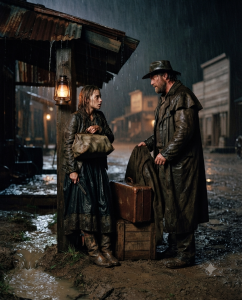
The abandoned station at the edge of town had half a roof and warped boards that still blocked some of the wind. It was enough to crouch under, not enough to feel safe in. Nora set her suitcase down, sat on it to keep it out of the rising water, and wrapped her arms around her medical bag.
She told herself it was only for one night.
She had slept in worse places. She had survived colder rooms, meaner towns, and kinder lies. But the truth was that she was tired in a way that had nothing to do with travel. Tired of being respectable enough to serve people but never acceptable enough to belong among them.
The creek behind the station was growing louder. Water crept beneath the broken planks and touched the soles of her boots. Nora reached down and slipped her hand into her right boot until she felt the handle of the small knife hidden there.
Then footsteps approached through the rain.
She looked up sharply.
A man stood beyond the slanting curtain of water, tall enough to block what little light came from the street. He had broad shoulders, a dark coat soaked through, and a noticeable limp when he came closer.
“Miss,” he said.
“I’m not looking for trouble.”
“I know,” he replied. “I saw what happened at Murphy’s.”
His voice was steady, flat, unpolished. It made her trust him less and more at the same time.
“Then you know I handled it.”
He gave the smallest nod. “You did.”
He removed his coat and laid it over her suitcase instead of trying to drape it around her shoulders. It was a careful gesture, the kind a man made when he understood exactly how little room he had to make a stranger feel trapped.
“Callum Wyatt,” he said. “I’ve got the blacksmith shop down the road. There’s a spare room at my place. It’s dry. It locks. Fire’s still going.”
Nora stared at him. “What do you want?”
Something shifted across his face—not offense, not surprise. Recognition, maybe.
“Nothing,” he said. “I know what it is to need shelter and hate the asking.”
She kept one hand near her boot. “I carry a knife.”
A strange shadow of approval moved through his expression. “Then keep it close.”
The creek water reached the edge of her skirt.
Nora picked up the coat.
Callum’s home was small and plain, but so carefully kept that she noticed absence before comfort. No clutter. No scattered belongings. No recent laughter in the walls. Just order, and the kind of quiet that suggested someone had once mattered there very much.
He led her to a room and stopped in the doorway.
“That bed’s made. Key works from the inside.”
She noticed the brush on the dresser. The folded shawl. A dress still hanging behind the door.
“Margaret’s room?” she asked.
His pause was brief, but not brief enough.
“Yes.”
He did not say who Margaret had been.
He brought hot water and left it outside the door. Then dry clothes that were too large but freshly washed. Then a plate with bread and potatoes. He made his own bed on the floor by the fireplace. Nora checked the lock twice and slept with her knife under the pillow anyway.
More than once during the night, she woke to the sound of him rising quietly to add wood to the fire.
He never knocked. Never asked for thanks. Never gave her reason to regret the coat.
At dawn, Dust Hollow found a reason to test her.
Mrs. Hutchkins arrived first, carrying a basket on one arm and suspicion in every line of her body.
“So you’re the nurse.”
“Nora Reed.”
“My grandson’s had fever for two weeks. Morrison says he’ll sweat it out.”
“Will he?”
The older woman’s mouth tightened. “If he dies because you don’t know what you’re doing, I’ll hold you responsible myself.”
Nora packed her bag and went.
The boy lay in a back room with cracked lips, labored breathing, and white patches spread through his mouth and throat. The town doctor had dismissed it as common fever. Nora recognized infection, dehydration, and dangerous neglect. She cleaned his mouth, mixed a rinse, brought his fever down carefully, and ordered a routine for food, water, and rest. Mrs. Hutchkins argued twice, then obeyed once she realized Nora was not guessing.
Three days later, the child sat up on his own.
Five days later, he smiled at his grandmother over a bowl of broth.
After that, word traveled the way it always did in small places—faster than kindness, slower than gossip, but harder to stop. People who wouldn’t have offered Nora a chair started knocking at dawn with coughs, burns, fevers, labor pains, swollen joints, and sick children.
She treated babies too weak to nurse and old men too proud to admit they were ill. She cleaned infected wounds, changed dressings, sat through terrible nights with frightened mothers, and taught practical remedies to women who had never had anyone explain their own homesickness of the body back to them in plain language.
Then there was Thomas Garrett.
He was eight years old and had not spoken a word in his life. The town had decided that meant he understood nothing. His father called him simple. Other children mocked him. His mother loved him fiercely but had no language for him beyond tears.
Nora sat with him in the yard, watched his eyes, the shape of his attention, the speed of his hands when he got excited. She began showing him signs for water, bread, yes, no, pain, tired, happy. Thomas learned with startling speed. Within days, he was communicating more clearly than most adults in Dust Hollow.
When his mother realized her son had been listening all along, she cried so hard she had to grip the porch rail to stay upright.
Dust Hollow did not become generous overnight. But it changed.
Sometimes change starts as need before it grows into respect.
Through all of it, Callum remained the one constant Nora had not expected. He watched her come and go from the forge or from the porch with that same quiet attention that never pushed. If she returned exhausted, there was food left warming. If she came back shaken, there was silence available. He never asked questions on nights she clearly couldn’t bear them.
And slowly, because kindness given without pressure is harder to resist than charm, Nora began to notice the man beneath the limp.
Callum’s injured leg had healed badly years before. Long hours standing at the forge made the pain worse, though he pretended otherwise. He had a habit of pressing one hand to the table edge when rising too quickly. Sometimes, when he thought she wasn’t looking, pain darkened his face so suddenly that it vanished before anyone else would have caught it.
Nora did.
She also noticed that Margaret’s room had never really been emptied.
One evening, while folding the borrowed dress she had washed and mended, Nora asked carefully, “Who was she?”
Callum stood at the stove a long time before speaking.
“The woman I meant to marry.”
He said it with no decoration, and that made it heavier.
Margaret had fallen ill two winters earlier. A coughing sickness that turned deep, then cruel. He had nursed her himself because there was no one else. By the time the doctor admitted how serious it was, she was too far gone to save. The room Nora slept in had been hers. The shawl on the chair. The brush on the dresser. The dresses left hanging because removing them would have felt too much like erasing proof that she had existed.
“I kept meaning to pack things away,” he said. “Then one season turned into another.”
Nora looked at him and understood with a pain she did not expect that some griefs were not dramatic. They were domestic. They lived in drawers and folded cloth and the shape of a room kept exactly the same because changing it felt like betrayal.
That night, perhaps because grief had finally been spoken aloud between them, she told him about Chicago.
About Charles.
About Rose.
The engagement party had taken place in her aunt’s bright front room with champagne, lace, and too many smiling relatives. Nora had gone upstairs looking for an extra shawl and found her fiancé with her younger sister, close in a way no misunderstanding could explain. The humiliation was not only in what she saw, but in how little surprise showed on their faces when they realized she knew.
They married three months later.
Her family called it unfortunate. Complicated. Painful for everyone. As if betrayal became gentler when enough people used soft words around it.
So Nora left. Not because she was weak, but because staying would have required her to smile in rooms where everyone expected her to swallow disgrace politely.
When she finished, the fire between them had burned low.
Callum poked once at the embers and said, “Sometimes broken things still work. They just work different.”
No promise. No sermon. Just truth, offered carefully.
Nora carried that sentence for days.
By the time winter fully settled over Dust Hollow, she had become part of the town in the strangest possible way: not accepted exactly, but depended upon. It was enough that people lowered their voices when she entered rooms. Enough that children waved. Enough that even Murphy’s Inn no longer looked at her as if she were contagious.
Then came the fire.
It began in the Malone house on a wind-sharp evening when snow had already crusted over the edges of the road. Someone shouted first from the street. By the time Nora got there, flames were biting through the front windows and smoke rolled into the dark sky in thick black columns.
Mrs. Malone was in the yard half-mad with terror.
“Mary’s inside!”
Nora’s medical bag dropped into the snow before she consciously let go of it.
She ran.
Heat slammed into her immediately, dry and violent. The inside of the house glowed orange through smoke so thick it made the walls seem to sway. She stayed low, calling Mary’s name, coughing hard enough to tear her throat raw. A weak cry answered from the back room.
The child was curled beside a chair, disoriented and frozen with fear. Nora dragged her up, wrapped one arm around her, and tried the back door only to find it jammed. Flames licked down the hall. She turned, saw the nearest window, and made the choice on instinct. She shoved a blanket around Mary, drove her elbow through the weakened glass, kicked out the remaining frame, and pushed the girl ahead of her into the snow.
They landed hard outside to a wave of shouts.
Mrs. Malone threw herself over her daughter, sobbing in relief.
Nora was on her knees coughing, trying to pull air into lungs that felt lined with fire, when the woman screamed again.
“Caesar! Her dog!”
The little terrier.
Still inside.
Nora lifted her head just in time to see Callum moving toward the house.
“Callum, don’t—”
But he was already gone into the smoke.
The next few seconds stretched into the longest of Nora’s life. The crowd surged uselessly. Men shouted that the roof was weakening. Somebody grabbed a bucket. Another called for rope. Nora stood, stumbled, and would have followed if two people hadn’t caught her by the arms.
Then Callum reappeared through the front doorway with a shaking dog clutched against his chest.
A cheer started and died in the same breath.
A burning beam gave way above him and crashed down across his shoulder.
Callum hit the ground.
Nora reached him first.
Snow hissed under falling embers. Caesar was still alive, singed and trembling. Callum’s coat had begun to smolder near the sleeve. Nora slapped the sparks out with bare hands and called for blankets, boards, anything. Her training took over because panic could come later.
“Don’t move him yet,” she snapped. “Support the neck. Easy—easy!”
He opened his eyes when she pressed against the wound to slow the bleeding.
“Don’t you dare die after saving a dog,” she said, furious because fear felt too exposed.
His mouth twitched despite the pain. “He wasn’t just a dog.”
At first she thought smoke had stolen part of the sentence.
Then she remembered Margaret.
Later, once they had him carried to safety and laid out in his own front room, Mrs. Malone came with Caesar wrapped in a quilt and crying so hard she could barely speak.
“Margaret found him,” she said. “Years ago. Half-frozen by the creek. Mary’s loved him ever since.”
Nora looked at Callum, pale with pain even in half-consciousness, and finally understood. He had not run into that fire because it was brave. He had run because the dog was one of Margaret’s last mercies still living in the world. Saving Caesar was, to him, one more way of not failing her.
That realization struck Nora somewhere deep and undefended.
She worked on him for hours. The beam had bruised and torn muscle across his shoulder and upper back. There were burns, though not the worst kind, and the old weakness in his body made shock more dangerous. She cleaned, stitched, wrapped, monitored, argued, and refused to leave his side. Mrs. Hutchkins bullied the curious out of the house. Thomas Garrett brought water without being asked. Even Murphy’s wife sent broth.
By morning, Dust Hollow knew two things.
Callum Wyatt had nearly died saving a child’s dog.
And Nora Reed had fought sleep, blood loss, and fear all night to keep him alive.
He woke near noon, disoriented and thirsty.
Nora was sitting beside the bed with dark circles under her eyes and dried soot still faintly shadowing one cheek. When he tried to sit up, pain stopped him immediately.
“You move again,” she said, “and I will personally finish what the beam started.”
His mouth curved. “You always this kind to patients?”
“Only the stupid ones.”
He looked at her for a long moment, then at the ceiling. “Dog make it?”
“Yes.”
“Mary?”
“Alive.”
He let out a breath that sounded almost like peace.
For the next week, the whole town participated in his recovery whether he wanted them to or not. Meals appeared. Firewood was chopped. The forge stayed closed under protest. Children left awkward little gifts on the porch. Mrs. Malone came twice to apologize for not stopping him, as if anyone could have.
And Nora, despite every warning she had once given herself about needing too much, remained beside him more than necessary.
At first she told herself it was medical.
His shoulder dressing needed changing. His fever had to be watched. He required help standing the first few days. Then there were medicines to time, meals to monitor, pain to manage, sleep to coax.
But medicine alone did not explain the softness creeping into the quiet between them.
One evening, with snow falling lightly outside and the room warmed by a steady fire, Callum said, “You know the first thing I noticed about you?”
Nora looked up from rewrapping his bandage. “My knife?”
He huffed a laugh that became a wince. “Your chin.”
“My chin.”
“The way you lifted it after they turned you out. Like you’d rather freeze than let them see you bend.”
She tied the bandage carefully. “I nearly did freeze.”
“I know.”
Something fragile and dangerous moved between them.
Nora set the cloth aside. “Why did you really come after me that night?”
He met her gaze. “Because I know what it looks like when someone’s trying not to break in public.”
That should not have undone her. It did.
She sat back, all at once unable to hide inside practical tasks anymore.
“I thought if I stayed nowhere too long,” she admitted, “then no place could hurt me.”
“And did it work?”
She looked around his small house, at Margaret’s room no longer feeling like a shrine but a history, at the chair where Callum had once slept by the fire to keep a stranger warm, at the man who had never asked her for anything she wasn’t ready to give.
“No,” she said.
He was quiet a moment. “Good.”
She stared at him.
He swallowed carefully. “Because I don’t want you leaving.”
The words landed with startling force.
For a woman who had been abandoned in a hundred quieter ways, it would have been easy to mistrust them. Maybe that was why the next thing mattered so much: Callum did not reach for her. Did not crowd the moment. He simply let the truth stay there between them.
Nora stood, walked to the window, and watched the snow for several seconds before turning back.
“I don’t know how to start over,” she said.
“Neither do I.”
It was the most hopeful answer anyone had ever given her.
Months later, when spring finally softened the roads and green returned in thin stubborn lines along the creek, Dust Hollow held a fair. Children ran between stalls. Thomas signed jokes at his mother until she laughed loud enough for three people. Mrs. Hutchkins pretended not to cry when her grandson raced the other boys. Mrs. Malone kept Caesar on a leash as if the dog might personally seek out another disaster.
Murphy’s wife approached Nora near the pie table with an expression so strained it almost made Nora smile.
“I was wrong,” the woman said at last. “That night.”
Nora let the silence sit just long enough.
“Yes,” she said. “You were.”
It was not forgiveness exactly. But it was honest, and honest was often the stronger thing.
By summer, the room that had once been Margaret’s was truly Nora’s. Not because Margaret had been forgotten, but because love is not erased by making room for the living. Callum helped move the dresses to a cedar chest one quiet afternoon. He cried only once. Nora held his hand through it.
When he asked her to marry him, there was no audience, no flowers, no polished speech. Just the forge cooling in the evening, the smell of iron and rain in the air, and Callum saying, “I don’t have much talent for grand gestures. But I’d like to spend the rest of my life making sure you always have one warm place to land.”
Nora laughed and cried at the same time, which he later claimed was unfair because it made him nearly forget the ring.
She said yes.
And years later, when strangers came through Dust Hollow in bad weather and asked after lodging, no one was turned away for arriving alone.
People said it was because the town had changed.
Nora knew better.
Towns don’t change on their own. People do. One choice at a time. One open door at a time. One act of stubborn mercy at a time.
Still, whenever she thought back to that first night—the rain, the mud, the humiliation at Murphy’s Inn, the rusted station, the creek rising at her feet—she understood how close her life had come to taking a colder shape.
All because one man with a limp had seen her in a storm and offered shelter without demand.
All because later, she had chosen to stay long enough to see that grief and goodness could live in the same house.
Maybe the biggest red flag in her old life had been how often she had been asked to accept betrayal quietly. Maybe the biggest lesson in her new one was that love did not always arrive with charm, certainty, or perfect timing. Sometimes it came with old pain, rough hands, a scarred shoulder, and a spare room that still belonged to someone else.
Sometimes the right person was not the one who made the grandest promise.
Sometimes it was the one who kept a fire burning through the night and never once asked to be thanked.