The night Clara Mendoza was locked inside a rusted office at the port of Veracruz, she stopped being invisible.
For three years, invisibility had been her greatest skill.
She knew how to stand quietly beside power without becoming part of it. She knew how to answer calls, schedule meetings, adjust her boss’s calendar, and keep her face still when men with expensive watches and dangerous eyes stepped into Arriaga Transportes headquarters without signing in. She knew when coffee should arrive, which folders needed to be locked, and which names should never be said loudly enough for a hallway to hear.
And above all, she knew how not to ask questions.
That was the rule that kept people employed in Veracruz.
Sometimes, Clara thought, it was also the rule that kept them alive.
At twenty-nine, she lived in a small apartment with peeling paint, a stubborn orange cat named Chispa, and the permanent smell of instant coffee. Every month she sent money to her mother in Xalapa, where the older woman’s medicines grew more expensive by the season. Clara’s life was not glamorous, but it was stable. Stability mattered more to her than comfort ever had.
Working for Julián Arriaga paid well.
Working for him also meant learning that expensive suits and polished conference rooms could hide things no one wanted named. His company, Arriaga Transportes, looked pristine from the outside. Clients loved its reliability. Tax records were spotless. Uniforms were pressed. Trucks were immaculate.
But cities like Veracruz had their own way of measuring men.
And by that measure, Julián Arriaga was not simply a businessman.
He was the kind of man people lowered their voices around.
He was tall, controlled, and impossible to read. He spoke softly, which somehow made him more intimidating. He never laughed loudly. Never wasted words. Never repeated himself. When angry, he became quieter, not louder.
At first, Clara had feared him.
Then she learned something stranger.
He watched everything.
He noticed when employees were late because their children were sick. He knew who was stealing fuel, who was lying on invoices, who had a gambling problem, who had a drinking problem, and who needed an advance on salary but was too ashamed to ask. He could be ruthless, yes. But he was not careless. There was order in the world he built, and people who depended on him survived by respecting it.
Clara respected it.
Maybe that was why he trusted her more than most people did.
Maybe that was also why, on the night everything collapsed, she was the one sent to Warehouse Seventeen.
It started with payroll envelopes.
The evening had already turned heavy with incoming rain when Julián called her into his office. He was standing near the window, jacket on, ready to leave for a private dinner meeting.
“Take these to the night shift at Seventeen,” he told her, handing over a stack of sealed envelopes. “Get signatures. Leave immediately after.”
“Is something wrong there?” she asked.
He looked at her for one beat too long.
“Not if everyone does what they’re supposed to.”
That should have unsettled her more than it did.
But Clara had worked around tension long enough to treat it like background noise. She took the envelopes, drove to the port, and told herself she would be in and out in ten minutes.
Warehouse Seventeen looked half asleep when she arrived. Sodium lights buzzed overhead. One truck was parked crooked near the loading area, and a damp wind carried salt from the water.
The security booth was empty.
So was the supervisor’s station.
Clara frowned. Hugo Salcedo, the floor foreman, was supposed to sign for the envelopes. Hugo had worked for Arriaga Transportes for nearly seven years. Thick-necked, broad-handed, always smelling faintly of diesel, he was not a man Clara liked, but he had always behaved with enough obedience around the office to avoid trouble.
She called his name once.
No answer.
Then she heard voices from deeper inside the warehouse.
She should have turned around.
Later, she would replay that moment over and over, wondering whether some tiny instinct had already tried to save her. But curiosity, once mixed with uncertainty, can be stronger than caution.
So she followed the sound.
Through a gap between stacked pallets, she saw them.
Hugo stood beside three men she had never seen before. Their posture alone made it obvious they did not belong to any official transport crew. One had a shaved head and a scar under his chin. Another wore gloves despite the heat. The third leaned against a crate as if he had all night.
Hugo was speaking quickly, nervously.
Clara couldn’t catch every word.
But she saw him hand over a folded paper with access codes.
And she saw sealed boxes marked with Arriaga Transportes inventory numbers being loaded into a dark van with no plates.
Her blood turned cold.
This wasn’t random theft. This was internal.
Someone had opened the gate from inside.
Clara stepped backward.
The heel of her shoe struck an empty metal bucket.
The clang exploded through the warehouse like a gunshot.
Every head turned.
For half a second, nobody moved.
Then Hugo pointed directly at her.
“Get her!”
She ran.
She didn’t think. Didn’t scream. Didn’t stop to argue that she hadn’t really seen anything. She clutched the payroll envelopes to her chest and sprinted past forklifts, crates, and hanging chains while footsteps thundered behind her.
Some instinct sent her up the iron stairs to the second floor.
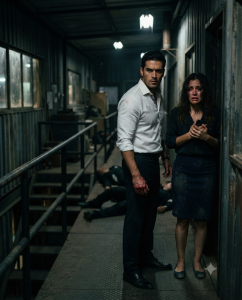
At the end of the walkway she found the supervisor’s office, shoved herself inside, and locked the door. The room smelled like rust and damp paper. A metal desk. A chair. Filing cabinets. One dirty window.
Her hands shook so hard she almost dropped her phone.
She called the number she was never supposed to use unless it was urgent.
The black number.
The private one.
Julián answered on the first ring.
“Talk.”
At the sound of his voice, something inside her almost gave way.
“Mr. Arriaga…” she whispered. “Can you come get me?”
There was breathing at the other end. Then nothing. Then steel in his voice.
“Where are you?”
“Warehouse Seventeen. Second floor. Supervisor’s office. I locked the door, but they have keys.”
He asked no useless questions.
“Get under the desk. Leave the call open. Don’t breathe too loud.”
Outside the office, footsteps pounded up the stairs. Men cursed. Metal rattled.
“Julián…”
She had never called him that before.
There was the smallest pause.
Then: “I’m coming.”
She crawled beneath the desk, knees pressed against her chest, phone clutched so hard her fingers cramped. The men found the door fast.
One of them laughed.
“Come out, sweetheart. We just want to talk.”
Another tested the knob.
Then the lock.
Clara put a hand over her mouth.
She thought of her mother in Xalapa. Of the medicine money she had not sent yet. Of her cat waiting at home. Of every time she had convinced herself that silence was safety.
Metal scraped in the lock.
Then came a crash so violent it shook the wall.
A grunt.
Another impact.
A body hitting the floor.
She heard a strangled cry, then nothing.
Silence rushed in so completely it was worse than noise.
Three soft knocks sounded against the door.
“Clara.”
She knew his voice instantly.
When she opened the door, Julián was standing in the hallway with his sleeves rolled up, tie missing, and blood split across his knuckles. Two men were down behind him. One conscious. One maybe not.
He looked at Clara the way a man looks after arriving one second too close to disaster.
She grabbed his shirt and broke into sobs she didn’t know she had been holding back for years.
“I saw them. Hugo gave them the codes. They were moving boxes. They came after me—”
“Not anymore,” he said.
He slid his jacket over her shoulders and guided her downstairs.
Outside, rain had started falling in sheets.
Ramiro, Julián’s most trusted enforcer, stood by the black truck.
“And Hugo?” Julián asked.
“Gone.”
“Find him.”
Inside the truck, Clara stared at the blood on her fingers and realized it wasn’t hers. Julián took out a handkerchief and wiped each finger clean as gently as if she were made of glass.
“I’m sorry,” he told her.
She looked at him, stunned by the softness in his voice.
“For what?”
“You should never have seen my world like that.”
“But you came.”
His hand stilled around hers.
“If you call me,” he said, “I will always come.”
The confession sat between them, dangerous in ways neither of them named.
Then Ramiro’s phone rang.
He answered, listened, and his expression changed.
“Boss. They found Hugo.”
“Where?”
“At Doña Mercedes’s house.”
The temperature in the truck seemed to drop.
Clara looked from Ramiro to Julián. “Who is Doña Mercedes?”
“My mother.”
They drove there in silence.
Mercedes Arriaga lived in an old stone house overlooking a quieter section of the coast, far from the ports and warehouses. Clara had seen her only twice before at company events. She was elegant, immaculately dressed, and famous among Veracruz’s upper circles for charity luncheons, church donations, and a spine made of polished ice.
She was also known for one unshakable truth: nobody influenced Julián Arriaga more deeply than his mother had.
By the time the truck reached the house, the gates were already open.
That detail bothered Clara immediately.
No one opened those gates without permission.
Rain glittered on the driveway as Ramiro’s men hauled Hugo across the patio. His face was swollen and one eye was already closing. He was shaking so badly he could barely stand.
The front door opened before they knocked.
Mercedes stood there in a cream silk robe, one hand around a glass of red wine, perfectly composed. She took in the scene—her son, the blood, the foreman, the frightened young woman in his jacket—and did not seem surprised by any of it.
Instead, she looked directly at Clara.
“So,” she said softly, “that’s the girl.”
A chill ran up Clara’s back.
Julián stepped in front of her. “Tell me I’m wrong.”
Mercedes gave a faint sigh, as though the evening had become inconvenient.
“If you were wrong,” she said, “your employee would be home by now.”
Hugo dropped to his knees.
“Señora, please, I did what you said. I only wanted to scare her. I swear I didn’t know he’d go there himself—”
“Quiet,” Julián said.
The single word hit harder than a shout.
Mercedes set her wine glass down with exquisite care.
“I told them not to touch her permanently,” she said. “I needed her frightened, not dead.”
Clara stared at her.
Needed?
Julián’s face emptied of expression in a way that felt more alarming than rage.
“Why?”
Mercedes’ eyes flicked toward Clara again. Not with hatred exactly. With calculation.
“Because she saw something she was never supposed to see,” she replied. “And because if she talked, she would destroy what is left of this family.”
Julián took a step forward. “Explain.”
Mercedes was silent for a moment. Rain whispered against the windows. Hugo breathed in short desperate bursts on the floor.
Then she said a name.
“Tomás.”
Julián froze.
Clara had never heard that name before, but the effect on him was immediate. Something old and buried flashed behind his eyes.
“My brother is dead,” he said.
Mercedes’ mouth tightened. “That is what I allowed everyone to believe.”
The room seemed to shift.
Ramiro looked stunned. Hugo actually stopped groaning.
Mercedes moved to the sitting room and sat down as if beginning a formal conversation. No one else sat.
“Tomás stole from us years ago,” she said. “Not money. Information. Routes. Clients. He had your father’s weakness and none of his discipline. When he realized he would never inherit control while you were alive, he made arrangements with men who wanted access to the company. Those arrangements did not die with him, because he never died at all.”
Julián’s voice turned flat. “You’re lying.”
“No,” Mercedes said. “I buried his name, not his body.”
Clara felt sick.
The warehouse.
The codes.
The stolen crates.
This had never been a random inside job. It was part of something older. Something private.
Mercedes continued, “Tomás has been using old company channels through intermediaries for months. Hugo was one of them. Small diversions at first. Inventory transfers. Access points. Men who remembered old loyalties. I knew about it before you did.”
Julián’s stare could have cut stone. “And instead of telling me, you let it continue?”
“I contained it.”
“You hid it.”
“I protected this family.”
“By sending men after my employee?”
Mercedes stood abruptly. For the first time, the mask cracked.
“She is not just your employee,” she snapped. “Do you think I’m blind? Do you think I don’t see what happens to men when they start choosing with their hearts instead of their heads?”
The accusation hung in the air.
Clara felt heat rush to her face despite the cold.
Julián said nothing, which somehow said too much.
Mercedes turned on Clara. “Girls like you think a rescue changes what world you’re standing in. It doesn’t. It only makes you useful.”
Julián stepped forward so fast Ramiro tensed.
“That’s enough.”
His mother met his eyes. “The night your father trusted blood over caution, we nearly lost everything. I will not watch you repeat him.”
“Tomás is alive,” Julián said. “Where?”
Mercedes’ silence returned.
He understood before she spoke.
“You’ve been helping him.”
Her chin lifted. “I have been deciding which son was least likely to burn this family to the ground.”
The confession landed like a physical blow.
For the first time that night, Clara saw genuine pain in Julián’s face.
Not anger.
Not violence.
Pain.
“He sold information. He sold routes. He put our people at risk.”
“He is still my son.”
“And I am what?”
Mercedes did not answer quickly enough.
That was answer enough.
Hugo, sensing the room tilt, started speaking too fast.
“I never wanted trouble, boss, I swear. Doña Mercedes said it was controlled. She said the girl only needed to be scared because she’d seen the transfer list with Tomás’s name on it. She said if you found out too early, there would be war.”
Clara blinked.
“The transfer list?”
Hugo swallowed. “You picked up the wrong envelope from the loading desk before you ran. Payroll was under it.”
Everyone looked at the papers still clutched in Clara’s hand.
In the panic, she had never checked them.
With numb fingers, she opened the damp stack.
Payroll envelopes.
And beneath them, a folded manifest.
She handed it to Julián.
He opened it and read in silence. Then once more. His jaw tightened.
At the bottom of the page, beside a transfer authorization, was a signature line with a name written in ink.
Tomás Arriaga.
Not dead.
Active.
Moving goods through Warehouse Seventeen.
Using his mother’s protection.
Mercedes finally looked worried.
“Julián, listen to me. If you go after him publicly, every rival you have will smell weakness. The company will fracture. Clients will run. Men will choose sides.”
He folded the paper once, carefully.
“Then let them choose.”
He turned to Ramiro. “Lock the house down. No phones out. No one leaves.”
Mercedes stepped toward him. “You would do this to your own mother?”
He faced her fully, and Clara thought she had never seen a colder expression on any human being.
“No,” he said. “You did this to your own son.”
What followed moved fast.
Ramiro’s men took Hugo away. Two others quietly collected Mercedes’s phone and cut the landline. She did not scream. She only stared at Julián with a grief sharpened into pride, as if even now she believed she had been the only adult in the room.
Julián gave orders with frightening calm. Pull records from the northern storage lots. Freeze every transfer linked to old authorization codes. Call three regional managers he trusted. Shut down the port channels before dawn. Find Tomás.
Then he turned to Clara.
For the first time since the warehouse, the room became small again.
“You should leave,” he said.
Clara almost laughed at the absurdity. “And go where? Someone tried to corner me in a locked office because I saw your brother’s name on a document your mother wanted buried.”
His gaze softened just enough to hurt.
“That is exactly why you should leave.”
She looked at the chaos around them. At Mercedes standing tall in silence. At rainwater drying on the marble floor. At the blood on Julián’s hand, reopened and ignored.
“No,” she said quietly. “Not until I know what happens next.”
Something changed in his face then. Not surprise. Recognition.
As if this was the moment he truly understood that Clara was not fragile simply because she had been afraid.
Fear and strength often lived in the same place. She knew that. Maybe now he did too.
Tomás was found less than nine hours later.
Not in Veracruz proper, but at a coastal property registered under a shell company once owned by their late father. He tried to run when Ramiro’s men arrived. He failed.
By sunrise, he was standing in one of Arriaga’s private storage facilities, wrists zip-tied, rain still on his shoes, staring at the brother he had hidden from for years.
Tomás and Julián looked enough alike to make the scene unsettling. Same height. Same dark eyes. But where Julián was disciplined, Tomás looked frayed at the edges, handsome in a ruined way, like charm had rotted into appetite.
“I knew eventually you’d come yourself,” Tomás said.
Julián said nothing.
Tomás smiled when he saw Clara standing farther back near Ramiro.
“So that’s her. The witness.”
Julián hit him before anyone else moved.
Not wildly. Not emotionally. Just once. Hard enough to knock him to the floor.
“Talk,” Julián said.
Tomás spat blood and laughed. “Mother always liked you better in public. Me better in private.”
“What were you moving?”
“Routes. Inventory. Access. Whatever your enemies would pay for.”
“You sold our people.”
“I sold your illusion.”
Julián crouched in front of him. “You sent men after her.”
Tomás glanced at Clara. “I told Hugo to scare whoever saw the list. Mother approved it.”
That was enough. The rest came out in pieces over the next hour—old accounts, stolen manifests, client leaks, security gaps, long-term siphoning hidden under legitimate shipments. Mercedes had covered the damage to prevent scandal. Tomás had used her protection to dig deeper. Hugo and a handful of others had played both sides for money.
It was betrayal layered over betrayal until family itself looked like a criminal enterprise.
When it was done, Julián made his choice.
He cut Tomás out completely.
No private forgiveness. No quiet exile. No more protection.
Authorities would receive just enough evidence to make Tomás’s next years very difficult, though not enough to destroy Arriaga Transportes entirely. Hugo disappeared into a smaller, harsher corner of Julián’s world where men who confused fear with loyalty often ended up. Mercedes was removed from every internal decision, every account, every trusted channel. She kept her name, her house, and her dignity in public—but never again her influence.
And Clara?
Clara resigned.
Not dramatically. Not in tears. She typed the letter herself two days later.
When she placed it on Julián’s desk, he looked at it for a long time before looking up at her.
“I can raise your salary,” he said.
“This isn’t about salary.”
“I can move you somewhere safer.”
“This isn’t about safety either.”
He stood.
The silence between them held too much truth now to hide behind job titles.
“I meant what I said,” he told her. “If you call me, I will come.”
She believed him. That was part of the problem.
“I know,” she said. “And that’s exactly why I have to go before I forget what it cost for you to mean it.”
For the first time since the night at the warehouse, Julián had no answer ready.
Clara left the office with steady hands.
Three weeks later, she found work with a customs law firm in another part of the city. Smaller salary. Cleaner conscience. Chispa still knocked pens off tables. Her mother still needed medicine. Life did not transform into a fairy tale because danger had looked at her and missed.
But she was no longer invisible.
As for Julián, people in Veracruz said Arriaga Transportes became even harder after that. Tighter systems. Fewer leaks. No tolerance. Yet those same people noticed he stopped attending certain society dinners where his mother still appeared like nothing had happened. They noticed he no longer used family language in business conversations. They noticed something in him had gone colder.
Months later, Clara saw him once across a hotel lobby.
They did not speak.
They only looked at each other for one suspended second that seemed to contain an entire unfinished life.
Then he walked away.
Some stories end with justice. Some end with love. The worst ones make room for both and still leave damage behind.
Maybe Mercedes believed she was protecting her family.
Maybe Julián was right to burn the lie down.
Maybe Clara did the bravest thing by stepping away from a man who would have saved her every time, even if standing near him meant being pulled into wars she did not create.
But if there was one red flag no one in that house could deny, it was this:
The most dangerous betrayals are rarely the ones that come through the door.
They are the ones already sitting at the family table.