When Norma Elaine Buckhart found herself locked out of the bakery she had helped build, she did not yet understand that the hardest part would not be losing the business.
The hardest part would be realizing how long the betrayal had been in motion.
For twelve years, Buckhart & Delaney Bakery had been the center of her life. The shop sat on Clover Street, where the morning traffic rolled past just as the first racks of bread came out warm and fragrant. It was the kind of local place that knew family names, remembered anniversaries, and boxed pastries for funerals with the same care it used for weddings. The bakery mattered to Millfield because it had become stitched into the town’s rituals. Birthday cakes, church fundraisers, retirement parties, baby showers, graduation cookies—if a family had celebrated something in the past decade, there was a good chance Norma had stayed late the night before to make sure it was right.
She had never minded the work.
She minded what people misunderstood about it.
Gerald Delaney, her business partner, was charming in a polished, public way. He wore pressed shirts even around flour. He could talk to donors, flirt with sponsors, and pose for smiling photos with a boxed cake balanced in his hands like he had just pulled it from the oven himself. People liked Gerald. He understood how to be seen.
Norma understood how to make things hold together.
She knew invoices, ingredient shortages, refrigeration failures, and the exact number of minutes a buttercream emergency could cost on a humid day. She knew which employee could handle front counter pressure and which one would cry in the walk-in freezer after a difficult customer. She knew how to rescue a failing sourdough starter and how to talk a frantic bride down from panic when an ice storm shut down half the county the day before her reception.
In 2019, when severe weather delayed several wedding orders, Gerald issued a polished statement online thanking the community for its patience. Norma was the one who stayed in the bakery until past midnight calling every client personally, apologizing, re-routing deliveries, and making sure nobody’s day collapsed entirely. That had always been the pattern. Gerald represented the brand. Norma saved it.
She had accepted the imbalance because she believed partnership was still partnership. They had signed papers. They had built the business together. She did not need applause to know where she stood.
That certainty ended on a Tuesday in October.
She arrived just before dawn, as she always did, the sky still dark and the air raw with the bite of oncoming winter. She parked in her usual spot behind the building, grabbed her bag, and walked to the back entrance. In one hand she carried her key ring. In the other she held a plain white coffee mug with a red cardinal painted near the rim. She had taken it home the day before to wash because she’d left it sitting overnight with tea inside and disliked the faint stain it left.
The mug had belonged to her mother.
Not originally, of course. Her mother had given it to Norma years earlier, on the day the partnership papers were signed. The gift had been wrapped in tissue and handed over with a teasing smile.
“For the desk in your office,” her mother had said. “So when men start talking too loudly in meetings, you can sip something and let them think.”
Norma had laughed then. She remembered that.
She remembered laughing because that morning, standing behind the bakery with a key that would not turn, laughter felt like it belonged to another version of her life.
She tried the lock once. Then again. Then harder.
Only after the third attempt did she really see the metal.
The deadbolt was new.
She stepped back, staring at the back door as the cold shifted under her coat. There was a sheet of paper taped at eye level. Her name appeared first.
Norma — ownership restructuring effective immediately. Please contact my attorney for transition details. — G
She read it once, then again, then a third time, as if repetition might change the meaning.
It did not.
She looked at the windows. Dark. Quiet. The bakery she had helped build was right there, a few feet away, but suddenly sealed against her. Her first thought, absurdly, was that something terrible must have happened and Gerald had handled it badly. Her second thought was worse.
No. He had planned this.
She walked back to her car with the note still in her hand, slid into the driver’s seat, and put the mug on her lap. She did not cry. The numbness came first. The kind that makes a person sit completely still while their mind lags behind the event, trying to catch up to what the world has already done.
At home, she placed the mug on her kitchen table and finally called Gerald.
He did not answer.
His attorney did.
The conversation was short, formal, and infuriatingly polished. There had been a restructuring. Ownership matters had been clarified. She would receive transition information. Further communication should be directed through counsel.
Transition.
The word was so clean it made her nauseous.
When she hung up, she sat at the kitchen table staring at the cardinal. After a while, her neighbor Roy Caplan knocked on the back door.
Roy had lived next door for years. He was a widower with a dry sense of humor, a habit of trimming his hedges in old loafers, and a mind that had not softened at all since his retirement from title law. He noticed things. He noticed trash pickup schedules changing, strangers parking too long on the street, and when someone next door looked like they had received the sort of phone call that rearranged their blood pressure.
Norma showed him the note.
Roy read it once and asked, “Do you still have copies of your original documents?”
She did. Most of them, anyway. Partnership agreement, deed records, financing paperwork, amendments, insurance files, expansion documents from the second renovation.
He read the note again.
Then he said, “This smells like document fraud dressed up in paperwork.”
That sentence changed everything.
The next morning Roy came over carrying reading glasses, legal pads, and the expression of a man who had just been given a mission too irritating to refuse. Norma made coffee. She filled the cardinal mug. Roy spread out papers. What began as neighborly concern turned into a six-month excavation.
Gerald’s move, once they traced it, was both cautious and arrogant. Years earlier, a filing omission connected to a property record had created a gap—not the kind of gap that erased ownership, but the kind an unscrupulous person might exploit if everyone else was too trusting to monitor the paper trail. Gerald had been building on that gap. He used amendments, supporting records, and selective submissions to present himself more and more clearly as sole controlling owner. Each step by itself looked technical. Together, they told a story.
He had not stolen the bakery in one dramatic act.
He had stolen it in increments.
Norma learned this one yellow tab at a time.
Roy reviewed county archives. He requested copies. He made notes in the margins. He traced notarizations and cross-referenced dates. He grew visibly offended whenever a document revealed another layer of manipulation.
“Look here,” he’d say, pushing a page across the table. “This filing references a prior instrument but excludes the rider.”
Or, “This signature block should have triggered review. It didn’t.”
Or, on better mornings, “We’ve got him on this one, Norma.”
Every time Roy said that, she put both hands around the warm mug and let herself believe, for a minute, that she had not been foolish for trusting the wrong person.
The cardinal became ritual.
Every morning she washed it, filled it, and set it beside the files. The tiny painted bird stared out over stacks of paper while the two of them rebuilt the story Gerald had tried to bury. It was ridiculous, maybe, how much comfort she took from a chipped mug. But grief often attaches itself to humble things. The mug had been there when her mother congratulated her. It had been there in the little office behind the bakery where she tracked orders and soothed brides and fixed mistakes no one else wanted to own. Now it sat on the kitchen table while she fought not to lose all of that to technical theft.
Meanwhile, the bakery carried on without her.
People in town began mentioning changes. Some did not realize they were saying anything important. “The cinnamon rolls tasted different.” “The wedding delivery was late.” “There’s a new girl at the front who doesn’t know regulars.” These comments were tiny cuts. Norma never bad-mouthed the bakery, but hearing them hurt in a private, physical way. That place had once moved to her rhythm. Now every failure felt like watching strangers mishandle something she loved and being powerless to stop it.
Gerald, however, seemed unbothered.
Photos appeared in the local chamber newsletter. Quotes about innovation. Posts about expansion. He smiled from ribbon cuttings and networking events as if prosperity had arrived by virtue of his brilliance alone. In interviews, he used singular language more and more often.
My bakery.
My vision.
My business.
Norma noticed every time.
Then spring came, and with it the announcement for the Millfield Chamber of Commerce Annual Gala. Gerald Delaney would be honored for Local Business Leadership.
Norma stared at the notice on her phone until her anger gave way to a strange calm.
Roy looked over her shoulder and said, “Well. That’s unfortunate timing. For him.”
By then they had found the critical chain.
The original financing structure for the bakery had included a guarantor protection rider tied to the property. Norma’s mother, years earlier, had co-signed an instrument that protected the ownership arrangement during the fragile first stretch of the business. It was one of those practical acts families perform quietly when they are trying to help each other survive. Not glamorous. Not public. Essential.
That rider had never been legally extinguished in the way Gerald’s later filings implied. Worse, his effort to consolidate control appeared to rely on leaving it out of the story altogether.
He had counted on memory fading. On a dead parent not speaking. On paperwork being too dense for anyone outside the process to challenge.
He had not counted on Roy Caplan.
By the week of the gala, the evidence packet was complete. Not flashy. Not theatrical. Solid. Roy assembled duplicates with tabs, explanatory notes, copies of recorded documents, and the exact pages needed to show how Gerald’s ownership narrative fell apart once the omitted co-signer instrument was restored to the chain.
Norma asked him, “What happens if I do this publicly?”
Roy answered, “The truth gets heard before anyone can smooth it over.”
She slept badly the night before the gala.
Not because she feared being wrong. That fear had faded weeks earlier. She feared the room. The eyes. The possibility of being made to look emotional or petty in front of the very people who had applauded Gerald for months. Public confrontation is rarely comfortable for the person who deserves to win it.
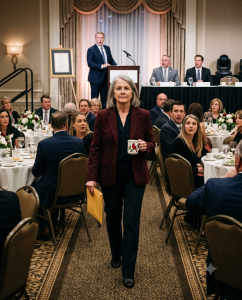
Still, she ironed her burgundy blazer. The same one she had worn to her daughter’s college graduation. She chose it because it reminded her who she was outside the bakery and outside Gerald’s version of events. She packed the packet into a manila envelope.
Then she reached for the cardinal mug.
She nearly left it on the table.
Instead, she carried it to the car.
The hotel ballroom was full when she arrived. Soft music, linen-covered tables, polished silver, local donors in formalwear, business leaders rehearsing warmth in every direction. At the front of the room stood the head table and the podium, where Gerald in a navy suit looked entirely at ease.
By the time Norma slipped through the side door, he was mid-speech.
He thanked the chamber.
He spoke about sacrifice.
He praised perseverance.
Then he referred to Buckhart & Delaney Bakery as his bakery.
Norma felt something in her settle.
She started walking.
At first only a few people noticed her. Then more. The room shifted in the subtle way large rooms do when attention begins to travel faster than sound. Gerald glanced up from the podium and saw her coming down the center aisle.
His face changed instantly.
Later, several people would say that was the moment they knew something was wrong. Men who are confident in their legal footing do not go pale at the sight of a sixty-one-year-old woman in a burgundy blazer carrying office supplies and a coffee mug.
Norma reached the stage without hurrying. She climbed the step. Gerald stopped speaking.
She placed the white mug on the podium first.
That detail would be discussed all over town afterward, because it was so strange and so precise. The mug looked almost delicate under the ballroom lights, the little red cardinal vivid against the white ceramic.
Then she laid down the manila envelope.
She tapped the microphone once.
The room went quiet.
She looked at Gerald, not angrily but clearly, and said, “Gerald. I believe you forgot to mention a co-signer.”
It took half a second for the sentence to land.
Then Gerald’s attorney moved toward the envelope. Before he could grab it, a voice from the aisle said, “Don’t.”
Roy Caplan was standing there with a duplicate packet in hand.
He walked forward without rush, holding the documents up just enough for the chamber president to see. The expression at the head table changed from irritation to fear. Some people in the audience stood. Others reached for their phones under the table, pretending not to.
Norma continued, steady as stone.
“You locked me out before sunrise,” she said into the microphone. “You sent me to your attorney as if I were an employee you could dismiss. Meanwhile, you filed around a signature you assumed nobody would ever trace back.”
Gerald tried to interrupt. “This is not the place.”
Norma replied, “You made it the place when you accepted an award for a business you don’t legally own by yourself.”
There was a rustle of shock across the ballroom.
Roy handed the packet to the chamber president and, in the measured tone of a man reading the weather, said, “The guarantor rider was never properly extinguished. Mrs. Buckhart’s mother remains part of the ownership protection chain by signature, and later filings omit that material fact.”
The chamber president flipped pages. Gerald took a step forward, then stopped, as if instinct finally met the wall of documentation.
Norma reached into the envelope and removed one final page.
Gerald saw it and whispered, “No.”
Unfortunately for him, the microphone caught that too.
A few people near the front audibly inhaled.
What followed moved quickly because, once people realize they may have been applauding fraud, they become very interested in procedure. The chamber attorney requested the packet. The award presentation paused. Someone from the board escorted Gerald away from the podium while questions erupted in controlled, horrified clusters. Norma did not raise her voice once.
She stood with one hand resting on the cardinal mug.
That image made the local paper the next day.
There were hearings after that. Reviews. Corrections. Lawyers with more polished shoes than Roy’s porch slippers. But the public moment mattered because it prevented the quiet burial Gerald had been aiming for all along. Under scrutiny, the paper trail collapsed. The omitted instrument was restored to the conversation. The ownership claim Gerald had relied upon could not stand the light.
Buckhart & Delaney Bakery did not survive unchanged.
The name changed first.
Norma refused to keep Delaney on the sign.
There were costs, delays, negotiations, and a period where reopening felt as daunting as the original build had once been. Some equipment had been neglected. Some staff had left for good. Some customers were wary of the scandal.
But towns have longer memories for honesty than opportunists expect.
When Norma reopened under a simpler name, people came back. Quietly at first, then in numbers. Former customers brought flowers. One bride whose wedding Norma had once salvaged drove in from another county just to buy a loaf of bread and hug her. Roy insisted on paying for every pastry he took home and became infuriatingly proud of a corner table that everyone started calling “the legal department.”
Norma kept the cardinal mug in the bakery office after that.
Not hidden. Visible.
The chip near the handle was still there. So was the painted bird.
Sometimes customers asked about it after seeing the newspaper photo framed by the register. Norma never told the story theatrically. She simply said it had belonged to her mother and had been with her on important days.
As for Gerald, public sympathy did not break his fall. People are often willing to forgive greed when it remains abstract. They are less forgiving when they watched the person you betrayed walk into a ballroom carrying proof. His name disappeared from committee rosters. His explanations grew smaller each time he told them. The story everyone remembered was not the one he had wanted attached to him.
It was the image of Norma at the podium, steady and unflinching, reminding a room full of influential people that paperwork can lie by omission and that the quiet person at the edge of the photo is sometimes the one holding the whole truth.
The strangest part, when it was all over, was that Norma did cry eventually.
Not in the parking lot. Not at the gala. Not in any attorney’s office.
She cried one ordinary morning months later, after the bakery reopened, when she unlocked the back door before dawn and the key turned smoothly in the lock. She stepped inside, set her bag down, filled the cardinal mug with coffee, and stood listening to the familiar hush before the ovens started.
For the first time in a long time, the building felt like hers again.
And maybe that was the part no legal record could fully capture.
Gerald had tried to take more than property. He had tried to take authorship of a life’s work and confidence from the woman who had carried it. In the end, the documents mattered, the signatures mattered, and the law mattered. But so did the fact that Norma refused to let humiliation keep her silent. She understood something he never did: people who build things know their foundations better than people who pose in front of them.
Some people in Millfield still debate the story when it comes up. Was the gala confrontation too public? Did Norma embarrass him more than necessary? Should she have handled it quietly?
Maybe.
But plenty of others ask a different question.
What kind of man changes the locks on a woman who spent twelve years keeping his business alive and then thanks the town for honoring his leadership?
That, more than the legal filings, is the detail people remember.
And it tells them everything they need to know.