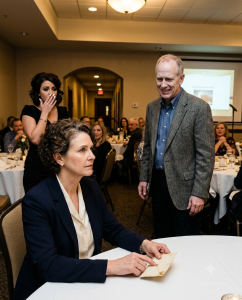
When Marlene Pierce found the receipt, she was sitting in the parking lot of a Food City with a carton of eggs rolling gently against a bag of green beans in the passenger-side floorboard.
It was not a dramatic setting for the destruction of a marriage.
No thunderstorm. No music swelling in the background. No shaking hands dropping papers in slow motion.
Just a humid Tuesday in Knoxville, a tired 58-year-old bookkeeper in a faded blouse, and a cream-colored church envelope that had slid out from under the seat when she braked too hard for a teenager cutting across the lot.
At first she almost ignored it.
The envelope was one of the old offering envelopes from Cedar Hill Baptist, worn soft at the corners, the kind her husband used to stuff with receipts, screws, and odd bits of hardware because he never carried a real folder. Marlene picked it up with two fingers, already irritated at the thought of one more piece of Dale in her car. Even after everything, his clutter still seemed to find her.
She nearly tossed it into the trash bag hanging from the gear shift.
Then she noticed his handwriting on the front.
Three numbers. The word MONDAY.
That was all.
But Marlene had spent more than three decades making sense of numbers. She knew which ones belonged and which ones looked wrong merely by instinct. Those three numbers meant something to him. Enough that he had written them down. Enough that he had kept them.
She opened the flap.
Inside was a laminated index card, stiff and yellowed, and behind it a folded receipt from a courthouse kiosk three counties away.
Marlene unfolded the receipt slowly, as if some part of her already knew that once she read it, there would be no going back.
The charge date hit her first.
It was the same day the deed to her family home had been filed transferring ownership out of her hands.
For a long time she just sat there. She could hear shopping carts rattling in the corral. Somewhere nearby, a child was crying over a spilled drink. A pickup truck pulled into the next space with country music thudding from the speakers.
The ordinary world kept moving, completely unaware that hers had just tilted again.
She looked at the laminated card next.
On the back, in Dale’s unmistakable blocky handwriting, were four names: a notary, a bank officer, a paralegal, and a drywall supplier. Beside each one were notes. Times. Amounts. Short reminders written like a work checklist.
Bring her old license copy.
Marlene read that line three times.
By then, she already knew Dale had betrayed her. That discovery had come in pieces over the previous two weeks, each one worse than the last. First the overdraft notice from the joint business account. Then the missing funds. Then the transfer records into an LLC she had never authorized. Then the county records proving the house she had lived in since 1998 was no longer legally hers.
Then the scanned deed with a signature that looked enough like hers to fool someone who did not know better.
She knew better.
She had seen her own signature on tax returns, payroll filings, vendor authorizations, church committee minutes, and birthday cards written over decades. The forged version on the deed was close but not close enough. The first stroke was too careful. The spacing was wrong. The confidence was counterfeit.
When she confronted Dale, he did not crumble. That was what frightened her most.
He leaned against the kitchen counter in the duplex he had insisted on renting “temporarily” when he told her he needed space. He listened to her accusations with a look of weary patience, as if she were the unreasonable one. He said she must have forgotten signing the papers months earlier. He said she was under stress. He said they had discussed the house. He said maybe she needed to talk to someone because lately she seemed confused.
Then, in the same smooth voice he used with clients and church members and suppliers, he added, “Don’t embarrass yourself, Marlene.”
It was one of the cruelest things anyone had ever said to her because of how gently he said it.
By then she had also learned there was a woman. Not a fling. Not a brief mistake. A real arrangement. Her name was Trina Bell, and she was fifteen years younger, bright-haired, flashy, and newly visible in parts of town where Dale once brought Marlene. Friday night football games. Chamber lunches. Casual dinners at restaurants where waitresses knew his order.
People described Trina with that infuriating little smile reserved for gossip they claimed not to enjoy. She was “young.” She was “fun.” She “made him feel alive again.”
As if there were any language insulting enough for what Dale had really done.
Because the affair was not even the center of it. The affair was decoration. The real crime was calculation.
Dale had not merely left his wife. He had stolen from her.
Marlene had done every set of books for Pierce Custom Homes since the second year of the business. Dale handled the job sites and the charm. She handled everything that made the company real. Payroll taxes, account reconciliation, permit tracking, vendor disputes, insurance renewals, and quarter-end reporting. She knew what sat in every account and why. She knew which projects were profitable, which clients paid late, and which subcontractors padded invoices.
He used to joke that she knew the business better than he did.
That had not been a joke. It had been an admission.
When the bank manager finally confirmed that substantial funds from the joint business operating account had been transferred over months into a separate LLC, Marlene felt something inside her go still. The manager, a man who had shaken her hand for years and attended the same community breakfasts as Dale, would barely meet her eyes. The transfer authorizations carried her name.
Her forged name.
The first instinct was to explode. To march into the branch lobby. To call every mutual friend. To show the deed and scream until someone admitted what had been done.
Instead, Marlene went home to the duplex, spread every paper she had on the table, and began a list.
It was the same thing she did any time numbers stopped making sense.
You start where the error appears. You move backward. You document everything. You trust paper over personalities.
The receipt and the laminated index card changed everything because they did what hurt wives’ testimony often cannot do on its own: they showed planning.
Not confusion. Not a bad marriage. Not miscommunication. Planning.
Dale had made a checklist.
He had written down the people needed, the order of the steps, and the reminder to bring a copy of her old driver’s license. He had thought ahead. He had prepared to impersonate her. He had left himself a trail because he believed no one would ever look close enough to see it.
That belief became Marlene’s weapon.
She did not tell everyone what she found. In fact, she told almost no one.
For the next eleven months, she built her case in silence.
The quiet was not weakness. It was strategy.
She began with certified records. Bank statements, account authorizations, business ledger exports, deed filings, tax documents, and LLC registration forms. She tracked dates and compared signatures. She made binders with tabs and duplicates and handwritten notes in the margins. She marked every discrepancy in yellow, every forged authorization in pink, and every suspicious payment in blue.
She found that the filing fee from the courthouse kiosk had later been reimbursed through the business books under a fake permit expense linked to a church renovation bid Pierce Custom Homes never won.
That was classic Dale. Steal big, then steal small on top of it because arrogance breeds carelessness.
She found utility payments for Trina’s townhome disguised as “client housing.” She found checks issued to a drywall supplier who happened to be Trina’s cousin. She found invoices tied to projects that had never broken ground and reimbursement requests with rounded numbers that no legitimate expense report should ever contain.
She also found something even more powerful than paperwork.
Timing.
One notarized document claimed Marlene had personally appeared and signed on a weekday afternoon in another county. But Marlene was a church finance committee member, and that same afternoon she had attended a luncheon in Knoxville. There were photos on social media showing her at a round table smiling beside two retired teachers and the pastor’s wife. One image was time-stamped within the hour of the notarization.
The notary became nervous when presented with that fact.
Then defensive.
Then suddenly unable to remember much at all.
Marlene’s lawyer noticed that shift too.
By then, Marlene had stopped being merely a woman wronged. She had become a problem.
Dale, meanwhile, went on performing the role he trusted most: respected local man unfairly burdened by a difficult spouse.
He and Trina attended public events. He told people retirement was near and he was ready to “finally enjoy life.” He let others do the dirty work of repeating that Marlene had agreed to sell, that she was bitter about the divorce, that she was making things harder than they needed to be.
A few people believed him because they wanted to. A charming man with a script is easier to accept than a trusted man revealed as a thief.
But not everyone was fooled.
Some noticed that Marlene never made loud scenes. She did not post cryptic messages online. She did not camp outside Trina’s townhome or send midnight texts. When she spoke, she asked calm, pointed questions.
Do you remember what date that fundraiser was?
Who drove with him that day?
What time did the meeting end?
Did he leave early?
Was Trina there yet?
It unsettled people. They were used to wounded wives offering tears or anger. Marlene offered timestamps.
Even her sister, Denise, eventually stopped urging her to “just move on somehow.” One evening, sitting at the duplex table while Marlene sorted copies into folders, Denise picked up a stack and read through it in silence. When she looked up, her face had changed.
“Oh,” she said quietly. “He really thought he could erase you.”
Marlene kept the church envelope close through all of it.
Sometimes it sat in her purse. Sometimes in the glove compartment. Sometimes under a folded stack of sweaters in the duplex bedroom when she was away. She never opened it in front of casual company. She showed copies of the documents to the people who needed them, but not the original card and receipt together. That combination felt too dangerous, too final, too revealing of the mind behind the fraud.
People noticed the envelope anyway.
A friend from church once asked if it was a prayer card she was carrying around. Marlene smiled and said, “Something like that.”
In a way, it was. It held patience. Restraint. The promise that truth did not vanish merely because a liar got there first.
Then, nearly a year after she found it, the invitation arrived.
Dale’s retirement banquet.
Community center ballroom.
Semi-formal attire.
A celebration honoring his years of service, mentorship, and contribution to local business.
Marlene stood at the duplex counter reading it while a pot of soup cooled behind her. There was even an insert listing the evening’s program. Welcome remarks. Dinner. A slideshow. Testimonials. Presentation from the Chamber of Commerce. Closing speech from the guest of honor.
The guest of honor.
She laughed once, without humor, and set the invitation down.
For a few hours she considered ignoring it. Let him have his fake applause. Let him pose for pictures. Let the lies ripen until court peeled them open. The law was already moving. Her attorney had nearly completed the civil filing. The licensing board had received supporting materials. An investigator had started connecting the bank transfers to the shell LLC. Public humiliation was not necessary for justice.
Then she imagined him standing in front of that room talking about integrity, family sacrifice, and “new beginnings.”
And she understood something important.
This banquet was not separate from the fraud. It was part of it.
Dale’s power had always relied on witnesses. He needed rooms full of people to reflect his own version of himself back at him. Honest builder. Generous employer. Long-suffering husband. Community man.
If the lie had been built in public, the first crack should happen there too.
So Marlene prepared.
She made three complete evidence packets. One for her attorney. One for her sister. One for secure storage. She confirmed filing dates. She reviewed what could be handed over and what needed to remain sealed. She chose the exact document copies she wanted immediately accessible and left the originals protected.
All except the church envelope.
That, she kept with her.
On the afternoon of the banquet, Knoxville sweltered under a pale sticky sky. Marlene took longer getting dressed than she had in years. Not out of vanity. Out of precision. Navy blazer. Cream blouse. Dark slacks. Pearl studs. Low heels stable enough for carpet and tile alike. She brushed her silvering hair and left it natural. She wanted no costume, no transformation. She wanted to look exactly like the woman Dale had underestimated.
Before leaving, she sat at the edge of the bed and looked at the envelope in her lap.
Eleven months of evidence had passed through her hands, but this object still carried the first electric shock of certainty. She ran her thumb over the soft paper and thought of everything Dale had counted on: her shame, her age, her decency, her reluctance to make scenes, the town’s tendency to protect men who build things and smile while doing it.
He had mistaken restraint for helplessness.
She stood, picked up her purse, and drove to the banquet hall.
The parking lot was already half full. Trucks. Sedans. A few nicer SUVs belonging to Chamber people and local donors. Through the glass doors she could see warm lights, linen-covered tables, and a projection screen glowing blue before the slideshow began.
She turned off the engine and sat in the quiet for one last moment.
On the passenger seat, the church envelope waited.
Marlene picked it up and placed it on her lap.
“Time,” she whispered, though no one was there to hear.
Inside, the room was dressed for celebration. Centerpieces glittered under low lights. Waitstaff moved between tables with tea pitchers and metal serving trays. On the screen, photos flashed in rotation: Dale in a hard hat, Dale shaking hands at ribbon cuttings, Dale grinning with clients in front of finished homes. The mythology of a good man, professionally assembled.
At the front, one seat beside the head table remained empty, marked with a folded place card.
As Marlene got closer, she read the name.
Trina Bell.
Conversations nearby softened as people noticed her. A woman near the entrance blinked hard and pretended to fuss with her shawl. Two former employees stopped mid-sentence. Someone whispered, “Is that Marlene?”
Across the room, Dale was laughing with three men from the builders’ association. He lifted his head casually at the disturbance, saw her, and froze.
The transformation in his face was brief but unmistakable. The blood left it so fast that his smile collapsed before he could catch it.
Marlene kept walking.
She did not rush. She did not glare. She did not announce herself. The envelope rested lightly in her hand.
At the microphone, the emcee was introducing the next segment. “And now,” he said warmly, “the man himself would like to say a few words about the future.”
Marlene reached the head table.
Every eye in the room was on her.
Then, with the calm of someone setting down a ledger where it belonged, she took the chair they had saved for Dale’s girlfriend and sat.
A hush spread through the banquet hall so completely that the faint hum of the projector became audible.
Dale did not go to the microphone.
Instead he stared at the envelope.
Trina appeared a second later from the hallway near the restrooms, smiling at something on her phone, until she saw who was sitting in her place. She stopped so abruptly the woman behind her nearly collided with her. Her expression shifted from annoyance to confusion to something sharper and uglier.
Fear.
Marlene set the envelope on the white tablecloth beside her water glass.
Nothing in the room moved.
Then Dale started toward her, still trying to salvage his face. He reached the table wearing a smile so strained it made him look ill.
“Marlene,” he said in a low voice, “this isn’t the place.”
She looked up at him calmly.
“You’re right,” she said. “The courthouse would’ve been simpler.”
The words fell into the room like glass.
A former project manager at a nearby table leaned back, creating distance without seeming to. The emcee lowered his notes. Somewhere in the back, a chair scraped the floor. Trina did not come any closer.
Marlene slid one finger beneath the envelope flap.
Dale’s hand twitched.
Trina whispered, “No,” so softly only the nearest table heard.
For one suspended second, no one breathed.
Then Marlene pulled out the laminated index card and held it up where Dale could see his own handwriting from six feet away.
His expression changed completely.
Not confusion. Not outrage. Recognition.
That was the moment the room understood there was a truth in the air they had not been invited to hear.
“What is that?” one Chamber member asked, too loudly.
Dale ignored him. “Put that away,” he said.
Marlene almost smiled. “You remember it.”
He glanced toward Trina, and that tiny movement gave away more than any speech could have. It was quick, involuntary, panicked.
Marlene rose to her feet at last. Her voice, when she spoke, was not loud, but it was perfectly clear.
“This,” she said, holding the laminated card in one hand and the courthouse receipt in the other, “is the checklist my husband used when he forged my name, moved money out of our business, and deeded my house to his girlfriend.”
The banquet hall exploded into whispers.
Someone actually gasped. One of the older men at the far table said, “Dear God,” before his wife touched his arm.
Dale reached for her hand. “That is not what this is.”
Marlene stepped back before he could touch her. “It has your handwriting. It references my old license. The receipt matches the filing date. The transfer reimbursements came out of company funds. I have certified copies of all of it.”
The emcee, who had clearly not trained for this sort of event, took two steps away from the microphone.
Trina finally found her voice. “Dale,” she said, but not like a lover defending a man. Like a woman realizing she had not been told the same story.
That, more than anything, seemed to unsteady him.
Because Dale knew how to lie one-on-one. He knew how to soothe, redirect, and isolate. What he could not do was control dozens of witnesses at once once the script shattered.
Marlene opened her purse and removed a sealed packet.
“Copies have already been filed with my attorney,” she said. “Additional packets have gone to the licensing board and the investigator handling the financial complaint. I’m giving this one to the Chamber president so no one here has to wonder later what tonight was about.”
The Chamber president, a woman who had looked sick since the first mention of forgery, stood automatically as Marlene handed her the packet.
Dale looked around the room for help.
None came.
Not because everyone suddenly became noble. Some were merely stunned. Some were calculating the fallout. Some were remembering moments that made sense now. But the old magic was gone. The crowd that once reflected his version of himself back to him no longer could.
A lie needs confidence to survive. Dale had lost his.
He turned to Trina. “I can explain.”
That was the wrong thing to say.
Trina’s face hardened. “Explain what?” she snapped. “You told me she signed everything. You said it was settled.”
Marlene did not interrupt. She let the question hang between them because sometimes the truth arrives best when the guilty begin tearing at each other.
“I did what I had to do,” Dale said, too fast. “You don’t understand how things were—”
“No,” Trina said, stepping back from him now, “apparently I didn’t.”
That gave the room its final answer.
If even the girlfriend looked blindsided, then whatever story Dale had sold publicly was rotten at the core.
The Chamber president opened the packet with visibly shaking hands. On top was the certified deed copy, then the bank transfer log, then the duplicate reimbursement tied to the kiosk receipt.
“Oh my God,” she whispered.
Someone near the bar left the room, likely to make a phone call. Two former employees exchanged a long look that suggested private suspicions had just become public facts. One of the deacons from Cedar Hill stood with his jaw tight, eyes fixed on the old church envelope in Marlene’s hand as if even that object had become an accusation.
Dale tried one last time to regain control.
“This is a private marital matter,” he said, louder now. “It shouldn’t be discussed here.”
Marlene looked at him for a long moment. Then she answered in the tone of a woman balancing a final account.
“You made it public when you stole publicly held business funds, filed public documents with my forged name, and sat down to celebrate yourself in a room full of witnesses.”
No one clapped. It wasn’t that kind of scene.
What followed was quieter and, in some ways, worse.
People stepped away from him.
Just inches at first. Then more.
One by one.
His former project manager moved to another table. A supplier who had been laughing with him moments earlier turned his body sideways and would not meet his eye. The emcee set the microphone down entirely. Trina picked up her purse from beside the table and left through the side door without looking back.
Dale watched her go, and the panic on his face deepened into something naked.
Consequences.
Real ones.
Not just legal. Social. Professional. Permanent.
Marlene stood there holding the envelope and the card and understood, with startling calm, that she no longer needed him to confess. The room had seen enough. The institutions would see more. The paper would finish what his performance could not survive.
She gathered her things.
Dale spoke her name once, but she did not stop.
At the exit, she felt a hand touch her elbow gently. It was the bank manager. The same man who had barely met her eyes weeks earlier. He looked ashamed.
“I’m sorry,” he said.
Marlene considered that. Then she nodded once and walked on.
The civil case moved quickly after the banquet. Public exposure shook loose cooperation that had been slow and slippery before. The notary’s statements changed. The bank produced additional internal records. The licensing board opened a formal review. A judge eventually invalidated the fraudulent deed transfer, froze related assets, and referred portions of the matter for criminal investigation.
The business did not survive.
Neither did Dale’s reputation.
As for the house, Marlene went back for the final walk-through after Trina had cleared out. The porch light fixture was still there, the one she had chosen in 2006. Dust lay on the windowsills. The place smelled faintly of stale perfume and fresh paint, as if someone had tried to redecorate over a stain they couldn’t remove.
Marlene stood in the kitchen for a long time with one hand resting on the sink.
She did not cry.
Not because it hadn’t hurt. It had. It still did. But grief had changed shape. It was no longer the helpless grief of being erased. It was the harder, cleaner grief of knowing exactly who a person had been while you loved them.
Later, sitting on the porch she had paid for line by line, she took the church envelope from her purse one last time. The laminated card inside had done its work. So had she.
Some betrayals are crimes of passion. Others are bookkeeping. Deliberate. Itemized. Signed in the wrong hand and hidden in the hope that shame will do the rest.
Dale’s biggest mistake was probably not the forgery, or the stolen money, or even the arrogance of handing another woman a life he had built partly with Marlene’s labor.
It was assuming the person who kept every record in his world would fail to keep one on him.
Even now, the people who heard the story divide in interesting ways. Some say Marlene should have confronted him privately. Some say public exposure was too harsh. Others say she showed more restraint than he deserved.
But nearly everyone agrees on one thing: the real red flag was never the girlfriend.
It was the man who thought his wife’s patience meant she didn’t know how to end a story.
He Stole Her House—Then She Took His Retirement Party