The night Dale Whitmore stood at the head table of the Cascade County Heritage Gala and lifted a champagne flute to toast himself, he believed he had already won.
The room was full of the right people. County officials. Ranching families. Donors. People who loved the sound of words like legacy, stewardship, tradition. The ballroom lights softened everyone into a more flattering version of themselves, and Dale had dressed accordingly. Polished boots. Crisp shirt. Silver belt buckle. Bolo tie chosen carefully enough to look expensive without appearing flashy. He had spent the last hour shaking hands, laughing loudly, accepting compliments on his nomination for the Stewardship Award as if the award itself were a formality.
He looked like a man being welcomed into history.
What he did not know was that Renee Driscoll had arrived before him.
And what he noticed even less was the small brass surveyor’s pin she placed directly at his seat before anyone sat down.
Stamped 1947.
By the time Dale saw it, it would be far too late.
Most people who knew Renee would never have guessed she could engineer a public reckoning. She wasn’t dramatic. She wasn’t loud. She didn’t dominate conversation or turn pain into spectacle. If anything, she had a way of making herself smaller in social spaces, as if she had spent a lifetime understanding that the loudest person in the room usually got too much credit and too little scrutiny.
She lived in Billings and had worked for more than two decades as an agricultural accountant. It suited her. Numbers did not perform. Records did not flatter. Filing dates did not care who had the best smile at the county gala. Her work had trained her to notice details that other people skipped over out of boredom or trust. A misdated form. A contradictory signature. A valuation that drifted a little too conveniently in one direction.
She was the kind of woman people underestimated because she was kind.
Dale had made that mistake first.
The Driscoll ranch sat outside Roundup, three hundred and forty acres of high-grass grazing land first staked by Renee’s grandfather in 1947. To outsiders it was property. To the family it was origin. There was a practical history attached to every part of it: the north fence rebuilt after a storm, the stock pond dug in a dry year, the cottonwoods planted as a windbreak, the scar in the old barn wall from a horse that had kicked through in 1968. Renee’s mother, June Driscoll, used to say the land remembered everything.
It was supposed to pass equally to Renee and her younger sister, Patrice.
June had said that more than once and in more than one setting. At the kitchen table. In the truck. On the porch during calving season. No one had reason to doubt her. Renee never imagined she would need a witness to her mother’s promises because mothers like June weren’t supposed to require documentation to be believed by their own daughters.
Then illness rearranged everything.
June passed away in the spring of 2021. Before the family had even adjusted to that loss, Renee’s father deteriorated fast. The last nine weeks of his life became a blur of medical appointments, medication schedules, and the exhausting routine known only to families who keep vigil in hospitals long enough to forget what ordinary time feels like.
Renee went to him without hesitation.
She drove four hours, stayed near the hospital, and slipped into the role of caretaker with the quiet efficiency she had always brought to everything else. She handled dialysis days, insurance calls, meals no one wanted to eat, sleepless overnights in a reclining chair that never fully reclined. At night, when her father struggled or grew restless, she read to him from Louis L’Amour novels because those stories soothed him. Men on horseback. Hard country. Straight lines between right and wrong. Sometimes he drifted to sleep before she finished a page. Sometimes he listened with his eyes closed and squeezed her hand at the turn of a sentence.
She was there at the end.
That mattered to her. It still would, even later, when the price of being there became clear.
Because while Renee sat in hospital rooms and whispered comfort into the last stretch of her father’s life, paperwork was moving back home.
Dale Whitmore, Patrice’s husband, said he was taking care of things.
He was the kind of man who made people comfortable quickly. He smiled before entering a room as if he already expected to be welcomed. He used first names aggressively. He called older men “sir” in a way that sounded respectful without ever making him appear subordinate. He liked to refer to the ranch as “our operation,” though most of the work he took credit for had a way of happening after someone else had fed, fixed, hauled, or repaired what needed doing.
What Dale truly cultivated was image.
He wanted to be seen as a man of land, family, and continuity. He liked speaking in public because public speaking let him perform certainty. And certainty, in communities built on custom and trust, often passed for integrity.
Three weeks after June’s death, Patrice told Renee the ranch had been transferred.
They were in Patrice’s kitchen. Renee would remember every detail later: the stale coffee smell, the pale streak of afternoon light through the blinds, the way Patrice never quite held eye contact for more than a few seconds at a time. She spoke carefully, as if repeating explanations already rehearsed with someone else.
Mom changed things, she said.
There were updated documents.
Dale had helped with the process.
It was legal.
It was done.
The ranch now belonged to Patrice and Dale.
Renee sat still through the entire explanation. She asked to see the documents. Patrice said copies could be arranged, but the matter was settled. There was something in her tone that sounded half-defensive, half-afraid, though Renee could not yet tell whether the fear came from guilt or manipulation.
Maybe Patrice expected screaming. Maybe tears. Maybe accusation.
Instead, Renee nodded once and left.
That control would later become one of Dale’s greatest miscalculations. He mistook quiet for surrender.
Back in Billings, Renee let herself into her house, shut the door, and stood alone in her kitchen while the truth settled into her body in painful, uneven stages. First disbelief. Then humiliation. Then a hard, clean anger that felt almost clarifying.
She went to the ceramic dish beside the sink and picked up the brass surveyor’s pin attached to an old ring.
Her grandfather had given it to her shortly before he died. He had pulled it from the corner of the original property line himself, holding it up in the sun so she could see the stamp. 1947. Then he had pressed it into her hand.
“This land knows who it belongs to, Renee-girl.”
At the time, she had smiled at the sentiment. Standing in her kitchen years later, the words felt less sentimental than instructive.
She set the pin on the counter, opened her laptop, and began.
The first month was records.
County filings. Probate documents. Property tax updates. Boundary descriptions. Prior versions of deeds. Digital copies first, then certified hard copies where necessary. Her training made the process instinctive. She built timelines. Color-coded dates. Compared witness names. Looked for changes in language that might seem harmless to a casual reader but carried legal consequences under scrutiny.
The transfer itself was suspicious immediately.
June had supposedly changed the land arrangement near the end of her life, but the resulting documents didn’t track cleanly with the attorney who had drafted her original will. Renee called that attorney’s office and, after navigating careful language and confidentiality boundaries, learned enough to know something was wrong. Not enough for proof. Enough for direction.
She kept going.
Then she found the deed amendment filed eleven days after June’s death.
Renee stared at the date until the implications sharpened.
No one in the family had discussed an amendment. No attorney had mentioned a revision after death. Yet there it was in the county record, tucked into the chain as if it belonged there.
It did not.
A second issue emerged when she matched a notarization against a witness signature. The counties didn’t line up cleanly. The timing was even worse. A parcel description borrowed language from an older filing, but certain boundary references had been altered just enough to consolidate control. It was clever on the surface, sloppy underneath. The kind of sloppiness born from arrogance.
Renee made copies of everything.
The second document she found made her physically step back from the table. It suggested not only that the transfer had been manipulated, but that someone had moved a historic boundary marker before related paperwork was filed. That detail mattered because old agricultural land often depended on chains of description and physical reference points. Shift the marker, then reshape the paperwork, and confusion becomes plausible. Plausibility, in the hands of someone like Dale, could become ownership.
The next morning she drove to Great Falls to meet an attorney who specialized in probate fraud and agricultural land disputes.
He was a careful man in his late fifties with wire-rimmed glasses and the flat patience of someone who had heard every variation of “this happened in the family” imaginable. Renee laid out her records, her notes, her timeline. He listened without interrupting, occasionally sliding a page aside to compare a date with another entry.
At one point he stopped and looked at her.
“Who prepared this filing?”
“Dale Whitmore oversaw the transfer process,” Renee said.
The attorney tapped a document with one finger.
“Did he think no one would compare these?”
Renee’s face didn’t change.
“I think he thought I was too busy grieving.”
The attorney’s expression softened only slightly.
“That may have been true for a while,” he said. “It isn’t true now.”
From there, things accelerated quietly.
He filed what needed filing. He preserved records. He pulled on loose threads that began to connect. Not everything could move fast, but some things didn’t need speed. They needed precision. Renee gave statements. Signed affidavits. Gathered supporting testimony. She said little to almost everyone in her personal life, because experience had taught her that the moment wrongdoing feels threatened, somebody always starts talking in order to protect the wrong person.
Then February brought something neither she nor her attorney had anticipated.
It was Renee’s birthday. She came home to find a plain envelope in the mailbox with no return address. Inside was a card with a short handwritten sentence:
He moved the marker before he moved the line.
Taped to the bottom was another brass surveyor’s pin.
Same shape. Same age. Same 1947 stamp.
Renee stood in her hallway for nearly a full minute, the card open in one hand, the second pin in the other. Her first thought was impossible. Her second was worse: somebody else knew.
Whoever sent the card understood not only that a marker had been moved, but which marker. That meant knowledge. Perhaps firsthand. Perhaps guilty knowledge. Perhaps witness knowledge. The note didn’t identify the sender, but it changed everything. Anonymous tips are often weak on their own. Anonymous artifacts are different. Objects imply access.
Renee gave the card to her attorney.
His investigator did what investigators do. Quiet tracing. Quiet interviews. Quiet pressure applied in places where people had assumed no one would look. Eventually, a picture emerged.
Months earlier, a local survey assistant had been paid cash to “correct” an old corner marker placement under the claim that previous family records were inconsistent. He had not fully understood what he was participating in until later, when deed language began to echo the same altered line. By then he was panicked. He had kept one of the original pins after the marker work and, once rumors of the legal challenge reached him, he mailed it anonymously. When finally confronted with documentary evidence, he signed a statement.
That statement would become the page that turned Dale white.
But before that night arrived, Dale kept building his reputation.
By summer he was talking openly about improvements, grazing plans, long-term stewardship. He used the phrase “keeping the family ranch intact” with painful frequency. People praised him for stepping up. Some sincerely believed he had saved the land from messy inheritance division. Others, more cynical, simply liked a confident story better than a complicated one. Patrice stood beside him through most of it, her smile increasingly brittle.
Renee watched from a distance and said nothing.
Silence can look like weakness to dishonest people. In reality, silence is often where the trap is assembled.
When the Cascade County Heritage Gala announced Dale as a nominee for its Stewardship Award, Renee almost laughed when she saw the flyer. The irony was so complete it felt staged. Yet from a legal perspective, the gala presented something useful: a public room, a clear timeline, and a man at the peak of his self-congratulation.
Her attorney coordinated with the sheriff’s office. The civil action was ready. Supporting documents were organized. There were grounds not only for a suit contesting the transfer, but for criminal investigation tied to false filings and fraudulent representations. Service would occur publicly but calmly. No theatrics. No ambush beyond the truth arriving at a moment Dale felt safest.
Renee did not attend for revenge alone.
She attended because some lies become community property if they are not broken in front of witnesses.
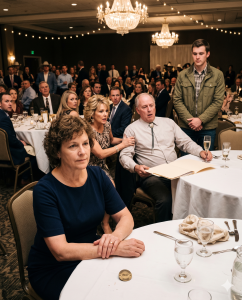
The ballroom looked exactly like these events always did: white tablecloths, polished glasses, centerpieces trying too hard to make hay look elegant. Donors in pressed jackets. Women in dresses chosen somewhere between practical and formal. The air carried roast beef, perfume, and old money’s softer cousin—county respectability.
Renee arrived early and moved through the room unnoticed.
At the head table, she stopped at Dale’s place setting and laid down one brass surveyor’s pin.
Stamped 1947.
Then she returned to her seat near the back.
When Dale arrived, he never saw it. He was too busy playing host to a celebration built around the image he had been curating for months. He shook hands. Accepted praise. Bent toward local officials with the ease of a man who had practiced gratitude in the mirror.
Patrice looked tense. Dale looked euphoric.
At last, he rose for his toast.
He thanked the committee. Spoke about family. Spoke about the burden and honor of preserving Montana’s agricultural legacy. The speech had all the right phrases and none of the truth. He lifted his glass and smiled broadly.
“The Driscoll land has been in this family for generations,” he said. “And I intend to make sure it stays that way. As the last true keeper of that legacy—”
The deputy entered quietly from the side of the room.
He wore an off-duty jacket and moved with the calm of a man who did not need to announce authority because authority was not the point. He was there to deliver paperwork, not drama. He stepped past two chairs, reached the head table, and laid a manila folder directly in front of Dale Whitmore.
Then he said, with perfect neutrality, “Mr. Whitmore.”
Dale let out a small laugh, as if this might be some harmless interruption. He set down his champagne flute and opened the folder.
Everything changed in a single glance.
The smile disappeared first.
Then the color drained from his face so fast Patrice immediately reached for his arm.
The room quieted. Not politely. Instinctively. As if everyone present sensed they had just crossed from ceremony into something real.
Dale looked down at the first page: service documents for the civil challenge, followed by supporting exhibits and notice of related allegations under review. But what broke him was clipped behind them—a signed statement from the survey assistant. It described the marker relocation, the cash payment, the instructions, and the later realization that the manipulated boundary aligned with deed language Dale had pushed through county filing.
The statement was witnessed. Corroborated. Attached to records Renee had spent fourteen months assembling.
Dale looked up.
His gaze landed on Renee at the back table.
She sat straight, hands folded in her lap, expression unreadable. On the table before her rested the second brass surveyor’s pin.
That was when Patrice reached for the folder.
“What is this?” she whispered.
Dale tried to close it.
The deputy put a hand on the table, not threatening, just final. “There’s more than a civil filing in there, sir.”
Patrice pulled the top pages free before Dale could stop her. Renee watched her sister’s face shift from confusion to shock to a deeper devastation that looked almost like self-recognition. Patrice was seeing not only the documents but the memory of all the moments she had dismissed: the pressure, the impatience, the rehearsed explanations, the way Dale insisted certain things were too complicated for her to worry about.
“You told me Mom signed everything,” Patrice said.
Her voice carried.
Heads turned.
Dale reached for her elbow. “Patrice—”
She yanked away.
“No,” she snapped, louder now. “You said she signed everything.”
Dale opened his mouth, but the room had already moved against him in that subtle social way communities do when certainty flips. People were no longer listening for his explanation; they were listening for the truth. And the truth, once introduced into a public room, has a way of changing where everyone looks.
Patrice turned another page. Then another.
At the bottom of the witness statement, she saw the signature of the survey assistant and the investigator’s verification. Tucked behind that was a record pull demonstrating the amendment filed after June’s death. Behind that, notarization inconsistencies. Boundary comparison maps. A pattern too ugly to excuse as clerical confusion.
Patrice lifted her head slowly and looked across the ballroom at Renee.
For a brief second, the sisters were no longer separated by tables, lawsuits, or a man who had stood between them. They were simply two daughters standing in the aftermath of what had been done to their mother’s land and their father’s trust.
Tears filled Patrice’s eyes. Not theatrical tears. The stunned, humiliating kind that come when a person realizes she has been used in front of a room full of witnesses.
“Did you know?” she asked Renee.
Renee answered honestly.
“I knew enough to keep looking.”
That was the exact right answer, because it didn’t accuse Patrice of complicity, and it didn’t rescue her from responsibility either. It left space for the truth to settle where it belonged.
Dale tried once more to seize control. Men like him rarely surrender the stage willingly.
“This is being twisted,” he said, voice suddenly rough. “There are details you people don’t understand.”
The phrase you people was a mistake. So was the word twisted. They sounded defensive, not authoritative. Worse, they sounded like the language of a man who had realized his old performance no longer worked.
The deputy remained calm. “Mr. Whitmore, you are not under arrest at this moment. You are being advised to retain counsel and preserve all records connected to the filings listed in that packet.”
At this moment.
Everyone heard those three words.
Dale heard them too.
He sat down hard.
The award committee chair, who only minutes earlier had introduced him with glowing remarks, looked mortified. Someone at a side table muttered, “My God.” Another person whispered, “June would’ve buried him.”
No one laughed.
No one applauded.
Renee did not move to the front of the room. She did not need to. The public spectacle had never been the point. Exposure was the point. Bringing the hidden machinery into light. Letting the community see the difference between inheritance and theft.
The legal process that followed stretched for months, but the outcome was never really in doubt after that night. Additional records surfaced. The survey assistant cooperated fully. County filing irregularities were formally examined. Patrice, once confronted with the complete picture, gave her own statement and separated herself from Dale’s defense. She admitted she had believed his explanations at first, then stopped asking questions because she had wanted security and because grief had made it easier to surrender judgment to someone louder than herself.
That confession hurt Renee more than she expected.
Not because Patrice had benefited, but because somewhere along the line the sisters had stopped being each other’s first call. Loss had isolated them, and Dale had exploited the gap expertly.
In court, the transfer was challenged and undone. The manipulated amendment collapsed under scrutiny. The original estate intentions were restored. Title to the ranch was corrected in accordance with the legitimate probate structure. Dale faced consequences that stripped away the image he had used to shield himself. Even before formal judgments landed, the county had made up its mind about him. In places built on reputation, social verdicts often arrive first.
Months later, Renee stood with Patrice near the original boundary line outside Roundup. The grass moved in long green waves under a steady Montana wind. The repaired marker sat where it belonged. Honest. Unmoved. Their grandfather’s land stretched around them with the quiet indifference of earth that had outlasted every lie told over it.
Patrice turned one of the old brass pins over in her hand.
“I should have seen it,” she said.
Renee watched the horizon before answering.
“He counted on neither of us seeing it soon enough.”
Patrice nodded, tears threatening again.
“You still came back for it.”
Renee looked at the pin, then at the land, then at her sister.
“No,” she said softly. “I came back because it was never his.”
They stood there a while longer, not healed exactly, but no longer standing on opposite sides of someone else’s deception.
Later, when people retold the story, they focused on the gala. The folder. Dale’s face going white in front of the whole room. The deputy’s timing. The poetry of a man being publicly exposed while praising himself for protecting a legacy he had tried to steal.
But the real story wasn’t the spectacle.
It was the fourteen months before it.
The patient work. The grief that sharpened instead of breaking. The woman everyone thought was too quiet to fight back. The old brass pin that outlasted forged confidence, altered paperwork, and one man’s belief that a family in mourning would be too exhausted to chase the truth.
In the end, maybe that was the biggest red flag of all.
Dale never loved the land the way he claimed to. If he had, he would have known the first rule of land passed down through decent hands: you can manage it, use it, protect it, even lose it for a time—but you cannot make it yours by lying to the people who were born to remember where the lines really are.
And maybe that is the part that stays with people longest.
Not that he was caught.
But that he believed, right up until the folder opened, that no one was patient enough to catch him at all.