When Daniel kissed his wife goodbye for what he believed was the last time, he expected grief to be the worst thing he would feel that day.
He was wrong.
The worst thing was the warmth.
Emilia was twenty-eight years old and eight months pregnant when she collapsed in the kitchen of the apartment she shared with Daniel. Hours earlier, they had been arguing over nothing important—whether the baby’s bookshelf should go beside the crib or near the window. It was the kind of domestic disagreement couples forget before bed. Daniel remembered that detail later with a kind of cruelty that made him sick, because ordinary life had still existed then. They had still been inside it.
By the time the ambulance reached the hospital, Emilia was unconscious.
Doctors worked on her for hours. Daniel saw only flashes of it: the blur of blue scrubs, a nurse hurrying past with blood on one glove, the sound of quick footsteps behind doors that stayed closed to him. At some point Emilia’s mother and younger sister arrived. At some point someone brought Daniel water he never drank. Time lost its shape.
Then a senior physician came out and delivered the news.
A catastrophic vascular event, he said. Massive internal complications. They had attempted everything possible. Neither Emilia nor the baby had survived.
Daniel heard the words. He simply could not fit them into reality.
The paperwork that followed felt obscene. Signatures. Identification. Release forms. Questions about arrangements. A different doctor, avoiding eye contact, said they had done all they could and that in rare cases these tragedies happened with terrifying speed. Daniel nodded because he had no language left. Emilia’s mother broke apart completely. Her sister had to be sedated.
In the days that followed, Daniel existed inside mechanical tasks. He met with the funeral director. He chose a pale gown because Emilia had once joked that if she ever had to wear formal clothes again, she wanted something comfortable and not “one of those stiff, miserable dresses.” He hated himself for remembering that while choosing what she would be cremated in.
At night he sat in the nursery and stared at the crib.
He kept expecting her to walk in and ask why he was sitting in the dark.
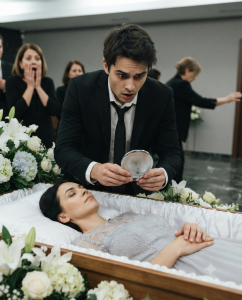
The cremation was scheduled three days later. Only close family attended. The mourning hall was elegant in the cold, controlled way such places often are: polished floors, white flowers, dim lights, muted walls meant to absorb human collapse without reflecting too much of it back. Emilia lay in an open coffin, her makeup done softly, her hair arranged with such care that the sight of her made several people cry before they had even stepped fully into the room.
She looked too alive.
That thought came to Daniel the moment he saw her, and he hated himself for having it. Grief played tricks. Everyone said so. The body did not yet look like death because death had come too quickly, that was all. Still, he could not shake the feeling that the room had made some gigantic mistake.
He tried to ignore it.
One by one, family members approached the coffin. Emilia’s mother stroked her daughter’s hair and whispered in a broken voice that she was sorry. Her sister leaned over the coffin and sobbed so hard two relatives had to help her step away. Daniel stood back, unable to move until everyone else had gone first.
When the final words were spoken, a crematorium employee announced that the ceremony was ending and the transfer for cremation would begin shortly.
That was when Daniel stepped forward.
He looked down at Emilia’s face and thought of everything he had left unsaid. Not dramatic confessions. Smaller things. The stupid argument about the bookshelf. The nights he had answered work emails while she talked. The afternoon she wanted to go baby-clothes shopping and he said he was too tired. That ordinary, maddening collection of tiny failures that become unbearable when one person no longer has the chance to forgive them.
He bent down close to her and whispered, “I’m sorry. For all of it. Every careless thing. Every time I thought we had more time.”
Then he kissed her forehead.
Her skin was warm.
Not room temperature. Not the vague trapped warmth of fabric or cosmetics. Warm.
Daniel pulled back and stared. His first thought was that his own lips had deceived him. He touched her forehead with his fingers.
Warm.
His pulse began to pound in his ears. He pressed two fingers shakily to the side of her neck, the way Emilia had once shown him during her pregnancy when she became anxious and asked him to feel how fast her heart was racing after climbing stairs. He found nothing at first. Or thought he found nothing. Then he panicked at his own uncertainty and leaned closer to her mouth.
Was that air?
He held still.
Nothing.
Then maybe the faintest whisper of breath. So slight it could have been movement in the room.
“Daniel,” someone behind him said softly, assuming his silence meant collapse. “Come away now.”
He ignored them. He looked around wildly, spotted a compact mirror left near the flowers, snatched it up, and held it beneath Emilia’s nose.
For one terrible second, it stayed clear.
Then the glass clouded.
The fog was faint, but it was real.
Daniel straightened so violently the mirror nearly flew from his hand. “Stop everything right now!”
The hall erupted with alarm. Relatives rushed in, trying to comfort him, trying to steady him, trying to interpret his terror as grief. One crematorium employee told him, kindly but firmly, that he needed to step away from the coffin.
“She’s breathing,” Daniel shouted.
No one wanted to believe him. Belief would mean something unthinkable.
Then Emilia’s right index finger twitched.
That tiny movement destroyed the last fragile layer of denial in the room.
Emilia’s mother screamed. Her sister collapsed. The employee stumbled back and grabbed for the phone mounted on the wall. Daniel leaned over the coffin, calling Emilia’s name with a desperation so raw it left the room shaking. And then he saw something else.
Her abdomen moved.
Not much. But enough.
The panic deepened instantly. If there had been any chance—any chance at all—that the doctors had been wrong, then the horror was bigger than Emilia alone. The emergency call became a frenzy. Paramedics arrived in minutes that felt to Daniel like entire lifetimes.
At first, they entered with the professional skepticism of people who had seen grief become delusion before. Then one paramedic checked Emilia’s carotid pulse and his face changed. Another attached monitoring leads with brutal speed. A faint rhythm appeared. Weak. Intermittent. But there.
“She’s alive,” the medic said, and those two words hit the room like a physical force.
Daniel grabbed the man’s arm. “The baby too? You said there might be two—”
“We don’t know yet,” the paramedic snapped, already working. “Move.”
They transferred Emilia to a stretcher and rushed her to the ambulance. Daniel rode in front because there was no room, staring through the partition window as medics ventilated his wife and relayed urgent information to the hospital. He heard phrases that made no sense together. Severe hypothermic state. Possible cataleptic presentation. Misread vital signs. Fetal status uncertain. Immediate surgical team.
When they reached the hospital, the emergency department exploded into action. This time Daniel was not made to wait for explanations. He demanded them.
A physician pulled him aside while Emilia was wheeled toward surgery.
“We believe your wife may have entered an extremely rare state that mimicked death,” she said. “Profoundly depressed vital signs. Minimal respiration. Nearly undetectable pulse. It should have been identified, but at this point our focus is saving her.”
“And the baby?”
“We don’t know until we get inside.”
Daniel stared at her. “They told me my son was dead.”
The doctor’s jaw tightened. “I know what you were told.”
That was not an answer, and they both knew it.
The next hour was the longest of Daniel’s life. Emilia’s mother sat beside him shivering uncontrollably. Her sister stared ahead without blinking. No one spoke much because speech suggested they understood something. They did not.
Finally, a surgeon came out still wearing cap and mask around his neck.
Emilia was alive, he said. Critical, but alive.
Daniel nearly collapsed.
Then the surgeon said the baby had also been alive when they began the emergency procedure, but in severe distress from prolonged oxygen deprivation. The neonatal team had managed to restore a heartbeat and stabilize him, barely. He was in intensive care. The next twenty-four hours would determine almost everything.
Daniel cried then. Not neatly. Not quietly. He bent over with both hands covering his face and sobbed with the sound of a man whose body had been holding terror far beyond its design.
Emilia remained unconscious for two days.
During that time, the hospital administration launched an internal emergency review. Another review followed from the health authority. It became clear with horrifying speed that Emilia had never undergone the final, layered confirmation procedures required in a case that complicated. One exhausted physician had made the original call after catastrophic signs, another had signed off under pressure, and the chain of assumptions had moved faster than certainty. In a crowded hospital on a chaotic night, a woman with vanishingly faint vital signs had been declared dead.
Daniel listened to the explanation in stunned silence.
It was not murder. It was worse in a way that chilled him differently.
It was preventable.
Their son, whom Emilia and Daniel had planned to name Leo, remained in the neonatal unit surrounded by machines. He was tiny, fragile, and furious, which the nurse said was a good sign. Daniel stood beside the incubator and wept all over again the first time he saw the baby’s hand curl around his finger.
On the third morning, Emilia opened her eyes.
At first she was disoriented, drifting in and out under sedation. Daniel was by her bed when she focused on him long enough to recognize his face. Tears slid silently from the corners of her eyes.
“You’re here,” she whispered through cracked lips.
Daniel laughed and cried at the same time. “I’m here.”
Her brow furrowed. “What happened?”
He could not answer all of it then. No one could.
Weeks passed. Emilia slowly regained strength. Leo remained in intensive care, then high-dependency care, then finally a regular neonatal room. There were more complications, more frightening nights, more alarms, more moments when Daniel felt the hospital itself had become a living thing feeding on hope and fear in equal measure. But mother and son both kept fighting.
The legal process began long before Emilia was discharged. The crematorium submitted statements. Paramedics submitted reports. Hospital records were seized and reviewed. The doctors involved were suspended pending investigation. The case made headlines for obvious reasons, but Daniel refused interviews. Emilia refused them too when she recovered enough to be asked. She had no interest in becoming a spectacle.
“What would I even say?” she told Daniel one evening as she held Leo skin-to-skin for the first time without wires between them. “That I almost listened to people say goodbye while I was still there?”
It was the first time she had put that horror into words.
Daniel went cold.
Emilia remembered fragments. Not everything. But enough. Pressure. Darkness. Voices that seemed both close and very far away. The terrifying inability to respond. She remembered trying to move and not knowing whether she had. She remembered Daniel’s voice more clearly than anything else.
“I heard you,” she said quietly.
Daniel stared at her.
“In the hall,” she whispered. “I heard you say you were sorry.”
He broke down again, because that meant his greatest fear had a shape now. She had been trapped inside silence while people mourned her.
Months later, Emilia and Leo both came home.
The nursery that had once felt like a museum of grief became what it had always been meant to be: messy, noisy, sleepless, alive. The stuffed rabbit ended up on a shelf because Leo preferred grabbing Daniel’s shirt collar and Emilia’s hair. Friends brought food. Family hovered constantly. Emilia’s mother refused to leave before checking that both mother and baby were breathing at least ten times an hour, and nobody had the heart to stop her.
The court case took longer.
In the end, the hospital admitted to grievous procedural failures. There were settlements, disciplinary actions, rewritten verification policies, and public statements full of formal regret. None of it could restore what had been done to Emilia’s mind or what had been torn open inside Daniel. There are some kinds of fear money cannot even begin to touch.
One evening, almost a year later, Daniel stood in Leo’s room while Emilia rocked their son to sleep. The lamp cast a warm pool of light across her face. For a second he saw the funeral hall superimposed over that ordinary moment—the coffin, the pale gown, the mirror fogging at her lips.
He had a physical reaction to the memory.
Emilia noticed. “You’re doing it again.”
“What?”
“Looking at us like we might disappear.”
Daniel stepped closer and touched Leo’s tiny foot. “I almost lost both of you.”
Emilia held his gaze for a long moment. “And then you didn’t.”
That was true. But it was not the whole truth.
The whole truth was harder and uglier. He had not saved them because of bravery or instinct alone. He had saved them because he knew the feel of her skin well enough to recognize something was wrong when the world had already accepted she was gone. He had saved them because love noticed what procedure missed.
People later called it a miracle.
Daniel never did.
Miracles are clean. Miracles feel holy.
This felt like standing one breath away from an irreversible fire and realizing that everyone around you had been prepared to let it burn.
And maybe that is why the story unsettled everyone who heard it. Not because a woman survived after being declared dead. Not because a baby returned from the edge with her. But because the most frightening part was how close ordinary people came to mistaking stillness for the end.
Sometimes Daniel still woke in the middle of the night and walked to Leo’s room just to watch his chest rise and fall. Sometimes he stood in the doorway of his own bedroom and listened to Emilia breathing in the dark. He never apologized for that habit, and Emilia never asked him to.
Anyone can say the lesson is to trust love, or to question everything, or to admire the husband who noticed what others did not. But the truth sits somewhere more uncomfortable than that.
What should haunt people most is not that Daniel stopped the cremation.
It is that if he had kissed her forehead a little less carefully, if he had stepped away when they told him to, if he had doubted himself for one more minute, everyone would have gone home believing a tragedy had already ended when in reality the most unforgivable part had not even begun.