Twenty-two years ago, Cecily Warren walked into the fellowship hall of Calvary Lutheran Church carrying three cardboard boxes and the kind of hopeful nerves that make people stand a little too straight.
She was twenty-six, newly engaged, and trying very hard to become the sort of woman who slipped neatly into another family. Danny Harwick had proposed two months earlier at a lakeside restaurant with a ring that needed resizing and a speech he forgot halfway through because he was smiling too hard. Cecily had loved him for that. She loved that he blushed. She loved that he never seemed to know what to do with his hands. She loved, maybe most of all, that he felt safe.
Or so she thought.
Calvary was hosting a reunion fundraiser that summer, and Cecily had spent a week going through her grandmother’s house after the funeral, choosing a few things to donate. Nana had lived in the same little white house for forty-three years. There were quilts folded in cedar chests, a bread box painted with faded strawberries, two porcelain figurines, and a tiny ceramic bluebird that had sat on the kitchen windowsill for as long as Cecily could remember.
The bird wasn’t valuable. Even Nana knew that. She used to laugh and call it her “five-cent guardian” because she’d found it at a church rummage sale sometime in the 1970s and loved it instantly. One wing had a chip. There was a pale crack near the base. But every morning it caught the light over the sink, and every afternoon when Cecily came home from school, she saw it there and felt, irrationally but completely, that someone was waiting for her.
After Nana died, that feeling mattered.
So Cecily wrapped the bluebird in a dish towel and placed it carefully in the top box. She imagined someone else loving it. Or maybe a child choosing it from a sale table and carrying it home. She liked the thought of it staying in the world.
The fellowship hall buzzed that day with women arranging pie servers and men hauling folding chairs and children slipping under tables until someone hissed at them to stop. Cecily brought in the boxes and set them near the sorting tables with an almost shy pride.
Then Gary Harwick arrived.
Danny’s older brother had built a reputation in town as the man who knew what things were worth. He appraised antiques on weekends, sold estate pieces to collectors in Indianapolis, and carried his expertise like a weapon. He wasn’t rich, exactly, but he knew how to perform authority, and that was usually enough.
He lifted the lid of Cecily’s first box and began sorting through it while people watched.
“Reproduction,” he said, holding up a quilt.
He dropped it aside.
He picked up the bread box. “Common.”
One figurine. “Cracked.”
The second. “Cheap.”
At first Cecily assumed he was helping categorize the donations. Then she heard the tone—dry, amused, slightly louder than necessary. The room started to quiet around him. People sensed entertainment.
When he reached the bluebird, he held it between thumb and forefinger and turned it over. Cecily remembered the sudden hot rush in her face.
“That was my grandmother’s,” she said.
Gary glanced at her, barely. “Then your grandmother had sentimental taste.”
A few people smiled awkwardly. No one spoke.
Cecily stood frozen, waiting for Danny to step in. He was only a few yards away, stacking envelopes, hearing every word. He looked up once, then looked down again.
Gary raised the bluebird slightly. “Lord,” he said, to the room rather than to her. “Who donates something like this?”
Then he held it over the trash can and dropped it.
It struck the plastic liner with a faint, brittle tap.
“Junk,” Gary said. “Not fit for a Goodwill bin.”
That was all. A tiny sound. One sentence. A room full of witnesses deciding, in real time, to let it happen.
Cecily left before she started crying. She made it to her car, shut the door, and sat there for forty minutes with both hands over her mouth, sobbing so hard her chest hurt. She cried for the bluebird, yes, but also for the bigger thing that had just been exposed. Danny had watched his brother humiliate her in public and chosen comfort over courage. His mother had watched. The pastor had watched. The church women who called her sweetheart had watched.
No one bent down to pull the bird out of the trash.
Three weeks later Cecily returned Danny’s ring. He asked if there was someone else. His mother asked if wedding stress had “clouded her judgment.” Gary didn’t ask anything at all.
Cecily simply said she had changed her mind.
It was easier than explaining that she had looked directly at the future and found it full of polite betrayals.
She left town not long after.
Indianapolis did not welcome her with open arms. It offered a cramped apartment over a laundromat, temp jobs, and winters that got into her bones. But it also offered distance. Then work. Then the kind of hard-earned momentum that feels invisible while it’s happening and miraculous in hindsight.
She discovered she was good at seeing what organizations needed before they knew how to ask for it. She was better at planning than the men who assumed she was taking notes for them. Better with numbers. Better with donors. Better with people, honestly, because she had learned early that listening closely was another form of survival.
Within ten years, Cecily was helping run a small consulting firm for nonprofit development. Within fifteen, she owned it. She married Thomas Pruett, a contractor with laugh lines and patient hands who thought old things deserved one more chance before being discarded. On their third date she told him, almost by accident, the bluebird story.
He listened without interrupting.
When she finished, he said, “That wasn’t about an object.”
She stared at him.
“That man wanted the room to agree your memories didn’t matter,” Thomas said. “The ugly part is that the room did.”
No one had ever said it that plainly.
Thomas became the quiet center of her life. He loved unshowy things: sturdy shoes, repaired furniture, summer tomatoes, Sunday naps with baseball muttering in the background. He never once asked why she still tensed when someone judged her possessions, her taste, or her past. He simply noticed and moved closer.
He died eight years before the Calvary reunion fundraiser, leaving behind a grief so clean and deep it changed the color of ordinary days. After the funeral, Cecily spent months sorting through his tools, his shirts, his notes in the margins of hardware catalogs. She understood then how objects become sacred—not because they are expensive, but because someone loved them while living.
That understanding shaped what came next.
By the time Pastor Dale from Calvary Lutheran called her office, Cecily had spent years advising foundations and donors across the region. The church had found her through a community contact who knew she had grown up nearby. Pastor Dale sounded young, exhausted, and embarrassed to be asking. The church roof leaked. Their fellowship space was failing. They were one of the only places in the county still offering free meal distribution, school-supply drives, and emergency winter shelter partnerships. They wanted to build a modest community center but had nowhere near the money.
Cecily listened, asked questions, and did not mention her history with the place.
A month later she drove to town quietly and walked the neighborhood around Madison and Mulberry. She noted the empty storefronts, the aging apartment blocks, the bus stop with no bench, the elementary school playground with patched asphalt. She sat in her car outside Calvary and watched a volunteer help an older man load groceries into a trunk. She saw two teenage girls sharing earbuds on the front steps while waiting for tutoring to start.
Need was not abstract here. It had an address.
So she made the gift through her family foundation: seven figures for construction, start-up programming, and an operating reserve. The condition was simple. The building would be named The Pruett Center for Community.
Thomas’s name.
Not because she needed visibility. Not even because she wanted gratitude. But because Thomas had been the opposite of every small cruelty that had once shaped her life, and because naming something after him in the town where she learned the cost of silence felt like setting a stone in the river and changing the current.
She intended to stay anonymous until the paperwork was complete.
Then came the reunion fundraiser.
Pastor Dale asked if she might attend quietly. Nothing public, he promised. Just a chance to see the place one more time before plans were finalized. Against her better judgment, she agreed.
The morning she arrived, she sat in the parking lot for eleven minutes.
She almost drove away four times.
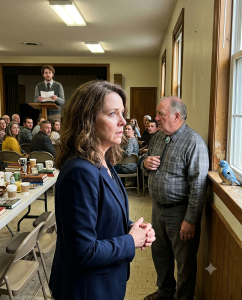
In the end, she stepped into the fellowship hall wearing a plain navy blazer and a badge that said only Cecily. The room smelled exactly as it had twenty-two years earlier: coffee, lemon polish, old paper, warm air trapped under fluorescent lights. Even the wobbling table in the third row was still there.
Memory, she realized, doesn’t just live in people. Sometimes it clings to linoleum.
She began walking the perimeter, keeping to herself, when she saw the bluebird.
It sat on a table between a crocheted potholder and a stack of paperbacks. Chipped wing. Hairline crack. Glue residue at the base.
Her pulse stumbled.
It couldn’t be the same one. Could it?
The rational part of her said no. There were countless cheap ceramic birds in the world. But grief and humiliation do not answer to reason. One look at that crooked repair line and she was twenty-six again, standing in a room full of people learning what it meant to be dismissed.
A cheerful woman behind the table saw her staring. “Sweet little thing, isn’t it? Somebody keeps moving it around. I think the kids are playing games.”
Cecily smiled and moved on, unsettled in a way she couldn’t explain.
She found coffee. Walked another lap. Avoided eye contact. Then she saw the bluebird again on a different table near the windows.
Still no children around it.
Still no one paying attention.
Across the hall, Gary Harwick was laughing beside the dessert table, older now but unmistakably himself. Gray at the temples, heavier through the middle, dressed in expensive confidence. He had not recognized her. That almost made her laugh. Some men possess so little curiosity about other people that they can forget a face they once made cry.
Cecily might have stayed hidden all morning if Pastor Dale had not spotted her.
“Please stay for the announcement,” he whispered, steering her gently toward the chairs before she could refuse. “You deserve to hear it.”
She didn’t deserve anything from this room, she thought. But she let him lead her to the back.
And somehow, by a mean little miracle of geometry, she ended up standing beside Gary Harwick.
He gave her a distracted nod without seeing her. She looked at her shoes.
When Pastor Dale stepped to the podium with a folded letter in hand, the room settled. Cecily lifted her gaze and saw the bluebird again, now perched on the windowsill across the hall like it had climbed there to watch.
A prickle ran up her arms.
Pastor Dale cleared his throat and began.
He spoke first about community, need, generosity, and answered prayer. The room listened politely, waiting for details. Then he opened the letter further, inhaled, and read the donor’s name.
“Mrs. Cecily Pruett.”
The silence snapped.
Heads turned row by row until the whole room was looking backward. Gary’s body went rigid beside her. He turned slowly, and she watched recognition arrive in pieces. Confusion. Concentration. Memory. Shock.
“Cecily?” he whispered.
“Hello, Gary,” she said.
Pastor Dale continued, voice trembling harder now as he announced the amount and the building name: The Pruett Center for Community.
The reaction was immediate and uneven. Some people gasped. Some clapped too late. Others simply stared, because surprise is never just surprise in a room full of old history. It is also inventory. Faces began searching their own memory for where this woman belonged and what, exactly, had happened all those years ago.
Gary looked pale.
“I didn’t know,” he said under his breath.
“No,” Cecily replied. “You usually didn’t.”
He flinched.
Then something unexpected happened. An elderly woman in the front row stood up with tears in her eyes.
“I remember you,” she said. “You brought your grandmother’s things.”
The room shifted again.
Another woman rose—Reverend Mills’s widow, upright despite her age, her voice clear as a struck bell. “There’s something this church should have said a long time ago,” she announced. “And before we praise this gift without naming the truth, I think we owe Cecily Warren an apology.”
The hall went still.
Gary stared at the floor.
The widow told the story plainly. Not with embellishment, not with gossip’s pleasure, but with the clean force of a witness tired of her own silence. She said Gary had shamed a young woman over donated family belongings. She said the church had stood by and let it happen. She said Danny Harwick had said nothing. She said she herself had said nothing too, and she had regretted it for twenty-two years.
One by one, others began nodding.
A woman from the old quilting circle said, “I remember the bird.”
A former deacon muttered, “We should’ve stopped that.”
Someone near the back whispered, “Lord, I forgot.”
“No,” Reverend Mills’s widow said, turning toward the room. “You chose not to remember.”
That landed.
Gary finally lifted his head. His face was mottled with embarrassment and anger—the two emotions pride confuses most easily. “I was appraising donations,” he said. “People are making it sound worse than it was.”
Cecily looked at him for a long moment. She was surprised to find she felt no heat anymore. Just clarity.
“You dropped my grandmother’s bluebird into a trash can while I stood there asking you not to,” she said. “And what made it worse wasn’t your opinion. It was the audience.”
No one came to his rescue this time.
Gary swallowed. He glanced toward the windowsill as if searching for escape, and there, impossibly, was the bluebird again.
He went quiet.
Pastor Dale, to his credit, stepped down from the podium and crossed the room to Cecily. In front of everyone he said, “I’m sorry. For what was done, and for what wasn’t done. We are deeply honored by your gift, but more than that, we are grateful you came back into this room at all.”
It was such a simple apology that it almost undid her.
Afterward, the room dissolved into clusters. Some people approached Cecily with damp eyes and earnest hands. Others kept their distance, ashamed of what they remembered. Gary disappeared before the coffee was refreshed.
Cecily stayed only fifteen more minutes. Long enough to answer Pastor Dale’s practical questions. Long enough to watch Reverend Mills’s widow squeeze her hand. Long enough to walk once more past the tables and see that the bluebird had disappeared for good.
On impulse, she asked the sunflower-brooch woman, “Did anyone buy the little ceramic bird?”
The woman frowned. “What bird?”
“The blue one. Chipped wing.”
“There wasn’t any bluebird on my table, honey. Not today.”
Cecily almost corrected her. Then she didn’t.
She drove back to Indianapolis under a sky the color of old dishwater and cried only once, briefly, at a red light she almost missed. Not from pain. Not exactly. More from the strange exhaustion that follows when something heavy is finally set down.
Months later, when the new building opened, the sign out front read THE PRUETT CENTER FOR COMMUNITY in dark bronze letters above the glass doors. Children ran through the lobby. Volunteers stocked shelves in the food pantry wing. A tutoring room buzzed with after-school noise. There was a grief support circle scheduled for Thursday, a winter coat drive for Saturday, and a summer lunch program already full.
Pastor Dale asked if she wanted to say a few words at the ribbon-cutting.
Cecily stood at the podium, looked at the crowd, and chose honesty.
“This building is named for my husband,” she said. “He believed people should never be treated as if what they love is worthless. I think communities survive when they remember that.”
That was all.
No mention of Danny. No mention of Gary. No dramatic revenge. Life had already supplied the sharpest symmetry: the woman once mocked for bringing junk now funding the place itself.
After the ceremony, Reverend Mills’s widow pressed something wrapped in tissue into Cecily’s hands.
“It turned up in a cabinet after the fundraiser,” she said. “No one can explain how it got there.”
In the car, Cecily unwrapped it.
A ceramic bluebird. Chipped left wing. Crack along the base, repaired badly with yellowed glue.
She held it very still.
Maybe someone had rescued it from the trash twenty-two years earlier and tucked it away. Maybe one of the old ladies had kept it all this time out of guilt and never found the courage to return it until now. Maybe memory had worked a stranger kind of miracle.
She no longer needed to solve it.
At home she set the bird on the kitchen windowsill above her sink. In the late afternoon the light caught the chip in its wing and turned the glaze almost luminous.
Sometimes, while washing dishes, Cecily found herself looking at it and thinking not about Gary, or Danny, or the room full of silence, but about Thomas. About Nana. About all the ways people reveal themselves when faced with something fragile that belongs to someone else.
Some lift it carefully.
Some drop it.
And sometimes, many years later, the ones who were discarded are the very ones who build the shelter everyone else ends up needing.
That was the part the town would debate, of course. Whether Gary deserved public shame. Whether Cecily’s return was generosity or justice. Whether an apology twenty-two years late counted as repentance at all. Some would say the biggest red flag had been Gary’s cruelty. Others would say it had been Danny’s silence, because the people who wound us are one danger, but the people who watch and do nothing are another. Cecily knew only this: a person’s character is rarely hidden in grand crises. More often, it appears in tiny moments around folding tables, in what they protect, what they dismiss, and what they let fall without reaching for it.