The night Henry Russo nearly died, Sophie Bennett was on her knees scrubbing dried mud from the marble floor in the east wing of his mansion.
That was how life worked inside the Russo estate. Wealth shone from every surface, but the people who kept it gleaming were meant to move quietly, speak rarely, and notice nothing. Sophie had been working there for six months, long enough to understand the rhythm of fear that held the house together.
The gates were tall enough to make guests feel important and workers feel trapped. Cameras watched every hallway. Men in dark suits stood near staircases with the stillness of statues and the eyes of predators. Deliveries arrived late at night in black SUVs. Expensive art hung on walls that had probably heard screaming. Nobody said any of this out loud, of course. They just did their jobs and went home grateful they had not been summoned downstairs.
To the city, Henry Russo was a real estate mogul. He funded hospital wings, shook hands with aldermen, and donated to youth sports programs with a smile polished for newspaper photos. But Chicago had another version of him, the one spoken about only in private. The one attached to missing men, broken alliances, and businesses that changed ownership after their owners suddenly stopped resisting.
Sophie knew enough to be afraid of him and not enough to protect herself from him.
She was twenty-two, smart, exhausted, and poorer than fear allowed. Her mother had died the previous year after a long illness that left Sophie with debt, grief, and a brutal understanding of how little mercy the world gave women without money. The Russo estate paid more than any cleaning job she could find, and it came with cash bonuses for silence. She took the work because she needed it. She stayed because survival made morality feel expensive.
That October night, she heard the side door slam and turned just in time to see Henry stumble into the kitchen.
He was bleeding heavily from his side. His white shirt was soaked dark. One hand pressed against the wound, the other braced against the edge of the table. He looked furious, pale, and seconds from collapsing.
“Don’t call anyone,” he said.
It wasn’t a request.
Sophie froze. Every instinct told her to back away. To let one of his own men handle him. To pretend she had never seen him.
Then Henry’s knees buckled.
She caught him badly, nearly falling with him, but it was enough to stop his head from smashing into the floor. He cursed under his breath. Up close he smelled like iron, smoke, and whiskey.
“Pantry,” he muttered.
She dragged him there because it was the nearest place with a lock. By the time she had him against the wall, her hands were slick with his blood and her pulse was roaring in her ears. She grabbed the estate’s medical kit, cut away his shirt, and found the wound.
She had no business doing what she did next.
But her mother’s cancer had taught her how to dress wounds, manage fevers, keep pressure where it counted, and keep moving even while terrified. She cleaned the injury, stopped the worst of the bleeding, and stitched him with hands that trembled only when she let herself think.
Outside the pantry, the mansion was chaos. Men stomped through hallways. Phones rang. Orders were barked. Someone shouted that the Falcones had an informant inside Russo’s crew. Someone else said the boss had disappeared.
Inside the pantry, Henry Russo leaned his head back against the shelves and watched Sophie save his life.
For the first day, he barely spoke. Pain made him vicious and suspicious. He demanded water, then snapped at her for giving it too slowly. He asked who else had seen him, how long she had worked there, whether she had family, whether she had ever spoken to police. It felt less like being trusted and more like being examined for weaknesses.
But fever has a way of breaking down a man’s performance.
By the second night, Henry was shivering despite the blankets she piled over him. His voice had lost its steel. He spoke in fragments, then in sentences, then in confessions so incomplete they were almost accidents.
He said he hadn’t slept more than two hours at a time in weeks.
He said everybody wanted something from him.
He said power was just a prettier word for isolation.
At one point he asked her why she was still there.
Sophie looked at the wound she had been cleaning and said, “Because if I leave, you die.”
He laughed softly at that. “Maybe that would solve a lot.”
It was the first human thing she had ever heard from him.
When dawn pressed gray light through the pantry’s high window, he studied her face for a long moment and said, “You look at me like you don’t know who I’m supposed to be.”
“I know who they say you are,” she replied.
“And?”
She hesitated. “That’s not the same thing.”
That answer changed something.
After his men finally found him and moved him to a private doctor, Sophie expected the whole strange episode to vanish. Instead Henry began orbiting her.
He would appear in the kitchen late at night when her shift ended. He asked whether her mother had suffered. He remembered details she mentioned only once. He watched her in a way that was unsettling at first and intoxicating later, as if she had reached some bruised place in him that no one else could touch.
The first time he kissed her was in the study, after midnight, with the fireplace throwing gold over dark wood and leather. He touched her like a starving man discovering warmth. It should have terrified her. Instead it made her feel chosen, which is one of the most dangerous feelings a lonely person can know.
What followed never had a proper name. Henry never called her his girlfriend. He never took her to dinner, never introduced her to anyone who mattered, never allowed their relationship to exist in daylight. But he sought her out relentlessly. He listened when she spoke. He softened in her presence. He said things in darkness he would never repeat in morning light.
Sophie told herself he was damaged. Guarded. Unused to tenderness.
She mistook secrecy for depth, intensity for love, and possession for devotion.
Three months later she learned she was pregnant.
She waited until evening to tell him, wanting the right moment, foolishly hoping for surprise first and happiness after. Henry was in his study, whiskey in hand, his knuckles split from some violence she did not ask about.
“Henry, I need to tell you something.”
He turned toward the fire instead of toward her. “Then say it.”
She drew in a breath. “I’m pregnant.”
The reaction was immediate and merciless.
He went still in a way that felt more dangerous than movement. Then he looked at her with a coldness she had never seen turned fully on her before.
“Who sent you?”
The question was so grotesque she almost smiled from disbelief.
“No one. It’s yours.”
“Shut up.”
She flinched.
He stepped toward her, eyes hard. “The Falcones have been trying to get inside my house for months. The feds are sniffing around every business I own. And now suddenly one of the maids I was stupid enough to trust walks in pregnant?”
“I saved your life,” Sophie said, voice breaking.
“To use it against me later?”
He pulled cash from his desk and threw it at her. The bills hit her shoulder and scattered across the floor.
“Take it. Get out.”
There are moments when a heart does not break cleanly. It tears while still trying to hope.
Sophie begged then. Not gracefully. Not proudly. She said she had nowhere to go. She said it was freezing. She said there was a baby. She reached for his sleeve as though the man who had held her in the dark might still be hiding somewhere inside the monster in front of her.
Henry shoved her into the door and called for Vincent.
The bodyguard entered immediately.
“Take out the trash,” Henry said. “If she comes back, finish it.”
Sophie screamed his name as Vincent dragged her away. Henry poured himself another drink.
That was the last time she saw him for eight years.
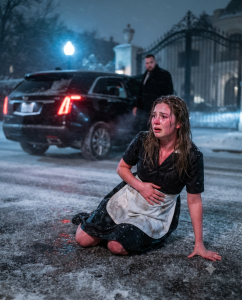
Vincent left her on a frozen corner in Garfield Park. To his credit, he looked uneasy. To Sophie, that made him no less guilty. She landed on the pavement with one knee twisted under her and the wind cutting through her thin clothes like knives. The SUV drove away. The taillights vanished. The snow kept falling.
She might have died there.
Instead, an older bus driver on his break spotted her under a failing streetlamp and called for help. A church shelter took her in that night. She had mild hypothermia, bruised ribs, and a fever by morning. What she did not have anymore was softness.
She disappeared before anyone from Russo’s world could find her.
Over the next months she moved through women’s shelters, day jobs, and temporary rooms. She lied when she needed to. She trusted almost no one. She gave birth in a county hospital to a little boy she named Oliver. When the nurse laid him against her chest, she expected relief. What she felt instead was fierce, frightening resolve.
No one would ever throw this child away.
Raising Oliver was ugly work wrapped around beautiful moments. Sophie cleaned offices before dawn, stocked shelves during the day, and folded laundry at night. She learned which grocery stores marked down produce near closing and which landlords would ignore late rent if the hallway stayed mopped. She taught Oliver to read from library books and to stay away from windows when unknown cars parked too long outside.
He was a serious child with observant eyes and a habit of asking questions that cut too close to the truth.
“Where’s my dad?”
“Not here.”
“Was he bad?”
Sophie would pause before answering. “He made bad choices.”
The years passed. Hard, but not empty. Oliver grew. Sophie built a life small enough to protect and honest enough to survive. Eventually she found steady work managing inventory for a neighborhood bakery. She made friends. She laughed again sometimes. The Russo name became something she locked away in a mental room she rarely opened.
Then one winter evening, there was a knock at her apartment door.
Vincent stood on the other side.
He looked older. The bulk was still there, but the certainty was gone. Snow melted on his coat while he stared past Sophie and saw the dark-haired boy standing in the hallway behind her.
It took only one look.
The child’s face was too familiar.
Vincent exhaled slowly. “He knows now.”
Sophie’s fingers tightened around the door. “Get out.”
“Please. Just listen.”
She nearly shut the door in his face, but he spoke quickly.
“Henry had a stroke. Then they found the cancer. It spread fast. He’s still alive, but barely. And the men around him…” Vincent glanced toward the stairwell before continuing. “They smell blood. Half the organization is splitting. The Falcones are moving in again.”
Sophie stared at him without sympathy. “Sounds like justice.”
Vincent nodded once. “Maybe it is.”
“Then why are you here?”
“He wants to see the boy.”
The sentence landed like poison.
“He had a chance to see his child eight years ago,” Sophie said. “He threw us into the street.”
“I know.”
Vincent reached into his coat and placed an envelope on the table just inside the doorway. “I was told not to leave this unless you refused.”
She should have thrown it back at him. Instead she opened it.
Inside was a photograph of Henry in a hospital bed. He was thinner, paler, stripped of the force that once filled every room he entered. But the eyes were the same.
Beneath the photo was a note in Henry’s handwriting:
Tell Sophie the truth about the night her mother died.
The room tilted.
Sophie’s mother had died in a public hospital after a brutal decline. Sophie had been told there had been a medication delay, then complications, then cardiac arrest. A tragedy. A failure. One more poor woman lost in a crowded system.
Only a few people knew the full details.
Henry Russo should not have been one of them.
Sophie looked up slowly. “What does this mean?”
Vincent’s expression was grim. “It means you don’t know everything.”
She wanted to deny that. Wanted to call it another manipulation. But Henry’s entire empire was collapsing. A dying man did not send for the son he had denied and invoke a dead mother by accident.
Against every instinct she possessed, Sophie agreed to one meeting.
Russo’s estate no longer looked invincible when she returned. Security was tighter but more nervous. Several windows were dark. The staff moved like people counting exits. Men in suits watched each other as much as they watched the gates. Decay had crept into luxury.
Henry was not in the study.
He was in a medical suite on the mansion’s second floor, half-reclined in a bed beside machines that hummed and clicked with quiet authority. The first shock was how diminished he looked. The second was how dangerous he still felt even weakened, because some men build power so deeply into other people’s fear that illness can’t erase it.
Oliver waited outside with Vincent.
Sophie entered alone.
For a long time Henry simply looked at her. His voice, when it came, was rough and thin. “You survived.”
“You sound disappointed.”
A shadow of shame crossed his face. “No.”
She stayed near the door. “Say whatever game you brought me here for.”
He swallowed. “The night your mother died, she wasn’t just another patient.”
Sophie felt her heartbeat in her throat.
Henry told the story in halting pieces. Years earlier, before Sophie worked for him, her mother had seen something she should not have seen at one of his development properties: money being moved through shell companies connected to a clinic contract. She hadn’t understood the full criminal web, but she had recognized enough to frighten the wrong people. When she later entered the hospital for treatment, a fixer tied to Russo’s organization flagged her file. Care was delayed. Records were altered. Nobody ordered her death outright, Henry insisted, but men under his protection made sure saving her was never anyone’s priority.
Sophie could barely breathe.
“I didn’t know her name then,” Henry said. “When I realized who you were, it was already too late.”
“Too late for what?”
He shut his eyes. “For me to deserve telling you.”
The room rang with silence.
It was almost laughable, the scale of it. She had saved the life of the man whose empire had helped kill her mother. Then she had loved him. Then she had carried his child into the snow.
“Why now?” she asked, voice shaking. “Why tell me now?”
Henry turned his head toward the door, toward the hallway where their son waited. “Because they’ll come for him.”
That froze her.
Henry explained what Vincent had only hinted at. Rival factions inside his organization had learned of Oliver’s existence through old records and loose tongues. Some saw the boy as leverage. Some saw him as a future claim to the Russo assets that would survive the federal seizures. Others wanted him erased so no heir could complicate their takeover.
Sophie’s horror sharpened into rage. “This is your fault.”
“Yes.”
The answer was immediate.
No defense. No minimization.
Just yes.
He went on. There was money hidden outside the books, enough to keep Oliver protected and free of the criminal machinery swallowing the Russo estate. There were names, accounts, and evidence Henry was prepared to give federal prosecutors in exchange for witness protections that could extend to Sophie and Oliver. But the arrangement depended on Sophie’s consent, because once it started, there would be no pretending Oliver was not Henry Russo’s son.
“You want to save him now?” Sophie asked.
Henry looked at her with ravaged eyes. “I want to do one thing before I die that isn’t poison.”
He asked to see Oliver.
Every instinct in Sophie screamed no. But the larger instinct, the one motherhood had carved into bone, was to measure danger, not emotion. She made the meeting happen on her terms. Vincent stayed in the doorway. Sophie remained between father and son. Oliver, solemn and wary, stepped inside.
Henry stared at him the way people stare at miracles they no longer deserve.
“Hi,” Oliver said after a long silence.
Henry’s mouth trembled. “Hi.”
There was no cinematic reconciliation. No instant warmth. Oliver asked blunt, painful questions children ask when adults have ruined what should have been simple.
“Are you my dad?”
“Yes.”
“Why weren’t you there?”
Henry closed his eyes for a moment. “Because I was a coward.”
Sophie had not expected that answer. Neither had Oliver.
“What does that mean?” the boy asked.
“It means,” Henry said slowly, “I was so afraid of being betrayed that I betrayed the people I should have protected.”
Oliver considered this with the grave concentration of a child trying to build a bridge across adult wreckage.
“Mom says bad choices matter.”
Henry managed the faintest, saddest smile. “Your mom is right.”
The legal storm moved quickly after that. Henry gave up names, financial routes, judges on payroll, officers on retainer, shell companies, safe houses, and burial sites hidden beneath construction projects. Federal agents swarmed. The Falcones retaliated. Arrests hit the news like thunder. The Russo empire, so long protected by fear and money, split open for the whole city to see.
Henry did not live to watch it finish.
He died three weeks later after one final conversation with Sophie.
In it, he apologized without asking to be forgiven. He said there were no words equal to what he had done. He admitted that when Sophie told him she was pregnant all those years ago, he had believed her for one terrible second. And in that second, instead of feeling joy, he had felt fear that loving anyone openly would hand his enemies a weapon. So he chose cruelty, because cruelty had always felt safer than vulnerability.
“I told myself I was protecting myself,” he said. “Really, I was protecting the worst part of me.”
Sophie listened. She did not absolve him.
After his death, the hidden funds Henry disclosed were released through courts and trusts. Sophie used them to move far from Chicago, change their routines, and build a life that belonged to neither the Bennett grief nor the Russo bloodline. Oliver received therapy, security, and, eventually, the full truth in pieces appropriate for his age.
Years later, when he was old enough to ask again who Henry Russo had really been, Sophie answered with more honesty than comfort.
“He was a man who did terrible things,” she said. “And at the end, he finally understood what they cost.”
Oliver was quiet for a while. Then he asked the question that lingered over everything.
“Did you forgive him?”
Sophie looked out the kitchen window at the ordinary, peaceful yard her son had grown up in, the one won at such brutal price.
“No,” she said after a moment. “But I let him tell the truth.”
That was the nearest thing to mercy he ever received.
Some people would say Henry’s final acts proved there was good in him all along. Others would say death simply cornered him into honesty. Sophie never found those debates especially useful. A revelation at the end does not erase a cruelty at the beginning. Regret does not resurrect the dead. Truth told late is still late.
But she also knew this: the most dangerous red flag had never been Henry’s violence. It had been the moments of tenderness that made her believe violence could be safely loved.
That was the lesson she carried.
Not that monsters are never human.
But that seeing their humanity does not obligate you to hand them your life.