By the time most people in Maple Hollow heard that Darlene Bell’s marriage was over, Gary had already decided what story the town would be allowed to tell about it.
He moved fast. Faster than anyone expected from a man who had spent years acting as if paperwork bored him and deadlines were for other people. On a gray Thursday morning in late February, he filed for divorce from his wife of thirty-one years. Before noon, according to what would later come out, he had also completed the steps he believed would secure the far more valuable separation: the removal of Darlene from the business she had spent nearly three decades building.
To the outside world, Bell & Finch Antique Restoration looked like a tidy local success story. It occupied a brick storefront near the courthouse square and a larger workshop behind the old feed mill. The front windows displayed restored walnut sideboards, carved mirrors, rolltop desks, and velvet chairs brought back from the dead by patient hands. People from neighboring counties brought in family heirlooms wrapped in quilts. Estate attorneys called when they needed a professional opinion before appraisals. A regional museum had even consulted them twice on period furniture repairs.
The name on the sign suggested a partnership. Anyone who really knew the business understood that the soul of it belonged to Darlene.
She had started young, working in her father’s garage with a toothbrush, beeswax, and more confidence than technique. By nineteen she could identify wood species by smell and touch. By twenty-four she was taking private commissions. She met Gary at twenty-eight when he came into her first rented workshop to ask if she could repair a cracked barrister bookcase that had belonged to his grandmother. He was easy to like in those days—handsome, flattering, full of ideas. He admired her talent with an enthusiasm that felt like recognition. When he suggested that they expand, open a proper storefront, and build something bigger than one woman at a workbench, it sounded less like control than faith.
For a while, it was faith.
Darlene handled the restoration, client relationships, records, estimates, inventory tracking, and quality control. Gary handled what he liked to call growth. He talked to landlords, shook hands at civic events, made friends in the Chamber of Commerce, and learned which local photo ops mattered. He was useful, especially in the early years, when getting attention was survival. But Bell & Finch succeeded because Darlene’s work gave people a reason to come back.
Clients asked for her by name. They trusted her with pieces no one else was allowed to touch. When a family from Willow Creek brought in an 1880s secretary desk that had survived a flood and a house fire, Darlene stayed late every night for two weeks because she could not bear to tell them it was beyond saving. When she unveiled it restored, the daughter cried. That was the business she built. Not headlines. Not branding. Trust.
Gary liked to say they complemented each other. Darlene learned, over the years, that what he meant was this: he liked being publicly attached to something she privately made possible.
The shift did not happen all at once. It arrived in small, irritating doses. Gary began talking over her in meetings, then speaking for her entirely. He referred to the workshop staff as “my people.” He exaggerated his role to investors and minimized hers to newcomers. If Darlene corrected a detail, he smiled as if she were being adorably technical. When she objected in private, he accused her of not understanding how business worked at scale.
The cruelest thing about that kind of erosion was how easy it was for others to miss. There was never one dramatic betrayal at first. Just hundreds of moments that taught a woman how much of her own labor could be repackaged in another person’s language.
Then came Sienna Voss.
She arrived as a consultant, at least according to Gary. He said the market was changing, their brand was aging, and younger clients wanted a fresher image. Sienna was in her thirties, stylish, articulate, and fluent in the kind of business jargon that makes ordinary decisions sound visionary. She wore pointed boots, expensive coats, and the expression of someone always a little bored by whoever was speaking. She talked about luxury repositioning, digital reach, premium verticals, and monetizing story value.
Darlene disliked her almost immediately, though not for the reasons town gossip later preferred. It wasn’t jealousy. It was contempt. Sienna looked at restored furniture the way a trader looked at stock. One afternoon, after Darlene had spent six hours repairing the hand-carved apron on a nineteenth-century dining table, Sienna glanced at it and asked, “Can we charge more if we describe it as heritage dining content?”
Darlene had stared at her for a full second before saying, “It’s a table.”
Gary laughed like that was charming.
Within six months, Sienna was in more meetings than senior staff. Within eight, she was traveling with Gary to trade expos. Within ten, Darlene found perfume in Gary’s overnight bag and stopped asking herself whether she was imagining things. The affair, once seen clearly, made a dozen earlier confusions snap into place.
Still, even then, Darlene did not expect what came next.
The divorce filing came first, delivered with astonishing bureaucratic neatness. The business transfer came with it, though Darlene did not understand the full scope until two days later, when their longtime insurance representative called and asked why ownership records had been updated.
“Updated how?” Darlene asked.
There was a pause on the line. “I assumed you knew.”
That was how she learned that Bell & Finch Antique Restoration had been shifted into the name of Sienna Voss through a sequence of filings and internal revisions that Gary evidently believed would be irreversible once completed. When Darlene confronted him by phone, Gary did not deny it. He did something worse.
“It’s cleaner this way,” he said.
Cleaner.
As if removing her from the company she founded were an accounting convenience.
He told her she had never understood the growth side of the business, that she was too emotional to handle transition, that it was time to move forward. When she reminded him that her name was in the founding documents, he replied, “Names on paper aren’t always the same as who actually runs things.”
That sentence stayed with her for a long time.
The town expected fireworks. Maple Hollow loved public implosions as long as they happened to someone else. People waited for Darlene to sue immediately, to cry on the courthouse steps, to expose the affair in humiliating detail. Instead she packed her personal tools and records, moved into a small apartment above a florist, and disappeared into a silence that unsettled everyone more than rage would have.
Quiet, however, is not the same as passive.
Darlene spent the first month in grief so clean and heavy it felt almost architectural. She woke at odd hours. She sat at her kitchen table with tea gone cold. She replayed decades, searching for the point where love had turned into strategy. But grief, in her case, had a practical side. Once the rawest shock passed, she began writing things down.
Dates. Conversations. Missing records. Which client files had vanished from the office cabinet. Which passwords had stopped working. Which employees had quietly texted their condolences with careful wording that said more than they intended. She visited the workshop once, legally escorted, to retrieve personal items and noticed that three old ledgers were gone from the archive shelves. She remembered the founding partnership agreement, stored in a blue accordion file because Gary always complained that “old paper clutter” did not belong in the current office. She remembered an attorney years earlier insisting on a clause Darlene had barely considered relevant then: if fraud, concealment, or abandonment of fiduciary duty ever occurred, management control over restoration operations reverted to D. Finch Bell pending review.
At the time, she had laughed and said, “That sounds dramatic.”
The lawyer had shrugged. “Partnerships are dramatic.”
Fourteen months passed. In public, Bell & Finch became Bell Finch Heritage Interiors. The old hand-painted sign disappeared. Their ads became glossier. Gary spoke on panels about modernization. Sienna updated the showroom and gave interviews about “evolving a legacy brand.” They landed quick-turn commercial projects that photographed well and generated attention, though some long-term clients drifted away. Darlene heard things because people talked. Not always to her face, but enough.
She also heard about mistakes. Delayed repairs. Client complaints. One family upset that an heirloom chest had been reassigned mid-project without notice. A museum curator quietly furious over altered estimates. Nothing catastrophic alone. Together, enough to sketch a pattern.
Still Darlene stayed outwardly still.
The object people noticed most during that year was the laminated index card.
She had made it herself one Sunday afternoon after realizing loose notes were too easy to lose or damage. It was a standard white index card, typed and printed, then laminated at the copy store for less than three dollars. On it she listed the items she knew had been removed or hidden before the divorce filing—records, forms, archived files, and one detail no one else would have understood at first glance: Master slideshow file for Chamber banquet.
The Chamber banquet mattered because Darlene knew exactly how that annual event worked. For nine years she had helped run it. She knew where the tech table sat, who approved presentation uploads, how sponsor reels were queued, when the award slideshow changed, which volunteer double-checked the USB backups, and how often committee members trusted her enough not to verify what she said. She was not scheming when she stayed on long enough to help finalize the current year’s event. She was waiting to see what the evidence became.
Then the evidence became enough.
An old employee, frightened and ashamed, contacted her after resigning. He had seen Gary remove archive files from the locked records cabinet on the morning of the divorce filing. A second source sent copies of internal emails. One attorney’s note, buried in a chain, asked for confirmation of missing partner consent before final transfer processing. Someone had ignored the red flag and moved ahead anyway. There was also security footage. Grainy, yes, but clear enough to identify who entered the office and when.
Darlene assembled everything methodically.
She did not post it online. She did not leak it to gossip pages. She sent copies where they needed to go legally and kept one presentation package for the moment that mattered most—not because it was theatrical, but because Gary had built his protection through public narrative. To puncture that narrative, the truth had to arrive in the same room where he intended to celebrate it.
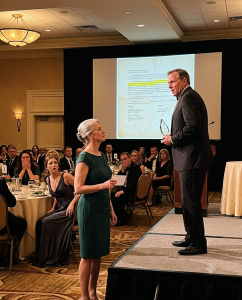
The Chamber of Commerce banquet took place on a mild spring evening at the Waverly Hotel ballroom. Darlene had chosen the room years earlier because the stage sightlines were clean from every table. She had also insisted, back then, on navy velvet draping behind the lectern because it made photos look formal without appearing stiff. This year, as she entered in a dark green dress with a cardigan folded over one arm, she noticed all those old choices still serving their purpose.
People saw her immediately.
Pity followed her like perfume she had not chosen. So did curiosity. She accepted both with the same measured grace. At Table Twelve, she sat among committee donors, a retired teacher, the florist who rented her downstairs storefront, and a banker’s wife who asked too many careful questions. Each time someone glanced toward her cardigan pocket, Darlene touched it lightly.
“What is on that card?” the florist finally whispered.
“Something I didn’t want to forget,” Darlene said.
Onstage, the banquet moved through recognitions and speeches. Applause rose and fell. Coffee was poured. Silverware chimed softly against plates. Then came the Small Business of the Year award.
Gary stood at the announcement with his familiar public smile. Sienna squeezed his arm and looked around the room as if accepting admiration by diffusion. Gary walked to the stage under applause that sounded supportive until you listened closely. Beneath the volume, there was tension.
The mayor, genial and red-faced from a long evening of speaking, launched into the introduction. He praised resilience, innovation, and local economic impact. Behind him, the scheduled slideshow began with company images: polished showroom photos, staff snapshots, branded signage, all the curated proof of a rising enterprise.
Gary took the glass obelisk and leaned into the microphone.
“It’s been quite a journey,” he said. “Small businesses are built on sacrifice, adaptability, and knowing when it’s time to move forward.”
From three tables away, Darlene heard someone inhale sharply.
Gary thanked the Chamber. He thanked mentors. He thanked his “brilliant partner Sienna.” He thanked his team. He did not thank Darlene, though half the room knew he was standing inside an event architecture she had created almost piece by piece over the years.
The mayor returned for the handshake. Cameras came up. Applause swelled.
At her table, Darlene removed the laminated index card from her pocket and set it beside her water glass.
The florist looked down first. Then the retired teacher. Then the banker’s wife. The card did not explain everything, but it explained enough to make their faces change.
ITEMS REMOVED FROM BUSINESS BEFORE FILING.
Original client ledger books.
Insurance archive drive.
Three unsigned transfer forms.
Trademark renewal packet.
Founding partnership agreement.
Master slideshow file for Chamber banquet.
The moment the mayor clasped Gary’s hand, the screen behind them changed.
The applause died so quickly it felt stolen.
The first image was not promotional. It was a scan of the founding partnership agreement, enlarged cleanly enough for the signatures to be unmistakable: Gary Bell. Darlene Finch Bell. Below them, highlighted, the clause about equal ownership and management reversion in the event of fraud, concealment, or abandonment of fiduciary duty.
Onstage, Gary turned halfway toward the screen, then back toward the audience, calculating. The mayor’s smile slid away.
The next slide showed an incomplete transfer form. One signature line blank. Another executed electronically on the morning of the divorce filing. A highlighted attorney note asked for confirmation of missing partner consent.
A murmur traveled through the ballroom like a current.
Then came the office security still. Date and time stamped. Gary at the records cabinet. Sienna beside him. The blue accordion file visible in his hand.
“Turn it off,” Sienna said from the audience, but her voice was too small against the silence.
No one at the tech table moved.
Darlene stood.
She did not rush. She did not grandstand. She walked toward the stage with the calm of a woman whose anger had already done the useful work of becoming evidence. The laminated card remained in her hand, absurdly small beneath the chandeliers.
“Darlene,” Gary said into the microphone, but the microphone magnified what he had not intended to reveal: fear.
She stopped at the foot of the stage.
Another slide appeared—an email exchange. On the ballroom screen, in black text against white, the first line was devastatingly plain:
Proceeding without partner authorization creates exposure if Mrs. Bell contests ownership.
There was no dramatic music, no one shouting, no overturned table. The destruction happened in expressions. A banker lowering his glass. A museum donor pressing fingers to her mouth. A former client staring at Sienna with open disgust. The mayor taking one involuntary step away from Gary, as if contamination worked by proximity.
Gary tried to speak first. “This is misleading,” he said.
Darlene looked up at him. “Is it?”
He opened his mouth, shut it, then looked toward the tech booth with the trapped irritation of a man unaccustomed to losing control in public. “These are private documents.”
“That didn’t stop you from using them,” Darlene replied.
Her voice was calm. That calm cut harder than outrage.
The next several minutes unfolded in fragments the town would repeat for years. Sienna mounted the stage, pale and furious, insisting there had been legal advice, that everything had been in process, that Darlene was bitter and theatrical. Darlene answered only when necessary. The Chamber president, white-knuckled and horrified, signaled the AV team to stop the slideshow after the final evidentiary slide. The mayor asked for a recess no one really heard.
And then, because some truths require one clear sentence to finish what evidence starts, Darlene said into the microphone, “I restored every piece that built that company’s reputation. Gary handled introductions. I handled reality. The business was never his to take alone, and it certainly wasn’t his to gift.”
That was the line people quoted later, but it was not the end.
The legal consequences came fast because the public moment accelerated what private filings had already begun. The contested transfer triggered review. Missing consent documents, internal warnings, and the partnership agreement shredded Gary’s position. Several clients withdrew accounts immediately. A local bank froze expansion financing pending investigation. The Chamber rescinded the award within forty-eight hours. By the end of the month, the rebrand that Gary and Sienna had pushed so aggressively was a liability instead of an asset.
Sienna left first. Not quietly, despite her attempts. She blamed Gary for misrepresenting the ownership structure and told at least three people he had assured her Darlene had “signed off years ago.” Whether that was a lie Gary told her, a lie she wanted to believe, or a lie they shared between them hardly mattered in the aftermath.
Gary lasted longer, but not with dignity. In court filings he tried to frame the transfer as an administrative misunderstanding. That claim collapsed under documentation. Staff testimony, archived correspondence, and the old agreement established both Darlene’s founding role and Gary’s concealment. Bell & Finch’s operating control was restored to Darlene under temporary authority that later became permanent.
She did not celebrate.
That surprised people too.
When she returned to the workshop months later, the place felt both familiar and bruised. Some equipment had been neglected. Several pieces had been mishandled. One walnut chest she had left nearly complete was sitting under fluorescent lights with a finish so overworked it looked plastic. She stood in the workshop alone for a long minute, breathing in sawdust, shellac, and the old ache of having to rescue something damaged by someone who never understood its value.
Then she got to work.
She restored the name first.
Bell & Finch Antique Restoration returned to the sign, though this time the lettering was hand-painted in a slightly deeper gold. Gary’s name remained because contracts and legal history made abrupt erasure complicated, but people in town quickly adjusted to the truth. Clients once again asked for Darlene directly. The museum curator came back. So did the estate attorneys. Apprentices who had nearly left asked to stay. One by one, trust returned not because of sympathy, but because Darlene’s work remained what it had always been: real.
As for the laminated index card, she kept it for another year.
One afternoon, the florist downstairs asked if she still carried it.
Darlene smiled, reached into her cardigan pocket, and pulled it out. The edges were cloudy from use. On the back, in her small neat handwriting, she had added a sentence after the banquet:
Never argue with a lie that is still collecting proof against itself.
The florist read it and laughed softly. “That’s what was on the back?”
“Eventually,” Darlene said.
She did not frame the card. She did not put it in a scrapbook. She tucked it into the top drawer of her workbench beneath a packet of veneer patches and a brass key she no longer needed. Some objects serve their purpose and do not require ceremony.
The town, of course, kept debating the story long after the legal dust settled. Some people thought Darlene should have acted sooner. Others thought the banquet reveal was ruthless. A few still said private matters should stay private, as if Gary had not already weaponized privacy to steal both credit and control. There were endless arguments over whether Sienna knew the full truth, whether Gary had ever loved Darlene in any meaningful way, whether public humiliation was justice or merely revenge in formal clothes.
Darlene herself never joined those debates.
What she knew was simpler and harder.
A business could be rebuilt if the craft remained. A reputation could recover if the truth arrived with receipts. But trust, once stripped and repainted by the wrong hands, never looked exactly the same again.
Sometimes, late in the workshop, she would run her fingers over a piece of antique wood and think about how damage worked. Fresh damage looked dramatic—splits, gouges, obvious breaks. Older damage hid deeper. Warping. Stress fractures. Quiet weakness under polished surfaces. The second kind was harder to repair because people preferred not to see it until something collapsed.
That, perhaps, was the true red flag she wished she had recognized earlier. Not the affair. Not the ego. Not even the theft. It was the years Gary spent standing inside her labor as if proximity entitled him to ownership.
In the end, she got the business back.
Whether he ever understood what he had actually lost was another question entirely.