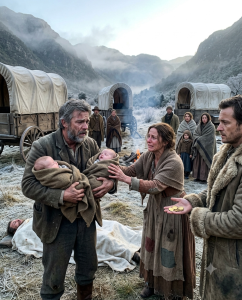
Thomas Brennan lifted his newborn sons before forty-seven families and announced he would sell them for twenty dollars before the mountain cold killed them all.
Nobody moved after that.
The wagon circle stood frozen in the dim gray light of morning, as if the words themselves had turned the ground to stone. The babies were wrapped tightly in blankets that still held the scents of milk, blood, and campfire smoke. They were so new to the world that their faces still looked unfinished, still soft with the blur of first breath and first hunger. One of them stirred against Thomas’s arm. The other slept, mouth open, unaware that the first bargain of his life was already being discussed.
A few yards away, under a white sheet held down with stones, lay Sarah Brennan.
She had been dead less than three days.
The women had tried not to let the babies hear the crying when Sarah stopped breathing. They had worked in terrible silence after the labor went wrong, moving with those practical hands frontier life demanded, though each of them knew they were losing her. By dawn, Sarah was gone, and two boys remained behind like a promise the wilderness had no interest in honoring.
Thomas looked like a man whose body had forgotten how to keep going but was doing it anyway. He had led wagon trains before. He knew rivers, weather, livestock, mountain routes, and all the thousand small decisions that stood between civilization and a field of graves. Men trusted him because he did not panic. Women trusted him because he did not boast. Children ran to him because he always knew how to fix a wheel, set a snare, or carve a whistle from a scrap of wood.
Now he stood in front of all of them with two babies in his arms and a dead wife behind him, speaking in a voice that sounded scraped hollow.
“I can’t lead this train and keep these boys alive too,” he said. “If I fail, it won’t only be them that dies. Sarah told me if it came to this, I was to find them a good home.”
There were gasps at that. A few people looked offended, but none of them stepped forward to help. Some were already stretched thin feeding their own children. Some were old. Some had sick family members. Some probably felt pity and relief in equal measure that the burden was not theirs.
Margaret Holloway stood just beyond the fire line, hands knotted into her skirt.
She was thirty-four, a widow, and childless in a way people had spent years trying to explain to her. Some said God had other plans. Some said stress. Some said she should pray harder. Some said nothing at all, which had been the cruelest version. Her husband Daniel had never blamed her, but that almost hurt more. He had been gentle right to the end, even when fever took him before they had managed to build the family they once whispered about in bed.
After Daniel’s death, St. Louis became unbearable. Every street corner held memory. Every market held women with babies on their hips. Every church pew held the sound of prayers she no longer wanted to say out loud. So she sold the house, packed what remained, and joined the wagon train west.
Out there, she told herself, people might care less about what she failed to become and more about what she could still do.
And she had done plenty. She knew how to mend clothing, dress wounds, boil herbs for fever, and calm frightened horses. She had helped deliver a breech baby in Missouri and a miner’s wife in Independence. Sarah Brennan had liked her from the start. They had cooked together, laughed together, traded recipes and old stories. Sarah had once touched the tiny flowers stitched into a half-finished cradle lining and said, “I know it sounds foolish, but I want them to grow up remembering gentleness.”
Margaret remembered that now so sharply it felt like a cut.
The first person to answer Thomas was James Campbell.
Campbell was a trader from Kentucky who traveled with his wife, his daughter Mary, and two hired men he never called by name unless he was displeased with them. He had good boots, polished buttons, a heavy watch chain, and the practiced manner of a man who liked every room to tilt toward him. Margaret had watched him enough over the months to understand him. He smiled when it was useful. He helped when he expected payment in gratitude, loyalty, or control. Even the way he looked at people seemed to involve tallying future value.
“Thirty dollars for both boys,” Campbell said. “My family can provide what they need. Food. Shelter. Education. A proper future.”
He paused, then added, “They’ll grow into useful men.”
Margaret felt her stomach harden.
Useful.
She had heard that tone before. Not fatherly. Not tender. Transactional. The twins were not yet three days old, and he was already measuring the return.
He was not the only one.
The Hutchinsons, a rough-faced couple bound for California, exchanged a long look. They had lost a son to cholera near Fort Laramie, and grief had made them strange. Mrs. Hutchinson’s sorrow was raw and obvious. Mr. Hutchinson’s had curdled into urgency.
“We’d take them,” he said. “Strong boys raised right can work the camps one day.”
Work the camps.
Margaret almost laughed then, not because anything was funny but because the horror of hearing men discuss two newborns like future livestock nearly broke something in her.
She looked toward Thomas’s wagon. Inside sat the cradle Sarah had made from a packing box, lined with fabric she embroidered by lantern light. Little blue flowers. White stitches. A ribbon tied on one side. Sarah had made beauty in a place where most people had no time left for it.
That night the babies cried in shifts.
The women fed them with diluted cow’s milk and cloths. No one had a nursing mother with enough supply to take on two more mouths, and everyone knew the twins were at risk even before the mountain crossing. They were too small. Too fragile. Too dependent on whoever cared for them every hour of day and night.
Margaret lay awake listening.
A person can spend years learning how to live with one kind of emptiness. Then a sound enters the dark and suddenly that emptiness becomes unbearable again.
Just before dawn, frost spread over the wagon covers and camp ropes. Margaret rose, wrapped her shawl tightly, and walked to Thomas’s wagon. He was outside, bent over a leather harness strap, his hands clumsy with exhaustion. He looked up when he heard her.
“Thomas,” she said. “Don’t sell them.”
His face changed, but not toward hope. Toward pain.
“Then tell me what I do,” he said. “Because everyone expects me to choose between my boys and the people following me. I don’t know how to be both father and captain now.”
Margaret glanced into the wagon. The twins slept side by side in Sarah’s cradle, impossibly close, as if they still knew only one world and one heartbeat.
“Let me take them,” she said. “Both of them.”
He stared.
“You?”
“Yes.”
“You travel alone.”
“I’ve driven alone for six months. I can manage a team, a rifle, a boiling pot, and a fever. I know how to keep babies warm. I have savings. I have room in my wagon.”
He kept looking at her, searching for weakness, or perhaps for some sign that she was speaking from impulse rather than truth.
Margaret took a breath that seemed to come from somewhere deeper than courage.
“I’m not offering out of pity. I want them. I know what that means. I know it will be hard. I know I may fail. But I will love them whether they ever repay me or not.”
At that, Thomas looked away.
The silence between them might have turned into agreement if Campbell had not appeared.
“Brennan,” he said, voice smooth with irritation disguised as concern, “you’re exhausted. This is exactly the sort of sentimental decision men regret later.”
Margaret straightened.
Campbell continued, “Two infants in one wagon with a woman traveling alone? Over the mountains? They’ll die, and she likely will too.”
“Maybe,” Margaret said, before Thomas could answer. “But at least I know the difference between raising children and raising labor.”
Campbell’s polite expression sharpened at once.
Around the camp, people began stepping from their wagons. Children clung to shawls and peered around skirts. Men folded arms. Women watched with wet eyes and guarded faces. Everybody understood they were not just witnessing a private choice anymore. They were witnessing the kind of decision that reveals what a whole community is willing to become.
Thomas looked at Margaret. Then at the babies. Then at the eastern ridgeline where snow shone pale against the early light.
One twin woke and started crying.
The sound pierced the stillness so suddenly that Thomas reacted by instinct, reaching for him. Then he stopped halfway. His hand hovered in air, trembling. Margaret saw the truth on his face. He was terrified that choosing wrong would make Sarah’s death mean something ugly. Not just tragic. Ugly.
That was when Campbell reached into his coat.
He drew out a paper packet, unfolded it, and poured gold coins into his palm. Their color flashed in the weak dawn light. Heads turned at once.
“Forty dollars,” Campbell said quietly. “Now.”
The camp rustled with shocked whispers.
Forty dollars was not just a higher offer. It was flour, salt pork, ammunition, lamp oil, spare wheel iron, medicine. It was contingency. Safety. In a season and landscape where one broken axle or one fever could kill a family, forty dollars could sound a lot like salvation.
Campbell knew that.
He took one step closer to Thomas. “Buy extra oxen. Replace what you lost. Feed your people. This is not a selfish bid, Brennan. It helps the whole train.”
Margaret felt the brilliance and cruelty of it at the same time. Campbell had turned the sale into a moral trap. Refuse him now, and it would seem Thomas had chosen private feeling over collective survival. Accept, and he could tell himself he had done right by everyone.
Then a small voice interrupted.
“Papa said they’d earn back double.”
Every adult in the circle went still.
Mary Campbell stood just behind her father, still in her nightdress under a coat too large for her shoulders. Her hair was loose. Her cheeks were cold-red. She looked frightened, not of strangers, but of what she had accidentally revealed.
Campbell turned sharply. “Mary, go back to the wagon.”
She didn’t.
She looked instead at the twins, then at Margaret, and the pity in that child’s face was enough to shame half the camp.
Thomas lowered his gaze to the gold, then lifted it slowly to Campbell’s face. Something inside him hardened.
He set the crying twin against his shoulder, bent, and lifted the other child into his opposite arm. With both boys against him, he stepped back from the coins.
“No,” he said.
Campbell blinked. “Think carefully.”
“I have.”
“You would throw away forty dollars on the word of a grieving woman and the fantasy of a barren widow?”
Margaret heard several people suck in a breath.
Thomas’s eyes flashed for the first time since Sarah died.
“No,” he said. “I’m refusing because my sons are not freight. They are not compensation. They are not labor to be bought before they can even hold up their own heads.”
Campbell’s face lost all pretense of gentility. “Then who carries them through the pass when the weather turns? You? While leading scouts? While fording rivers? While rationing supplies? Do you think love keeps infants alive?”
“No,” Margaret said. “But greed kills something in a man long before the body follows.”
Campbell rounded on her, but before he could answer, shouting erupted from the north edge of camp.
“Riders!”
Men spun. Women grabbed children. Every conversation shattered at once.
Three figures appeared on the ridge, moving fast. Not soldiers. Not tribal hunters. Scouts from the rear flank, returning hard. One of them nearly slid off his horse coming down the slope.
“Snow coming in early,” the lead rider shouted before he was fully in camp. “Heavy. We’ve got less than a day to clear the narrow pass.”
Panic moved through the train like fire in dry grass. Families rushed for wagons. Oxen were checked, harnesses tightened, cookfires kicked out. The argument over the twins should have ended there, swallowed by necessity.
Instead it sharpened.
Campbell stepped close to Thomas one last time. “Take the money. Put the boys with us. You know I’m right.”
Thomas looked at Margaret.
That was all it took.
“I’ll ride in the middle column,” Margaret said quickly. “Closest to the strongest wagons. The women can help with feedings. I’ll sleep when they sleep. I’ll carry one against my chest if I must and wedge the other into the cradle. You know I can work. You know I don’t complain.”
Mrs. Givens, an older woman with six children grown and buried enough grief of her own, stepped forward. “I’ll help feed them.”
Another woman nodded. “I’ll trade linen and help at night.”
Then a third. “I’ve got goat milk left.”
The shift happened all at once. Once one person moved toward mercy, others discovered they had wanted permission to do the same.
Campbell saw it too late.
Thomas looked around the circle at the women, at the wagons, at the men avoiding Campbell’s eyes, at little Mary standing pale and silent. Then he turned to Margaret.
“If I do this,” he said, his voice low, “they are your sons in every way that matters.”
Margaret’s throat closed. “Then let them be.”
He stepped forward and placed Henry into her arms first.
The weight was almost nothing, but it changed her whole body. Instinct took over before thought. She cradled his head. He fussed once, then settled against her. Thomas looked at that, and his face nearly broke.
Then he handed her William.
The world seemed to stop.
A woman began crying behind them. Someone whispered Sarah’s name. Mrs. Givens crossed herself. Even the wind felt different, as if the camp had turned some invisible corner.
Campbell shoved the coins back into his pocket. “This is madness.”
“No,” Thomas said. “This is the first decent thing that’s happened since my wife died.”
They broke camp within the hour.
The climb into the pass was brutal. Snow began earlier than the scouts predicted, needling down first in light grains, then thick white sheets. Wheels jammed in ice-rutted tracks. Oxen snorted steam. Men pushed from behind, women steadied children, and every mile seemed to demand some fresh sacrifice of strength.
Margaret lashed the cradle inside her wagon and padded it with spare quilts. She kept one baby against her whenever the road grew too violent. The other rode beside the cradle, wrapped in Sarah’s embroidered lining. Each time one cried, the other startled awake. Feedings took forever. Sleep came in scraps. More than once she thought Campbell’s prediction might prove right, not because he had cared, but because the trail was merciless to everyone.
Yet help came from places she had not expected.
Mrs. Givens walked beside her wagon for two hours through sleet just to keep her talking and awake.
One of the younger boys from another family warmed stones by the fire every night and ran them over for the twins’ bedding.
Even Mr. Hutchinson, awkward and ashamed, said one evening, “I was wrong how I spoke of them,” and fixed a broken wheel pin on Margaret’s wagon without charging so much as a thank-you.
The worst moment came on the third day in the pass.
The snow had thickened so heavily that the lead wagons nearly vanished from sight. Margaret had William inside her coat and Henry in the cradle when the wagon lurched against a buried rock. The cradle tipped. Henry slid, cried out, and the whole wagon listed toward a drop hidden under snow.
Margaret screamed.
Hands appeared instantly—Thomas on one side, two teamsters on the other. They heaved against the wheel while Margaret threw herself across the cradle and caught Henry before he struck the floorboard edge. The wagon righted with a violent slam.
For several seconds no one moved.
Then Thomas climbed up, snow crusting his beard, and looked at the twins, then at Margaret.
“You all right?”
She nodded, though she was shaking too hard to speak.
He glanced at the boys again. “Sarah would have loved you for that.”
Margaret turned away before he could see her cry.
They made it through the pass by dusk the next day.
Not comfortably. Not cleanly. But alive.
When the snow eased and the trail widened, the mood of the camp changed. People laughed too loudly from relief. Fires burned longer. Children ran again. The twins, against every fear, had survived the crossing.
Campbell became quieter after that.
He still carried himself with the same pride, but something in his standing among the others had shifted. People remembered Mary’s words. They remembered the gold. They remembered exactly how quickly he had translated two motherless infants into future profit. His wife spoke less in camp. Mary drifted often toward Margaret’s wagon, asking if the babies were warm enough, whether one cried more than the other, whether she might hold a bottle cloth.
One evening, while the sun dropped copper over the plains, Mary stood beside Margaret and whispered, “I’m sorry for what Papa said.”
Margaret adjusted Henry’s blanket. “You’ve got nothing to be sorry for.”
Mary hesitated. “Will they know she wasn’t their real mother?”
Margaret looked down at the twins.
“They’ll know she was the one who gave them life,” she said. “And I hope they’ll know I loved them enough to stay.”
Mary nodded, though her eyes filled.
When they finally reached the Willamette Valley months later, the train did what such trains always did at the end: it scattered. Families found claims, opportunities, churches, rivers, timber, and futures that no longer required them to wake side by side. Goodbyes were quick because lingering made people feel the losses too sharply.
Thomas asked Margaret to stop with him one last time before they parted.
Sarah’s cradle sat between them. The boys were stronger now. Rounder. Loud. Alive in a way that no longer seemed miraculous every minute, though perhaps it always would be.
Thomas held out a folded paper.
“What is this?” Margaret asked.
“I wrote down everything I remember about Sarah,” he said. “What she liked. How she laughed. The songs she knew. The names she wanted if the babies had been girls. The story of the day we met. I don’t want them to lose her just because they were too young to keep her themselves.”
Margaret took the paper with both hands.
He cleared his throat. “I’ve also written that I gave them to you freely. No debt. No claim to be used against you later. When they’re older, if you think it right, tell them about me. If not… tell them whatever lets them sleep at night.”
She looked at him then. Really looked. This man had loved them enough to let another person become home.
“They should know the truth,” she said. “That their father broke in half to save them.”
His face crumpled at that.
He kissed each twin once. Then he left.
Years later, William would have Thomas’s steady hands. Henry would have Sarah’s way of watching people before he trusted them. Both boys would call Margaret Mother without hesitation. Both would know they had been born into grief and chosen into love.
And in quiet moments, after chores were done and the lamps were low, Margaret would sometimes unfold Thomas’s paper and read Sarah back into the room.
The strange thing was this: for all the suffering bound up in that beginning, the story never truly belonged to the auction. It belonged to the refusal.
A man destroyed by loss nearly let the wilderness turn his children into currency. Another man tried to profit from that desperation and called it practicality. A whole camp stood silent until one woman, who had spent fifteen years being told what she would never be, stepped forward and named what the boys were actually worth.
Not money. Not labor. Not survival points to be traded.
Love, offered at the exact moment greed expected to win.
And maybe that is the part that lingers longest. Not whether Thomas was weak for almost selling them. Not whether Margaret was reckless for taking them. Not whether Campbell believed his own excuses. It is the harder question left behind for everyone who heard the story afterward:
At what point does necessity become cruelty, and how many people know the difference only when one brave soul says no?