When Elena reached the broken gates of Los Arrayanes, she was too tired to believe in miracles.
The iron arch had once been grand. Even in decay, it still carried the remains of a family name worked into the metal. But one side had collapsed inward, and wild vines had nearly swallowed the stone pillars. She stood there for a moment with dust on her shoes, a canvas bag over her shoulder, and hunger twisting in her stomach, wondering whether she should keep walking.
She had been walking for too long already.
There are people who leave home because they are chasing something. Elena had left because there was nothing left worth staying for. She had learned not to explain that to strangers. A woman alone on the road survived by saying less than she knew and needing less than she felt.
So she pushed open the gate and stepped onto the property.
The estate spread out before her in a silence so deep it felt wounded. The house was large but dim, the white exterior grayed by weather and neglect. Apple trees covered the slopes beyond it, heavy with fruit no one had harvested. Fallen apples spotted the ground in bruised reds and yellows, sweetening in the sun until the air itself smelled faintly fermented. The courtyard was overrun by weeds. A wheelbarrow lay on its side near a stone wall. One shutter banged softly in the breeze, the sound sharp enough to make the whole place seem more abandoned than it was.
When Elena knocked, nobody answered.
She pushed the door open and found herself in a main hall that smelled of damp wood, old linen, rotten fruit, and something else harder to name. Something like pride that had gone stale.
At the far end of the room, a man sat in a wheelchair facing the orchard through a tall, dirty window.
He did not turn when she entered.
“There’s no work,” he said.
It should have sent her back outside. But Elena had spent too many nights hearing doors close before she even touched them. Something about the certainty in his voice irritated her more than it discouraged her.
She looked around the hall. Cobwebs in the corners. Mud at the threshold. Dust on the sideboard. The polished remains of a life that had not been maintained, only remembered.
“There’s work everywhere,” she said. “What’s missing is someone who still wants to do it.”
That got him to turn.
His face was lean and handsome in the worn-out way grief can sharpen a person. He looked younger than the bitterness in his expression. His eyes moved over her dress, her shoes, the bag on her shoulder, the stubborn way she stood.
Before he could answer, a woman appeared from the side doorway carrying a cup of coffee. She was round-faced, gray-haired, and alert in the way of women who have spent a lifetime noticing everything while pretending not to.
Doña Candelaria.
Her mouth twitched at Elena’s answer, but she hid it fast.
The man in the wheelchair glanced at the older woman, then back at Elena.
“One month,” he said. “You eat what you earn. Nothing more.”
Elena should have thanked him politely. Instead she nodded once, as if he had simply confirmed what she already expected.
“My name is Elena.”
“Julián Valderrama,” he said. “This is Los Arrayanes. If you break anything, you replace it.”
She almost laughed at the absurdity of that in a house half broken already, but she saw something in his eyes that stopped her. Not arrogance exactly. It was worse than arrogance. It was a man defending the bones of his dignity because he had so little else left.
So Elena got to work.
The first days were brutal. She swept rooms that hadn’t seen a proper broom in months. She dragged old linens into the yard and beat the dust from them until her arms shook. She washed windows and let the afternoon light enter rooms that had nearly forgotten it existed. She cleaned out kitchen cupboards, sorted spoiled food from usable stores, and turned bruised apples into jam because she could not bear to watch them rot when they could still feed someone.
Tomás, the young stable hand, watched her at first with the detached confusion of a man who had already accepted defeat and did not understand why anyone would volunteer to fight it. But she handed him tasks without ceremony, and little by little he obeyed. Gather fruit. Patch the fence. Check the cellar. Clear the path to the orchard.
Doña Candelaria fed her with increasing portions and decreasing suspicion.
Julián remained the hardest part of the house.
He spoke little. When he did, it was usually to criticize. Not because Elena was doing things badly, but because he could not stand the idea that the estate might begin improving without reminding everyone it had once run by his standards, not theirs.
She learned quickly that he had not always lived like this. There were old photographs in the hallway—Julián on horseback, Julián beside cider barrels, Julián at harvest festivals with his sleeves rolled up and his smile unguarded. Then there were no recent photographs at all.
She pieced together the rest through silence, hints, and one conversation with Doña Candelaria at dawn.
“It was after the accident,” the older woman said softly while kneading dough. “Horse threw him near the lower ridge. Broke more than his body did.”
“Elena asked carefully, “And after that?”
“After that the debts grew. The workers left. The orchard suffered. Men who called themselves friends became lenders. And men who became lenders started smelling blood.”
There was one name that came up more than any other.
Fausto Beltrán.
In town, Fausto was known for polished boots, generous smiles, and careful investments. On paper he was respected. In private, people lowered their voices when they said his name. He had acquired land steadily over the years, always through debt, inheritance disputes, or desperate sales. He never shouted. He never hurried. He let pressure do the work for him.
Elena saw him for the first time a week later in the square.
He tipped his hat to Julián from across the street with a smile that looked almost warm if you didn’t know better. Julián stiffened in his chair and said nothing.
That reaction told her more than words would have.
The truth arrived fully two weeks later.
Elena had taken jars of apple preserves to the baker when she heard voices behind the municipal storage building. She only meant to pass by, but then she caught Fausto’s laugh and instinct made her stop.
“Let him feel alive a little longer,” Fausto said. “At the fair I’ll humiliate him in front of everyone. If he doesn’t pay the interest, Los Arrayanes will be mine before the month ends.”
Another man asked, “And the girl?”
Fausto’s answer came smooth and dismissive. “A servant with ideas. When her crippled master falls again, she’ll run.”
Elena stood motionless behind the wall, the jars cold in her hands.
Anger came first. Then fear. Then something sharper than either. Clarity.
She did not confront him. She did not reveal herself. She waited until they left, then walked back to the estate with a steady pace that hid the fact her heart was pounding.
That night she entered the old storage room.
It was the kind of room families use when they cannot bear to throw the past away but no longer know how to live with it. Dusty trunks. Broken tools. Account books tied in twine. A warped cabinet with one stuck drawer. Elena searched it by lantern light until she found receipts from the bank, mortgage notices, correspondence, supply invoices, and finally a set of older ledgers from the years before Julián’s accident.
Buried among them was a notebook belonging to Julián’s grandfather.
The handwriting was small, disciplined, and precise. It recorded the original cider recipe of Los Arrayanes—apple ratios, fermentation timings, barrel treatment, wax sealing notes, weather observations, harvest variations by year. It was not just a recipe. It was lineage.
Elena nearly cried when she realized what she was holding. This estate still had something no polished rival could imitate. Its memory.
Then she found the irregularities.
An interest percentage in one contract that didn’t match the bank notice attached to it. A copied figure that had been changed in darker ink. A repayment schedule shifted after signature. Missing delivery credits from the cider years. Piece by piece, she saw what Fausto had done. Julián had been losing money, yes, but the noose around Los Arrayanes had been pulled tighter on purpose.
Elena gathered every relevant document and placed them in a brown envelope.
Then she wrote a note in her own hand, brief and direct, naming the discrepancies and where each one could be proven.
The next morning she told Julián they should produce cider for the fair.
He laughed once, bitterly. “With what? Hope?”
“With apples,” she said. “And with a name people still remember.”
He stared at her.
Then, slowly, something shifted behind his eyes. Not trust yet. But interest.
They began that day.
Tomás harvested before sunrise. Doña Candelaria washed old bottles until her hands wrinkled white. Elena sterilized equipment, cleaned barrels, labeled crates, and followed the notebook with near-religious care. Julián directed the work from his chair.
“Use the tart apples from the northern slope.”
“No, not that barrel. The oak one breathes better.”
“Wait longer before sealing.”
“My grandfather waxed every bottle by hand. It mattered.”
At first his instructions came clipped and cold. Then they came faster, fuller, almost eager. Elena watched him return to himself one remembered detail at a time. He still moved through pain. He still had bad nights when she heard him in the next room unable to sleep, trapped inside his own body and pride. But by morning he was back at the table, tasting batches and correcting proportions.
The house changed with the work.
It no longer smelled like neglect. It smelled like apples, sugar, woodsmoke, and effort. People spoke louder. Tomás joked. Doña Candelaria sang under her breath. Even Julián began asking Elena questions that had nothing to do with chores—where she had learned to cook, how far she had traveled, why she always looked at the horizon before going inside any new place.
She answered some of those questions. Not all.
The day of the fair dawned bright and merciless.
Elena wore her cleanest dress. Tomás loaded the cases. Doña Candelaria tucked a rosary into her pocket. Julián insisted on going in person.
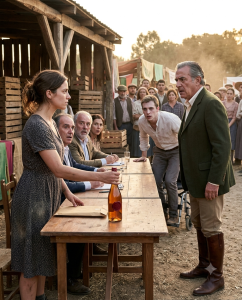
Fausto’s stall dominated the center row. It glittered with electric lights, polished wood, expensive branding, and staff who looked trained to smile on command. By comparison Los Arrayanes looked humble to the point of fragility—old tables, simple linens, handwritten labels, and bottles sealed with red wax.
But when the tasting began, everything changed.
The first people came out of curiosity. The second group came because they had seen the first turn back for another sip. Then came the judges.
Their expressions sharpened almost immediately. They asked about the blend. The harvest. The fermentation process. Julián answered, and Elena heard his voice become what it must once have been before the accident—confident, exact, rooted.
“This is the Valderrama method,” one judge murmured after tasting again.
Fausto saw the crowd gathering and knew at once that admiration was slipping away from him. That was when he struck.
He raised his voice for the whole fairground.
“What a touching scene,” he said. “The master sitting down, the servant pretending to be a businesswoman, and a bankrupt estate acting as though nostalgia counts as solvency.”
The square went silent.
Elena felt every eye shift toward them.
There are moments when humiliation can either freeze a person or purify them. Elena looked at Fausto, at the crowd, at Julián’s clenched jaw—and understood in a flash that fear had already cost this estate too much.
She took one bottle from their table and walked to the judges.
Then she placed the brown envelope on top of it.
Fausto frowned. “What is that?”
Elena met his gaze.
“The taste of fine print.”
The nearest judge opened the envelope. His expression changed by the second page. Another reached for the documents. A third looked up at Fausto with visible alarm.
Then came the moment no one forgot.
Julián gripped the edge of the table and reached for Elena’s hand. His knuckles were white. His face drained with effort. Every muscle in his arms trembled as he pushed upward from the wheelchair.
People gasped.
Slowly, painfully, he stood.
Not fully steady. Not unbroken. But upright.
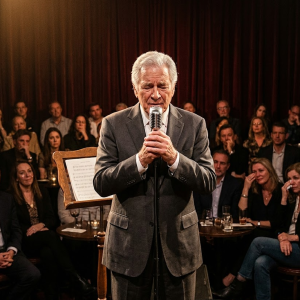
When he took the microphone, even the children stopped whispering.
“Los Arrayanes pays tomorrow,” he said. “And anyone intending to touch my land again should first read what Elena left in that bottle.”
The applause began at the back and crashed forward like a wave.
Fausto’s public mask failed all at once. He demanded the papers. The judges ignored him. Town officials moved closer. Men who had laughed with him at earlier fairs suddenly found reasons not to stand beside him. It was the smallest movement of power, but Elena saw it clearly. Predators rely on an audience. Once the audience hesitates, the teeth show.
She left before the scene ended.
Not out of fear. Out of instinct. Some victories are truest when you don’t stand in the center of them begging to be seen.
That night Los Arrayanes glowed warmer than it had in years.
Doña Candelaria cooked as if feeding a wedding party. Tomás laughed until he cried. Julián sat at the long kitchen table with exhaustion carved into his face and life burning underneath it.
Then the telephone rang.
Elena answered.
Fausto’s voice came low, furious, controlled only by force. “What did you put in that envelope, Elena? What did you leave with the judges?”
She looked at the final bottle on the table, still sealed with red wax.
“Your real debt,” she said. “The kind money can’t pay. The kind that gets paid in public shame.”
There was silence.
Then he made a mistake. “You think papers can destroy me?”
“No,” Elena said. “But witnesses can.”
He inhaled sharply.
“You should have walked away. That estate was already mine.”
Julián looked up the moment she repeated the line aloud.
Was already mine.
Not “would be.” Not “will be.” Already.
After Elena ended the call, she took the last bottle and set it between herself and Julián.
“What’s in it?” he asked.
She broke the wax and slid out a tightly rolled sheet protected inside the neck.
It was a ledger page, older than the others, preserved by accident and hidden by fear. Elena had found it tucked into the false bottom of a storage box after the fair documents were packed. It connected altered debt calculations on Los Arrayanes to similar manipulations attached to other estates Fausto had acquired.
Julián read the page once, then again.
“This isn’t just about us,” he said.
“No.”
That was when someone knocked on the kitchen door.
Three slow knocks.
Tomás went pale. Doña Candelaria crossed herself.
Julián motioned for Elena to open it.
Standing outside was a thin man in a worn coat with rain in his hair and terror in his eyes. He introduced himself as Gregorio Sanz—Fausto’s former accountant.
Doña Candelaria nearly dropped the lamp.
“I heard what happened at the fair,” Gregorio said. “If the town is finally willing to listen, I’m ready to talk.”
They brought him inside.
Gregorio looked like a man who had spent years sleeping badly. He drank water with shaking hands and confessed everything in fragments at first, then in a rush. Fausto had used hidden clauses, forged revisions, pressure tactics, and strategic public humiliations to seize properties from men already weakened by injury, grief, or debt. Gregorio had altered records under threat and kept copies when guilt became impossible to silence.
“Why now?” Julián asked.
Gregorio looked straight at him. “Because today, for the first time, someone stood up to him in public and survived.”
The next morning, Los Arrayanes was not the only estate being discussed in town.
The judges had already reported the discrepancies. Gregorio signed a formal statement. Two other families came forward by noon. By evening, Fausto’s office had been visited by authorities and his bank manager had stopped answering his calls. Rumors spread faster than official notices, but in this case the truth was worse than rumor. People realized his wealth had not grown from brilliance. It had grown from carefully arranged desperation.
Fausto tried once to recover control. He arrived at Los Arrayanes in person just before sunset, hat in hand, smile carefully rebuilt.
He asked to speak privately with Julián.
Elena remained in the room anyway.
Fausto’s eyes flicked to her with open dislike. Then he turned back to Julián and lowered his voice.
“This can still be settled.”
“No,” Julián said.
“You’ll destroy more than me if this continues. Banks. Contracts. Families.”
Fausto intended that as a warning. It sounded more like an admission.
Elena stepped closer. “That would be the price of truth.”
For the first time since she had seen him, Fausto’s composure truly cracked. “You were nothing when you arrived here.”
Elena held his gaze. “And still enough to stop you.”
He left without another word.
In the weeks that followed, the case against him widened. Properties were reviewed. Contracts were reopened. Some losses could not be undone, but enough could that the town’s silence finally broke. Fausto Beltrán did not vanish dramatically. Men like him rarely do. They shrink in stages—first the invitations stop, then the allies disappear, then the confidence drains from the voice everyone once obeyed.
Los Arrayanes survived.
More than survived.
The fair gave them visibility. The story gave them customers. The cider orders grew beyond what Tomás and Doña Candelaria could handle alone, and for the first time in years workers returned to the estate not out of pity but because there was honest work again. The orchard was pruned properly. The fences were mended. The broken gate was repaired but not replaced entirely; Julián insisted on leaving one scar visible.
“So I remember what nearly happened,” he said.
His recovery came slowly. Some days he walked with assistance. Some days pain pushed him back into the chair. But the difference was no longer measured only in steps. He had returned to decision, to anger, to pride that looked forward instead of backward.
As for Elena, she intended to leave once the estate no longer needed saving.
That was still her plan until one evening at harvest’s end when she stood under the apple trees watching late sunlight burn gold across the rows. Julián joined her, leaning on a cane.
“You never answered why you looked at the horizon before entering a new place,” he said.
Elena smiled faintly. “To see how easy it would be to leave.”
“And now?”
She looked at the orchard, at the house no longer haunted by surrender, at workers’ voices carrying from the yard, at the repaired windows catching light.
“Now I’m checking whether I still want to.”
He was quiet for a moment.
“And do you?”
She turned toward him. “Not today.”
That answer seemed to settle something deep inside him.
Months later, when the first new bottles of Los Arrayanes cider left the estate with proper labels and fresh red wax seals, Elena held one in her hands and thought about the night she had arrived with dust on her shoes and hunger in her stomach. She had come asking for a roof. She had found a battle. A home. A man who had been half buried inside his own grief. And somewhere between saving the estate and exposing the man who tried to steal it, she had saved something in herself too.
People in town still argued over the whole story. Some said Julián should have seen the trap sooner. Some said Elena was reckless to provoke a man like Fausto in public. Some said public shame was too cruel. Others said it was the first honest thing he had ever been forced to pay.
Maybe all of them were partly right.
But whenever anyone asked Doña Candelaria what the real turning point had been, she gave the same answer.
“Los Arrayanes stopped dying the day someone bent down and picked up the first fallen apple.”
And in the end, that may have been the truest red flag of all: not Fausto’s greed, but how close everyone had come to mistaking surrender for fate.