In thirty years of selling bread, Andrés had never thrown a customer out of his bakery.
He had refused service before, of course. A drunk once. A teenager who thought it was funny to steal pastries and laugh in the face of the old woman who chased him. A man who screamed at Andrés’s teenage assistant until she cried. But that was different. Those moments were easy to understand. Clear lines. Clear reasons.
This was something else.
This was a woman in a cream coat, carrying an expensive leather handbag, speaking in a controlled voice that tried to sound refined while cutting another person down in front of a room full of strangers.
And what stayed with Andrés afterward was not even her face.
It was the way Miguel lowered his head before anyone asked him to.
As if he had done it many times before.
As if humiliation had become another part of his work clothes.
Andrés had spent nearly his whole life in the same small bakery in Valladolid. The shop sat on a modest corner between a pharmacy and a stationery store, with a narrow front window that displayed fresh loaves, empanadas, sugar-dusted pastries, and whatever tart his sister had baked the night before. The sign outside had faded years ago. The bell over the door was slightly crooked. The coffee machine made a grinding roar every morning that sounded like it might finally die and then never did.
It wasn’t elegant. It wasn’t fashionable. But it was known.
People trusted places like that.
They came for bread, yes, but also for routine. Familiar faces. The comfort of being recognized before they had to explain themselves. A bakery like Andrés’s was one of the last places where people still stood close enough to each other to witness ordinary life in all its quiet forms—new babies, old grief, small joys, financial trouble, loneliness, flirtation, fatigue.
Behind the counter, Andrés had become part baker, part bartender, part confessor, part witness.
He knew who lived alone. He knew who had bad knees and needed their loaf sliced thinner. He knew which widow liked two extra napkins because she cried unexpectedly at breakfast and didn’t want to admit it. He knew who paid in coins because payday was still three days away.
And he knew Miguel.
Miguel had been coming in for years. Not every day at first, but steadily enough that habits formed. He was a bricklayer with the kind of build that came from work, not from exercise. Broad shoulders, powerful arms, wrists marked by old strain, hands rough and cracked. Even when he stood still, he looked tired in a practical way, like a man conserving what little energy hadn’t already been spent.
Yet he was careful with people. He stood back when mothers had prams. He let older customers go ahead of him without making a speech about it. He always greeted Andrés properly. Always thanked him. Always paid exactly.
“The usual, please.”
Two slices of meat pie.
Always two.
The first few times, Andrés assumed the second was for a co-worker. Then for a wife. Then maybe for a child. But over the years he learned that there are questions you do not ask a man unless he offers the answer himself. Some people carry their lives openly. Others carry them folded inward, hidden and fragile.
Miguel was one of the second kind.
The morning it happened began like any other. Bread out by seven. Coffee on. Deliveries stacked in the back. The school rush first, then office workers, then pensioners who wanted conversation more than pastries. By half past nine, the bakery had that lived-in hum Andrés liked best—the bell ringing, tongs clicking against trays, paper crackling, voices rising and dropping.
Miguel arrived a little later than usual.
Andrés noticed because he always noticed. Miguel stepped inside, nodded in greeting, and took his place at the end of the line. There was a trace of gray dust on his boots, more on the sleeves of his jacket. Probably cement. Maybe plaster. Nothing unusual. Nothing dirty in any meaningful sense. Just evidence that he had already been useful to the world that day.
A woman entered behind him.
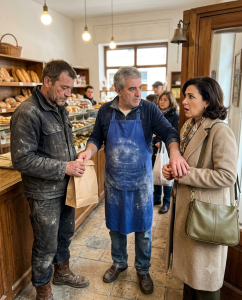
Andrés had seen her before once or twice, though never often enough to remember her order. She had the polished look of someone deeply practiced at being seen—hair blown smooth, makeup subtle and costly, coat cut well, handbag structured, gold earrings catching the light. She paused just inside the door and glanced around with the brief dissatisfaction of someone mentally improving the room without permission.
Then she looked at Miguel.
And kept looking.
Andrés saw it happen in stages. The boots first. The cuffs. The hands. Her mouth tightened. Her nose flared slightly. Miguel felt it too; Andrés could tell by the way his shoulders shifted.
Then came the sigh.
Long. Deliberate. Public.
“Honestly,” she said, “places like this should have a separate line for people coming straight from construction sites.”
Silence fell in a way it rarely does among strangers. Not the silence of calm. The silence of collective shame.
Andrés held two loaves in both hands and felt heat rise in his chest.
Miguel’s eyes dropped to the floor.
“I can come back later, Andrés,” he said softly.
There it was—that sentence that made everything worse. Not because it was polite, but because it sounded rehearsed by life. As if he already knew the role expected of him. As if dignity had become negotiable the moment someone richer entered the room.
Andrés set the bread down.
He looked at Miguel’s hands. Hands scarred by labor. Hands that built homes, repaired walls, carried weight. Hands people depended on while pretending not to see them.
He took two of the best slices of pie from the tray and put them in a fresh paper bag.
“You’re not coming back later,” he said. “It’s your turn.”
Miguel looked uncomfortable at once. “I don’t want trouble.”
“You’re not causing it.”
The woman stepped forward, offended less by the words than by the possibility that they applied to her.
“Well, if the performance is over, you can serve me now.”
Andrés did not shout. He had learned long ago that some people expect anger because it lets them dismiss what comes next. Calm is harder to fight.
“I’m sorry, ma’am,” he said. “I can’t serve you today.”
She stared at him. “Excuse me?”
“I can’t sell you anything today.”
The color in her face changed. “That is unbelievably disrespectful.”
Andrés nodded once. “No. Disrespect is humiliating a man for coming from work. Disrespect is deciding someone’s worth by whether their shoes are clean.”
No one in the bakery moved. A young mother by the pastry case looked down at her son and gripped his hand a little tighter. An elderly man near the register adjusted his cap and said nothing. Miguel stood as still as stone.
The woman’s voice sharpened. “Do you know who you’re speaking to?”
“A customer,” Andrés said. “And in here, customers are expected to behave with decency.”
Her laugh was brief and joyless. “I’m never coming back.”
“That’s your choice. But people may enter here with dust on their clothes. What I don’t allow is contempt in their mouth.”
For a second, Andrés thought she might argue louder. Demand the owner. Threaten him. But maybe she realized there was no room left to win. Maybe she heard, for the first time, how small she had made herself sound.
She turned and left.
The bell rang overhead. The room exhaled.
Miguel still looked uncomfortable, as if he were the one who had caused embarrassment by existing in public.
Andrés held out the bag. “Here.”
Miguel reached for his wallet. Andrés rang up only one slice.
Miguel noticed immediately. “No. I don’t want charity.”
Andrés met his eyes. “It isn’t charity. It’s respect.”
Something changed in Miguel’s face then—not relief exactly, but a loosening. The kind that comes when someone sets down a burden they didn’t know they had been carrying all morning.
He gave a small smile, almost shy, and left.
The bakery moved on. Customers ordered. Coffee was poured. Bread was sliced. Yet the moment stayed with everyone. By noon, Andrés’s assistant asked quietly, “Are you all right?”
“Yes,” he said.
But he knew something had shifted.
The next day, Miguel returned. Same calm greeting. Same order. Yet before leaving, he took a folded sheet of paper from his pocket and pushed it across the counter.
“This isn’t mine,” he said. “It’s from my daughter.”
Then he was gone.
Andrés unfolded it between customers.
It was a child’s drawing of the bakery. The bell over the door was too large. The display case gleamed like treasure. Andrés himself stood behind the counter in a giant apron, smiling. In front of him was Miguel, holding a paper bag. Above them, in uneven handwriting, were the words: This is where bread tastes like home.
Andrés had to step into the back room to collect himself.
He taped the drawing behind the counter that very day.
It became part of the bakery. Customers noticed it. Some smiled. Some asked who had drawn it. Andrés always answered, “Someone who reminded me why I still open this place every morning.”
That should have been the end of it.
But life rarely ends where a story first seems complete.
Late that same afternoon, as Andrés was wiping down the coffee machine and preparing to close, the bell rang again.
He looked up.
The woman stood in the doorway.
For one absurd moment, irritation flashed through him. Then it vanished, because this was not the same woman who had walked out that morning with outrage and perfect posture. Her coat was the same, but wrinkled now. Her hair had begun to fall loose around her face. There were dark shadows under her eyes, and whatever polish she wore no longer concealed how strained she looked.
She stepped inside carefully, like someone entering a church after making a fool of herself outside it.
Miguel happened to be there too. He had come in later than usual, which Andrés realized only then was unusual in itself. He was waiting by the counter, one hand around his paper bag.
The woman saw him and stopped.
Miguel stiffened.
Her eyes moved past him and landed on the drawing behind the counter.
Andrés remembered then the small clinic card he had found tucked beneath the receipt she’d left behind that morning. He had not intended to read it, only to clear the counter at closing. But once seen, it had been impossible to ignore. Follow-up consultation regarding anxiety-related episodes.
He had slipped it into an envelope, planning to return it if she ever came back. Not because he wanted to embarrass her, and not because the card erased what she had done. It didn’t. Cruelty is still cruelty, no matter what feeds it. But human beings are rarely made of one thing alone.
The woman drew a shaky breath.
“I came to apologize,” she said.
Neither man answered immediately.
She looked at Miguel, not at Andrés. “What I said this morning was ugly. There’s no excuse for it.”
Miguel’s jaw tightened. “No,” he said quietly. “There isn’t.”
The words hit her hard enough that Andrés could see it. Good, he thought. Some truths should.
She nodded. “You’re right.”
Andrés reached below the counter, took out the envelope, and set it down gently. “You left this.”
Her expression changed the moment she recognized it. Color drained from her face.
“Thank you,” she whispered, taking it quickly.
No one spoke for a few seconds.
Then she surprised them all by laughing once under her breath—not from humor, but from embarrassment. “I suppose this is the moment where I admit I nearly didn’t come back because I was ashamed.”
Andrés said nothing.
She looked at the drawing again. “My father was a mason.”
Miguel blinked.
“So was my grandfather,” she continued. “I grew up watching men come home with dust in their hair, with their backs hurting, with hands so rough they snagged every towel in the house.” Her voice faltered. “And this morning, I looked at you and said something I would have despised hearing anyone say about them.”
Miguel stared at her, unsettled less by her insult now than by her confession.
“What changed?” he asked.
The woman closed her eyes briefly. “My son.”
Andrés felt the room tighten.
“He stopped speaking to me three months ago,” she said. “He said I had become impossible to be around. That I corrected everyone. Judged everyone. Treated people badly and then dressed it up as standards.” She swallowed. “I told myself he was dramatic. Ungrateful. Sensitive.”
She glanced at the envelope in her hand.
“Then I had a panic attack in the middle of a meeting last week. The doctor asked me if anyone in my life had told me the truth lately. I said no.” She gave a small, bitter smile. “This morning, I suppose I forced strangers to do it.”
Miguel shifted his weight. Andrés could almost hear the battle in him—the anger that remained, the instinct to dismiss her, the fatigue of being asked, yet again, to make room for someone else’s lesson.
The woman looked at him steadily. “I am sorry for what I said to you. Not because I was embarrassed. Not because he threw me out.” She nodded toward Andrés. “Because you did nothing except stand there after a day of work, and I tried to make you feel less than me.”
Miguel’s fingers tightened around the paper bag, crumpling it slightly.
“My daughter drew that picture,” he said after a long silence, gesturing toward the wall. “She waits for those two slices. One is mine. One is hers.”
Something in the woman’s face cracked open.
“I know,” he said. “You didn’t know that. But that’s the point, isn’t it? You didn’t know anything about me, and you spoke anyway.”
Tears filled her eyes too quickly for performance. “Yes,” she said.
Andrés watched the moment carefully. He had seen apologies offered as currency, as vanity, as strategy. This one was clumsy, late, and imperfect—but real.
Miguel finally exhaled. “I accept the apology,” he said. Then, after a pause, “That doesn’t mean I’ll forget it.”
“That’s fair,” she replied.
Andrés, feeling the air ease by a fraction, gestured toward the counter. “Would either of you like coffee?”
Miguel gave him a look that was almost amused. “Now?”
“Yes, now. It’s been a long day for everyone.”
To his surprise, the woman laughed properly this time, a small, helpless sound. “I think I owe at least one round.”
“You don’t owe me anything,” Miguel said. “But you can pay for your own.”
Andrés snorted. “That’s the spirit.”
He made two coffees and, after a moment’s thought, cut three thin slices of almond cake. No one objected. They stood there in the nearly empty bakery while evening light faded in the windows. The conversation that followed was awkward at first, then human.
The woman’s name was Elena.
Her father had indeed been a mason, a proud one. She had married into money young and worn refinement like armor ever since. Somewhere along the way, standards had hardened into judgment. Control had become contempt. She had learned how to criticize before anyone could criticize her. By the time her son said it aloud, she had become the kind of person she herself would once have feared.
Miguel listened more than he spoke. When he did speak, it was plain and unsentimental. He told her his daughter was nine, loved drawing, and insisted the bakery smelled “like safe.” He said her mother had left years ago. He said the second slice had always been for the girl, because even when money was tight, he wanted her to have one small thing to look forward to after school.
Elena pressed her lips together at that, fighting fresh tears.
“I nearly shamed that,” she said quietly.
“Yes,” Miguel answered. “You did.”
No one softened it for her.
That mattered too.
By the time the coffees were finished, the room felt different. Not magically healed. Not transformed into sentiment. Just honest. Which is rarer and better.
As she prepared to leave, Elena hesitated by the counter. “Would you ever serve me again?” she asked Andrés.
He studied her for a moment.
“Yes,” he said. “If you come in the way everyone else does.”
She nodded. “Understood.”
She reached into her handbag, pulled out a business card, and set it down. “I help manage several apartment buildings in the city. One of them needs repair work soon. If you want it, I can pass your name along.” She looked at Miguel. “Not as pity. As work. Paid properly.”
Miguel looked at the card, then at her. “I’ll decide tomorrow.”
“That’s fair,” she said again.
After she left, the bell rang softly in the evening quiet.
Miguel finished the last of his coffee and shook his head. “Strange day.”
Andrés smiled. “I’ve had stranger.”
Miguel looked at the drawing one more time. “Thank you,” he said.
“For what?”
“For not letting me leave.”
Andrés wiped the counter with slow, practiced hands. “People should not have to disappear just to make other people comfortable.”
Miguel nodded once and went home.
A week later, he took the repair job. Not because he trusted Elena completely, but because he trusted contracts, money, and the right to be cautious. The work lasted three months. She kept her word. Paid on time. Spoke to him with respect. Sometimes stopped by the bakery on Saturdays and waited her turn like everyone else.
She never again complained about dust on someone’s clothes.
Her son came into the bakery once, months later. Tall, tired-looking, carrying flowers. He stood beside her awkwardly while she chose bread. Andrés pretended not to notice the careful softness between them, the kind people use when they are rebuilding something fragile. As they left, she touched the drawing behind the counter with two fingers and smiled.
Years passed.
The drawing stayed.
Miguel’s daughter outgrew her child handwriting and eventually came in on her own for coffee she was far too young to enjoy properly. She blushed when Andrés told new customers she was the artist. Miguel’s hair began to gray at the temples. Andrés’s coffee machine finally died and had to be replaced, though the new one somehow made worse coffee.
The story was never told loudly. It didn’t become neighborhood gossip for long. That was fine with Andrés. The point had never been to make a lesson of anyone.
The point was simpler.
A bakery is not only a place where bread is sold.
Sometimes it is a line in the sand.
A small room where a person who has been looked down on all his life is told, clearly and without performance, that he does not have to step aside.
Sometimes it is also the place where another person hears, perhaps for the first time in years, that elegance without kindness is just decoration.
Andrés still says the same thing when people ask about the drawing.
“Someone reminded me why I keep opening this bakery.”
Because flour can be dusted off. Mud can be cleaned. The marks of labor fade from clothes by evening.
But the words used to humiliate someone can stay in the body far longer than dirt ever does.
And perhaps that is what lingered most from that day in Valladolid: not the insult, not even the refusal, but the pause that came after—when one man chose not to make himself smaller, another chose not to let him, and a woman who had hidden inside her own superiority was finally forced to see what she had become.
Some would say Andrés was right to throw her out. Some would say he should have handled it more gently. Some would argue Elena deserved no second chance. Others would say the apology mattered because genuine shame is where change begins.
Maybe all of them would be partly right.
But anyone who stood in that bakery that morning would remember one thing clearly:
The cleanest person in the room had not been the woman with the perfect coat.
It had been the man with dust on his boots.