He whispered a name no one has called me in 47 years.
And I knew — before I even looked at his face — that my whole life was about to split open.
—
I’ve been a hospice nurse for nineteen years. I’ve held the hands of 200 people as they crossed over. Farmers. Schoolteachers. A man who’d been a circus performer in his youth and still smiled like he was about to do something spectacular. I’ve learned to stay present, to breathe slow, to let them feel that they are not alone in the leaving.
I am good at this work because I learned early how to love someone who isn’t fully there.
His name on the intake chart was Raymond Earl Hutchins. Seventy-one years old. No emergency contact. No next of kin listed. He’d been brought in by a neighbor who found him on the porch of a rental property outside of Cookeville, barely conscious, a paper bag of belongings beside him like he’d been planning to go somewhere and just… didn’t make it.
He had maybe forty-eight hours. Probably less.
I took the night shift. I always take the harder ones.
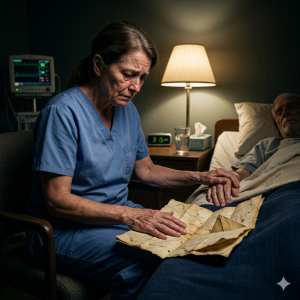
The room smelled like cedar and something else I couldn’t name — something that tugged at me the way old songs do. I checked his vitals, adjusted his blanket, and sat down beside him the way I always do. I took his hand. It was rough. Calloused. The hands of a man who had worked outdoors his whole life.
He was mostly gone already.
But then his lips moved.
“Junebug,” he whispered.
I stopped breathing.
That name. That exact name. My mother called me June. My teachers called me June. But Junebug — that was something else entirely. Something that lived in a place inside me I had boarded up before I started kindergarten. I hadn’t heard it spoken aloud in nearly five decades.
I leaned closer. “Sir? Can you hear me?”
“Junebug,” he said again. Softer. Like a man exhaling a prayer he’d been holding his whole life.
My hands were shaking when I reached for his chart again. Raymond Earl Hutchins. Born 1953, Billings, Montana.
Montana.
I sat very still for a long moment.
My mother never talked about my father. Not really. I knew his first name. I knew he had signed papers when I was four years old — legal papers, the kind that meant he chose to stop being my father on purpose. I knew that one night, when I was small, she burned something in the fireplace. She thought I was asleep. I wasn’t. I watched her feed it to the flames one piece at a time, her face doing something I didn’t have a word for then.
One of the things she burned was a piece of paper folded into the shape of a little boat.
I had never forgotten it. The way it sat on top of the kindling for just a moment before it caught. The way it seemed almost to float.
That’s when I noticed the shape at his chest.
Through the thin fabric of his hospital gown, where a shirt pocket would have been — someone had tucked something beneath the cloth. Small. Folded. It had been there when they transferred him, overlooked in the intake. I could see the faint outline of it.
I don’t know what made me reach for it.
I don’t know what made me stop.
I sat with my hand hovering over that small folded shape for what felt like a very long time. Raymond Earl Hutchins breathed his shallow, labored breaths. The monitor beeped its slow, indifferent rhythm. Outside, a truck moved down the highway, headlights sweeping across the ceiling, and then it was dark again.
His lips moved one more time.
“I kept it,” he whispered. “I kept the other one.”
I closed my eyes.
Then I reached into his pocket and took out the paper boat.
My fingers already knew what it was before I finished unfolding it. A hand-drawn map. Faded blue pen lines, careful and childlike — a lake, a dock, a path through trees with little X marks I remembered drawing because I thought that’s how you marked important places. Northern Montana. A lake I had never visited but had drawn from a photograph once, sitting at a kitchen table, age four, because a man with rough calloused hands told me we were going to go there together someday.
My mother had burned her copy the night he disappeared.
This one had survived.
And when I unfolded it all the way — when I smoothed it flat across my knee with trembling hands — I saw writing on the back that I had not put there.
Written in a child’s handwriting.
Written in my handwriting, from a time I couldn’t remember.
An address I had never seen. A town in Montana I had never been to.
And a date.
Tomorrow.
I looked up at Raymond Earl Hutchins. At his face. At the shape of his nose, the line of his jaw — features I had seen every morning of my life in the mirror and always thought came from my mother’s side.
My mouth opened. Nothing came out.
He took one long, slow breath.
And then his hand went still in mine.
—
The monitor flatlined at 3:17 in the morning.
I did everything I was supposed to do. I called it. I notified the attending. I stood in the hallway while the overnight tech came in, and I held myself together with both hands the way you learn to when you’ve done this work long enough.
Then I went to the bathroom, locked the door, sat on the floor with my back against the wall, and fell completely apart.
I am not ashamed of that. I have cried in that bathroom before. Grief has its own schedule and it does not consult you.
But this was different. This wasn’t the clean grief of witnessing a stranger’s ending. This was something older and more tangled, something that had been living in me so long it had grown roots. I cried for the woman who had watched a paper boat burn and never explained why. I cried for a four-year-old girl who had drawn X marks on a map because someone told her those were how you saved important places. I cried for forty-seven years of a name that no one said.
When I was done, I washed my face. I folded the map very carefully along its original creases and put it in the breast pocket of my scrubs, right over my heart. Then I went back and finished my shift.
—
The paper bag of his belongings was still in the room.
I almost didn’t open it. It felt like a violation — a man’s whole portable life in a grocery bag, and me with no legal claim to any of it. But there was no next of kin. No emergency contact. And something in me, some frequency I had no name for, said: look.
There wasn’t much. A change of clothes, worn soft. A pocket knife with a staghorn handle. A bus ticket stub from Billings to Nashville, dated three weeks earlier — he had been traveling toward Tennessee, not away from it. A small spiral notebook, the kind you buy at a drugstore, its cover warped from being carried a long time.
And a photograph.
I knew the woman in it immediately. My mother, young — younger than I’d ever seen her, maybe twenty-two or twenty-three, standing in front of a truck with her head thrown back laughing at something off-camera. She had her whole face in that laugh. I’d never seen a picture of her like that. I didn’t know she had ever been that unguarded.
On the back, in handwriting that wasn’t hers: Carol. Flathead Lake. Summer of ’77.
I turned the notebook over in my hands for a long time before I opened it.
It wasn’t a journal exactly. It was more like a record. Careful, methodical entries going back years — newspaper clippings folded between pages, a few printed from the internet. My mother’s obituary from 2019 was there, folded into quarters. Beside it, he had written just three words: Too late. Carol.
Then there were entries about me.
Not surveillance. Not obsession. More like the notes of a man trying to locate someone he had no right to contact, who kept locating her anyway and then losing his nerve. He knew I’d become a nurse. He knew what county I lived in. He’d driven through Cookeville twice, according to the dates, and both times he’d written some version of the same thing: Couldn’t do it. What would I say. She doesn’t need this.
The last entry was from eleven days ago.
I’m sick. Real sick. Doc says maybe a month, maybe less. I’ve been carrying this map for 47 years and I always told myself there’d be a right time. I think what I’m understanding now is there is no right time. There’s just time, and then there isn’t.
I’m going to go find her. I don’t know what I’ll say.
Maybe I’ll just give her the map.
Maybe she’ll understand what I couldn’t ever put into words — that I was young and I was a coward and I made a terrible choice and I have thought about it every single day since. That her mother was right to burn her copy. That Junebug deserved better than me.
That I kept the other one so there’d always be a version of that day where we still went to the lake. Even if it only existed on paper.
He had gotten as far as the porch.
—
I went home at 7 a.m., still in my scrubs. I sat at my kitchen table with the map and the notebook and the photograph, and the early light came through the window the way it does in June, gold and unhurried. I made coffee I didn’t drink.
Then I called my daughter.
She’s thirty-one. She lives in Knoxville with her husband and my two grandsons, and she has my nose — which I now understood differently than I had twelve hours before. I told her I’d had a hard night at work, which was true enough. I told her I loved her. She said “Mom, it’s seven in the morning, are you okay?” and I said I was, I just wanted to hear her voice.
After I hung up I sat for a while longer.
I thought about my mother burning that boat. For a long time I had read that night as anger, as erasure — her trying to make him disappear entirely. But looking at that photograph of her laughing in front of a truck at Flathead Lake, I wondered if it had been more complicated than that. If maybe she had burned it because keeping it hurt too much. Because some things you love that have caused you pain, you have to let them go in smoke or they’ll stay inside you forever.
She had protected me. She had also, maybe, protected herself. Both things were true.
I didn’t burn the map.
—
I took two weeks of leave. My supervisor didn’t ask many questions — nineteen years earns you a certain amount of trust.
I drove to Montana.
I want to be careful about how I say what I found there, because I am still figuring out what it means, and I don’t want to make it sound like a tidy resolution when it was anything but.
The address on the back of the map was a house on the eastern shore of Flathead Lake. A small place, neat, with a garden that someone had kept carefully. I knocked on the door not knowing what I’d find or what I’d say.
The woman who answered was somewhere in her late sixties. She looked at me for a long, suspended moment.
“You’re June,” she said. Not a question.
Her name was Darlene. She had been Raymond’s companion for the last eleven years — not his wife, but close to it. She had known about me. She said he talked about me, not constantly, but with a particular quality of attention, the way people talk about an old wound that never quite healed over.
She had not known he’d gone to find me. He’d left one morning while she was at church and called her from the bus station. She said she wasn’t surprised. She said she’d been expecting him to go for years.
We sat at her kitchen table overlooking the lake, and she poured coffee that I actually drank, and she told me about who Raymond Hutchins had been for the portion of his life she’d known. He was stubborn. He was funny in a dry, quiet way. He grew tomatoes. He had a habit of folding things — napkins, receipts, paper towels — into small shapes while he was thinking, without seeming to notice he was doing it.
I thought about the map in my breast pocket. The careful childlike folds.
She went to the back of the house and came back with a cardboard box. She set it on the table between us and didn’t say anything.
Inside were letters. Dozens of them. All addressed to me, at addresses I had lived at over the years — some of them apartments from my twenties that I had almost forgotten, which meant he had been finding me for a very long time. None of them had been sent. They were sealed, stamped, and unsent, and the postmarks on the stamps — the ones he’d actually put stamps on — dated back to 1986.
Thirty-nine years of letters he had written and never mailed.
I didn’t open them at the table. I couldn’t. I thanked Darlene. I asked if I could take them and she said of course, they were mine, they had always been mine.
She walked me to the door and then stopped me with a hand on my arm. She said: “He was not a good father. I want you to know that I know that. He knew it too. He just — he didn’t know how to be brave about it until it was too late to matter.”
I said: “It matters some.”
She nodded. Her eyes were wet.
I left before mine were too.
—
I drove to the lake.
It wasn’t hard to find the spot from the map. The dock was still there, older now, a few planks replaced. The path through the trees still ran where I had drawn it in blue pen at age four, my X marks landing more or less on a flat granite rock that jutted out over the water, warm from the afternoon sun.
I sat on that rock for a long time.
The lake was very blue. The mountains were still there, exactly where the photograph had put them. A family of ducks moved through the shallows without urgency.
I held the map in my lap. I thought about the little girl who had drawn it. Who had understood, at four years old, that you put X marks on the places you didn’t want to lose. Who had boarded up that particular room of herself so thoroughly that it took a dying man whispering her secret name at 3 a.m. to break the door back open.
I did not feel cheated, sitting there. I want to be clear about that. I’d had a life. A full one. A daughter, grandchildren, nineteen years of holding hands in the dark, a hundred small moments of grace that had nothing to do with this man and his unsent letters. My mother had raised me with everything she had. The missing had shaped me, yes, but it hadn’t hollowed me out. It had made me someone who knew how to sit with people in the hardest room.
I thought about the circus performer who still smiled like he was about to do something spectacular.
I thought about how every person I had ever sat with at the end had carried something unfinished. A word not spoken. A letter not sent. A paper boat that needed to float.
That is not a tragedy. That is just what a life is.
—
I read the letters at night in the motel, one by one, starting from the oldest.
The early ones were defensive, then apologetic, then — as the years went on — quieter. Simpler. The later ones were mostly just accounts of his days, written to me the way you’d write to someone you’d been talking to your whole life. He described the weather. He described the tomatoes. He mentioned, once, that he’d read I’d become a nurse, that he wasn’t surprised, that I had always been the kind of kid who wanted to take care of things.
The last letter was dated four months ago. It was also the shortest.
It said: I don’t know if you’d want to hear from me, and I understand if you wouldn’t. But I want you to know that the map is still in good shape. I’ve kept it flat. I thought about you when I folded it. I thought about the lake.
I hope you’ve had a good life, Junebug. I think you probably have.
That was all.
I folded it back up and held it against my chest in that small motel room with the lake outside the window, and I let myself feel the whole weight of it — the waste of it, and also the strange tenderness of it, and also the fact that he had made it to that porch. He had bought the bus ticket. He had traveled nine hundred miles with bad lungs and a paper map and a name he’d been saving for forty-seven years.
He hadn’t made it inside.
But he had gotten to the porch.
I have held enough dying hands to know that getting to the porch is sometimes everything a person has. And sometimes it’s enough.
—
I drove home the long way, up through Wyoming, down through Colorado, the kind of drive that gives you time to settle things into their proper places inside yourself.
The map is framed on my wall now. I had it archival-mounted under glass, the way you’d treat something that needs to be