When Darlene Futch stepped through the double doors of the Elks Lodge in Tupelo carrying a green bean casserole in a glass dish with a chipped handle, not one person in the room looked at her twice for the right reason.
Some barely looked at her at all.
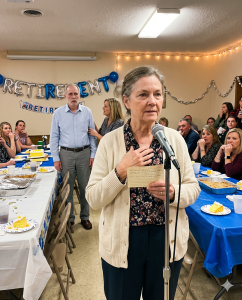
The hall was full already, thick with the smell of baked ham, coffee, buttercream icing, and those polished wooden floors that always seemed to hold onto fifty years of cigarette smoke no matter how many times somebody refinished them. A banner stretched across the far wall in shiny blue letters: HAPPY RETIREMENT, EARL. Folding tables lined the room under white paper cloths. There were silver balloons tied to the backs of chairs, a sheet cake near the kitchen, and a slideshow screen set up beside the podium, waiting to turn one man’s life into a sequence of flattering photographs.
Darlene paused just inside the entrance, one hand under the casserole dish, the other smoothing the front of her cream cardigan.
She wore navy flats, plain enough to disappear under the hem of her skirt. Small pearls. No bracelet. No perfume that announced itself before she did. Her graying hair was pinned back neatly, and her face carried that mild, composed expression some women learned after years of being interrupted, underestimated, and talked over.
A younger man at the guest table glanced at the dish in her hands and said, “Kitchen’s that way, ma’am,” before he even asked her name.
Darlene gave him a faint smile. “Thank you.”
Then she took the pen, signed the guest book in her careful script, and wrote:
Darlene Futch.
He didn’t react. Either the name meant nothing to him, or he was too young to remember when it meant everything.
That was all right with her.
Across the room, Earl Futch was holding court beside the podium, laughing too loudly with a cluster of men from the county road department. He had put on weight in the face and middle, the kind that softened nothing and only made him seem more settled into himself. His hair was thinner now. His cheeks ruddy. But he still held his chin at the same angle Darlene remembered from twenty years earlier, a little lifted, as if he expected admiration to rise naturally toward him.
For most of the county, Earl was exactly what the banner said he was: a hardworking public employee finally getting his due. A man who had put in his years. A man who knew everybody. A man who could call in favors, tell stories, slap backs, and walk into any breakfast spot in Tupelo expecting a refill before he even sat down.
For Darlene, he was also the man who had once stood in their kitchen, tossed a faded index card onto the table, and told her she was too simple to ever amount to anything.
That part never made it into retirement speeches.
She carried the casserole to the buffet and set it down between the baked beans and the deviled eggs. Her fingertips slipped into her cardigan pocket and found the worn edge of that same old card. It was faded now, the ink softened with time, the corners bent nearly white from years of being handled. She touched it once, the way some people touched a cross or a wedding ring.
Then she lifted her hand away and turned.
“Darlene?”
The voice belonged to Patsy Borden, Earl’s older sister, who stood frozen beside the desserts with a stack of napkins in her hand. Patsy’s expression rearranged itself twice in three seconds: surprise, discomfort, then a smile that came in too late to look sincere.
“Well,” Patsy said. “This is… something.”
“I got the invitation,” Darlene answered.
Patsy eyed the casserole. “That was nice of you. Earl always did like your cooking.”
Darlene met her gaze. “Yes. He did.”
Patsy shifted. There was history in that pause, and both women knew it.
Back when Darlene and Earl were married, Patsy had mastered the art of the insult wrapped in syrup. She’d compliment a pie and ask if Darlene had needed help with the crust. Praise the house and ask if Earl remembered to tell her what color paint to buy. She had never openly attacked Darlene. She never had to. Earl did enough of that for everyone.
After the divorce, Patsy had chosen her side with cheerful efficiency.
“You still over in that little white place by the tracks?” Patsy asked.
Darlene touched the card in her pocket again. “No.”
Patsy waited for more. Darlene gave her none.
Another woman passed by and lit up with the kind of expression people wore when they wanted to appear kind in public. “Darlene, honey, look at you. It’s been forever. Earl always worried about you.”
Darlene smiled gently. “Did he?”
The woman laughed, then seemed to hear the answer inside the question and drifted toward the punch bowl.
That happened several more times in the next half hour.
People approached her with tilted heads and softened voices. Asked if she was doing all right. Asked if she had family nearby. Asked whether she still cooked for church suppers. Asked if she needed help carrying her plate. Nobody was cruel outright. That would have required courage. Instead, they offered that particular small-town condescension reserved for women who had been publicly classified and privately dismissed years ago.
Quiet Darlene.
Simple Darlene.
The one Earl outgrew.
Darlene answered all of them calmly. The less they knew, the more they showed of themselves.
Only one person in the room looked at her and saw something else.
Raymond Ellis from First State Bank stood near the coffee urns, balancing a plate of ham on one hand while watching the room with the contained amusement of a man who understood a secret too large to fit in ordinary conversation. Raymond had known Darlene for twelve years. Not socially. Professionally. He had watched her buy her first distressed property at a tax sale, then another, then two more through an LLC so people wouldn’t gossip before she was ready.
She had started with a duplex no one wanted, just off Green Street. The roof leaked, the wiring was ancient, and there was a colony of raccoons living under the back porch. Everybody assumed she was in over her head.
She was not.
Darlene had sold a patch of land her father left her, used the proceeds as seed money, and spent weekends learning what nobody ever thought to teach her. Contractor estimates. County records. Liens. Permits. Tax assessments. Leases. She sat in bank offices and listened more than she spoke. Men mistook that for confusion until they realized she had noticed the clause they hoped she would miss.
Then she bought another property.
Then another.
A laundromat building nobody thought worth saving.
A narrow brick storefront on Main.
A two-story place with rotten stairs and good bones.
A row of neglected rentals on the edge of town.
She never dressed like money. Never talked like money. Never announced herself at ribbon cuttings. She let managers manage, attorneys file, accountants structure, and tenants pay rent to companies whose names sounded boring on purpose. She understood something Earl never had:
People often hid from judgment by pretending to be larger than life.
Darlene hid from interference by pretending to be exactly what they thought she was.
Plain was camouflage.
Simple was freedom.
By the time the county noticed half of Main Street had stabilized and improved under a series of quiet acquisitions, the paperwork had long since been filed. The legal owner named across most of it was Darlene Futch.
Not Earl’s current wife.
Not one of the old money families.
Not a developer from Jackson.
Darlene.
She had never corrected the rumors because rumors had built her a cloak she could work beneath. While people underestimated her, they also left her alone.
Until tonight.
The slideshow began. Pictures flashed on the screen while guests settled into metal chairs. Earl in an orange safety vest. Earl with a fish. Earl in a Santa hat at the county Christmas party. Earl posing with road crews beside fresh asphalt. Every few minutes somebody laughed louder than necessary, and Earl basked in it like a man sitting under a heat lamp.
Darlene stood near a side pillar with a paper cup of punch and watched.
She remembered another version of him. Earl at thirty-eight, impatient in the kitchen. Earl counting cash at the table and calling her over not because he needed help but because he wanted an audience. Earl asking what she’d done all day in a tone that made a list of labor sound like laziness. Earl deciding that because she hated boasting, she must have lacked ambition. Earl assuming that because she paused before speaking, she had nothing worth saying.
The night he left for good, he packed with theatrical irritation, muttering under his breath as if she were inconveniencing him by not begging harder. Then, before slamming the back door, he had scribbled something on an index card and tossed it onto the kitchen table.
For when your memory fails you, he’d said.
She had picked it up after he left.
In thick blue ink, the card read:
You are too simple to ever amount to anything. Don’t embarrass yourself trying.
She should have thrown it away.
Instead, she slipped it into a cookbook, then later into a dresser drawer, then years afterward into the pocket of whatever cardigan she wore most. Not because she believed him. Not forever. But because there had been a time she almost did.
In the first months after the divorce, she cried in grocery store aisles because choosing the wrong detergent felt like proof. She stared at bills too long. Second-guessed every decision. Spent whole evenings sitting at her kitchen table listening to train sounds in the distance and wondering whether a person could become invisible simply because enough people agreed she was small.
Then one afternoon she drove past a boarded-up duplex with a county auction notice stapled to the post.
She parked.
Read the paper twice.
Went home and looked up everything she could.
The next month she bought it.
It wasn’t courage all at once. It was quieter than that. A stubbornness. A refusal to let the loudest man she had ever known be the final editor of her life.
At the front of the room, Mayor Crenshaw arrived to applause and handshakes. He climbed to the podium, smiling in that polished public way politicians did when they wanted to appear warm without committing to sincerity.
He spoke about service, duty, loyalty, roads repaired after storms, years given to the county. The crowd nodded along. Earl dabbed at one eye when the mayor called him “a steady hand.”
Then came the personal remarks.
Patsy cried on cue and said Earl had always been the family’s rock.
A former coworker told a rambling hunting story.
Jolene, Earl’s second wife, thanked him for showing her “what real partnership looks like,” which nearly made Darlene laugh out loud.
Then Earl himself took the microphone.
He began acceptably enough. Thanked God. Thanked the mayor. Thanked his department. Thanked his sister. Thanked Jolene. He told two safe stories, got two easy laughs, then made the mistake men like him made when they believed a room belonged to them completely.
“Life teaches you who can keep up and who can’t,” he said, smiling. “You learn some folks just ain’t built for much beyond standing still.”
There were chuckles. Then uncertainty.
Earl glanced toward the side of the room. Toward Darlene.
That was all it took.
He didn’t say her name. He didn’t have to. The old insult walked into the room on its own and sat beside every person who had ever heard him use it. A few people looked down at their plates. Others looked toward Darlene and then away quickly, embarrassed on her behalf but not enough to object.
Darlene slipped her fingers into her pocket and touched the index card.
Her face remained composed.
Inside, something settled.
Not rage. That had burned off years ago.
This was the colder thing that came after you built enough of a life not to fear the opinions of people who once wounded you.
Mayor Crenshaw stepped back in with a tight smile, rescuing the mood. “Well,” he said lightly, “thank you, Earl, for those reflections.”
Laughter wobbled around the room and disappeared.
He lifted a plaque and made the official presentation. Cameras flashed. Earl held it for photos.
Then the mayor glanced at a note card in his hand.
“That’s not all,” he said.
The room stirred again.
“As many of you know, the county has been working for years to secure funding for the new public library branch.”
That got people’s attention immediately. Everyone in Tupelo knew about the stalled library plan. Meetings had been held. Pledges made and withdrawn. Committees formed. The proposed branch mattered, especially the literacy center and children’s room, but the financing gap had become a recurring local embarrassment.
Mayor Crenshaw continued. “Tonight, I’m honored to announce that a private donor has closed the remaining gap.”
The room buzzed.
Someone near the buffet actually gasped. Another whispered, “Who on earth?”
The mayor smiled. “This gift covers the final land purchase, the children’s reading room, and the literacy center.”
Now everyone was fully alert.
Jolene sat straighter. Patsy’s eyes darted around the room, hunting for the obvious answer: an old-money family, a businessman, somebody whose last name already adorned a building.
Earl looked curious too, but also faintly annoyed that attention had shifted.
“The donor requested anonymity until this evening,” the mayor said. “But given the occasion, she agreed this was the right time to share her name publicly.”
She.
That caused another ripple.
Darlene stood still by the pillar, one hand resting over the faded index card in her pocket.
Raymond Ellis looked down at his plate to hide his expression.
Mayor Crenshaw leaned toward the microphone.
“The donor,” he said clearly, “is Ms. Darlene Futch.”
Silence.
It hit the room in a single clean drop.
Patsy’s mouth opened, then closed. Jolene’s smile vanished. One of the servers whispered, “That lady?” loud enough for three nearby guests to hear. A fork clattered against a plate. Somebody in the back actually turned to look behind Darlene, as if there might be another woman with the same name standing somewhere out of sight.
There was not.
Earl Futch went the color of old milk.
Not pale from emotion exactly. Pale from collapse. From the instant an old story fails in public and takes a man’s authority with it.
He stared at Darlene with naked disbelief.
She met his gaze calmly.
Mayor Crenshaw, sensing the room needed anchoring, kept going. “Ms. Futch asked that the gift be made in honor of lifelong readers and late learners alike. Her only conditions were that the children’s room stay fully funded and that no politician cut the literacy center once construction begins.”
That sparked the first shocked laugh.
Then came the murmurs.
“Darlene owns property, doesn’t she?”
“How much property?”
“I heard she bought that building near the square.”
“Not just one.”
“Oh my Lord.”
The room began to reassemble itself around a new understanding, but Darlene wasn’t interested in helping them along.
She reached into her cardigan and slowly took out the faded index card.
Raymond straightened.
Patsy froze.
Earl’s expression changed from shock to dread.
Darlene held the card between two fingers and looked down at it once, almost tenderly. Then she stepped toward the front, not hurried, not dramatic, just precise. Her navy flats made almost no sound on the floorboards, but somehow the room seemed to hear every step.
“Darlene,” Mayor Crenshaw said, uncertain whether he should hand her the microphone.
She didn’t answer him immediately. She stopped a few feet from Earl.
The two of them stood facing each other under the retirement banner, the audience only a breath away.
“I kept this,” she said.
Her voice was soft. The softness made the room lean in.
Earl swallowed.
Darlene lifted the card slightly. “From the day you walked out.”
The mayor lowered his hand from the microphone stand.
Nobody moved.
“You wrote it for me,” Darlene continued, “because you said I’d never remember otherwise.”
Patsy looked sick.
Jolene stared at Earl as if she had just discovered something rotten under a floorboard.
Darlene turned the card over once in her fingers, then back again. “I surely did remember.”
Earl made the mistake of trying to recover his old footing. “Now hold on,” he said with a strained laugh. “This ain’t the time for—”
“For truth?” Darlene asked.
The question landed harder than any shout could have.
He stopped speaking.
The crowd did too.
Darlene took the microphone from the stand at last. Her hands were steady. “Y’all have heard him tell the county who I was for a long time,” she said. “Seems fair you hear his exact words at least once.”
She unfolded the card.
Every eye in the room followed it.
In that instant, Darlene thought unexpectedly of the kitchen where she’d first read it. The yellow curtains she had hated. The dead clock over the stove. The ache in her chest so large she couldn’t imagine surviving it. She thought of the first property she bought with shaking hands. The first tenant who thanked her for fixing a broken heater no landlord had touched in years. The first rent check that made her realize she would never need Earl’s approval for anything again. She thought of the boys and girls who would sit in that library reading room one day, with shelves around them and air-conditioning in summer and a place to learn without asking permission.
Then she read.
“You are too simple to ever amount to anything,” she said, clear and even. “Don’t embarrass yourself trying.”
No one breathed.
The sentence seemed to hang above the folding tables like smoke.
Darlene lowered the card. “For a little while, I thought he might be right.”
Earl opened his mouth, but the room had already turned on him in the only way that mattered. Not with yelling. With recognition.
Men looked away from him.
Women looked directly at him.
Jolene’s face hardened into something stony and unreadable.
Patsy sat down abruptly in the nearest chair.
Darlene kept speaking.
“Then I got embarrassed anyway.” A tiny smile touched the corner of her mouth. “Bought a duplex. Fixed it. Then another building. Then another. Turns out trying suited me just fine.”
This time the laugh that rolled through the room belonged to her.
It was startled, impressed, a little ashamed.
Earl’s lips parted, but nothing came out.
Mayor Crenshaw, sensing history and politics colliding in real time, stepped a half pace back and wisely said nothing.
Darlene folded the index card again. “I carried this because I never wanted to forget what it cost me to start believing in myself after somebody did their best to beat it out of me.” She glanced around the room. “And because every now and then, being underestimated is useful.”
A murmur of agreement moved through the crowd, especially from women old enough to know exactly what she meant.
Then Darlene turned to Earl one last time.
“You were right about one thing,” she said. “Everybody does have their place.”
He flinched before she even finished.
“I suppose mine just turned out bigger than yours.”
Nobody clapped at first.
They were too stunned.
Then Raymond Ellis set his plate down and started. One sharp, deliberate clap. Then another. Soon others joined him. Not polite applause. Something fuller. Something with force behind it. It spread table to table until the hall rang with it.
Earl stood in the middle of it holding a plaque no one cared about anymore.
Jolene rose slowly from her chair, picked up her purse, and walked toward the side exit without looking at him.
Patsy stayed seated, eyes fixed on the tablecloth.
Mayor Crenshaw recovered enough to clear his throat and say, “Well. On behalf of the county, Ms. Futch, thank you.”
Darlene nodded once.
She handed back the microphone, slipped the index card into her pocket, and walked to the buffet. For one surreal moment, no one knew whether to speak to her, congratulate her, apologize, or get out of her way.
She solved it for them by lifting the lid off her casserole dish.
“Somebody ought to eat this before it gets cold,” she said.
That broke the tension at last.
People laughed. Real laughter this time.
Then they came toward her in a different way than before. Not with pity. Not with that false sweetness. With respect, and in some cases with visible regret. A schoolteacher thanked her for funding the literacy center. A young mother asked whether the children’s room would have after-school reading hours. Raymond came over and quietly said, “About time.”
Darlene smiled. “I thought so too.”
As the party thinned, Earl tried once to approach her. He made it three steps before stopping. Maybe he understood there was no language left that could repair what had just been exposed. Maybe he knew apologies offered only after humiliation were just another form of self-protection.
Darlene didn’t wait to find out.
She collected her empty casserole dish, thanked the kitchen volunteers, and walked out into the warm Mississippi night. The air smelled like cut grass and asphalt cooling after sunset. Crickets had already started up in the dark edges of the parking lot.
She stood beside her car for a moment and looked at the lodge windows glowing behind her.
Inside, they would still be talking when the chairs were folded and the cake boxed up. By morning the story would be all over town. By next week half the county would act as though they had always known she was remarkable. That was fine. People revised themselves more easily than they revised their memories.
Darlene opened her purse, took out the faded index card, and looked at it one final time under the lot light.
You are too simple to ever amount to anything.
The words had once been a sentence imposed on her life. Then a challenge. Then fuel.
Now they were only evidence.
She tore the card neatly down the middle.
Then again.
Then once more, until the pieces were too small to read.
She dropped them into the trash can beside the lodge door, set her casserole dish on the passenger seat, and got behind the wheel.
Tomorrow there would be contractors to call about the library site and a meeting about the children’s room design. There would be shelving to plan, windows to approve, and a corner she intended to dedicate to adults learning to read later in life, because shame had stolen enough years from enough people.
She started the engine and pulled onto the road.
At the next red light, she caught her reflection in the windshield glass. Same cardigan. Same pinned hair. Same sensible flats.
The whole county had looked at those things and seen smallness.
Maybe that was the final lesson.
Sometimes the biggest red flag isn’t cruelty shouted in public. It’s the easy confidence of people who believe they know exactly what another person is worth. And sometimes forgiveness matters less than this: living well enough that the people who tried to define you are forced to stand still and watch while the truth says your name out loud.