After the divorce, Beth thought the humiliation had been carefully designed.
In truth, it had.
Daniel had kept the house with the wraparound porch that everyone in town admired at Christmas. He had kept the truck they once used for weekend market runs before his life became too polished for that kind of work. He had kept the savings, the retirement accounts, the restaurant investors, the sleek office downtown, and the shining family name mounted above the best-known dining room in the city.
What he left Beth was a failing bakery with a leaking roof and machinery old enough to belong in a museum.
In court, he had called it a generous gift.
That was the part that made people angriest on her behalf. Not the division itself, because ugly divorces had a way of turning practical cruelty into paperwork. It was the smile he wore when he said it. The ease. The soft confidence of a man who expected everyone to admire how calm he was being while he buried someone in public.
Beth had stood beside her attorney and kept her face still. She had learned that trick in the final years of their marriage. Daniel had become the kind of man who watched reactions carefully, collecting them, measuring which words made people flinch. If she cried, he looked pleased. If she argued, he looked patient. If she stayed silent, he filled the silence with his own version of events.
So she said almost nothing.
And in the end, the bakery became hers.
The old Hale Bakery sat on the far side of town where the pavement cracked near the curb and the old storefronts hadn’t been updated in decades. Once, long ago, it had been the center of the family business. People still remembered that. They remembered lining up for Walter Hale’s morning bread before sunrise. They remembered his honey rolls and dense cinnamon loaves and little fruit tarts that sold out before noon.
But that had been years before Beth married Daniel.
By the time she came into the family, the bakery had become a neglected side business, kept alive more as a sentimental backdrop than a real operation. Daniel’s focus was on the downtown restaurant: upscale plates, reservation lists, polished wood, glowing light fixtures, and carefully curated heritage. He liked telling guests the restaurant had been built on family tradition. He liked saying he came from bakers. He liked being photographed under the sign.
He rarely visited the bakery unless cameras were involved.
Beth had, though.
When they were still happy—or what passed for happy in hindsight—she spent long evenings there testing desserts. Walter had been alive then, slower on his feet but still sharp-eyed and stubborn about ingredients. He had shown her how to feel flour between her fingers, how to judge dough by smell before touch, how to wait the extra minute that made frosting turn from decent to impossible to forget.
“Recipes aren’t just ingredients,” Walter once told her. “They’re memory with discipline.”
Daniel had laughed when he heard that. “Granddad thinks butter is philosophy.”
Walter had ignored him.
Back then, Beth thought it was just a harmless difference in temperament. Now she saw that Walter had been studying them both.
The divorce came years later, after ambition hardened Daniel into someone she no longer recognized. Success had made him shinier and colder at the same time. He stayed late downtown. He answered her questions with irritation. He treated every conversation like a negotiation he intended to win. By the end, even the house felt like his performance space. Beth moved through it as if she were visiting a place where she had once lived.
When the settlement gave her the bakery, Daniel’s sister Marcy made sure to enjoy it.
“At least you can sell cookies until the rats take over,” she called from across the street the night Beth got the keys.
Beth shut the bakery door in her face and stood in the dim front room breathing through the sting in her throat. She had promised herself she would not cry over Daniel’s family again.
Inside, the air smelled stale and faintly sweet, like sugar trapped too long in old wood. The display case was empty except for crumbs. A fluorescent bulb buzzed overhead and then died. Beth turned on her flashlight and walked room to room, taking stock of what she had inherited.
One mixer turned half a rotation and locked. The refrigerators were inconsistent. The office files had been stripped of anything useful. She found a dead patch in the ceiling where water had clearly been coming in for months. In the pantry, the shelves leaned so badly she was afraid to stack flour on them.
The message was obvious.
Daniel had given her a business designed to fail publicly.
She sat in the back that night on an overturned bucket, phone in hand, tempted to call a realtor and unload the place before it swallowed whatever dignity she had left. She imagined Daniel hearing that she had sold it for almost nothing. She imagined his nod, the private confirmation that he had been right about her all along.
Then the storm began.
Rain struck the roof in hard uneven bursts. Beth jumped up, grabbing bowls and trays to catch the leaks. One stream landed against the old brick wall behind the flour shelves, darkening the plaster until it sagged. When she moved the shelf aside, she noticed a square patch in the wall softer than the rest.
She pressed it.
The plaster broke.
A chunk fell away, revealing a small iron door hidden inside the wall.
For a long moment Beth only stared. The bakery had just gone from sad to strange.
The little door resisted at first. Rust flaked under her fingers. But she worked the handle loose and pulled it open. A narrow compartment had been built into the brick, and inside sat a fireproof box covered in dust.
She carried it to a prep table with both hands.
Inside were bundles of papers wrapped carefully in cloth. Old recipe cards in Walter’s slanted handwriting. Property deeds. Corporate filings. Tax records. A photograph of the bakery in its earliest years. And a sealed envelope addressed in dark ink: For my rightful heir.
Beth opened it with the strange, prickling feeling that someone long dead had just reached across time and touched her shoulder.
Walter’s letter was direct.
He wrote that the bakery was never the family’s leftover business. It was the original company, the legal root from which every later enterprise—including the restaurant downtown—had grown. He wrote that he had tied the family name, core recipes, and parent business rights permanently to ownership of the bakery property. He had done it intentionally, because he feared that one day someone in the family would value image over craft and abandon the place where the business began.
Beth read that sentence three times.
Then she read the property records.
Then the incorporation amendments.
Then the signatures.
The meaning settled in slowly and then all at once. Daniel had not handed her a worthless shell. He had signed over the one property that controlled the entire legacy.
The original company.
The name.
The recipes.
Potentially even the rights supporting the downtown restaurant’s branding.
Beth sat on the floor until after midnight with papers spread around her like pieces of a life she hadn’t known existed. She laughed once in disbelief and then cried, sudden and hard, because the cruelty of the divorce had just collided with an absurd, impossible reversal.
Daniel had punished her with the one thing he had never bothered to understand.
By morning she was in attorney Renee Solis’s office.
Renee had handled a few commercial filings for Beth years earlier, and she was one of the few people who never seemed dazzled by Daniel. She put on glasses, read the documents in silence, then looked at Beth over the top edge of the pages.
“Did he transfer the bakery to you exactly as listed on this deed?”
“Yes.”
Renee placed the papers neatly together. “Then this may be the most expensive act of arrogance I’ve ever seen.”
The next hours moved quickly. Renee pulled archived filings. She cross-checked Walter’s language against existing business structures. By lunchtime she was drafting formal notices asserting Beth’s ownership rights over the foundational company assets.
Daniel called before Beth had even locked the bakery door to reopen for the day.
She ignored him.
He called again.
Then Marcy.
Beth turned both phones face down and tied on an apron.
The bakery itself was still a wreck, but it was her wreck now, and that changed something. She swept. She cleaned the windows until sunlight brightened the front counter. She found one working tray and mixed dough from one of Walter’s old recipe cards for cinnamon rolls rich with brown sugar and cardamom. As they baked, the smell drifted out to the street like a signal fire.
The first customer came in because she saw Beth moving around inside and got curious. The second came because someone texted that the old bakery had reopened. The third came because news in town had already started humming—Daniel Hale was in some kind of legal trouble, and somehow it traced back to the ex-wife nobody expected to hear from again.
By late morning, Beth had sold out of the first tray.
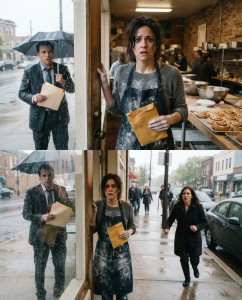
That was when Daniel arrived outside the window.
His courtroom smile was gone. He stood on the sidewalk in a navy suit that suddenly made him look less powerful than brittle. Beth could see the strain in his jaw from across the room. A few pedestrians slowed. One man delivering produce to the café next door stopped entirely.
Daniel raised a hand for Beth to come outside.
She stepped to the door but did not open it immediately. She wanted him to feel that barrier. Glass. Wood. A locked threshold he no longer controlled.
When she finally cracked it open, she noticed the folder in his hand.
“There’s more you haven’t read yet,” he said.
The tone caught her off guard. Daniel was angry, yes. But beneath the anger there was fear—real fear, the kind a person cannot disguise with posture.
Before Beth could answer, Marcy’s car flew around the corner and braked hard enough to squeal. She rushed toward them, pale and tense.
“Daniel, don’t,” she said.
Beth looked from one face to the other and felt the shape of something much larger moving beneath the surface.
“What is it?” she asked.
Daniel held up the folder. “Read it inside. Alone.”
Marcy reached for it. He pulled it back.
That tiny movement told Beth more than any explanation could. Marcy knew what was in there, and Daniel didn’t want her deciding when Beth saw it. Whatever it was, it had the power to wreck him beyond money.
Beth took the folder.
Inside was another yellowed envelope written in Walter’s hand.
This one was addressed simply: Beth.
Not Beth Hale.
Not Beth Carter.
Just Beth.
As if Walter had known that surnames could lie.
A chill moved through her so fast she had to steady the folder with both hands. She looked up. Daniel had gone visibly still. Marcy looked ill.
“Found out what?” Beth asked, remembering Marcy’s panicked words.
Neither answered.
Beth broke the seal.
Walter’s second letter was shorter than the first and far more personal. The opening line made her vision blur.
If you are reading this, then the truth was hidden from you far too long.
Beth read on while the world around her narrowed to the page.
Walter wrote that years earlier, before Beth and Daniel married, he had discovered something while reviewing old family records after Daniel’s father died. Daniel was not his blood grandson. There had been a private adoption, concealed within the family after an affair and a hasty arrangement no one wanted exposed. Walter insisted the boy should still be loved and raised with dignity. But the secret did not end there.
According to Walter, Beth’s own late mother had once worked at the bakery as a teenager. During that time, Walter’s son—Daniel’s legal father—had fathered a child with her in secret. That child was Beth.
Beth stopped reading and pressed a hand to her mouth.
Traffic moved at the end of the block. A door opened somewhere behind her in the bakery. But all of it felt far away.
She read the line again.
Beth was Walter’s biological granddaughter.
Not by marriage.
By blood.
Walter wrote that he had wanted to tell her himself, but by the time he confirmed it, Beth was already engaged to Daniel. The family had panicked. There was shouting, denial, threats of scandal. Daniel and Marcy knew. Their mother knew. Walter had intended to stop the wedding until final proof was secured, but his health failed. By the time he was strong enough to act, the marriage had gone ahead, and Walter feared destroying Beth publicly with a truth that would come without context, comfort, or certainty.
So he did the one thing he believed he still could.
He changed the business structure to protect the rightful blood heir of the Hale line.
Beth.
The bakery was not only the company’s legal root. It was Walter’s safeguard, a way of making sure that if the truth stayed buried during his life, the family legacy would still reach the person he believed should hold it.
Beth looked up from the letter so suddenly that Daniel flinched.
“You knew?” she whispered.
Daniel’s face tightened.
“You knew before you married me?”
He said nothing.
That silence was answer enough.
Marcy began crying first. Not dramatically. Quietly, angrily, with the face of someone who had defended an ugly secret for too many years.
“Our mother said it would ruin everything,” she said. “The business, the family, all of it. She made Granddad promise—”
“Promise what?” Beth snapped. “To let me marry someone who already knew?”
Daniel stepped forward. “I didn’t know at first.”
Beth’s laugh came out broken and sharp. “At first?”
He closed his eyes briefly, and when he opened them again there was no polish left. “Granddad told me before the wedding. I thought he was trying to manipulate me. I thought he hated what I was building downtown and wanted to scare me away from it. My mother told me he was confused, obsessed with old rumors. I believed her.”
“You still married me.”
“Yes.”
“You still let me take your name.”
His voice dropped. “Yes.”
The crowd outside had gone from curious to riveted, but Beth barely registered them. Her whole marriage had just shifted into a shape she could hardly bear to look at. Every family dinner. Every cold silence. Every subtle cruelty from Marcy. Every strange look from Walter in the final months of his life. It all rearranged itself with horrifying clarity.
“You found out it was true later,” Beth said.
Daniel did not deny it.
“When?”
He looked away toward the restaurant district, as if even now he wanted another landscape. “A few years into the marriage. There was more paperwork. A test. Granddad had left notes. I knew then.”
Beth felt something inside her turn hard and calm.
“And you stayed.”
“I didn’t know how to unravel it.”
“You divorced me instead.”
Daniel’s expression collapsed into something like shame. “I thought I could end it quietly. I thought if you took the bakery and moved on—”
“You thought I’d disappear.”
He had no answer.
Renee arrived twenty minutes later after Beth called with a voice she barely recognized as her own. She read both letters in the office while Beth sat rigidly across from her desk, hands clasped too tightly. When Renee finally spoke, it was with lawyerly caution wrapped around unmistakable outrage.
“The inheritance issue is one matter,” she said. “The marriage issue is another. The paternity claims may be difficult to prove conclusively at this late stage without additional records or testing from surviving relatives. But the business documents are real, immediate, and enforceable. As for what they knowingly concealed from you…” She paused. “That opens doors they do not want opened.”
Beth looked through the office window at the bakery floor, at the old mixers and cracked tile and trays cooling on the rack. Just yesterday she had thought this place was the remains of her ruined life. Now it felt like the only honest thing she had been given.
The legal battle that followed did exactly what Daniel had feared.
Renee moved for injunctions preventing the downtown restaurant from using the Hale name and foundational recipes pending final determination. Investors panicked. Suppliers hesitated. Local papers ran the story in cautious fragments first as a business dispute, then as whispers of a deeper family secret. Daniel tried to negotiate, then threaten, then apologize. None of it held.
Beth refused private settlements that required silence.
More records emerged from storage, including handwritten notes from Walter, employment documents tying Beth’s mother to the bakery, and correspondence that showed the family had indeed spent years burying questions about Beth’s parentage. It never became a courtroom spectacle about the marriage itself—the law, the dates, and the evidence made that path too messy and painful—but the moral truth of it spread faster than any formal ruling could have.
And in business terms, the outcome was decisive.
Ownership of the bakery property gave Beth controlling rights over the original company identity and core branded assets. The restaurant could continue operating only after a costly rebrand and under a licensing arrangement Beth was under no obligation to make generous. She chose not to close it outright. Instead, she required the Hale family name to come down.
The day they removed the sign, half the town gathered on the sidewalk to watch.
Daniel wasn’t there.
Beth was.
She stood in front of the bakery wearing a flour-smudged apron and holding a cup of coffee while the letters came down one by one from the restaurant that had once been treated like the center of everything. People glanced at her with open curiosity, sympathy, admiration, and uncertainty. She let them look. For once, she had nothing to hide.
Months later, the old bakery no longer looked broken.
The roof had been repaired. The brick wall remained exposed around the little iron door, which Beth kept restored but closed. New mixers stood where the dead ones had been. Morning lines stretched onto the sidewalk on Saturdays. She used Walter’s original recipes carefully, not as nostalgia theater but as working craft. Bread sold out by ten. Her cinnamon rolls became the thing people drove across town for.
Above the front window hung a new sign:
Beth’s Original Bakery.
No borrowed surname. No family performance. Just the truth she chose.
Daniel eventually wrote asking to meet. Beth read the message twice and deleted it. Marcy came once in person, stood awkwardly by the counter, and bought a loaf of sourdough without saying much. Before leaving, she whispered, “I should have told you.”
Beth answered honestly. “Yes. You should have.”
That was all.
Some people in town still argue about what mattered most—the legal mistake, the hidden letter, the money Daniel lost, or the secret his family buried for years. Others say Beth should have shown mercy because the dead had made the first mess and the living only inherited it.
Maybe.
But when people ask what the biggest red flag was, those who know the story usually say the same thing: it wasn’t the divorce. It wasn’t even the cruel settlement.
It was the fact that Daniel could stand in court, smile, and call the bakery a generous gift while knowing exactly what he had taken from Beth for years—and exactly what the little ruined building was always meant to give back.