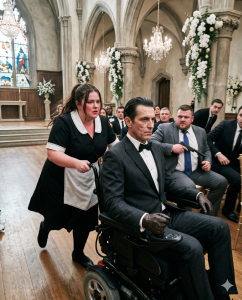
The first thing Lorenzo Johnson noticed was the silence.
Not the silence in the ballroom now, where five hundred important people had dissolved into panic after two suppressed gunshots tore through stained glass. That silence was gone, replaced by screaming, running, and the sound of wealth colliding with terror.
He meant the silence inside himself.
Six months earlier, in Palermo, there had been a white flash, a car bomb, and then months of pain so complete it had burned language out of him. Men later told him he had nearly died twice. Surgeons rebuilt what they could. Specialists talked carefully around words like permanent and irreversible. His enemies celebrated too early. His allies visited with flowers and promises and eyes that kept slipping down to the dead weight under the blanket.
Lorenzo survived all of it.
But survival had taught him something colder than pain: the world only feared power it could still imagine standing up.
That was why this wedding mattered.
Victoria Aster was not beautiful in the warm, soft way men wrote poems about. She was beautiful the way a knife was beautiful—precise, expensive, and dangerous if handled wrong. She came from a family whose wealth had outlived scandals, recessions, political shifts, and criminal investigations that had somehow never gone anywhere. The Asters did not need Lorenzo’s money. They needed his reach. His leverage. His fear. He, in turn, needed what they could provide: legitimacy, old institutional doors, and a public symbol that said the Johnson Syndicate was not weakening simply because its king no longer walked.
No one in that ballroom believed in romance. The guests had come to watch a merger.
And now they had watched it crack in half.
As Bianca pushed him down the service corridor, Lorenzo’s mind moved faster than his chair ever had. Dead joystick. Empty offshore accounts. Missing security personnel. Dominic’s betrayal. A hired shooter. Too many variables converging too neatly.
Richie came around the corner dragging the scarred gunman. Blood dripped from the man’s mouth. He had a tactical earpiece and the kind of eyes Lorenzo knew well—eyes trained to detach the job from the consequences.
“Check his lining,” Lorenzo ordered.
Richie found the trigger device.
Bianca stared at it, the blinking green light reflecting in her wide eyes. She still wore her black staff uniform, sleeves damp at the elbows, apron twisted where she must have grabbed it while running. She looked like she did not belong anywhere near men like Lorenzo, which was exactly why she had seen what none of them did.
Lorenzo turned his head toward the ceiling vent. There it was again: a faint hiss, almost polite.
Gas.
Dominic had adapted. The first plan was public humiliation followed by a clean kill. When Bianca ruined the shot, he pivoted to a second strategy—clear the room through panic, then destroy the evidence and anyone who could testify to what really happened.
“Move,” Lorenzo said.
Richie hauled the gunman forward. Bianca shoved the chair. The corridor opened into a back prep area lined with catering racks, silver domes, and crates of wine. Staff members were crying, crouched behind counters, clutching phones with no idea whom to call.
“Everyone out through the loading dock,” Bianca yelled. “Now!”
Maybe it was her voice. Maybe it was the authority in Lorenzo’s silence. Maybe disaster makes people obey the first person who sounds certain. Whatever the reason, they moved.
Lorenzo pointed toward the industrial fire control cabinet mounted by the far wall. “Break it.”
A dishwasher grabbed a serving tray and smashed the glass. Richie twisted the emergency gas shutoff wheel. Somewhere behind the walls, the hiss died.
Not enough.
“The ballroom has a separate decorative line for the heat lamps and candle arrays,” Bianca said suddenly.
All three men looked at her.
She wiped sweat from her face with the back of her hand. “I helped setup yesterday. Event management complained the old hall controls were split between service and stage systems. There’s a secondary valve near the musicians’ access.”
Lorenzo studied her. Most people got quieter around danger. Bianca got more precise.
“Show Richie.”
She hesitated. “What about you?”
“I’m harder to carry than I look.”
That almost made her laugh, which surprised both of them.
“Go,” he said.
Bianca and Richie ran.
Lorenzo was left with the captured gunman and a teenage busboy who looked one bad sound away from fainting. Lorenzo rolled the chair’s inert wheel slightly with one hand, uselessly, then looked at the gunman.
“Dominic tell you the bride was aboard the jet?”
The man spat blood.
Lorenzo nodded once. “So she’s here.”
The gunman’s face did not move, but his left eyelid twitched.
Enough.
“Busboy,” Lorenzo said, “take the pistol from his ankle holster.”
The teenager blinked. “His what?”
“Left leg. Inside.”
With shaking hands, the boy found it.
The gunman lunged. Lorenzo moved on instinct, driving the heavy metal footplate of the wheelchair into the man’s knee as the boy stumbled back. Something cracked. The gunman screamed for the first time.
By the time Richie and Bianca returned, the secondary gas line had been shut and the loading dock was filling with coughing staff. Fire alarms began strobing red down the corridor.
“No ignition yet,” Richie said.
“Then Dominic is waiting for confirmation,” Lorenzo replied. “He doesn’t trust systems. He’ll want eyes on me.”
Bianca frowned. “You think he’s still inside?”
“I know him. He won’t leave before he sees me dead.”
They moved toward a concealed side passage that opened near the musicians’ balcony. From there Lorenzo could see into the ballroom without being seen. The orchids still hung in ghostly white curtains. Half the guests were gone. The rest clustered near exits, trapped by security confusion and their own disbelief. Aster family representatives were conspicuously absent. So were three of Lorenzo’s newer captains.
He followed the lines of movement, the gaps, the blind spots.
Then he saw her.
Victoria stood above the ballroom on the shadowed upper gallery in a travel suit, not bridal silk. No veil. No panic. A compact radio in one hand. Beside her stood Dominic, handsome in the easy, treacherous way some men are, as if betrayal came to them as naturally as charm. He had changed out of formalwear and into a dark coat. Practical. Ready to run.
Lorenzo felt the wound then—not because Victoria had betrayed him, but because she had played him well enough to think she respected the game.
Bianca saw them too. “So she never got on the jet.”
“It was bait,” Lorenzo said.
Dominic leaned toward Victoria and smiled at something she said. Even at a distance Lorenzo recognized the arrogance in it. They believed the ballroom was theirs. They believed panic meant victory. They believed the man in the wheelchair was still fixed in place at the altar, waiting to die on their timing.
Lorenzo touched Bianca’s wrist.
“When I tell you, push me through the balcony doors.”
Richie stared. “Boss, that puts you in the open.”
“Yes.”
“And if they shoot?”
“They will.”
Bianca’s jaw set. “Tell me where.”
It happened fast after that. Richie sent two loyal men to flank the gallery stairs. Another slipped outside to cut off the east motor court. Lorenzo instructed the busboy to pull the ballroom’s main lighting board on his mark. Total darkness for two seconds. Confusion. Then emergency lights. He did not need a long window. He only needed a crack.
He looked once at Bianca. Up close, her face was flushed and determined, hair escaping its tight work bun, breath still rough from running. She had no reason to stay in this story. One shove had already saved his life. Any sane person would have fled the estate.
Yet she remained.
“Why?” he asked quietly.
Her answer came without drama. “Because I know what it’s like when a room decides you’re finished before you get to fight back.”
That landed somewhere deeper than he expected.
Lorenzo nodded once. “Good. Then let’s fight.”
The lights died.
Screams rose again. Richie’s men moved. Bianca shoved the wheelchair through the balcony doors just as emergency strips snapped on in dim amber lines along the walls.
“Dominic,” Lorenzo called, his voice carrying across the ballroom like a blade.
Every head turned upward.
Dominic froze.
Victoria’s expression changed first—not to fear, but to irritated surprise, as though an equation had produced the wrong number. Dominic recovered faster, pulling a pistol from inside his coat and stepping in front of her.
“Still alive?” he called back.
“For the moment.”
Richie’s men hit the stairwell below. One of Dominic’s guards shouted. Shots rang out—loud this time, no need for silencers anymore. Guests dropped and crawled. The FBI agents outside must have heard the chaos because sirens began to rise in the distance.
Dominic aimed at Lorenzo.
Bianca moved before he fired, throwing her weight against the back handles and wrenching the chair sideways. The bullet shattered a gilt frame where Lorenzo’s throat had been. Splinters sprayed. Lorenzo kept talking.
“You stole from me,” he said. “That hurts. You ran with my bride. That’s embarrassing. But trying to burn half of Long Island’s political class to erase the evidence?” His eyes shifted to Victoria. “That was greed.”
Victoria stepped around Dominic. “You were done, Lorenzo. Everyone knew it. This just speeds up what was already happening.”
“Does it?”
She glanced at the ballroom below. The remaining guests were staring now—not at a broken king, but at a woman on a gallery with a gunman, in the middle of an attempted massacre. Bankers. judges. donors. men who could forgive theft, extortion, even murder under the right conditions—but not public instability that might touch them personally.
For the first time, Lorenzo saw doubt enter her face.
“You picked the wrong audience,” he said softly.
Dominic fired again.
This time Richie hit him from the side, the shot going wild into the ceiling. They crashed into the gallery rail, wrestling for the gun. Victoria ran for the east stairs, heels skidding on the polished floor. Bianca did not wait for instruction. She shoved Lorenzo after her with astonishing force, the wheelchair slamming across the gallery.
Victoria looked back once, misjudged the turn, and hit the stair landing hard enough to twist her ankle. She cried out and caught the banister, one shoe lost. Lorenzo rolled to a stop a few feet away, breath steady, eyes unreadable.
Below them, Dominic broke free from Richie for half a second and raised the pistol again.
Bianca saw it.
She grabbed a brass stanchion from the velvet rope line and swung with both hands.
It hit Dominic across the wrist with a crack that sent the gun spinning over the rail into the ballroom below.
Richie tackled him. Three of Lorenzo’s men piled on. By the time FBI agents flooded through the side doors, Dominic Johnson was face-down on the gallery floor with a knee in his back and blood on his expensive collar.
Victoria tried for composure. It was almost admirable.
“This is a misunderstanding,” she began, turning toward the arriving agents.
“Is it?” Lorenzo asked.
He nodded toward Richie, who reached into Dominic’s coat and pulled out a passport packet, transfer codes, and a slim document wallet. Inside were the account authorizations for the offshore theft, copies of the staged jet manifest, and—better than all of it—a signed contingency agreement between Dominic and Victoria outlining the division of funds, succession support from rival families, and a cleanup operation in case Lorenzo survived the initial attempt.
Victoria’s face went white.
“You signed it?” Lorenzo asked her.
She said nothing.
“That,” Lorenzo said, “was careless.”
The aftermath spread for months.
Dominic cooperated just enough to avoid life without parole, which meant he confirmed what everyone eventually pieced together: he had believed Lorenzo’s injury made him a ceremonial boss, still feared but no longer untouchable. Victoria had never intended to marry him. The wedding was a stage, the ballroom a trap, the public humiliation a signal to rivals that the Johnson Syndicate was available for dismantling. Rival families had not planned the hit, but several were prepared to profit from it. Once federal charges came down, they disappeared from the conversation with breathtaking speed.
Victoria’s family denied everything, then retreated into silence when bank records, communications logs, and witness testimony made silence their best remaining option. The Aster name survived, because names like that often do, but it never looked invincible again.
Lorenzo survived the scandal too.
Not untouched. Men still whispered. Power always changes shape after blood enters it. But he did something none of his enemies expected: he made his survival visible. He stopped hiding the chair. Stopped arranging rooms to disguise it. Stopped pretending the injury had not changed the terms of his life. He let people see the damage—and then made them watch how little it helped them.
That scared them more.
As for Bianca, she became the kind of problem institutions do not know how to process.
A maid had saved a kingpin, spotted a kill setup, disrupted an assassination, and helped unravel a conspiracy involving organized crime, old money, and attempted mass murder. For a while she vanished into witness interviews, temporary housing, and a storm of attention she had never wanted. Reporters called her brave, then ordinary, then inspirational, as if every label were a way of turning her back into something manageable.
Lorenzo offered her money first.
She refused.
He offered a job.
She refused that too.
“Why?” he asked when they met one final time in a private garden at a rehabilitation estate he now used for business.
Bianca looked at him across a stone table scattered with late autumn leaves. “Because I saved you, Mr. Johnson. I didn’t join you.”
He smiled then, the smallest real smile she had seen on him.
“Fair.”
He still made sure a trust was quietly arranged in her name through lawyers too expensive to question. Enough for her mother’s medical care. Enough to finish the degree she had abandoned. Enough to mean she would never again have to let strangers decide what her body was worth by the hour.
She found out months later. She considered sending it back. She did not.
The last time she saw Lorenzo, he was moving through a charity gala in that same wheelchair, tailored black suit, cold dark gaze, surrounded by governors, bishops, and men who had once waited for him to fall apart. No one looked at the chair first anymore.
They looked at him.
He caught Bianca watching from across the room and lifted his glass in a brief salute.
She returned it with water.
People still argued about that wedding long after the trials, the plea deals, and the headlines faded. Some said Lorenzo had won because he kept his empire. Some said he had lost because betrayal from blood cuts deeper than any bullet. Some insisted Victoria was always going to betray him because alliances built on power never become trust. Others said Dominic’s biggest mistake was not the theft or the attempted murder, but believing a man who can’t stand can’t still rule.
Bianca had her own opinion.
The biggest mistake in that ballroom was simpler than all of that.
A room full of predators looked at a paralyzed man and assumed he was helpless.
A room full of powerful people looked at a working woman and assumed she was irrelevant.
They were wrong about both of them.
And in the end, that was the detail that destroyed everything.