I found a letter in a dead mail vault that had been sitting there for fifty years — and it was addressed to me.
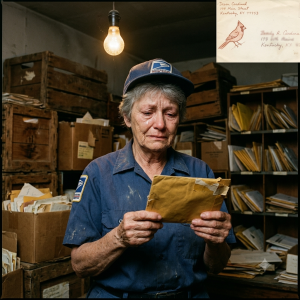
My name is Ruth Ann Colby. I worked thirty-one years for the United States Postal Service in Harlan County, Kentucky. I sorted mail in the dark. I walked routes in the ice. I knew every address in a twenty-mile radius the way some people know Scripture — by heart, without thinking.
And somehow, a letter meant for me had been buried alive in a vault I helped maintain.
Let me back up.
Last month, our postmaster asked me to help clear out the old dead mail room we’ve kept locked since the nineties. Boxes and crates stacked floor to ceiling. Rubber bands gone brittle as old bones. The smell of time itself.
I was pulling out a crate from the back corner when I saw it.
A small brown envelope.
Plain as a paper bag, except for one thing.
In the bottom left corner, someone had drawn a cardinal. Just a little sketch, red ink gone rusty with age. But it was careful. Loved. You could see the tiny crest on top of the bird’s head, the slight tilt of the beak.
I knew that cardinal.
When I was four years old, my father used to whistle for me. A two-note call — the same sound a cardinal makes in the morning. He’d stand at the back screen door and whistle, and I’d come running from wherever I was in the yard.
He left when I was five.
My grandmother raised me after that. She told me he’d chosen another life. That he was gone and we were not to speak of it further. She was a hard woman, my grandmother, but she kept the lights on and food on the table and I never doubted she loved me in her way.
I never heard from him. Not once.
I picked up the envelope with both hands.
The return address was on Barton Creek Road.
Barton Creek Road.
I know that road. I have driven it every single Tuesday for eleven years.
It’s the road to Shady Hollow Care Center. The nursing home where I volunteer.
The postmark said September 14, 1974.
I was six years old.
My hands were shaking so badly I had to set the envelope on the crate and breathe for a full minute before I could keep reading.
The letter was addressed to Miss Ruth Ann Colby, care of my grandmother’s house. Her name, her address, all in handwriting I didn’t recognize — but neat, deliberate handwriting, the kind a man uses when he is trying very hard to say something important.
The flap was still sealed.
Fifty years. Unread. Buried under a mountain of forgotten things in a building I worked in for three decades.
I thought about my grandmother. About how she’d said he left us. How she’d said it so final, so closed-off, that I never once thought to ask if maybe the story was more complicated than that.
I thought about that cardinal drawn so carefully in the corner.
I drove to Shady Hollow that same Tuesday. I didn’t call ahead. I just drove.
I still hadn’t opened the letter. I don’t know why. It felt like something I couldn’t do alone.
I walked in through the front doors like always. Dorothy at the front desk waved. The hallway smelled like it always does — antiseptic and cafeteria rolls and something like lavender underneath it all.
I found the charge nurse, Peggy, who I’ve known going on six years now.
I showed her the envelope. I showed her the return address. I told her what I’d found and where it had been sitting since 1974.
Peggy has seen a lot in thirty years of nursing. She is not a woman who rattles easily.
She looked at the envelope for a long moment. Then she looked at the cardinal in the corner.
Then she pulled out her clipboard and started scrolling through something slowly, the way you do when you’re buying yourself time to think.
And then she looked up at me.
And then back down.
And she said it very quietly, the way you say something you’ve been carrying a long time.
“Room 114 has been asking for someone named Ruthie for forty-seven years.”
She paused.
“And today — when I told him a volunteer was coming — he started to cry.”
The hallway was so quiet I could hear the fluorescent lights humming above us.
I looked down at that small brown envelope in my hands. At the little cardinal in the corner, red ink faded almost to nothing after half a century of dark.
I thought I heard, somewhere very far away, a two-note whistle.
And then I walked down the hall.
Room 114 is near the end of the east corridor. I have walked past that room every Tuesday for eleven years. I have never gone in. It wasn’t on my volunteer rotation. No one had ever directed me there.
I stood outside the door for what felt like a very long time.
The envelope was in both my hands again. I had held it so much by then that the edges were soft.
I knocked twice. Soft. The way you knock when you are afraid of what a door might open.
A voice said come in. Just those two words. Thin as paper and old as everything.
I went in.
He was very small in the bed. That was the first thing. I had carried the idea of my father as something large and gone, the way you do when someone leaves early and you never get to replace the myth with the man. But he was small. White-haired. His hands on the blanket were spotted and still and they were shaking a little, the same way mine had been shaking back in that dead mail room an hour before.
He was looking at the window when I walked in. The afternoon light came through at a low angle and caught the dust in the air and everything seemed to slow down, the way things slow down in moments you know you will remember.
Then he turned and looked at me.
His eyes were gray. Mine are gray. I had always thought I got them from my grandmother’s side. Forty-nine years of not knowing where my gray eyes came from, and now I was standing six feet away from the answer.
His mouth opened and no sound came out.
Then he said Ruthie.
Not a question. Just the word, like he was confirming something to himself. Like he’d been holding it so long it had worn a groove in him and now it just fell out.
I said, “I found your letter.”
I held it up.
He closed his eyes.
I sat down in the chair beside the bed. The chair that the aides use. The chair I’ve seen a hundred other volunteers sit in, in a hundred other rooms, holding a hundred other people’s hands.
I opened the envelope.
The letter was two pages, written front and back, on plain white paper gone the color of cream. The handwriting was the same as the address — careful, deliberate. The handwriting of a man trying to be precise because he knew he was saying something he might never get to say out loud.
I am going to tell you what it said. I have read it many times now and I have it nearly memorized, the way I used to memorize addresses. By heart, without thinking.
He wrote that he had not left. That is the first thing he needed me to know. He wrote that word and underlined it twice.
He had not left.
He and my mother had separated before I was born. She had moved back to her people in Harlan County. He had followed, because he couldn’t bear not to, and he had found work and a room and he had tried to be close to me from a distance because my grandmother would not allow him in the house. He said he understood why. He said he and my mother had hurt each other badly and he wasn’t asking anyone to forgive that.
But he had written to me.
Every birthday from 1974 to 1981. Eight letters total, he wrote. All sent to my grandmother’s address. All sent with a return address on Barton Creek Road, where he’d rented a room from a widow named Dellaphine Combs for four dollars a week.
None of them reached me.
He wrote that eventually the widow Dellaphine passed and he had to move on. He’d found work in Virginia, then Ohio. He married a woman named Carol in 1983. She was good to him. She died of cancer in 2009 and he had come back to Kentucky after that because it was where he still felt the most like himself. Where the hills were. Where the cardinal sang in the mornings.
He’d ended up at Shady Hollow because his heart was failing and his children — he had two, a boy and a girl with Carol — lived far away and couldn’t manage his care.
He wrote that he had never stopped wondering about me. That he had looked for me twice, once in 1989 and once in 2001, but my name was common enough and the trail had gone cold. He said he had thought about me every September 14th, because that was the date he mailed the first letter, the one I was now holding. He said he used to pray that I had a good life. That someone had been kind to me. That I had found work I was proud of and someone to love me.
He wrote — and this is the part I can barely get through without losing my composure — he wrote: I drew a cardinal in the corner so you would know it was from your daddy. I used to call you in from the yard that way. I hope you still remember.
I sat with that letter in my hands for a long time.
He was watching me read. He didn’t speak. He just watched, with those gray eyes, while I read every word he had written to me fifty years ago and never been able to say.
When I finished, I folded the pages carefully. I set them on my knee.
I said, “Why are you here? On this road. At this exact place.”
He said he didn’t know. He said when they’d told him a volunteer named Ruth was coming on Tuesdays he had not dared to think it. He said the first week he’d asked Dorothy at the front desk if she knew my last name and she’d said Colby and he had not slept that night.
He said he was afraid to ask for me. He said he was afraid I knew who he was and had chosen not to come.
He said he had asked for Ruthie for a long time. He said he stopped asking out loud a few years ago because he didn’t want to be the kind of man who asked for things he had no right to ask for.
I thought about that. About the forty-seven years of asking. About Peggy’s face in the hallway when she told me.
I thought about all the Tuesdays. Eleven years of Tuesdays, me walking past room 114 with my cart of puzzle books and crosswords, him lying in that bed twenty feet away.
I could have been angry. I think a part of me was. I think a part of me still is, if I’m being honest with myself, not at him exactly but at the fifty years themselves. At the letters that never came. At my grandmother’s hard silences. At all the mornings I thought about the two-note whistle and told myself it was just grief and there was nothing to do with grief but carry it.
But I looked at him in that bed. At those shaking hands. At the gray eyes looking back at me like they were waiting for whatever verdict I had to give.
And I reached over and put my hand on top of his.
His hand was thin. Very thin. The skin loose over the knuckles the way old skin gets. But when I put my hand there he gripped it. Not weakly, the way you might expect. He gripped it like I was the thing keeping him on the earth.
We sat there for a long time without talking.
Eventually I said, “I have six more patients to see today.”
He said he knew. He said he didn’t want to keep me.
I said, “I’ll come back before I leave.”
He nodded.
I went and did my rounds. I don’t know how I did. I sat with Estelle in room 108 and helped her with her crossword. I brought Garvey in room 112 his puzzle book and we talked about the weather the way we always do. I did all of it and my hands were still and my voice was steady and I don’t fully understand how.
When I was done I went back to room 114.
He was awake. He had been waiting.
I sat down again.
I said, “I need to ask you some things and I need you to answer me honestly.”
He said he would.
I asked him everything. All of it. The parts I didn’t know, the parts I thought I knew, the parts that had lived in me for fifty years like a splinter too deep to find. He answered every question. Sometimes slowly. Sometimes he had to stop and gather himself. But he answered.
We talked until the dinner cart came rattling down the hall at a quarter to six.
I have been back every Tuesday since. Eight Tuesdays now. We have covered a lot of ground, eight Tuesdays.
He told me about Carol, who used to leave notes in his coat pockets. I told him about my husband Dennis, who passed in 2017, who used to leave the porch light on whenever I worked a late route. He told me about his son Marcus in Cincinnati and his daughter Joelle in Roanoke. I have talked to both of them on the phone. It was awkward and strange and I think we will talk again.
His name is Everett. Everett Lloyd Colby. He is eighty-one years old and his heart is tired and the doctors are plain about what that means.
Two weeks ago I brought him a cardinal feeder. One of the little plastic tube kinds. I hung it on the bracket outside his window, the one the maintenance man put up for the patients who like birds.
The second morning after I hung it, a male cardinal came.
He said he watched it for a long time. He said it was the best morning he’d had in years.
Last Tuesday when I came in, he was propped up against his pillows and he was humming something. Quiet, just under his breath. I stood in the doorway a moment before he noticed me.
It was a two-note sound. Low then lower, like a question.
I answered it. Standing in the doorway of room 114, I whistled the same two notes back.
He turned and looked at me.
And he smiled. The kind of smile that lives very deep in a person. The kind that costs something to find after a long time but is still there, still intact, like a letter in a sealed envelope in the dark.
I walked in and sat down.
I have been sorting things my whole life. Mail. Addresses. Routes. The right thing to the right place at the right time. I was good at that work. I am proud of it.
But for fifty years, one thing that was meant for me never got where it was going.
It got there now.
That’s enough. I have decided that’s enough.