I found my own death certificate inside my mother’s quilt.
I wasn’t supposed to exist. That’s what the paper said — or at least, that’s what I thought it said. But I’m getting ahead of myself.
My name is Loretta Mae Branscomb, and three weeks ago I was standing in the Goodwill on Route 9 outside of Harlan, Kentucky, doing the hardest thing a daughter can do.
Folding up a life.
Mama passed in October. Seventy-four years old, a bad heart, and a house so full of things that my cousin Darla said it looked like a memory museum. She wasn’t wrong. Mama kept everything. Church bulletins from 1987. A coffee can of buttons. Three bread pans she never once used.
And quilts. Lord, the quilts.
She had fourteen of them, all hand-stitched, and I knew I couldn’t keep every one. So I kept four — the ones I recognized from childhood — and loaded the rest into my Subaru.
One of them caught my eye before I boxed it up.
A double-ring pattern. Two interlocking circles stitched in cream and dusty blue, over and over across the whole top. I’d never seen it before in my life. Didn’t recognize the fabric, didn’t recognize the stitching style, didn’t recognize it as anything Mama had ever shown me.
I almost kept it just for that reason.
Instead, I set it on top of the donation pile. Something about it made me uneasy in a way I couldn’t name. Like hearing a song you know but can’t place.
The Goodwill in Harlan is small. One of those stores where the bell above the door still works and the lady at the counter knows most everyone who walks in. I’d driven forty minutes because the closer donation sites were closed that Tuesday.
The woman behind the counter was maybe forty-five, fifty. Dark auburn hair going silver at the temples. Reading glasses pushed up on her forehead. She had on a blue apron with the Goodwill logo, and she moved with the quiet efficiency of someone who has sorted through other people’s lives for years.
She smiled when I came in with my first armload. “You doing okay, honey? That’s always a hard trip to make.”
I told her my mama had passed. She nodded like she understood in her bones.
We made small talk while I made three trips to the car. On my last trip, I carried in the quilts — folded and stacked in a laundry basket, the double-ring one sitting right on top.
That’s when everything changed.
I set the basket on the sorting table.
And she went still.
Not the polite stillness of someone receiving a donation. A different kind of still. The kind that means the air just left the room.
Her eyes dropped to the double-ring quilt on top of the pile, and something moved across her face that I didn’t have a word for yet.
She reached out and touched the edge of it. Just one finger tracing the stitching along the border, slow and careful, the way you touch something holy or something lost.
“Do you mind if I—” she started.
“Go ahead,” I said.
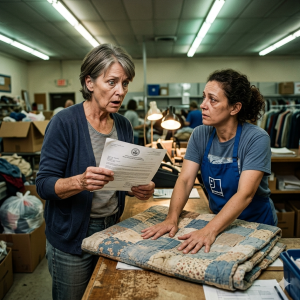
She lifted it from the basket and spread it across the table. And that’s when I noticed it for the first time, really noticed it — the double-ring patches weren’t just a pattern. In the center of each interlocking circle, so small you’d miss it if you weren’t looking, someone had stitched a tiny set of initials.
I leaned closer.
The initials in the rings nearest me read: L.M.B.
My initials.
My hands started to shake before my brain caught up to why.
I don’t know what made me reach into the folded layers to check — instinct, maybe, or whatever you want to call the thing that moves you when God is trying to get your attention. But I slipped my hand between the folds of fabric near the center seam.
My fingers found paper.
Old paper. Folded in quarters, soft at the creases like it had been opened and refolded many times.
I pulled it out and unfolded it right there at the sorting table, under the fluorescent lights, in a Goodwill in Harlan, Kentucky.
It was a certificate. Official-looking. State seal at the top.
My name. My birthday.
And a box checked: Deceased.
I couldn’t speak. Couldn’t move. I just stood there holding a document that said I had died the same month I was born.
And then the woman across the table — the clerk in the blue apron — smoothed the quilt with both hands the way you only do with something you’ve touched a thousand times.
She looked up.
Her eyes were gray-green.
The same gray-green I see every morning in my bathroom mirror.
She said, “Where did you get this.”
It wasn’t a question. Her voice was barely above a whisper.
“My mother made this the day she came home without you.”
I heard the words. I understood each one individually. But my brain would not arrange them into meaning. I just stood there with the certificate trembling in both hands, the fluorescent light buzzing overhead, a country radio station playing low somewhere in the back of the store.
“I’m sorry,” I finally said. “What did you just say?”
She didn’t repeat it right away. She pulled her reading glasses down from her forehead and set them on the table like she was setting something down for good. Her hands were steady. Mine were not.
“Your mama,” she said. “What was her name?”
“June,” I said. “June Annette Branscomb. Born June Annette Combs.”
Something crossed her face. A door opening that had been shut a very long time.
“Combs,” she said, almost to herself. “From up near Bledsoe?”
My mouth went dry. Bledsoe is a blink of a community about twelve miles northeast of Harlan. Most people outside the county have never heard of it.
“Her people were from there, yes,” I said. “How do you know that?”
She didn’t answer right away. She looked down at the quilt spread across the table between us, at all those interlocking rings, all those tiny sets of initials I hadn’t had time to read yet. Then she looked back up at me with those gray-green eyes that were my gray-green eyes, and she said, “Because my people were from there too.”
Her name was Darlene. Darlene Ruth Asher, née Combs.
She was fifty-one years old. She had been born in the county hospital in Harlan on March 4, 1973, and she had been adopted at six weeks by a family named Asher from Loyall, and she had spent the better part of her adult life knowing one true thing about where she came from: her birth mother’s first name had been June, and June had been very young, and June had not been able to keep her.
I was born on March 4, 1973.
I am fifty-one years old.
We stood on opposite sides of that sorting table and looked at each other, and I think we both understood before either of us said the next thing out loud. The body knows. Whatever the mind is still arguing about, the body already knows.
“I think we need to sit down,” I said.
There was a break room in the back, past the rack of men’s sport coats and a shelf of mismatched dishes. She put a sign on the counter that said Back in 15 minutes and she led me through the store and we sat down at a folding table with two coffees she poured from a machine that looked older than both of us.
And she told me what she knew. And I told her what I knew. And between the two of us, we started to piece together what neither of us had ever been told.
Mama — my mama, our mama — had been seventeen in 1973. This I knew. What I did not know, what she had never once told me in fifty-one years, was that she had not been pregnant once that year.
She had been pregnant twice.
Twins. Two girls born on the same morning in March, both of them named before the birth, both of their names already stitched into the quilt that June Combs, age seventeen, had been working on for months by the light of a lamp in her mother’s house up near Bledsoe.
L.M.B. Loretta Mae Branscomb.
D.R.B. Darlene Ruth Branscomb, who became Darlene Ruth Asher.
One baby went home. One baby did not.
I don’t know all the reasons, and I may never know all of them. What Darlene had been told, third-hand and filtered through the gentleness of the Asher family, was that her birth mother had been a young girl in difficult circumstances and had only been able to care for one child. What I can tell you from knowing Mama — from knowing how she carried certain silences like stones in her pockets — is that it was not a decision she ever got over.
The certificate wasn’t my death certificate. Not exactly.
It was a declaration of infant death filed with the state, the kind that was sometimes used in rural Kentucky in the 1970s to legally clear the record when a baby was given up in an informal arrangement before a proper adoption could be filed. The family who arranged it — some adult in the chain, a doctor or a county clerk or somebody’s uncle who knew somebody — had filed it under the name June had already given her, to close the loop. To make it clean on paper.
To make it so that Loretta Mae Branscomb had never existed, so that Darlene Ruth could exist without a trail.
Mama had kept the certificate because it was the only piece of paper she had with that name on it. The only proof that she had held a second daughter, even briefly. She had folded it into the quilt that she had stitched by hand in the months before the birth, the quilt meant for two babies that only one baby ever slept under.
She had kept the quilt in the back of a closet for fifty-one years.
And then she had died, and I had cleaned out her house, and I had almost — Lord help me, I had almost left it in a box by the roadside.
Darlene and I sat in that break room for two hours. We missed the fifteen-minute sign on the counter by a wide margin, and at some point her coworker Sandra came in to check on things and Darlene just said, “Sandra, I need a little more time,” and Sandra looked at the two of us and at our matching gray-green eyes and she said, “Honey, take all the time you need,” and quietly went back out front.
We compared photographs on our phones. Her daughter has Mama’s nose, the same small upturned nose I always thought was just a Combs family trait. Darlene has Mama’s hands — I noticed that last, and when I said it out loud she started crying for the first time, these quiet, controlled tears like she had practice keeping herself together.
I’m not as practiced. I was a mess.
We talked about what came next. Neither of us had a roadmap for this. There is no protocol for finding your twin sister over a quilt at a Goodwill in Harlan, Kentucky, at the age of fifty-one.
But we exchanged numbers. We hugged in the parking lot for a long time without saying anything. She kept the quilt — of course she kept the quilt, it was always hers as much as mine. I kept the certificate, because I was the one who needed to understand what it was and wasn’t.
That was three weeks ago.
Since then we have talked on the phone nine times. I have driven back to Harlan twice. Last Sunday she came to my house in Corbin for dinner and we sat at my kitchen table until midnight. Her husband Gary is a quiet, kind man who kept refreshing our sweet tea and staying out of the way, which was exactly right. My daughter Reese, who is twenty-six, spent the whole evening looking back and forth between us with an expression I can only describe as joyful bewilderment.
We are figuring it out. Slowly. Carefully. The way you do when something enormous and tender has been handed to you and you’re not sure yet how tightly you’re allowed to hold it.
There are things I grieve in this. I grieve that Mama never told me. I grieve that she carried it alone for so long, that she died with this folded up inside her, the way she folded that paper into the quilt. I grieve the fifty-one years that Darlene and I did not have. I grieve the version of my childhood that might have included a sister.
But here is what I keep coming back to.
Mama kept the quilt. She did not throw it away, did not burn it, did not pretend it had never existed. She kept it for five decades, moved it from house to house, preserved every stitch. And when she could not hold on anymore, she left it where I would find it.
Maybe she knew I needed to find it. Maybe she was past knowing anything by then and it was just what it was — a quilt that outlasted its keeper, finding its way to the light by accident.
I don’t know. I am fifty-one years old and I have learned recently that there are things you simply hold without knowing.
What I do know is this: I walked into a Goodwill on a Tuesday morning to drop off my dead mother’s things, and I walked out with a sister.
Those gray-green eyes. They were never just mine.
Darlene called me last Thursday evening, after she got off her shift. She said, “I’ve been thinking about what to call you.” I asked what she meant. She said, “I’ve called you ‘my sister’ on the phone three times this week and every time I do it I wait for it to feel strange, and it just doesn’t.”
I told her it didn’t feel strange to me either.
“Good,” she said. And I could hear her smiling.
We’re having Thanksgiving together this year. All of us — her family, my family, cousin Darla, who is going to absolutely lose her mind when she hears this story in person. We’re going to make it at my house in Corbin, and I have already decided that I am going to put that quilt on the table.
Not folded up. Spread out flat, the way it was always meant to be seen.
All those interlocking rings. All those tiny initialed names, stitched in cream and dusty blue by a seventeen-year-old girl who was doing the only thing she knew how to do, which was make something beautiful to hold the things she couldn’t say.
I see you, Mama.
We both do.