I found my own obituary today.
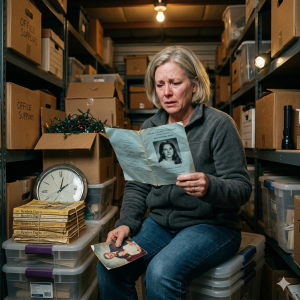
It was tucked inside a shoebox in the back of my mother’s storage unit, between a broken clock and a stack of Reader’s Digests from 1987.
My name. My face. My date of death.
And every single word of it was a lie.
—
My name is Carol Maguire. I’m fifty-four years old. I live in Tucson, Arizona, and I have spent the last thirty-seven years believing my family simply never forgave me for leaving.
I was seventeen when I ran.
It wasn’t dramatic. No screaming fight, no final door slam. I just packed a duffel bag one Tuesday morning while my parents were at work, walked to the Greyhound station on Route 9, and bought a ticket to Phoenix with the $200 I’d saved from babysitting.
I never looked back.
Or rather — I told myself I never looked back.
The truth is I looked back every single day.
—
My mother passed in March. Congestive heart failure, quick at the end, alone in the house she’d lived in for fifty years. A neighbor found her. I found out through a cousin’s Facebook message, three days after the funeral.
I wasn’t invited.
I didn’t expect to be.
But the storage unit — that was in my name. She’d put it in my name years ago, before we’d stopped speaking entirely, and somehow never changed it. So last week I drove the eleven hours from Tucson, rented a room at a Holiday Inn off the highway, and went to clean it out.
It smelled like cedar and old coffee and something I couldn’t name.
It smelled like her.
—
I found the shoebox in the first hour.
And inside it, folded into careful thirds like a church bulletin, was a funeral program.
The cover was pale blue. There were lilies printed in the corners.
And there was my face.
My senior portrait — the one taken at Sears in the fall of 1988 — smiled up at me from the front of a funeral program dated April 14, 1987.
I stood in that storage unit for a long time, just holding it.
Because here is what you need to understand.
My senior portrait was taken in October of 1988.
I supposedly died in April of 1987.
Someone had used a photograph of me that did not yet exist — could not yet exist — to bury me.
—
I sat down on a plastic tub and I read every word.
Carol Anne Maguire, beloved daughter, passed peacefully after a brief illness…
Brief illness.
I was in Phoenix eating gas station burritos and working a cash register at a Walgreens.
She is survived by her loving parents, Robert and Elaine Maguire, and her devoted sister…
I read that line three times.
Then I read it again.
Her devoted sister.
I was an only child.
I had been an only child my entire life. I had grown up in a three-bedroom house with one bathroom and no one to fight with over the remote control. I had spent every Christmas morning alone with two parents who loved me in the only ways they knew how, which were sometimes not enough.
I had no sister.
The program was still in my hands. Still perfectly folded, perfectly preserved, like my mother had taken it out and looked at it more than once over thirty-seven years.
Like she had kept it close for a reason.
The name on the page was printed clearly.
A surviving sister.
A name I had never heard spoken once in my entire life.
A girl who — if the math was right — would have been born less than a year after I left.
I looked at my own face on that program. My seventeen-year-old self, smiling in a Sears portrait studio, wearing the pink sweater my mother had picked out.
Buried before that photo was even taken.
Survived by a sister I never knew I had.
I reached back into the shoebox.
There was one more thing at the bottom.
A photograph, face-down.
I turned it over slowly.
And the woman looking back at me had my mother’s eyes.
And my nose.
And she was standing in front of a house I did not recognize, holding a baby on her hip, smiling at whoever was behind the camera.
On the back, in my mother’s handwriting, were four words.
She doesn’t know either.
—
I sat with those four words for a long time.
The fluorescent light in the storage unit buzzed overhead. Somewhere out in the parking lot, a car alarm went off and then went silent. A pigeon walked back and forth across the threshold like it was waiting for me to make a decision.
She doesn’t know either.
Not: she doesn’t know you’re alive.
Not: she doesn’t know about you.
Either.
Which meant there was something else my mother had decided, alone in that house for fifty years, that two people were not supposed to know. Something she had held so carefully that she put it in a shoebox and locked it in a storage unit and left the unit in a name she hadn’t spoken in decades.
Just in case.
I think she always meant for me to find it.
I think that’s why she never changed the name on the lease.
—
The name on the obituary for the surviving sister was Diane.
That’s all I had. Diane. No last name printed, because why would they print a last name for a child in a funeral program. She would have been — if my arithmetic was right, if my mother had been pregnant when I left in March of 1987 — somewhere around thirty-seven years old now.
I went back through the shoebox with both hands, carefully, the way you go through something when you suddenly understand that every object inside it was placed there deliberately.
There was the obituary program.
There was the photograph.
There was a folded receipt from a pharmacy in town, dated 1991, for something I didn’t recognize — a prescription. My father’s name on it.
There was a birthday card, the front printed with balloons, unsigned, never sent. Inside, in my mother’s handwriting: Thinking of you always, my Carol girl. Thirty-five today.
She had written it for my thirty-fifth birthday. She had bought the card, written in it, and never mailed it.
And at the very bottom of the shoebox, tucked under everything else, was a single index card with a Columbus, Ohio address written on it.
No name.
Just the address and, below it, in different ink, like it had been added later: still here as of Christmas.
The ink on the address looked old. The ink on still here as of Christmas looked less old.
Columbus, Ohio.
—
I drove back to the Holiday Inn and I sat on the bed with the curtains open and the parking lot light coming in orange across the ceiling and I tried to think like my mother.
My mother was not a complicated woman, but she was a private one. She kept things in the way that people keep things when they have been hurt badly enough that they stop trusting the world to hold their breakable items. She made decisions alone. She corrected her mistakes alone. She grieved alone.
When I left at seventeen, I imagine she did not tell people I had simply left. I imagine that was not a story she was capable of telling. Not in that town, not in that church, not to those neighbors.
So she told them I had died.
She made me a funeral. She printed a program. She put lilies on the cover because I liked lilies — I had told her that once, when I was twelve, standing in the grocery store, and she had remembered.
She gave me a brief illness and a peaceful passing and a date in April when the ground was still cold.
And then, less than a year later, she had a baby.
And I think — I am not certain of this, I was not certain of anything that night in the Holiday Inn — I think that baby was not my father’s.
I think that is what my mother could not say.
I think that is the second thing neither of us was supposed to know.
—
I want to be careful here, because I’m aware that I am telling a story about people who cannot speak for themselves anymore, and I am telling it with incomplete information, and some of what I believe may be wrong.
My father died in 1999. A stroke, I found that out from the same cousin who messaged me about my mother. He went quietly too. They were a family that did things quietly.
What I know for certain is this: there was a child. There was a child who was apparently still living in Columbus, Ohio as of some recent Christmas. There was a child my mother loved enough to keep a photograph of, to write her name into a funeral program, to guard the secret of for thirty-seven years.
And my mother’s last act, or one of them, was to make sure I had that address.
—
I left the next morning without finishing the storage unit.
I called a company that does estate cleanouts and told them to donate what they could and dispose of the rest, except for two boxes I had set aside, which I would come back for. The Holiday Inn had a waffle iron in the lobby and I made myself a waffle I couldn’t eat and then I got in my car and I drove to Columbus.
Seven hours.
I listened to the radio until it felt wrong and then I turned it off and drove in silence through the flat middle of Ohio, past the mile markers and the exit signs and the fields that had been fields for a hundred years.
I had the index card on the passenger seat.
I had the photograph.
I had a seventeen-year-old girl’s face on a pale blue funeral program in the back.
—
The address was a neighborhood on the east side of Columbus. Small houses, big trees, the kind of street where somebody’s always got a vegetable garden going in the front yard and there’s a basketball hoop at the end of the driveway with the net starting to fray.
I parked across the street and sat there for twenty minutes.
I had no plan. I had driven seven hours with no plan. I had a photograph of a woman I’d never met and a note in my dead mother’s handwriting and thirty-seven years of being an only child and I had no idea what I was going to say.
Finally I got out of the car.
The front walk had a crack running down the middle with grass growing up through it. There were wind chimes on the porch, the copper kind that have gone green. A bike leaning against the railing, child-sized, pink.
I knocked.
—
She answered the door in a Nationwide Insurance t-shirt and paint-stained jeans and she was wiping her hands on a dish towel and she started to say something about not being interested in whatever I was selling and then she stopped.
She looked at me.
I looked at her.
I had my mother’s eyes. She had my mother’s eyes. I had been told my whole life that I had my father’s nose, and maybe I had, but she had the same nose I had and I don’t know what that means and I have decided not to pursue what it means right now, because some things can only be carried one at a time.
She said, very quietly: “Oh.”
Just that.
Oh.
Like she had been waiting.
Like some part of her had always been waiting.
—
Her name is Diane Kowalski. She is thirty-seven years old. She was adopted at birth by a couple named Gerald and Patricia Kowalski, who are still alive and live in a suburb of Columbus and are, by all accounts, wonderful people who love her very much.
She knew she was adopted. She had always known. Patricia Kowalski had made sure of that, had made it something matter-of-fact and gentle, not a wound but a fact.
What she did not know was anything about her birth mother.
What she did not know was that her birth mother had kept her photograph for thirty-seven years.
What she did not know was that she had a sister.
We stood on her porch for a long time before either of us thought to sit down.
—
I showed her the obituary first.
I don’t know why I thought that was the right place to start, but she read it with the careful attention of someone who understands that a document like this is also a kind of confession. She read it twice. She looked at the photograph on the cover — my seventeen-year-old face in the pink sweater — and then she looked at me, the fifty-four-year-old version, sitting in a porch chair across from her.
She said, “She made you a funeral.”
I said, “She made us both disappear, in different ways.”
Diane was quiet for a moment. Then she said, “She kept my picture, though.”
I said, “She kept everything.”
—
We talked for four hours.
Her daughter, who is seven and whose name is Mae, came home from school in the middle of it and looked at us both with the frank assessment that seven-year-olds apply to all new situations and said, “You look like my mom,” and then went inside to find a snack.
Children have no idea the weight of the things they say.
I have a niece. I have a seven-year-old niece named Mae who has a pink bike with a fraying basket and who thinks I look like her mother.
—
There are things we still don’t know and may never know. Diane reached out to a DNA service last year, before all of this, just out of curiosity, just to see, and she had a match pending that she hadn’t followed up on. When she checked it that evening, sitting next to me on the porch while Mae watched something on television inside, the match at the top of her list was me.
I had uploaded my DNA two years ago, on a whim, because a coworker had done it and found a second cousin in Ireland.
My mother never knew about any of this. She didn’t need to. She had her own system, her own shoebox, her own index card with an address she checked up on every Christmas somehow, through some method neither Diane nor I can figure out and maybe don’t need to.
She made sure I had that address.
That is what she could do, at the end. That is the thing she was able to give.
—
I did not forgive my mother in that storage unit. I want to be honest about that.
I didn’t forgive her on the drive to Columbus, or on Diane’s porch, or in the days since I got back to Tucson.
I’m not sure forgiveness is the right word for what I’m working toward. It’s something more like — understanding. The slow, unwilling work of building a picture of a person from the fragments they left behind, and accepting that the picture will never be complete, and finding a way to carry it anyway.
She was a woman who made terrible decisions out of what I believe was genuine fear. She buried her living daughter rather than admit she had run away. She gave up another daughter rather than explain where she came from. She spent fifty years alone in a house that smelled like cedar and old coffee, keeping a shoebox.
She bought a birthday card for my thirty-fifth birthday and never sent it.
She wrote my name on a storage unit and left the key with a neighbor and kept paying the bill.
She took a photograph of a woman she had given away and wrote on the back of it, in her careful handwriting, the most heartbroken four words I have ever read.
She doesn’t know either.
Neither of us knew.
Now we do.
—
Diane and I have talked every day this week. On the phone, mostly. Sometimes for an hour, sometimes for ten minutes when one of us has to go pick up a kid or start dinner or get back to work. We are learning each other the way adults learn each other, slowly, circling, both of us aware of how much we missed and trying not to make that into a grief that swallows the present.
Mae calls me Aunt Carol.
She decided this on her own. Diane said she just started doing it and asked if that was okay and I said it was more than okay and then I sat in my car in the parking lot of a Walgreens — I noticed the irony, I have always worked in Walgreens, apparently — and I cried for about fifteen minutes.
Not sad crying.
Or not only that.
—
I don’t know why I’m posting this.
That’s not true. I know exactly why I’m posting this.
I’m posting it because I spent thirty-seven years believing that leaving meant I had forfeited the right to be known. That I had walked out of my life and so the life had simply gone on without me, and anything that happened after that door closed was not mine to claim.
I’m posting it because a pale blue funeral program taught me that the people we love keep us whether we ask them to or not. That a mother who never once called, who never wrote, who let me believe she was ashamed of me, had a photograph of a woman who looked like me and wrote my name on a storage unit and paid the bill every month for decades.
I’m posting it because a woman in a Nationwide Insurance t-shirt opened her front door and said oh like she had been waiting, and she was, because we both were, we just didn’t know what we were waiting for.
I’m posting it because I have a sister.
I’m fifty-four years old and I have a sister and her name is Diane and she has our mother’s eyes and there are still so many things I don’t know and I have decided that is all right.
Some boxes you open.
Some things you find were always yours.