PART 1
The morning a line of Yaqui horsemen surrounded his shack, Tomás Rentería thought he was about to die for saving two women he was never supposed to touch.
In the dry mountains of Sonora, where the sun split stones and the wind carried dust as if it wanted to erase the living, Tomás was little more than a shadow of a man clinging to a piece of land that no longer gave anything back.
His ranch sat far from town among twisted mesquite trees, dried cactus, and a forgotten trail that almost no one crossed anymore. The drought had emptied the corrals, and most of the neighbors had sold everything they owned and left for Hermosillo or farther north.
Tomás stayed.
His mother had died of fever when he was seventeen. His father followed not long after, leaving behind a crooked wooden cross behind the shack and a debt at Don Evaristo’s store. His younger brother had ridden away with federal soldiers and never returned.
Since then, Tomás had learned to speak little, work hungry, and sleep with one eye open, as if life were always waiting to take the last thing he had left.
He owned a skinny horse named Lucero, so thin he seemed to stand upright out of pure pride. He had three hens that barely laid eggs anymore. A broken fence. A half-dry well. A shack made of adobe and weathered wood that groaned every time the mountain wind rolled down the hills.
What he did not have was family.
The people in town looked at him with either mockery or pity.
“Rentería is going to die hugging that dry dirt,” Don Evaristo often joked behind his counter.
Others shook their heads.
“Sell the land to the Cárdenas family, boy. At least they have money to make something grow there.”
But Tomás never sold.
Not because he was stubborn, but because his parents were buried beneath that soil. Because on that very doorstep his mother had once told him:
“A poor man can run out of bread, but he must never run out of his word.”
And Tomás had promised to protect that ranch even if the entire world called him a fool.
One evening in July, when the sky burned red like hot coals and coyotes howled somewhere beyond the hills, Tomás went looking for Lucero after the horse slipped out of the corral.
His stomach was empty.
His hands were cracked from repairing a fence that never seemed to stay standing.
His shirt clung to his back with sweat.
Then he heard a scream.
It froze his blood.
Not the ordinary scream of fear.
The scream of someone trapped between life and death.
Tomás stopped.
He looked toward the ravine.
Nobody from town traveled there at dusk, especially since rumors spread that Yaqui families sometimes crossed those lands to avoid soldiers and landowners who hunted them.
Most people spoke about the Yaqui with fear, contempt, or ignorance.
Tomás had heard too many stories from mouths that had never helped anyone.
Another scream cut through the air.
Tomás had no rifle.
He had pawned it two months earlier for flour and beans.
He had little strength left.
For days he had survived on stale tortillas soaked in water.
But something inside him moved before fear could.
He climbed down into the ravine.
Sharp stones scraped his boots.
Mesquite branches tore at his arms.
The sun disappeared behind the hills, and shadows filled the canyon like an open mouth.
Then he saw them.
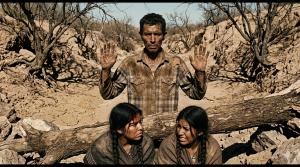
Two young women were trapped beneath the trunk of a dead tree that had been ripped loose during a landslide.
Large rocks pinned their legs.
One had dried blood on her forehead.
The other struggled to breathe through clenched teeth.
Both wore dark braids, worn shawls, and the kind of determination rarely seen in people who had already surrendered.
They were Yaqui.
Tomás felt his heart pound.
He knew how delicate the situation was.
Touching women from another community without permission could be considered a serious offense.
He also knew that if he left them there, they would be dead before sunrise.
The first woman glared at him.
“Don’t come closer.”
Tomás raised his empty hands.
“I’m not here to hurt you.”
Then leave,” the second woman whispered. “If you touch us, our men will come looking for you.”
Tomás swallowed hard.
He looked at the tree.
At their trapped legs.
At the darkening sky.
“If I leave, death will find you first.”
Without waiting for an answer, he knelt beside the trunk.
He dug his fingers beneath the splintered bark and pushed.
Nothing moved.
The tree felt rooted to the earth.
He gritted his teeth and shoved again.
Skin tore from his palms.
Blood ran down his wrists.
His back cracked under the strain.
“It’s too heavy,” the injured woman warned.
“Then let it break me first,” Tomás muttered.
He pushed again.
His legs shook.
Veins bulged in his neck.
For a moment he thought of his mother.
His father.
His missing brother.
Every time life had made it painfully clear that nobody was coming to save him.
And yet there he was.
Trying to save someone else.
With a hoarse cry, he lifted the trunk a few inches.
“Now!”
The first woman dragged herself free.
But the second remained trapped.
Tomás tried to stand and nearly collapsed.
The tree slipped downward.
The woman screamed.
“Leave!” she whispered. “You already saved my sister.”
Tomás stared at her through sweat, dust, and pain.
“Then now it’s your turn.”
He forced his shoulder beneath the trunk again.
Pain shot through him like fire.
His hands were no longer hands.
Only wounds.
He pushed with hunger.
With grief.
With every ounce of rage a man carries when he has nothing left to lose.
The trunk rose.
The second woman crawled free.
The moment she escaped, Tomás collapsed face-first into the dirt.
For several seconds he heard nothing except his own broken breathing.
Then he saw the shadows of the two women standing over him.
The first one knelt beside him.
“Why did you do it?”
Tomás barely managed to open his eyes.
“Because you were screaming.”
Neither woman spoke.
They looked at him as if that answer weighed more than any oath.
Then they disappeared into the ravine before night swallowed the mountains.
Tomás staggered home.
He washed his wounds with the little water he had left and wrapped his hands in strips torn from an old shirt.
He never slept.
Every creak of wood sounded like a horse.
Every gust of wind sounded like a sentence being carried out.
At dawn, the ground began to tremble.
Not from thunder.
From hooves.
Tomás stepped outside.
A line of Yaqui horsemen was riding toward his ranch, slowly surrounding it as if the desert itself had finally come to collect his life.
At their head rode an older man, straight as an ancient mesquite tree, his eyes fixed on Tomás.
And in that moment, Tomás realized that the noblest thing he had ever done might also become his condemnation.
PART 2
The horsemen closed the circle around Tomás’s shack without raising their voices.
That silence frightened him more than any threat could have.
Lucero let out a weak whinny from the corral.
The hens disappeared beneath a loose wooden plank.
Dust swirled around the horses’ hooves as the morning wind swept across the dry earth.
The older man dismounted with the calm certainty of someone who had never needed to chase anyone. No one escaped him because no one ever truly could.
Behind him stood the two women Tomás had rescued.
One wore a clean bandage across her forehead.
The other still walked with a limp.
But both were alive.
Tomás felt relief and fear at the same time.
The chief stopped in front of him.
His eyes traveled slowly over the bloodstained bandages wrapped around Tomás’s hands.
Then the broken shack.
The half-empty well.
The starving horse.
The poverty.
The loneliness.
The entire life of the man standing before him.
Yet he said nothing.
Tomás considered apologizing, though he wasn’t entirely sure for what.
He considered explaining that he had never meant any disrespect.
He thought of Don Evaristo and the Cárdenas family, who would probably celebrate if they found him dead and could buy his land for almost nothing.
Then the chief raised a hand.
Two warriors stepped down from their horses.
Tomás clenched his fists, reopening wounds that had barely begun to close.
The woman with the bandaged forehead stepped forward and spoke in her native language.
Her voice never trembled.
She pointed at Tomás’s shoulder.
Then his hands.
Then mimed lifting an impossible weight.
The younger sister spoke next, louder this time, making sure every rider heard her.
Tomás didn’t understand the words.
But he understood the truth.
They were telling everyone exactly what had happened.
Still, the chief’s expression never changed.
He stepped closer.
His shadow fell across Tomás.
“You touched my daughters,” he finally said in rough Spanish.
The air seemed to leave Tomás’s lungs.
“Yes.”
A murmur passed among the riders.
Tomás lifted his chin.
Inside, everything shook.
“I touched them to pull them out from under the tree. If that was an offense, then the offense is mine. They never asked for help. I chose to interfere.”
The chief studied him for a long moment.
“Did you know who they were?”
“Yes.”
“Did you know it might cost you your life?”
Tomás glanced toward the crosses behind the shack.
“Life has already taken almost everything from me. I wasn’t going to let it take two more people right in front of my eyes.”
One of the warriors lowered his gaze.
The answer had struck something deep inside him.
But the danger was not over.
A wagon appeared on the road.
Dust rolled behind it.
Don Evaristo sat at the front beside Julián Cárdenas and three armed ranch hands.
Their faces wore expressions of concern.
Their eyes looked like vultures.
“Tomás!” Don Evaristo shouted.
“We heard there were Indians on your property. We came to help.”
Julián never looked at Tomás.
He looked only at the ranch.
He always looked at the ranch.
“This land has become a problem,” Julián said. “If these people stay here, the government will get involved. Sign the sale today and save yourself the trouble.”
In an instant, Tomás understood.
They had not come to save him.
They had come to profit from his fear.
Don Evaristo pulled a folded document from his coat.
“Your debt has grown. Interest, you understand. But Don Julián is willing to settle everything if you hand over the property.”
Heat rose into Tomás’s face.
In front of everyone, they were stripping his poverty naked.
Julián smiled.
“Look at the way you live. Even these savages have better horses than you.”
The word shattered the silence.
The riders stiffened.
The chief’s daughters hardened their expressions.
Tomás had endured hunger.
Mockery.
Loneliness.
But he could not tolerate that.
He stepped toward Julián.
“Not on my land.”
Don Evaristo laughed nervously.
“Your land? You can barely afford salt.”
Julián pushed Tomás with two fingers against the chest.
“Sign it, starving man.”
Tomás fell to one knee.
His body simply lacked the strength to resist.
The ranch hands laughed.
Then something unexpected happened.
The younger daughter of the chief walked to Tomás.
She gently took one of his bandaged hands.
She lifted it for everyone to see.
Blood had soaked through the cloth.
Then she looked at her father and spoke a single sentence in her language.
The chief closed his eyes briefly.
When he opened them again, he no longer looked at Tomás as an accused man.
He looked at the townsmen.
And for the first time, he saw the true offense.
Slowly, he reached into a leather pouch hanging from his chest.
He emptied its contents onto the dirt.
Ancient coins.
A silver ring.
And a carved blue stone.
“This man lifted a tree for my daughters,” the chief said.
“You would crush him beneath pieces of paper.”
Julián’s face turned pale.
Tomás still didn’t understand what was happening.
Then the chief gave a single command.
Everything changed.
The Yaqui warriors stepped forward.
Not to attack Tomás.
To stand between him and the men who wished to destroy him.
PART 3
Don Evaristo tried to snatch back the debt papers with trembling hands.
But one of the chief’s daughters grabbed them first.
She couldn’t read Spanish.
Still, she handed the document to Tomás as if she had found a snake beneath a stone.
For the first time, Tomás read it carefully.
And finally saw the trap.
The original debt had been small.
Don Evaristo had added false interest.
Purchases Tomás had never made.
And a clause transferring ownership of the ranch to Julián Cárdenas if payment wasn’t made within three days.
At the bottom sat a signature.
Supposedly Tomás’s.
It wasn’t.
It was a crude imitation created by someone who believed a poor man was also a blind man.
Tomás slowly raised his eyes.
The pain in his hands suddenly felt insignificant.
“You forged my name.”
Don Evaristo stammered.
Julián immediately pretended outrage.
“Don’t be stupid, Rentería. Nobody will believe you.”
But the chief already understood enough.
He approached Julián.
Not with violence.
With authority.
Even the armed ranch hands took a step back.
“My people know how to recognize a man who saves lives,” the chief said.
“We also know how to recognize a man who steals with a smile.”
The humiliation hit Julián harder than a punch.
He wanted to order his men to raise their rifles.
None of them moved.
There were too many witnesses.
Too many riders.
Too much truth hanging in the air.
Then the older daughter spoke.
Her Spanish was slow but clear.
“He asked for nothing.”
She pointed at Tomás.
“He bled for us.”
Her eyes swept across the townsmen.
“If you are his people… why did you leave him alone?”
Nobody answered.
Not Don Evaristo.
Not Julián.
Not the ranch hands.
Tomás felt those words strike deeper than any wound.
Because they were true.
His own people had watched him sink for years.
They only came when there was something left to take.
The chief picked up the carved blue stone.
He placed it into Tomás’s bandaged palm.
“This is not payment,” he said.
“A life cannot be purchased with a stone.”
He closed Tomás’s fingers around it.
“It is a sign.”
A long silence followed.
Then the chief spoke words Tomás would remember for the rest of his life.
“From this day forward, if anyone asks about you, they will be told that Tomás Rentería has brothers in the mountains.”
Tomás couldn’t speak.
He had expected punishment.
Death.
Perhaps a grave beside his dry well.
Never this.
Never acceptance.
Never family.
Julián left with his face burning red.
Don Evaristo followed.
The ranch hands hurried after them.
Before climbing into the wagon, Julián muttered one final threat.
The chief heard it.
“If you return with false papers,” the old man said calmly, “you will also bring your shame.”
That afternoon, the riders stayed.
They inspected the well.
Helped repair the fence.
Left two sacks of corn, dried meat, and a thick blanket.
Not as charity.
As respect.
The two sisters carefully cleaned Tomás’s wounds.
The younger one, still limping slightly, looked at him.
“When you lifted that tree, you saved more than two lives.”
Tomás lowered his eyes.
Emotion tightened his throat.
“I only did what anyone should do.”
She shook her head.
“Many people say that.”
Her gaze softened.
“Very few do it when nobody is watching.”
Weeks later, a traveling judge arrived in town.
The forged debt was declared invalid.
Don Evaristo lost his store.
Julián Cárdenas lost much of his influence.
And nobody ever called Tomás useless again.
The drought did not magically end.
The ranch remained poor.
Lucero remained skinny.
The Sonoran sun still burned like fire.
But something had changed forever.
Some mornings, riders appeared on distant hills carrying seeds, tools, or news.
Sometimes the two sisters stopped by the well and left mesquite bread wrapped in cloth.
They rarely spoke.
They didn’t need to.
Tomás began building a stronger house beside the old shack.
Not because he had suddenly become rich.
But because, for the first time in years, he believed it was worth staying alive long enough to see another season.
One evening, he sat beside a small fire.
The blue stone rested in his hands.
In front of him stood the crosses of his parents.
He placed the stone gently between them.
Then he whispered:
“I’m not alone anymore.”
The wind moved through the mesquite trees like an ancient answer.
And in a land everyone else had called cursed, a man who had lost one family found another in the very place the town’s fear had never dared to look.