My brother-in-law stood at that podium holding a plaque with my son’s name on it.
And I just smiled.
That’s the part everyone in Millhaven still talks about. Not what was in the envelope. Not what happened after. Just that smile — from a woman who hadn’t smiled in eight months.
But I’m getting ahead of myself.
—
My son Danny died twenty-six months ago. Motorcycle accident, Route 9, a Tuesday morning in October. He was twenty-three years old and he was the best thing I ever did.
Six weeks after we buried him, I started the Daniel Ray Kowalski Memorial Scholarship. Bake sales. Raffle tickets. A golf scramble every June at Creekside Pines. I raised $34,000 in fourteen months, one ten-dollar donation at a time.
Every time I felt myself unraveling, I’d open Danny’s Bible — his grandmother’s Bible, really, the one with his name stamped in gold on the cover — and I’d look at the deposit receipt I kept tucked just inside the front cover.
Tulsa Federal Credit Union. Account ending in 7741.
I don’t know why I kept it there. I just did. I’d unfold it, look at the numbers, fold it back. It was the first deposit I ever made into that fund. It felt like proof that Danny still existed in the world in some form.
I checked it constantly. It sounds strange. It kept me sane.
—
My brother-in-law Gary is the kind of man who makes a room warmer just by walking into it.
He was Danny’s favorite uncle. He told the best stories at Danny’s funeral. He put his arm around me at the grave and said, “Connie, whatever you need. Whatever you need.”
So when he offered to help with the scholarship fund — handle the banking logistics, coordinate with the civic board, free me up to focus on the human side — I said yes without a second thought.
That was my mistake.
Fourteen months in, a woman named Shirley Odom pulled me aside after a Rotary luncheon. Shirley keeps the books for half the nonprofits in Millhaven. She had a look on her face I didn’t understand at first.
“Connie,” she said carefully, “has Gary given you the reconciled statements lately?”
He hadn’t.
He kept saying he would. Next week. After the holidays. Once the new filing system was set up.
I started pulling on that thread quietly. Very quietly. I am a sixty-one-year-old retired bookkeeper from Tulsa, Oklahoma, and I know what numbers are supposed to look like.
Over the next eight months, I assembled everything into a manila envelope. Old. Battered. The kind you’d throw away.
Every time I wanted to move faster, every time my hands shook with something I didn’t want to call what it was, I’d open Danny’s Bible and look at that deposit receipt. The original one. Account 7741. The beginning of everything.
It steadied me.
I never told anyone what I was building. Not my sister — Gary’s wife, God help her. Not Shirley. Not the board members who were falling all over themselves to give Gary the new honorary director title, the one that came with signature authority over the fund.
The vote was unanimous. Of course it was. Gary shook every hand in the room.
—
The annual awards banquet is held every April at the Millhaven Elks Lodge.
White tablecloths. The mayor. Local news camera from Channel 7 in the corner.
This year, the guest of honor was Gary.
I wore Danny’s favorite color. Navy blue. I sat at Table Four with Shirley Odom, who didn’t know why I’d asked her to come, only that I’d told her to bring her reading glasses.
I had the manila envelope in my lap.
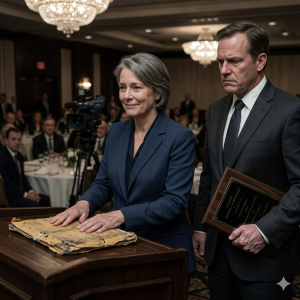
Gary gave a beautiful speech. He talked about Danny. He talked about community. He got a standing ovation. He accepted the plaque — dark walnut, gold lettering — and held it up like he’d won something.
The board chairman asked if anyone had remarks before they closed the evening.
I stood up.
The room was surprised. I could feel it. I walked to the front slowly, the way you walk when you’ve been waiting a very long time and you have absolutely nowhere else to be.
Gary’s smile flickered when he saw the envelope.
Just for a second.
I set it on the podium.
I smoothed it flat with both hands.
I looked directly at my brother-in-law, still gripping that plaque, his knuckles going just the slightest bit pale.
And I smiled for the first time in eight months.
—
I introduced myself. Connie Kowalski. Danny’s mother. Most people in that room already knew me, but I said it anyway, because I wanted it on record. I wanted it on the Channel 7 camera in the corner.
I said I wanted to share some numbers.
There is a particular silence that falls over a room when everyone suddenly senses something is wrong but no one yet knows what. It is not a polite silence. It is a held-breath silence. I had that room completely.
I opened the envelope.
The first thing I pulled out was a photocopy of a bank statement. Account ending in 7741. The Daniel Ray Kowalski Memorial Scholarship Fund at Tulsa Federal Credit Union.
I had requested the original statements directly from the credit union six weeks earlier, once Gary was formally made honorary director and I could establish that his new signature authority represented a material change in account governance. The credit union’s compliance officer — a patient, careful woman named Deb — had walked me through exactly what I needed to request and exactly how to request it.
I had been a member at that credit union for twenty-two years.
They gave me everything.
What I found was not complicated. It never is, really. That’s the thing about people who steal from the grieving — they don’t expect anyone to look, so they don’t bother being clever.
Between March of last year and February of this year, Gary had made eleven withdrawals from the scholarship account. Not large ones. Never large enough to trigger an automatic review. The smallest was $200. The largest was $1,100. Combined, they totaled $8,400.
He had reimbursed himself for expenses. For mileage. For a printer cartridge. For a dinner with a potential donor that I had no record of and that the alleged donor, when I quietly reached out, had no memory of attending.
Eight thousand four hundred dollars.
From a fund built on ten-dollar donations.
From a fund built in my dead son’s name.
I did not say any of this dramatically. I read the numbers the way I would have read them to a client when I was working. Clearly. In order. I passed the relevant pages to Shirley Odom, who had put on her reading glasses and whose face had gone a color I had never seen on a human being before.
The room had stopped breathing entirely.
Gary said my name. “Connie.” Just that. The way you say someone’s name when you are hoping the sound of it will change what is happening.
I looked at him.
I said, “I’m almost finished, Gary.”
I pulled out the last item in the envelope. It was a single sheet of paper, printed in plain twelve-point font. It was an accounting of every dollar raised for the Daniel Ray Kowalski Memorial Scholarship Fund, every dollar spent legitimately on behalf of that fund, and every dollar that could not be accounted for through any documentation Gary had ever provided — which, of course, was nothing, because he had never provided any documentation at all.
I slid that sheet across the podium toward the board chairman, a man named Ted Pruitt who sells insurance and coaches Little League and who was looking at me like I had just pulled back a curtain he very badly wished was still closed.
Then I said the thing I had been rehearsing since November.
I said: “I reported this to the Millhaven Police Department on Monday. I reported it to the Oklahoma Attorney General’s charitable trust division on Tuesday. And I reported it to the IRS on Wednesday, because the scholarship fund holds 501(c)(3) status and that makes what happened here a federal matter.”
I paused.
“I want to be very clear about something,” I said. “I did not come here tonight to embarrass my family. I came here tonight because my son’s name is on this fund, and his name deserved someone who would protect it. That is all I have ever been trying to do.”
I picked up my envelope.
I walked back to Table Four.
I sat down.
The room stayed silent for what felt like a very long time. Then Ted Pruitt asked Gary, very quietly, to please take a seat. Gary stood at the podium for a moment that I think he will think about for the rest of his life. Then he set the plaque down on the table beside the podium — not carrying it, just setting it down — and he walked to his chair and he sat.
The Channel 7 camera had been rolling the whole time. The reporter, a young woman I’d never met, caught my eye from across the room and gave me the smallest nod I have ever seen. I didn’t nod back. It wasn’t about that.
—
That was six weeks ago.
Gary has retained a lawyer. My sister — I will not say her name here because she is a victim in this too, whatever she does or does not choose to believe — has not spoken to me since that night. I understand that. I don’t expect it to be permanent. I can be patient. I have learned how to be patient.
The Millhaven Police referred the case to the district attorney’s office eleven days after I filed. I don’t know what happens next, or how long it takes. Deb at the credit union told me these things move slowly. That’s all right.
What I do know is this.
Last week, the Daniel Ray Kowalski Memorial Scholarship Fund — restored, audited, with a new board treasurer and new oversight procedures that Shirley Odom drafted herself, for free, in two days — awarded its second annual scholarship. Four thousand dollars to a kid named Marcus Webb from Millhaven High who wants to study mechanical engineering at Oklahoma State. He has a picture of himself with his first motorcycle in his application essay. I read that and I had to put the paper down for a minute.
I picked it back up.
I presented the check myself.
Marcus shook my hand and said, “Thank you, Mrs. Kowalski,” and I said, “Danny would have liked you,” and I meant it completely.
—
People keep asking me how I held it together. How I sat across holiday tables from Gary for eight months while I was building that case. How I smiled at him at board meetings. How I didn’t just come apart.
I tell them the truth.
I opened Danny’s Bible.
I looked at that deposit receipt.
Account ending in 7741. Fifty dollars. The very first one. A Tuesday in December, six weeks after the funeral, when I drove to the credit union alone and sat in my car in the parking lot for twenty minutes before I could make myself go in.
The teller who helped me was a young man with a Danny kind of face. Earnest. Unhurried. He counted out the receipt like it was the most important transaction of the day.
Maybe it was.
I’d look at those numbers and I’d think: this exists. This is real. Whatever else is happening, this is real.
That’s what kept me moving.
That’s what Danny always did, really. Kept me moving.
He was twenty-three years old and he was the best thing I ever did.
And his name is still on that fund.
Nobody is going to change that.