I went to cry for my wife at the cemetery, but what I found at her grave destroyed my life forever.
For five years, I had a routine I never talked about.
I would leave work early, buy fresh white lilies from the same flower stand, and drive across town to the cemetery where my wife was buried. I always parked in the far corner, where no one noticed how long I stayed. I always walked the same gravel path. And every time I reached her grave, my chest tightened the same way it had the day I lost her.
Valeria.
Even thinking her name had weight.
The stone was simple because her family said she would have wanted it that way. Her name, two dates, and a small engraved line beneath them: Beloved wife, forever remembered. I used to stare at that sentence for minutes at a time. Forever remembered. As if memory were enough compensation for losing a person who had once filled every room with heat and movement and noise.
Valeria had died in a car accident on a rainy night. At least that was the official story. Her car supposedly went off the road, rolled into a ravine, and caught fire before anyone reached it. Her parents handled most of the arrangements because I was barely functional. The casket stayed closed. I remember protesting once, weakly, saying I needed to see her, needed to say goodbye. Her mother cried so hard she nearly collapsed, and her father put a hand on my shoulder and told me I didn’t want my last image of her to be like that.
I believed them.
What else was I supposed to do? I was twenty-nine, half-crazy with grief, and clinging to whatever scraps of order other people gave me. I signed papers I didn’t read. I nodded through condolences I barely heard. I stood beside a coffin and buried a woman I thought I knew better than anyone in the world.
Then I spent five years trying to survive what was left.
I never remarried. I barely dated. I told myself it was loyalty, but maybe it was fear. Loving once had already wrecked me. Doing it again felt impossible.
My older brother Mateo tried to pull me out of that darkness in the beginning. He was the kind of man who used jokes as bandages, always acting like nothing in life was too heavy to carry. But three days before Valeria’s accident, he disappeared without warning.
At the time, I treated the two tragedies as separate wounds. Mateo had been struggling financially. The police said he may have chosen to leave. Adults vanish all the time, they told us. No note, no body, no crime scene. My mother refused to believe that. She spent the last two years of her life waiting for him to walk through the door.
He never did.
I buried one person and lost another in the same week, and somehow I kept moving. Not well. Not gracefully. But I moved.
Until the day everything tore open.
That afternoon, the cemetery was damp from a recent rain. The air smelled like wet stone and cut grass. I knelt in front of Valeria’s grave and did what I always did: I spoke to someone I believed couldn’t answer.
I told her I was tired. I told her I hated birthdays now. I told her I still reached for her in my sleep sometimes, only to wake up gripping air. My voice cracked, and I bowed my head, letting the grief hit me in ugly, humiliating waves.
Then I heard footsteps.
Soft little steps on gravel.
I turned and saw a girl standing a few feet behind me.
She was tiny, maybe seven years old, wearing a pale cardigan and scuffed shoes. She should have looked lost, but she didn’t. She looked like she had come looking for me. What struck me most were her eyes—dark, watchful, and disturbingly familiar.
She didn’t speak at first. She only walked closer and held out a photograph.
I took it, confused.
And my whole world lurched sideways.
Valeria stared back at me from that photo, alive and radiant in front of an enormous luxury home. She looked slightly older than the woman I had lost, but unmistakably the same. The same mouth. The same eyes. The same way she tilted her chin when she was pleased with herself.
I looked at the girl. “This is a mistake,” I said, my voice rough and unsteady. “She was my wife, and she died years ago.”
The child’s expression didn’t change. “That’s not true, sir. She is alive and lives with me.”
I remember standing up too fast and almost falling. For a second I thought I might be having some kind of breakdown, that grief had finally cooked my brain. But the picture was real. The girl was real. And somewhere beneath the shock, something colder started to form.
What if the lie wasn’t beginning now?
What if it had started five years earlier?
I asked the girl where Valeria was. She glanced toward the gates, then turned and began walking without a word. I followed because nothing else in the world mattered in that moment.
We left the cemetery and crossed into one of the wealthiest neighborhoods in the city. The houses there were less like homes and more like declarations. Tall gates, spotless cars, manicured hedges, cameras tucked under elegant rooflines. The little girl moved through it all easily, like it belonged to her.
Finally, she stopped at a massive stone house behind a black iron gate and slipped inside.
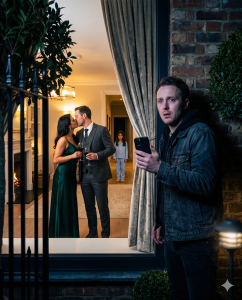
I stood outside for several seconds, my pulse hammering against my ribs. Then I crossed the street, went through the gate, and kept low along the front garden until I reached a large window glowing with warm light.
There was a gap in the curtain.
I looked through it.
Valeria stood in the living room with a wineglass in her hand.
Alive.
The shock wasn’t cinematic. It wasn’t loud. It was worse than that. It was like my insides shut down one by one. Breathing became mechanical. Thought became impossible. She wasn’t a ghost or a look-alike. It was her, flesh and blood, draped in a silk dress, laughing with a man in a navy suit.
Then she kissed him.
I took out my phone and started recording. My hands were shaking so hard the image jittered, but I didn’t care. I needed proof. Proof for the police. Proof for myself. Proof that the last five years had not been some elaborate hallucination.
Inside, the mood shifted. The man said something that made Valeria’s smile disappear. She set down her glass, stepped closer to him, and lowered her voice.
I moved nearer to the glass.
“I told you he would never connect it,” she said. “He was too busy mourning me.”
The man raked a hand through his hair. “You shouldn’t say that so casually.”
She gave a small laugh. “Why? It worked.”
My stomach dropped.
He asked the question that cracked everything open.
“And the brother?”
Valeria sighed with irritation, like she was tired of discussing a stain that wouldn’t come out. “He saw the transfer papers and recognized your name. He was going to tell my husband. He forced our hand.”
My brother.
Mateo.
I had to clamp my mouth shut to stop myself from making a sound.
Memories I had buried rushed back all at once. Mateo showing up at my apartment two days before he vanished, distracted and agitated. Saying he needed to talk to me about Valeria. Saying it was serious. I had brushed him off because Valeria’s accident had happened the next day and life turned into pure chaos. I never got to hear what he wanted to tell me.
Now I knew.
Or part of it, anyway.
Inside, Valeria continued speaking in that same cool voice I barely recognized.
“He was never supposed to become a problem,” she said. “But once the money was moved, there was no going back.”
The man lowered his voice. “You promised me this was finished.”
“It is finished,” she said. “My husband still visits my grave. No one suspects anything.”
Something inside me cracked then—not loudly, but permanently.
Not because she was alive. Not even because she had another man. But because the grief I had built my life around had been useful to her. My suffering had protected her. Every flower I laid at that headstone, every tear, every lonely night—she had counted on all of it.
Then the little girl appeared in the hallway.
She looked from Valeria to the man, then toward the window where I stood. Her gaze met mine for the briefest second. She pressed a finger to her lips and pointed toward the side of the house.
It took me a second to understand.
She wanted me to go around.
I backed away from the window and circled toward a side entrance, my mind racing. A child had led me here. A child who apparently lived in that house with my supposedly dead wife. Who was she? Why was she helping me?
The side door wasn’t fully latched.
I slipped inside into a dim hallway that smelled faintly of polished wood and expensive perfume. The girl was waiting near the staircase. Up close, she looked even more familiar, and that terrified me in a way I didn’t have room to process.
She motioned for me to follow.
We moved down the hall to a study. She pushed the door open just enough for me to enter, then pointed at a locked drawer in a desk.
“What’s in there?” I whispered.
“Papers,” she whispered back. “And a key.”
Before I could ask anything else, footsteps sounded in the hall. The girl vanished like she’d been trained to disappear.
I ducked behind the desk as a housekeeper stepped into the study, dusted a shelf, then left again.
When the room was clear, I tugged at the drawer. Locked. I searched the desktop, the bookshelves, the picture frames. Nothing. Then I saw a decorative box on a side table. Inside was a small brass key.
The drawer opened.
Bank documents. Fake identity papers. A passport with Valeria’s face and a different name. Property deeds. Insurance records. And beneath them all, a sealed envelope with my name on it.
My hands were numb as I opened it.
Inside was a letter from Mateo.
If you’re reading this, I was right to be scared.
That first sentence nearly dropped me to the floor.
The letter was dated six days before Valeria’s supposed death. Mateo wrote that he had accidentally seen financial records linking Valeria to a wealthy businessman named Esteban Rivas—the man in the living room. Large sums had been moved through shell accounts, including one tied to a life insurance policy in my name. Mateo believed Valeria and Esteban were planning to fake her death, collect the payout, and disappear. He said he confronted Valeria privately, and she begged for time to explain. He didn’t trust her. He planned to take everything to the police after showing me the evidence.
But there was one last line, scribbled harder than the rest.
If anything happens to me, don’t believe a word she says.
I heard voices growing louder in the hall.
No time.
I grabbed the letter, the fake passport, and photographed the rest of the documents as fast as I could. Then I saw another item tucked beneath the stack: a silver bracelet.
Mateo’s bracelet.
I knew it instantly. I had given it to him on his fortieth birthday.
The room tilted.
Whatever they had done, it wasn’t theoretical. It wasn’t financial only. My brother had been here. Maybe not recently. Maybe not alive. But here.
The voices stopped outside the study.
The door opened.
Valeria stood there first. Esteban just behind her.
For one suspended second, none of us moved.
She stared at me the way someone might stare at a ghost that had shown up at the wrong address. All the color drained from her face. Then, almost impressively, she recovered.
“Daniel,” she said softly, as if my name still belonged in her mouth. “You shouldn’t be here.”
My grief turned to fury so fast it made me shake.
“I shouldn’t be here?” I said. “I buried you.”
Esteban stepped forward, but Valeria held out a hand to stop him.
“Let me talk to him.”
That almost made me laugh.
“Talk?” I said. “Five years, Valeria. Five years at your grave. My mother died waiting for Mateo, and all this time you—”
“Your brother ruined everything,” she snapped, and the mask finally slipped. “He wouldn’t stay out of it.”
There it was. Not guilt. Not shame. Annoyance.
“What did you do to him?” I asked.
Her eyes flicked, just once, toward Esteban.
That was answer enough.
I raised my phone. “I recorded you.”
For the first time, real panic crossed Esteban’s face. He lunged.
I moved back, slamming into the desk. The phone nearly flew from my hand. Valeria shouted at him to stop, but he was already on me. We struggled, crashing into a bookshelf. A lamp hit the floor and shattered. I was stronger than he expected or maybe just crazier in that moment. I drove my shoulder into him and stumbled free, bolting into the hallway.
“Call security!” he shouted.
Instead, a different voice screamed from downstairs.
The little girl.
Then sirens split the air outside.
I froze for half a second, confused, until the girl’s earlier behavior clicked into place. While I was in the study, she must have called the police—or someone had. Maybe the housekeeper. Maybe a neighbor. Maybe the child had planned this from the moment she found me at the cemetery.
Red and blue lights flashed through the front windows.
Esteban cursed and ran for the back of the house. Valeria stood in the hallway, utterly still, like a woman realizing the life she built on lies had finally hit a wall.
Police poured in within minutes. My video, the documents, the fake identity, Mateo’s letter, the insurance files—once it started, it all came apart with shocking speed.
The little girl’s name was Sofia.
She was Esteban’s daughter from a previous relationship. Her mother had died two years earlier. Sofia had lived in that house long enough to understand that the adults around her were afraid of certain names and certain papers. She had found a picture of Valeria at the cemetery among old documents and overheard enough whispered arguments to know that the “dead woman” wasn’t dead at all. She saw me at the grave that afternoon and recognized me from a photo she had once found hidden in a drawer: a wedding picture of Valeria and me.
So she brought me the truth.
In the weeks that followed, investigators uncovered everything.
Valeria and Esteban had been lovers long before her supposed death. They had siphoned money through a series of fraudulent investments, then used a staged car accident and a substituted body—an unidentified victim from a separate crash—to create the illusion of her death. The insurance payout was only part of it. Her disappearance also allowed them to move funds without scrutiny and start over under different names.
Mateo discovered the scheme by accident.
He confronted Valeria. She warned Esteban. Together they arranged a meeting with Mateo under the pretense of explanation. He never made it home.
His remains were eventually found on a rural property tied to one of Esteban’s companies.
The police told me gently, professionally, as if there were any gentle way to hear something like that. My brother had not abandoned us. He had tried to protect me. He had died because he got too close to the truth.
Valeria was charged with fraud, conspiracy, identity falsification, and accessory to murder. Esteban faced murder charges in addition to a mountain of financial crimes. Watching Valeria in court was its own kind of nightmare. She looked smaller without the mansion, the silk, the careful lighting. But even then, there were moments when I caught glimpses of the woman I had once loved, and that made everything worse.
Because the hardest truth wasn’t that she had changed.
It was that maybe this had always been in her, and I had loved only the parts she chose to show me.
Sofia ended up living with her aunt. I visited once to thank her properly. She sat across from me with a cup of hot chocolate and asked the kind of question only a child could ask so directly.
“Did you still love her when you saw her in the window?”
I thought about it for a long time before answering.
“Yes,” I said. “For a few seconds, I did. Then I realized I didn’t know her at all.”
She nodded like that made sense.
Months later, I went back to the cemetery one last time.
I stood in front of Valeria’s grave—the stone that marked a lie, the place where I had poured five years of my life into mourning someone who was never there. I expected rage. I expected humiliation. What I felt instead was something quieter.
An ending.
I left the lilies anyway, not for her, but for the man I had been. The man who loved honestly. The man who believed what he was told because his heart had no reason to suspect cruelty on that scale. He was foolish, maybe. But he was not wrong for loving deeply. The wrong belonged elsewhere.
As I turned to leave, I thought about Mateo. About my mother. About Sofia. About how many lives can be bent around one person’s lie.
And I still don’t know what unsettles me more in the end—whether Valeria ever loved me at all, or whether she did, and chose to destroy me anyway.