My father disappeared thirty-one years ago, and last Tuesday I found his handwriting inside a booth that hadn’t been opened since the night he vanished.
I need to tell you what happened, because I’m still sitting in my truck in the parking lot of the Lakeview Supper Club, and I can’t make myself drive away.
—
My name is Patty Halverson. I re-key locks for a living. Have for twenty years. It’s quiet work, detail work — the kind that suits a woman who learned early that the world doesn’t stay still, so you might as well be useful while it’s spinning.
The job came in like any other. A property management company out of Duluth needed the old Lakeview re-keyed before a developer walked through. The place had been shuttered since 1994. Before that, it was the kind of Minnesota supper club your parents dressed up for on a Saturday — candlelight, brandy old-fashioneds, walleye that melted off the bone.
My parents used to go there.
I didn’t think about that when I took the job. You don’t, after thirty years. You just survive.
—
The inside smelled like cedar and old grease and something sweet I couldn’t name. Dust on every surface. Vinyl booths cracked at the seams. The bar still had glasses turned upside down on a rubber mat, like someone expected the door to open again the next morning and never did.
I worked my way through methodically. Front door. Side entrance. Kitchen. Storage.
Then I got to the corner booth.
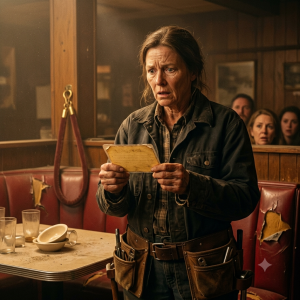
Every supper club has one. The owner’s booth. The one nobody sits in unless they’re invited. This one had a velvet rope across it — the kind with a brass clip — and a small hand-lettered sign that said *Reserved. Do Not Enter.*
Thirty years, that sign had held.
The property manager told me to re-key every interior door and note anything unusual. The booth had a private door on the side wall — a coat room, I figured, or a small office. The lock was on my list.
I unclipped the rope.
—
That’s when I noticed it.
The booth cushion was wrong.
Every other seat in that place was flat with age and neglect. But the corner cushion — the one along the back wall — sat slightly raised. The way a cushion sits when something is underneath it.
I told myself it was nothing. A board warped by moisture. I told myself that.
But my hand was already reaching.
I lifted the cushion.
And there it was.
A small laminated reservation card, the kind they used to slide into brass holders on the table. Yellowed at the edges, soft at the corners, like it had been handled many times before someone finally tucked it away.
The name on the front stopped my breath.
*Halverson. Party of 2.*
My maiden name.
Not my married name. Not the name I’ve used for twenty-three years.
*Halverson.*
—
I stood there in that dim, dusty corner of a dead supper club in northern Minnesota and I told myself there were a hundred explanations. Halverson isn’t an unusual name up here. This could’ve been my parents’ reservation from decades ago, saved by a sentimental owner. A coincidence. A keepsake.
Then I looked at the date printed below the name.
And my knees went.
The date was not from 1994.
The date on that card — laminated, yellowed, soft with age — was three weeks from today.
A date that hasn’t happened yet.
I turned the card over in my hands. Once. Twice. Trying to make sense of the paper, the laminate, the impossibility of it. My eyes kept going to the handwriting, because something about it was pulling at a door inside me I had kept bolted for thirty-one years.
The handwriting.
I knew that handwriting.
The long loop on the H. The way the *s* in Halverson curled back on itself like it was trying to hold onto the letters beside it. The slight leftward lean of every capital letter, the habit of a left-handed man writing in a right-handed world.
My father was left-handed.
My father, who walked out to start his truck on a January night in 1993 and was never seen again. No note. No call. No body. No answer that ever satisfied anyone who loved him.
My father, whose handwriting I would know in the dark, in a dream, in thirty more years if I had them.
I stood in that booth for a long time.
Then I turned the card over.
And there — in the same unmistakable looping cursive, written in ink that should not have existed, on a card that should not have been here, in a booth that should not have been touched —
was a single sentence.
A sentence I had heard him say only once.
The night he disappeared.
*”I left everything where you’d find it when you were ready.”*
The brass clip on the velvet rope was still swinging behind me.
I hadn’t heard anyone come in.
—
I spun around so fast I knocked my drill bag off the seat.
There was nobody there.
The rope was still moving. Just the air disturbed by my own turning, probably. Just physics. Just a draft from somewhere in this old building’s bones, because old buildings breathe whether we want them to or not.
I stood there with the card pressed against my chest and I made myself breathe.
Nobody had come in. The front door was deadbolted from the inside — I had locked it myself when I started work, habit of twenty years, you don’t leave yourself exposed in an empty building. I was alone. I had always been alone in here.
The rope slowed. Stopped.
I looked at the private door on the side wall of the booth.
I had almost forgotten about it in the shock of the card. But it was still there, and it was still on my list, and the lock was an old Schlage from sometime in the eighties, and my job was to re-key it.
I had a job to do.
That’s the thing about detail work. When the world tilts, the work is still there. The work doesn’t care what you found. The lock still has pins. The pins still have depths. You still have a job.
I stepped into the booth with my bag.
—
The door was not a coat room.
I saw that as soon as I got the old lock turned. It was a narrow passage, maybe four feet wide, that angled back toward the kitchen. A service corridor, the kind of thing these old places had — so the owner could slip out for a smoke or take a private call or move between the dining room and the back without walking through the crowd. The walls were knotty pine. A single bare bulb on a pull-chain that I did not expect to work, and which worked.
The passage was about twelve feet long.
At the end of it was a door.
Not on my list.
I stood at the mouth of that corridor for a long moment. I could hear my own breathing. I could hear sleet starting to tick against the high windows of the dining room behind me.
I told myself: this is not your business. Your business is the lock. Your business is the front door, the side entrance, the kitchen, the storage room, and the booth. You put a new lock on that booth door, you fill out your worksheet, and you drive home.
My father’s handwriting said: *I left everything where you’d find it when you were ready.*
I walked down the corridor.
—
The second door was not locked.
It wasn’t even fully closed. The latch had never caught, or had been left open on purpose, and over thirty years the frame had settled just enough to hold it at a permanent two-inch gap. I pushed it and it swung inward without any drama at all, like it had been expecting me.
A small room. Maybe ten by ten. No windows.
A metal folding table. Two chairs. A banker’s box on the table, the lid set neatly on top. A camping lantern — the propane kind — sitting to the left of the box, and beside the lantern, a yellow BIC lighter.
And on the wall, taped up with the same brown packing tape my mother used to seal Christmas boxes, was a piece of lined notebook paper.
One sentence on it, in the handwriting I had known since I was a girl watching him sign birthday cards.
*Don’t read anything in the box until you light the lantern and sit down.*
—
I lit the lantern.
I sat down.
My hands were shaking enough that it took me three tries with the lighter and I burned my thumb on the second. The lantern caught with that familiar hiss and the little room filled with yellow light and I pulled the lid off the box.
The first thing on top was a photograph.
My father and me. I must have been four, maybe five. We’re standing at the end of a dock — our dock, on Birch Lake, the one my grandfather built in 1959 — and my dad is holding a northern pike at arm’s length because I am terrified of it and thrilled by it at the same time, and my face in that photograph is doing something I haven’t seen my face do in a very long time.
I am completely safe. You can see it in how I’m standing. Every four-year-old muscle in my body is telling you that this dock, this man, this particular moment is the safest place in the world.
I had never seen that photograph before.
I turned it over. In his handwriting: *Birch Lake, July 1978. She named the pike Gerald and made me throw him back.*
I had forgotten that. Gerald. I had completely forgotten the name Gerald.
I set the photograph on the table and pressed my hand flat on it for a moment before I could keep going.
—
The box was not a mystery.
That’s what I want to tell you, because I know what you’re thinking. I know the shape of the story you’re expecting, because I would have expected it too. You’re waiting for the part where this gets dark. Where my father turns out to have been something other than what I knew. Where the box contains evidence of something shameful, something that explains the disappearance as a running-away, a chosen exit from a life he’d decided to put down.
That’s not what the box was.
The box was a man explaining that he had gotten very sick and had been too proud and too frightened to tell anyone, and that he had made a terrible decision that he spent every year afterward knowing was terrible, and that he was sorry.
—
His name was Dennis Halverson. He was forty-two years old when he disappeared in January of 1993. He had been diagnosed in November of 1992 with a brain tumor — a glioblastoma, which I now know is one of the fastest and cruelest ways a brain can fail a person. The neurosurgeon in Duluth had given him four to eight months. He had told no one. Not my mother. Not me. Not his brother Curt who lived twenty minutes away and came for dinner most Sundays.
He had told no one because he had decided, in the particular and terrible logic of a stubborn northern Minnesota man who had watched his own father die slowly in a hospital bed while the family stood around and gradually turned into caregivers instead of people — he had decided that dying in front of us was the worst thing he could do to us.
He wrote this in the box. He wrote it in a series of letters, twelve of them, dated over the course of about six weeks in late 1992 and early 1993. The handwriting changes across the letters. The early ones are sharp and controlled. The later ones wander more, the pressure on the pen lighter, the lines not quite tracking the ruled paper.
He knew what was happening to him. He wrote about that too.
—
He had driven north on that January night in 1993.
Not to disappear. Or — not only to disappear. He had driven north to a cabin that belonged to an old friend from his Army days, a man named Royce Pelletier who had died in 1989 and whose family had sold the property in 1995, which meant my father had no way to know that. He had gone there to die somewhere private and quiet, in a place that held a good memory, in a way that he had convinced himself would be easier on everyone than watching him go.
He did not die there.
This is the part that took me the longest to understand from the letters, because it isn’t entirely in the letters. Some of it I had to piece together later. But what happened, as best I can reconstruct it, is that Royce’s cabin was occupied. A couple from Hibbing had rented it for the winter — this was after Royce’s death, when the family started renting it out before they eventually sold it — and when my father arrived in the middle of a January night barely able to drive, barely able to see straight, they didn’t call the police.
They called a doctor.
A rural doctor named Emmett Varga who made house calls at any hour because that was still a thing that happened up there in 1993. Emmett Varga who, as it turned out, had trained at a hospital in Rochester that was doing early-stage clinical trials on exactly the kind of tumor my father had. Emmett Varga who sat with my father for four hours that night and then drove him personally to Rochester in his own car the next morning, my father apparently too exhausted and too relieved at being caught to argue anymore.
The trial did not cure him.
But it gave him eleven years.
—
He wrote about those eleven years.
He had settled eventually in a small town in northern Wisconsin, about ninety miles from where I’m sitting right now in this parking lot. He had worked as a handyman and then as a locksmith — I read that and I had to put the letters down and look at the ceiling of that little room for a while, because the world really does do things like that sometimes, the coincidences that aren’t quite coincidences — and he had lived quietly and he had been watching from a distance.
Not stalking. I want to be careful about how I say this because I don’t want to make it sound like something it wasn’t. He was not surveilling us. He had made a decision and he was living inside it. But he kept a distance that was close enough to know that my mother had eventually remarried a decent man named Ron and that she seemed okay. He knew that I had finished school and gotten married and started a business and that I was okay too.
He wrote that word a lot. Okay. Like it was a kind of prayer.
I think he told himself that okay was enough. I think he believed it for a long time.
—
He died in 2004.
He had prepared the box before he died. This is what took me the longest to understand, because of the reservation card, because of the date on it — a date three weeks from now, a date that hasn’t happened yet. How does a man who died in 2004 leave a reservation card dated in the future?
The answer was in the last letter. And it is the simplest and most human answer in the world.
He had a friend.
Her name was Doris Maki. She had worked at the Lakeview Supper Club from 1981 until it closed in 1994, and she had known my parents as regulars, and after the closure she had kept a key to the building. Not for any sinister reason. She had simply never returned it, the way people keep keys to places they love, and the building had changed hands twice in thirty years through transactions so muddled that nobody had ever asked her for it back.
My father found her in 2003, a year before he died. He told her a version of the story — not everything, but enough. He told her that he had a daughter named Patty who re-keyed locks for a living, and that eventually, when the Lakeview came up for sale and needed its locks changed, he believed she might be the one who got the call. He believed it the way a man believes things at the end of his life when he is working very hard to trust that the universe will cooperate.
He asked Doris to maintain the box. To replace the reservation card’s date periodically so it always showed a date three weeks out. To make sure the lantern had fuel. To keep the photograph on top.
And then once a year, every year, for twenty-one years, Doris Maki had let herself into the Lakeview Supper Club on a Tuesday in October — because my father had told her I was always busiest in spring and summer and I’d be more likely to take a Tuesday in the slow season — and she had pulled the date forward three more weeks and she had gone home.
Twenty-one years.
I don’t have the words for what that kind of faithfulness costs a person. I don’t think I’ll ever have the right words for it.
—
There was one more thing in the box.
Beneath the letters, beneath the photograph, in the very bottom: a key on a plain steel ring. An old house key, the heavy kind they made before everything went thin and cheap.
I recognized the shape of it.
Our house on Birch Lake. My grandfather’s house. My mother’s house, until she and Ron downsized in 2011. The house I had grown up in and sold for her because she couldn’t bear to do it herself. The house that currently belongs to a retired teacher from Duluth who has a boat and a golden retriever and hangs string lights on the dock in the summer.
The key