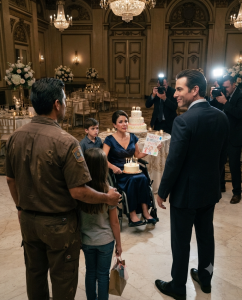
No one showed up to Emma Lawson’s birthday dinner, and by the time the second hand on the ballroom clock slipped past seven, humiliation had become impossible to disguise.
The room itself felt cruel.
It had been booked months in advance at the Grand Meridian, the kind of hotel where politicians held fundraisers and billionaires announced mergers over champagne. Gold chandeliers threw warm light over thirty-eight perfectly arranged tables. White linens fell in smooth, expensive folds. Crystal glasses stood in rows so precise they looked ceremonial. In the center of it all waited a three-tier cake brushed with gold leaf, elegant and excessive, exactly the kind of thing people photographed before anyone touched it.
Every seat was empty.
Emma sat at the head table in a midnight-blue dress, motionless in her wheelchair, her posture still regal even as the silence around her thickened into shame. She kept her hands folded so no one would see them tremble. Her assistant, Clara, hovered nearby with a phone that seemed to deliver a fresh insult every few minutes.
“The senator says a family emergency came up,” Clara said at last, almost apologetically.
Emma’s gaze remained on the cake. “And the others?”
Clara hesitated. “Delayed flight. Unexpected meeting. Charity obligation. Medical issue. A few sent flowers.”
Emma finally looked toward the entrance, where a line of extravagant floral arrangements stood like decorative apologies. White orchids. Imported roses. Cream cards inscribed by people who could not be bothered to show up in person.
“They didn’t cancel because of the weather,” Emma said quietly. “They canceled because it no longer helps them to be seen with me.”
Clara had known Emma for six years. She had seen her win negotiations that made veteran executives sweat through their shirts. She had seen her dismantle predatory deals in five calm sentences. She had seen her rebuild entire divisions of Lawson Technologies after reckless competitors tried to bury them.
But she had never known what to say when the wound was not business.
The accident had happened eighteen months earlier on a rain-slick highway. A freight truck lost control, slammed into Emma’s car, and crushed the driver’s side against the barrier. She survived after multiple surgeries and months in rehabilitation. Her spine did not fully recover. The wheelchair became permanent.
The press had called her brave.
Investors had called her inspiring.
The world had congratulated itself for admiring her survival.
Then, slowly, almost invisibly, it had begun to step back from her.
People still smiled, but too carefully. Men who once feared her started speaking over her. Some clients directed technical questions to Victor Hale, her longtime business partner, even when Emma had built the product they were discussing. Invitations shifted. Social circles cooled. She could almost feel the new category they had put her in—not useless, exactly, but inconvenient. Admirable from a distance. Less glamorous up close.
At 7:23, the hotel manager quietly signaled to remove some of the untouched appetizer plates.
“Leave them,” Emma said.
He approached her with the polite discomfort of someone who wished to disappear. “Ms. Lawson, we can arrange to have everything sent to your home.”
She turned to him, and the pain in her eyes was so naked it pinned him in place.
“I don’t want boxed food,” she said. “I wanted people.”
That sentence silenced the room.
Across town, Daniel Carter was finishing the last delivery of a twelve-hour shift.
His van rattled when he braked. The paint was scraped along one side. The passenger door only opened properly from the outside. He had meant to get it fixed for months, but every spare dollar went somewhere louder—rent, school supplies, a utility bill, Lily’s growing feet. Sweat clung to the back of his faded uniform shirt. His shoulders burned from carrying heavy boxes up office stairs all day.
His daughter Lily sat beside him with a workbook open on her knees and a flashlight propped against the dashboard because the interior light had stopped working two weeks earlier.
“Is this really the last one?” she asked hopefully.
“It is,” Daniel said. “Then we get soup.”
That was enough to make her smile.
Lily had been eight when her mother died of cancer. She was twelve now, old enough to understand money was always tight, old enough to notice when her father skipped meals and called it not being hungry, old enough to treasure ordinary comforts without being told to. She did not complain much. Daniel loved her for that and hated that life had taught her to be that way.
He carried the final package through the service entrance of the Grand Meridian and handed it to a clerk in administrative. While the man signed the form, Daniel noticed hotel staff carrying trays of untouched food away from the ballroom.
“Big event over?” he asked.
One waiter gave a hollow laugh. “Didn’t happen. Some executive’s birthday. Emma Lawson. Apparently everybody important was too busy to show.”
The name was familiar. Daniel had seen Emma on magazine covers in grocery checkout lines, in interviews about innovation, in articles about women who changed industries. He only knew the broad strokes: brilliant CEO, major tech company, terrible accident, miraculous survival.
He glanced through the ballroom doors.
Emma sat alone beneath the chandeliers, staring at the cake with a look he recognized instantly, though he wished he didn’t.
It was the look of someone trying to remain dignified while being left behind.
The sight took him straight back to nights after his wife died, when Lily would fall asleep in the hallway outside their bedroom because she could not stand how empty her own room felt. It reminded him of standing in supermarket aisles comparing prices while pretending not to hear a couple arguing nearby about where to go on vacation. It reminded him that public humiliation and private grief often wore the same face.
He turned on his heel and went back to the van.
“Come with me,” he told Lily.
She looked up. “Why?”
“Because someone shouldn’t be alone on their birthday.”
Lily did not ask another question. She reached into her backpack, pulled out a small paper gift bag she had decorated earlier for a class project, and smoothed the crumpled tissue inside. Daniel found a piece of tape in the glove compartment. Together they improvised.
At the ballroom entrance, the hotel manager stopped them.
“Sir, this is a private function.”
Daniel looked past him at the vast empty room. “A private function with no guests is just loneliness with a catering budget.”
The manager blinked.
Lily tugged lightly at her father’s hand. “Can we please?”
Something in her voice did what policy could not. The manager stepped aside.
The staff noticed them first. Then Clara. Then Emma.
Daniel suddenly became aware of every cheap detail about himself. The scuffed shoes. The wrinkled delivery shirt. The fading company patch on his chest. But it was too late to retreat now, and besides, Emma’s expression when she looked up made retreat feel cowardly.
“We weren’t invited,” he said, stopping a respectful distance away. “But my daughter and I thought no one should have to sit with their birthday cake in silence.”
Lily held out the bag.
“I made you a card,” she said. “Fast. So it’s not perfect.”
Emma accepted it like it was something breakable.
On the front were three stick-figure people around a cake under a giant yellow sun. Inside, in careful uneven letters, Lily had written: Nobody deserves to feel forgotten.
Emma stared at the words for a long second.
Clara looked away because she saw the exact moment Emma lost control of the expression she had been holding together all evening. Not into sobbing, not into spectacle. Just into something more devastating: relief.
“Thank you,” Emma said, her voice catching once.
Daniel glanced at the untouched cake. “Would it be all right if we sang?”
A sound escaped Emma that was half laugh, half disbelief. “Yes,” she said. “Please.”
A waiter set down his tray. Another joined them. Then the pastry chef appeared from the kitchen. Clara stepped to Emma’s side. Two housekeepers drifted in from the hallway. Even the manager came closer, his face lined with embarrassment over how close they had all come to letting this woman endure the evening alone.
They sang.
At first it was hesitant and uneven, the kind of singing people do when they are not sure they belong in the moment. Then it grew fuller. Warmer. Real.
Emma covered her mouth with one hand.
No senator. No society friends. No board members. None of the polished people who claimed they admired strength. Yet this ragged little gathering—the tired delivery driver, his brave daughter, hotel employees who stayed because decency outweighed protocol—felt more sincere than any gala she had ever hosted.
When the song ended, Lily said softly, “Now you can make a wish.”
Emma lowered her hand and looked at the candles.
Then the ballroom doors opened.
Victor Hale entered as if timing his arrival for maximum effect.
He wore a dark tailored suit and the expression of a man who had never once doubted a room would bend toward him. Behind him came two photographers and a public relations consultant with a tablet. Clara’s stomach dropped instantly.
Victor had confirmed his attendance three times.
Victor had also spent months quietly telling board members that Emma needed “support.”
His eyes landed on Emma, then her wheelchair, then Daniel and Lily standing by the cake. Finally he smiled, and Clara knew at once that the smile meant trouble.
“What a moving picture,” Victor said. He glanced toward the photographers. “Heartbreaking, really.”
Emma’s face closed.
Victor kept walking, adjusting his cuff links like he had entered a meeting he intended to win. “I had hoped to postpone this conversation. But perhaps this makes the situation clear enough on its own.”
“Victor,” Clara said sharply, “not tonight.”
He ignored her. “Investors are nervous. The board is nervous. Public perception matters. Leadership matters. And scenes like this—” He made a slight gesture that included the empty ballroom, the staff gathered near the cake, Daniel’s uniform, Lily’s handmade card. “—do not inspire confidence.”
Daniel’s jaw tightened.
Emma’s eyes never left Victor’s face. “You brought photographers to my birthday?”
Victor shrugged. “Documentation matters.”
“Of what?”
“Reality,” he said smoothly. “The company has outgrown emotional leadership. Courage is admirable, Emma, but it is not the same thing as control.”
The word emotional hung in the room like smoke.
Emma had heard versions of it all her life. Too sharp. Too ambitious. Too cold. Too difficult. Then after the accident, somehow, too fragile. Men like Victor always managed to invent a flaw suited to their needs.
Lily moved closer to her father.
Victor turned toward the photographers. “Take a few. The board should see this.”
One photographer hesitated.
“Now,” Victor said.
Before anyone could move, Daniel stepped forward.
“Maybe before that,” he said, “you should explain why the overnight package I dropped off contained your emergency leadership memo.”
Victor’s head turned slowly.
Daniel reached into his jacket and pulled out a sealed envelope bearing Lawson Technologies’ logo. The administrative clerk had called after him only minutes earlier, embarrassed and flustered, saying the package seal had already split and asking if he could return it because it was clearly sensitive. Daniel had grabbed it just before coming into the ballroom, planning only to hand it to someone important. He had not expected to understand what it meant.
But he understood enough.
Clara crossed to him and took the envelope. Her hands shook as she opened it. Board resolutions. Proxy signatures. Transfer of executive authority. Prepared statements for shareholders. A media timeline. The date on the first page was tomorrow morning.
Her face drained of color. “Emma,” she whispered, “this was planned.”
Victor laughed too quickly. “Board contingency planning is standard governance.”
“Not with photographers waiting outside a birthday dinner no one intended to attend,” Clara said.
Emma stared at Victor, and now the humiliation in her expression was being burned clean by something harder.
“You orchestrated this,” she said.
Victor straightened. “I took initiative. Investors need stability. You’ve become a symbol, Emma, and symbols are dangerous when a company needs decisiveness.”
She tilted her head. “That’s interesting.”
He frowned. “What is?”
“The part where you think I didn’t notice.”
The room changed.
Victor’s confidence slipped, barely, but enough.
Emma turned to Clara. “Call legal.”
Victor scoffed. “On what grounds?”
Emma looked at the PR consultant behind him. “You may want to stay and hear this. It concerns fraud.”
The woman with the tablet went still.
Emma folded Lily’s card carefully and placed it beside the cake before speaking again. Her voice was calm now, stripped of pain, stripped even of anger. That was when Victor should have been afraid.
“For six months,” Emma said, “I allowed certain financial irregularities to proceed without confrontation.”
Victor’s expression hardened. “I don’t know what you’re implying.”
“You know exactly what.” She looked toward Clara. “The Zurich transfer.”
Clara’s eyes widened. “You found it?”
“I found all of it. The shell vendors. The consulting fees. The inflated acquisition expenses routed through Hale Strategic Holdings.”
Victor took a step forward. “Be very careful.”
Daniel instinctively moved Lily behind him.
Emma did not blink. “I was careful. That’s why forensic accounting finished the review last week. That’s why an internal investigator attended two of your board dinners. That’s why the federal anti-fraud unit received copies this afternoon.”
Silence detonated through the ballroom.
The PR consultant lowered her tablet.
One photographer quietly switched off his camera.
Victor stared at Emma. For the first time since entering, he looked unsure of his footing. “You’re bluffing.”
Emma smiled, and it was the coldest thing anyone in the room had ever seen. “No. I invited everyone tonight because I knew most of your allies wouldn’t come. I wanted a clean pattern. No plausible deniability. No last-minute excuses about mixed loyalties. Just absence. Visible, deliberate absence. You handed me that.”
Clara was staring now, half shocked, half awed. “You knew they’d skip the dinner?”
“I suspected Victor advised them to,” Emma said. “Tonight was never only a birthday.”
Victor’s face darkened. “You set a trap.”
Emma’s gaze sharpened. “You built it. I just turned on the lights.”
He lunged for the file in Clara’s hand.
The hotel manager, of all people, stepped between them. “Sir, don’t.”
Daniel moved too, planting himself in Victor’s path with the solid stillness of a man who had spent years absorbing hardship without fanfare. He was not polished or powerful, but there was something unmovable in him that made Victor stop.
“You should leave,” Daniel said.
Victor looked from Daniel’s stained uniform to Lily’s frightened face, then back to Emma. He seemed to realize, all at once, that the room had gone from being his stage to his witness.
“This is not over,” he said.
Emma’s answer was immediate. “For you, it is.”
At that exact moment, two women and a man entered through the side doors in business attire—Emma’s lead counsel, the head of compliance, and an investigator Victor recognized from an investor dinner three weeks earlier. Behind them came hotel security.
Victor’s composure cracked.
“Victor Hale,” the investigator said, “we need to ask you not to leave the premises until local authorities arrive.”
He laughed once, sharply. “At a birthday party?”
“At an attempted corporate theft,” Emma replied.
The photographers stepped farther back, suddenly desperate to look uninvolved.
The next ten minutes were chaos in slow motion. Victor denied everything. Then he blamed accountants. Then rogue advisors. Then Emma herself. Each excuse sounded weaker than the last because every person in the room had seen the smug confidence with which he arrived. He had expected to document a fallen woman. Instead he had walked into a carefully monitored collapse of his own making.
When security escorted him out through a side corridor, he looked less angry than stunned. Predators often were when the prey refused the role.
The ballroom fell quiet again, but it was not the same quiet as before. The earlier silence had been humiliation. This one was aftermath.
Clara let out a shaking breath. “You really planned this?”
“Not the part where no one came,” Emma said softly. “That hurt more than I expected.”
Clara’s face broke. “I’m so sorry.”
Emma looked around the room—the empty tables, the abandoned floral arrangements, the half-melted candles, the employees still lingering because they did not know whether to leave or stay. Then she looked at Daniel and Lily.
“No,” Emma said. “Because if they had come, I might never have seen who actually has character.”
Lily stepped forward first. “Does that mean your wish came true?”
Emma laughed, this time for real. “Maybe it did.”
She asked the hotel staff to bring plates.
The manager, relieved to have something useful to do, nearly ran to the kitchen. Soon the untouched feast returned, not as a monument to embarrassment but as dinner for the people who remained. Waiters served food. The pastry chef cut generous slices of cake. Someone dimmed the ballroom lights until the huge room felt warm instead of hollow.
Emma insisted Daniel and Lily sit at her table.
At first Daniel resisted. He was conscious of his uniform, the grease under one fingernail, the absurdity of eating in a luxury ballroom after spending the day unloading boxes. But Emma’s expression left no room for refusal.
During dinner, Lily talked about school, her science teacher, and a stray cat she wanted to rescue. Daniel spoke carefully at first, then more naturally. Emma listened in a way very few powerful people ever did—fully, without glancing over a shoulder for someone more useful.
By the time dessert plates were cleared, Clara had already received three calls from board members who had somehow learned that Victor’s evening had gone wrong.
Emma ignored them all.
A week later, Victor Hale formally resigned under investigation. Two board members followed. A month later, charges related to fraud, falsified reporting, and breach of fiduciary duty were filed. The financial press devoured the scandal. The story that spread fastest, however, was not about the fraud.
It was about the birthday.
A hotel employee had quietly told a friend. The friend had told a reporter. Soon every outlet in the country was repeating some version of the same image: a powerful CEO abandoned by society’s elite, comforted instead by a delivery driver and his daughter.
People responded because they recognized the truth inside it. Success attracts crowds. Vulnerability reveals them.
Emma refused most interview requests, but she did make one public statement. It was brief.
“The people who stayed in the room mattered more than the people who didn’t.”
Lawson Technologies’ stock dipped for two days, then recovered stronger than before once the internal fraud was exposed and corrected. Investors who valued performance over optics stayed. Those who preferred manipulation found themselves unwelcome.
As for Daniel, he did not seek attention. He returned to work the next morning because rent did not care about headlines. But attention found him anyway. Someone at the hotel had remembered the name stitched onto his uniform. Within days, strangers were posting online about his kindness. His employer offered him a management track. Then Emma called.
She did not offer charity.
She offered a logistics contract for his company first, then a better role when she learned how much of the operation he had effectively been running without the pay or title. Daniel was hesitant, proud in the way people become when life has punished them for needing help. Emma understood that.
“This is not a favor,” she told him in her office, months after the birthday. “I hire people who show up when it counts.”
He accepted.
Lily, meanwhile, became unexpectedly famous at school for the card with the giant sun. Emma framed the original and kept it in her office across from her desk. Underneath it, in small silver letters, she later had a plaque installed:
Nobody deserves to feel forgotten.
They never became some fairy-tale version of a family overnight. Life was messier than that. Daniel carried grief that did not vanish because good things finally arrived. Emma carried scars that no victory erased. Lily still had days when she missed her mother so much it made ordinary happiness feel disloyal.
But they made room for one another.
Sunday dinners became a habit before anyone admitted it was a habit. Emma helped Lily with a school debate and lost spectacularly to her on purpose exactly once. Daniel fixed a cabinet in Emma’s kitchen and ended up staying for coffee that lasted three hours. Clara pretended not to notice what was growing between them until Emma began smiling at text messages she did not immediately answer.
The first time Daniel asked Emma out properly, he did it without any grand speech.
“Dinner,” he said, standing beside her office window after a late meeting. “A real one. Not at a crisis, not at a scandal, and not because you’re being ambushed by board members.”
Emma looked at him. “Will there be cake?”
“There can be cake.”
She smiled. “Then yes.”
It would be easy to say that the most important thing that happened that night in the ballroom was Victor Hale exposing himself.
It was not.
The most important thing was smaller and rarer. A man with very little saw someone with everything being publicly abandoned and chose kindness without calculation. A child who had every reason to protect her small, tired world still opened it for a stranger. And a woman who had spent her life being admired for power learned, in one brutal evening, the difference between being surrounded and being supported.
The elites who skipped Emma’s birthday thought proximity to struggle might diminish them. In the end, their absence exposed them more completely than their presence ever could have.
And that was the part people argued about long after the scandal was settled.
Was Victor the true villain, or were the silent guests just as guilty? Was Emma wrong to turn her own birthday into a trap, even if the trap caught exactly what she suspected? Did Daniel step in out of pure compassion, or because grief teaches people to recognize one another across a room?
Maybe the harder question was this:
How many empty chairs does it take before a person realizes who never deserved a seat at their table in the first place?