Nobody in that room expected Della Mae Hutchins to walk through the door.
And nobody expected what she left on the table.
—
Let me back up.
Fourteen years ago, Della Mae drove away from the Hutchins family in a twelve-year-old Chevy with a cracked windshield, forty dollars in her wallet, and a garbage bag of clothes on the backseat.
Patsy Hutchins — her mother-in-law, the woman who had made Della’s six years of marriage feel like one long job interview she kept failing — stood on the porch and did not wave goodbye.
She just watched.
Della saw her in the rearview mirror the whole way down the driveway.
—
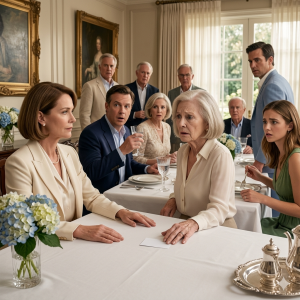
Now it’s a Saturday afternoon in June, and Patsy is turning eighty years old in the private dining room of the nicest restaurant in Clover Hill, Tennessee.
White tablecloths. Fresh hydrangeas. The kind of event where someone hires a calligrapher for the place cards.
Della wasn’t on the guest list.
She came anyway.
She walked in wearing a cream-colored blazer, hair done, chin up — and she drove herself there in a pearl-white F-250 with her dealership logo on the door.
Because Della Mae Hutchins owns the dealership now.
But nobody in that room knew that yet.
—
She found a seat near the end of the table, smiled at the cousins who didn’t recognize her, and set her purse down like she had every right in the world to be there.
Which, she had decided, she did.
The first person to notice her was Patsy’s daughter, Renee.
Renee’s mouth opened. Nothing came out.
Della gave her a small nod. Friendly. Calm.
Then she reached into the inside pocket of her blazer and placed something on the white tablecloth in front of her.
A business card.
Plain white. Simple black type. Nothing fancy about it.
She set it face-down.
—
Renee leaned over and whispered something to her husband.
Her husband glanced at the card.
Della’s hand moved — almost casual, almost without thinking — and covered it.
Still face-down.
—
The lunch went on. Plates came out. Someone gave a toast about Patsy’s garden. Someone else told a story about a fishing trip from 1987 that made the older men laugh too loud.
Della ate her salad. Smiled when it was appropriate. Refilled her own water glass.
And every so often, someone’s eyes would drift to that card sitting in front of her.
Every time, it was face-down.
Once, Patsy’s grandson — maybe nine years old, just curious the way kids are — reached across the table toward it.
Della slid it an inch further from his fingers without making a scene.
Still face-down.
People started watching her. Trying not to look like they were watching her.
—
Then came the real toast.
Patsy’s son, Gary — Della’s ex-husband, the man who had let his mother decide how their marriage would end — stood up with his glass of sweet tea and talked about legacy.
About family.
About what his mother had built and protected.
He talked for four minutes.
Della counted.
She kept her hands folded in her lap. Her expression was pleasant. Still.
When Gary sat back down, the applause settled, and the room exhaled —
That’s when Della reached into her blazer pocket again.
She picked up the business card.
She looked at it for a moment — the printed side, facing her — and she set it back down on the tablecloth.
Still face-down.
But this time, she didn’t cover it.
—
The room had gone quiet in that particular way rooms do when everyone is pretending not to pay attention to one thing.
Patsy noticed.
Of course Patsy noticed.
Patsy had spent eighty years noticing everything that happened in any room she was in. It was her greatest skill and her sharpest weapon.
She looked at the card. She looked at Della. She looked at the card again.
And then Patsy Hutchins, birthday queen, matriarch of forty years, the woman who had once told Della she would “never amount to anything worth mentioning” —
— reached across the table and snatched it up.
She flipped it over.
She read it.
The color left her face so fast that Renee grabbed her arm.
And every single conversation in that dining room stopped at once.
Because printed right there beneath Della Mae’s name was an address.
The address of the building Gary had just signed a thirty-year lease on.
The one he’d shaken hands over just six days ago.
The one he believed he was building his future in.
And written beneath that, in small clean letters that Patsy had to read twice to believe —
Property Owner.
Della Mae Hutchins.
—
The silence lasted maybe four seconds.
It felt like a month.
Gary was the first to find his voice, which surprised nobody, because Gary had always been better at talking than at listening.
“What is that?” he said. “What is she holding?”
Renee answered him, because Patsy seemed to have temporarily lost the ability to speak, which was, by everyone’s account later, the most frightening thing that happened all afternoon.
“It’s Della’s card,” Renee said. Carefully. Like she was reporting an accident.
Gary looked at Della for the first time since she’d sat down.
Della looked back at him the same way she’d been looking at everyone all afternoon. Pleasantly. Steadily. Like she had nowhere else to be and nothing to prove.
“The Kimball Building,” Patsy said. Her voice came back thin and dry, not the voice of a woman who’d commanded rooms for forty years, but the voice of someone who had just understood something very quickly and did not like what she understood. “You own the Kimball Building.”
“I do,” Della said.
“Since when.”
“Since February. Closed on Valentine’s Day, actually.” She picked up her water glass. “I always did have a sense of occasion.”
—
Here is what Della had not done:
She had not gone looking for revenge.
She had not tracked Gary’s business dealings. She had not hired someone to watch his movements or figure out what he needed. She was not, she would tell people afterward, that kind of woman, and she had spent fourteen years making very sure of it.
What she had done was build something.
She had left Clover Hill with forty dollars and driven three hours north to her aunt’s house in Cookeville. She had slept on a pullout couch for four months. She had worked the front desk at an auto body shop because it was the only job she could get on short notice and she needed money more than she needed pride, and it turned out she was good at it.
Better than good.
She understood cars. She understood people. She understood how to make someone feel like they were being taken care of rather than being sold something, and in the car business those two things are not always the same, and the ones who know the difference tend to go far.
Seven years after leaving, she had a sales manager title and a down payment saved.
Eleven years after leaving, she had a dealership of her own — bought out from a retiring owner in a town forty miles from Clover Hill, close enough that she knew the roads, far enough that she didn’t have to explain herself to anyone.
Thirteen years after leaving, the Kimball Building came up for sale.
She had driven past it as a young wife, when she and Gary used to come into town for errands. It was a beautiful old building. Pressed tin ceilings, original hardwood, big south-facing windows. She had mentioned once that she loved it.
Gary had said it was impractical.
She bought it in February. She had a tenant lined up for the upper floors before the ink was dry.
What she did not know — not when she bought it, not when she signed the papers, not on Valentine’s Day when she stood in those big south-facing windows and felt something loosen in her chest — was that six days before Patsy’s birthday lunch, Gary would sign a thirty-year lease on the ground floor commercial space through a property management company, without ever seeing the owner’s name on the documentation.
She found out on a Wednesday from her property manager, who sent her the signed lease as a routine notification.
She had sat with that information for three days.
And then she had put on her cream blazer and driven to Clover Hill.
—
“You let him sign it,” Patsy said. It wasn’t a question.
“I did,” Della said. “The lease is valid. The terms are fair. I’m not here to undo anything.”
“Then why are you here.”
The table was very quiet. Even the nine-year-old seemed to understand that this was not the moment to ask for more bread.
Della set down her water glass.
“Because Gary gave a speech about legacy,” she said. “And I thought someone in this room ought to know what that word actually costs.”
She said it without heat. That was the part people would talk about later — not what she said, but how she said it. Like she was describing the weather. Like she had processed every bit of the anger a long time ago and what was left was just the plain fact of the thing.
“I was twenty-four years old when I married your son,” she said, and she was looking at Patsy now, directly, the way she’d never been able to fourteen years ago. “I worked. I kept the house. I tried to learn what you wanted me to be, and every time I got close, you moved the target. And when it fell apart, Gary let you tell the story, and I drove away with forty dollars because I didn’t have anything left to argue with.”
Patsy had found her composure by now. She was holding the business card between two fingers like it was something she hadn’t decided whether to keep.
“You came to my birthday party,” Patsy said, “to say all that.”
“I came to your birthday party,” Della said, “because I wanted you to know I was alright.”
—
That landed differently than anyone expected.
Renee made a small sound.
Gary looked down at the tablecloth.
Della pushed her chair back slightly and folded her napkin.
“I’m not going to make a scene,” she said. “This is your day, Patsy, and whatever I think about the years I spent in your house, you’re turning eighty and that deserves to be celebrated.” She glanced around the table — the cousins, the grandchildren, Renee’s husband who looked like he wanted to be somewhere, anywhere else. “I want you all to have a lovely afternoon.”
She stood up.
She straightened her blazer.
And then she did the thing that nobody in that room anticipated, because they had all been bracing for the scene that was supposed to come next — the raised voices, the old accusations, the public accounting of old debts.
She picked up the business card from where Patsy was holding it and she placed it gently, face-up this time, in the center of the white tablecloth where everyone could see it.
“Gary,” she said, and he looked up. “The lease is good. I mean that. You’ll be a fine tenant and I’ll be a fair landlord. I don’t have any interest in making your life difficult.”
She picked up her purse.
“Happy birthday, Patsy.”
And she walked out of that dining room the same way she’d walked in. Chin up. Unhurried. Through the restaurant and out the front door and into the June heat, where her pearl-white F-250 was parked in a spot right out front.
She sat in it for a minute before she started the engine.
She wasn’t shaking. She had expected to be shaking.
She wasn’t anything, really. She was just quiet in the way you get quiet when something you’ve been carrying for a very long time has finally been set down.
She started the truck and pulled out onto Main Street.
—
Here is the last part.
Three weeks later, she got a letter at the dealership. Handwritten on plain white stationery. No return address, but she recognized the penmanship because she had spent six years watching it on grocery lists and Christmas cards.
It was four sentences long.
I have thought about what you said. I don’t expect you to believe that. I am not writing to ask for anything. I only wanted you to know that I heard you.
It was signed, simply: Patsy.
Della read it twice.
Then she put it in the top drawer of her desk, underneath the copy of her purchase agreement for the Kimball Building, and she went back to work.
She told me later — and I want to get this right, because this is the part that matters — she told me she didn’t feel triumphant when she read it. She didn’t feel vindicated. She didn’t feel the door open back up on any of it.
She said she felt something she hadn’t expected to feel.
She felt sorry for her.
“Patsy spent eighty years winning every room she walked into,” Della said. “And I drove away with forty dollars and ended up fine. What does that tell you about what winning costs?”
She shrugged.
“I hope she had a good birthday. I meant that part.”
I believe her.
That’s the whole story.