She almost didn’t go to Brookshire’s that morning.
Helen Tureaud, 68 years old, retired seamstress, and as of 7:42 a.m. today, officially behind on rent — stood in her kitchen in Shreveport and told herself she’d just skip it. Make do with what she had.
But her late husband Roy always said, *You can’t sew without thread, Helen. Go get what you need.*
So she went.
She rolled his thimble between her fingers the whole drive over. A small brass thing, dented on one side, warm from her palm. Roy had slipped it onto her finger the day he proposed — right there in the sewing room of his mother’s house, no ring box, no bended knee, just Roy being Roy. *This is all I had handy,* he’d said, laughing. *But I mean every word of it.*
Twenty-three years since she lost him. She still carried the thimble everywhere.
—
The Brookshire’s on Youree Drive was quiet that Tuesday morning. Helen took her time. Bread. Soup. The store-brand coffee she’d switched to when the bills started stacking up.
She didn’t notice the young woman in line ahead of her until she heard it.
The soft, strangled sound a person makes when they’re trying very hard not to cry in public.
The young mother — mid-twenties maybe, dark circles carved deep under her eyes, a toddler balanced on her hip like a small, squirming anchor — was watching the cashier void items off her total one by one. A bag of apples. Then the macaroni. Then the baby wash.
She was putting things back.
Helen’s chest tightened.
She stepped forward before she’d made the decision. Touched the woman’s elbow. *”Let me get this, honey.”*
The young woman turned. Eyes red-rimmed, jaw tight with the particular pride of someone who has had to accept help before and hated every second of it.
*”I can’t let you do that.”*
*”You’re not letting me,”* Helen said simply. *”I’m doing it.”*
Helen rolled the thimble between her fingers while the cashier finished ringing — an old nervous habit, that small rolling motion, brass against skin. She didn’t even realize she was doing it.
The total was $47.12. Helen paid it without blinking.
And that’s when she saw it.
The young woman shifted the baby to her other hip, and the movement opened her coat just enough. Tucked into the inside pocket was a folded piece of paper. Standard white. Creased in thirds.
Helen recognized it the way you recognize your own handwriting.
She had folded a piece of paper exactly like that this very morning. Tucked her own copy into her purse. An eviction notice — thirty days, same county courthouse letterhead, same brutal font.
*Lord.*
They were standing in the same storm. One of them just didn’t know it yet.
Helen didn’t say a word about that. She helped the young woman load her bags. The toddler reached out and grabbed Helen’s hand with both of his, the way small children do, utterly without permission, and Helen laughed before she could stop herself.
*”He likes you,”* the young woman said. Something in her voice had shifted. Softer now.
*”What’s his name?”*
*”Marcus.”*
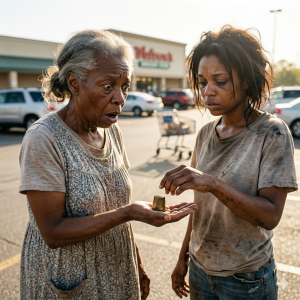
They walked out together into the flat Louisiana morning, the air already thick and warm even in March. Helen was searching her purse for her keys when the thimble slipped from her fingers.
It hit the pavement with a small, bright sound.
The young woman bent down and picked it up before Helen could.
She held it in her palm and stared at it.
Helen watched the color drain from her face.
*”Where did you get this?”* she whispered.
*”My husband gave it to me. Long time ago now.”*
The young woman’s hand had gone still. She was holding that little brass thimble the way you hold something you thought you’d never see again.
*”What was his name?”* she asked. And her voice — there was something in it Helen couldn’t name. Not quite a question. More like a prayer being confirmed.
Helen almost answered. She opened her mouth.
But the young woman didn’t wait.
She turned slowly. Looked down at the thimble in Helen’s open palm. And she whispered a name.
Roy’s name.
A name Helen had not spoken aloud to a single living soul in this parking lot, in this city, not that morning, not ever.
A name this stranger had absolutely no way of knowing.
Helen stood completely still in the Brookshire’s parking lot on Youree Drive in Shreveport, Louisiana, with the March sun on her face and her heart stopped dead in her chest.
And she couldn’t speak a single word.
—
The young woman was watching her. Not frightened by the silence. Patient with it, the way people are patient when they already know the answer and are simply waiting for you to find it too.
*”How do you know that name?”* Helen finally said. It came out smaller than she intended.
The young woman looked down at Marcus, who had gone calm against her shoulder the way babies sometimes do — like they sense the adults around them have arrived at something serious. She pressed her lips to the top of his head for a moment before she spoke.
*”My grandmother,”* she said. *”Her name was Coretta Blanchard. Before she married. She grew up on Bert Kouns, right off the industrial loop.”*
Helen knew that street. She knew it the way you know a street you drove down a thousand years ago in someone else’s car.
*”Roy used to talk about her,”* the young woman continued. *”I mean — he talked about a lot of things. But he talked about her.”*
Helen’s throat had gone very tight. *”I’m sorry, baby. I don’t understand what you’re telling me.”*
The young woman shifted Marcus again. Took a breath.
*”My grandmother and your husband were close. When they were young. Before either of them married anybody. She said he was the kindest man she ever knew in her life, and she meant it as a compliment and a sadness both at the same time.”* She paused. *”She passed four years ago. But before she did, she told me about the thimble.”*
Helen felt the word land somewhere below her sternum.
*”She said he’d shown it to her once. Said he was going to propose to a woman he loved and he didn’t have a ring. He had this — she called it a little brass cap, like from a sewing kit. She said he held it up and said, ‘You think she’ll have me, Coretta?’ And my grandmother said, ‘Roy Tureaud, any woman alive would have you.’ And he laughed.”*
Helen put her hand over her mouth.
*”She described it exactly,”* the young woman said softly. *”Dented on one side. The dent on the left, she said. From where he’d tapped it on something as a nervous habit.”*
Helen turned the thimble over in her palm. The dent on the left. She had never thought about which side the dent was on. She had never needed to.
*”She always wondered if he’d done it,”* the young woman said. *”Proposed with it. She hoped he had.”*
*”He did,”* Helen said. And then she was crying, right there in the parking lot, in a way she had not cried in a very long time — not the quiet, managed kind, but the kind that comes up from somewhere you forgot you were keeping things.
The young woman reached out and held her arm. Not awkwardly. Like she’d done it before. Like she knew what to do when a person needed steadying.
Her name, it turned out, was Deja. Deja Blanchard. Twenty-six years old. Coretta’s granddaughter. Recently separated from Marcus’s father, recently let go from her job at a medical billing office downtown, recently handed a piece of paper with a courthouse letterhead and a thirty-day window.
She had come to Brookshire’s that morning because it was the only thing she could think of to do that felt like forward motion.
They sat on the low concrete lip of a planter near the store entrance, Marcus installed between them like a small ambassador, eating crackers Deja fished from the diaper bag. The sun climbed. A man pushed his cart past them and nodded. A car alarm went off somewhere across the lot and silenced itself.
Helen told her about Roy. Not the edited version she kept for acquaintances — the real one. How he’d been a high school shop teacher for thirty-one years and never once complained about it because he genuinely loved it, every single year. How he used to sing off-key to the radio while he made coffee. How he died on a Tuesday, same as today, of a heart attack so sudden that the paramedics told her afterward it would have been fast, and she had held onto that the way you hold onto whatever you’re given.
Deja told her about Coretta. How she’d been a woman who took up a lot of room in the best possible way — loud laugh, firm opinions, the kind of person who remembered your coffee order and your birthday and the name of your childhood dog. How losing her had left a hole in the family’s center that they were all still learning to walk around.
*”She used to say,”* Deja said, *”that the Lord doesn’t waste a single thing. Not a single thing. Every hard day, every door that closes — she’d say He was just arranging something you couldn’t see yet.”*
Helen looked at the thimble.
She thought about Roy’s voice, the morning she found the eviction notice on her kitchen table. Or not his voice exactly — more like the idea of it, the shape of how he would have said something useful without making her feel small.
*”I’ve got thirty days,”* Helen said. She hadn’t planned to say it. It came out plain and factual, the way hard things do when you’re too tired to dress them up.
Deja looked at her. *”Me too.”*
They sat with that for a moment.
Then Deja said, *”My cousin has a duplex off Benton Road. Has for years. The back unit’s been empty since October. She’s been meaning to rent it but—”* She stopped. Started again. *”She’s good people. She’s reasonable.”*
Helen shook her head slowly. *”Baby, I can’t ask you to—”*
*”You already bought my groceries,”* Deja said. *”And you didn’t even know me.”*
There was a logic to it that Helen couldn’t argue with.
She didn’t try.
—
The cousin’s name was Tamara. She met them that same afternoon at the duplex on Benton Road, still in her scrubs from a morning shift at Willis-Knighton, hair pulled back, reading glasses perched on her head like a crown she’d forgotten about. She walked Helen through the back unit — two bedrooms, clean floors, windows that faced a yard with an old pecan tree in it — and she named a number that was three hundred dollars less a month than what Helen had been paying.
*”Why so low?”* Helen asked, because she had lived long enough to ask that question.
Tamara looked at her evenly. *”Because Deja called me and told me who you were. And because I got a grandmother too.”*
Helen moved in the following Saturday. Deja and Tamara’s cousin Darnell carried boxes. Marcus supervised from his playpen in the corner of the living room, banging a wooden spoon against a plastic bowl with great authority.
Helen set up her sewing machine in the second bedroom. She hadn’t touched it in months, had let the bills and the grief and the gray weight of things crowd it into a corner. But there was something about that room, about that particular afternoon light coming through the window and laying itself across the table — something that made her sit down and thread a needle.
She worked until the sun went all the way down.
—
That was eight months ago.
Helen still lives in the Benton Road duplex. The rent is current. The pecan tree out back drops more pecans than one woman can reasonably use, so she bags them up and brings them to Tamara’s family and to the church pantry on Jewella Avenue.
She started sewing again — not just for herself. Word got out the way it does. A bridesmaid dress here. A christening gown there. A woman from the church who needed her late mother’s coat taken in so she could wear it for the first time. Helen charged what seemed fair and sometimes less than that.
Deja found work at an insurance office on Line Avenue. Days, so Marcus could go to the church daycare two blocks over. She checks on Helen twice a week. Sometimes they eat dinner together — Helen cooks, Deja does the dishes, Marcus pulls every pot out of the lower cabinet and stacks them into configurations that make no structural sense and delight him completely.
Helen keeps the thimble on the windowsill above her sewing machine now. She still carries it with her when she goes out, still rolls it between her fingers when she’s thinking. But she doesn’t grip it the way she used to, like it might disappear.
She knows now it has a habit of showing up where it needs to be.
Roy would have had something to say about all of it. He would have leaned against the kitchen doorframe with his coffee and that look he had — the look that meant *I told you something, and now you see what I meant* — and he would not have said a single word. He would have just smiled.
Helen knows that look by heart.
She still carries it everywhere too.