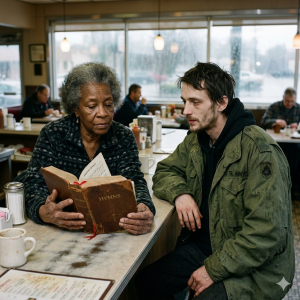
She almost didn’t go to Marvell’s Diner that Tuesday morning.
Her hearing aids were giving her trouble again, and the rain was coming down sideways off the Mississippi River, and seventy-one years of living had taught Claudette Simmons that some mornings the Lord just wants you to stay home in your housecoat and drink your coffee in peace.
But something nudged her out the door anyway.
She noticed the boy the moment she settled onto her stool at the counter.
Young. Maybe twenty-two, maybe younger. Thin in that particular way that isn’t natural — the way that means something has gone badly wrong somewhere. His jacket was too big for his shoulders, army surplus green, and his hair was damp from the rain. In front of him sat three little red ketchup packets torn open on a paper napkin, and he was eating them.
Not with anything.
Just the ketchup.
Claudette didn’t say a word to him. She caught the eye of their waitress, Donna, and she made a small gesture toward the boy and said quietly, “Whatever he wants. Put it on my card.” Donna nodded like she’d seen this before, like she’d been waiting for someone to do exactly this.
That’s when Claudette really looked at the boy.
His jacket had fallen open just slightly as he turned to read the laminated menu Donna set in front of him — and there, tucked inside against his chest like something precious, like something guarded, was a book.
A hymnal.
Battered brown leather, dark at the corners from years of hands. A red ribbon bookmark threaded through the pages. And on the cover, stamped in gold letters that had worn almost all the way down to nothing —
A name.
Claudette’s breath caught somewhere between her throat and her chest.
She knew that hymnal.
She had held that hymnal.
For thirty-four years she had stood at the front of Greater Mount Zion Baptist Church and directed her choir, and she had seen that book sitting in the front pew every single Sunday morning, because it belonged to her husband, Bernard, who could not carry a tune to save his soul but who followed along with his finger on every word like the music was something he could learn by touch.
Bernard had passed fourteen months ago.
And the night they buried him, after the repast, after everyone had gone home and she’d finally let herself cry alone in the church — that hymnal had disappeared from the pew.
She had assumed, in her grief, that she’d simply misplaced it.
She had looked for it gently, then desperately, then not at all, because looking for it hurt too much.
Now here it was.
Tucked against the chest of a gaunt young man eating ketchup packets in a diner in Natchez, Mississippi on a rainy Tuesday morning.
Donna brought the boy a full plate — eggs, grits, bacon, toast, the kind of breakfast that means someone cares whether you live. He looked up, startled, and Donna tilted her head toward Claudette. The boy turned.
She smiled at him. The warm, patient smile she had given choir members for thirty-four years when they were frightened and didn’t think they belonged.
He looked like he might run.
He didn’t.
He said something — she could see his mouth moving — and her hearing aids chose that exact moment to cut in and out in a burst of static, so she only caught the end of it.
“— didn’t know where else to bring it.”
She leaned forward on her stool. “I’m sorry, baby. Say that again for me.”
He swallowed. His hands moved to the jacket, to the place where the hymnal rested against his heart, and he pulled it out slowly and set it on the counter between them like an offering.
Or a confession.
“I’ve been trying to find you,” he said. “For almost a year.”
Claudette looked at the book.
Brown leather. Red ribbon. Gold letters so faded you had to catch them at just the right angle in just the right light.
She had always assumed the name stamped on the cover was Bernard’s.
She had never once, in all their years together, looked at it closely enough to be certain.
Her hand was trembling as she reached across the counter and turned the cover toward the gray morning light coming through the rain-streaked window.
And the name she saw there made her sit down hard on the stool.
And press both hands to her mouth.
And look up at this thin young stranger with eyes that had gone suddenly full.
Because the name on that hymnal was not Bernard’s name.
It was her son’s name.
Elijah Simmons.
Her boy who had walked out of her life eleven years ago over something she could no longer even reconstruct fully — pride on both sides, words that landed wrong and were never taken back, silence that hardened into habit and then into something closer to stone. Her boy who had moved north and then further north and then, eventually, nowhere she could find. Whose number changed twice and then stopped being a number she had. Who she had prayed for every single night from the front pew of Greater Mount Zion, sitting beside Bernard, who had loved Elijah like you love a wound that healed crooked — tenderly, carefully, aware always of where it pulled.
That hymnal had never been Bernard’s.
Bernard had been keeping it safe.
She understood that, whole and complete, in the space of a single breath.
“How do you know my son?” she said, and her voice came out steadier than she had any right to expect.
The boy across the counter looked down at his plate. He hadn’t touched the food. He seemed like a person who had rehearsed a great many versions of this moment and found, now that it had arrived, that none of them fit.
“My name is Caleb,” he said. “My mom was Renee. Renee Duchamp, before she got married.” He paused. “She passed in March. Ovarian cancer. It went fast.”
Claudette didn’t know a Renee Duchamp. She told him so, gently.
“No,” Caleb said. “But Elijah did.”
He picked up his fork, set it back down. Outside, the rain was starting to ease. You could hear the change in it, the way it went from a roar against the window to something softer, something that was almost finished.
“He lived with us for a while. Two, maybe three years. Me and my mom and my stepdad, up in Memphis. I was maybe thirteen, fourteen. He did odd jobs, fixed things. He was good at fixing things.” He looked up at Claudette for just a moment. “He talked about you. Not all the time. But when he did, he said your name like it was something he was still deciding what to do with.”
Claudette pressed her lips together. Donna had materialized somewhere behind her and placed a hand briefly on her shoulder, warm and quiet, and then gone.
“What happened to him?” Claudette asked. The question she had been carrying for eleven years, in one form or another.
Caleb shook his head slowly. “He left before my mom got sick. I don’t know where he went. I was sixteen, and he just — wasn’t there one day. But he left this.” He touched the edge of the hymnal. “He left it for my mom, I think, or maybe just left it. She kept it in her nightstand all the way to the end.” He cleared his throat. “When she was real sick, she made me promise I’d find out who Elijah was looking for. She said the name on the cover wasn’t his name. She said there was a note inside.”
Claudette looked at the hymnal.
All those years she had thought she knew that book. She had watched Bernard carry it in from the car, carry it back out. She had dusted the pew around it. She had never once opened it, because it was Bernard’s — and a person’s Bible, a person’s hymnal, has a kind of privacy to it like a letter addressed to someone else.
She opened it now.
The pages were thin as onion skin, the way old hymnals are, and they smelled of something she could not name except to say it smelled like church, like decades of Sunday mornings, like her whole past life compressed into something you could hold in two hands.
The red ribbon was marking a page near the center.
“Blessed Assurance.”
She and Elijah used to sing it together when he was small. She at the piano, him standing beside her in his Sunday clothes, too young to read all the words but bellowing along with the parts he’d memorized, completely confident and completely off-key, and Bernard would stand in the doorway and watch them with the particular face of a man who knows he is looking at the best thing in his life.
The note was tucked between the ribbon and the spine. A folded piece of notepaper, her name written on the outside in handwriting she knew the way you know a voice.
Elijah’s handwriting.
Her hands were not steady. She unfolded it anyway.
It was not a long letter. Three paragraphs, written close together like he’d been rationing space, or rationing himself.
The first said he was sorry. Not in the broad sweep way, not in the way people say sorry when they mean they’re sorry they got caught or sorry things turned out the way they did. It was specific. It named the night. It named the exact words. It said: I have thought about that night more times than I can count and every time I think about it I know that I was wrong and I was too proud to say so and I am saying so now.
The second paragraph said he was not in a good place and hadn’t been for a while, and that he was going to get somewhere better before he came home, because he did not want her to see him the way he was. He said: I know you would love me anyway. I know that. I’m asking you to let me get back to someone you don’t have to worry about loving. I’ll come home when I’m that person again.
The third paragraph said: Tell Daddy his book is the reason I still know all the words. And tell him I follow along with my finger, same as him.
Claudette sat at the counter of Marvell’s Diner on a Tuesday morning in November with the rain going quiet outside and her husband fourteen months in the ground and eleven years of silence in her chest, and she read that note three times without looking up.
Then she folded it. Carefully. The way you fold something you intend to keep.
Caleb was watching her. He had the look of someone who has been carrying something heavy for a long time and is not quite sure yet if he’s been relieved of it or not.
“He doesn’t know,” Claudette said. It wasn’t a question.
“No ma’am. I don’t think he knew your husband passed. I don’t have any way to reach him.”
“But you found me.”
He almost smiled. It rearranged his whole face, made him look his age for a second. “You directed the choir at Greater Mount Zion for thirty-four years. I started calling Baptist churches in Natchez and the third one gave me your name and told me you came to Marvell’s on Tuesday mornings.” He paused. “I’ve been coming here every Tuesday for six weeks. Donna knew who I was looking for. She’s the one who spotted you.”
Claudette turned to look at Donna, who was standing at the far end of the counter doing absolutely nothing that required being at the far end of the counter.
Donna shrugged with the elaborate innocence of someone who has earned the right to feel good about herself.
“Baby,” Claudette said, turning back to Caleb, “eat your breakfast.”
He ate. She had her coffee. She asked him questions and he answered them and she listened the way she had always listened, all the way through, without rushing toward the next thing. She learned that he was twenty-three, that he’d driven down from Memphis in a car that was held together with optimism and a prayer, that his mother’s death had left him unmoored in ways he was still sorting through. She learned that he didn’t have a job yet but that he had a cousin in Natchez he was staying with while he figured things out.
She told him about Bernard. About the choir. About what the church had been to her and what these fourteen months had been like without Bernard sitting in the front pew, keeping his finger on every word.
At some point the rain stopped completely and the light coming through the windows went from gray to silver to something that was almost gold.
Before they left she took out her phone — a thing she was not fully confident with, but competent enough — and she opened it to a photograph. Her and Bernard at their forty-fifth anniversary, taken in the church vestibule, both of them in their good clothes, Bernard with his arm around her waist and grinning the way he grinned in every photograph they’d ever taken, like the camera was an old friend.
She showed it to Caleb.
He looked at it for a long time. “That’s him,” he said. “That’s the picture Elijah had.”
She put the phone away.
“I’m going to find my son,” she said. It came out matter-of-fact, the way she said most things. Not a wish or a hope. A thing that was going to happen. “I don’t know how long it’ll take. But I’m going to find him. And when I do, I’m going to tell him his daddy spent thirty-four years sitting in that front pew following along with his finger because he loved the sound of music even though he couldn’t make it himself, and that he kept that book safe all those years without ever once letting on that he knew whose name was on it, and that some things get to be forgiven even if we don’t get to say so out loud while there’s still time.”
She slid off the stool. She tucked the hymnal into her own bag, against her own chest, the same place Caleb had carried it.
“You come to church Sunday,” she told him. It was not a question either. “We have a nine-thirty and an eleven. Either one.”
He said he would.
She believed him.
She left Marvell’s Diner and walked to her car under a sky that had gone, while she wasn’t watching, from storm to something clear and clean and new. The Mississippi was still brown and swollen off to the west and the air smelled of rain and mud and distance.
She sat in the car for a moment before starting it.
She opened her bag and she took out the hymnal and she turned to the page with the red ribbon. “Blessed Assurance.” And she read the first line to herself, silently, the way Bernard used to do. Moving her finger along the words.
Then she started the car.
She had some phone calls to make.