“I’m sorry. I’m sorry I’m not what you expected.”
Faye said it before she even said hello.
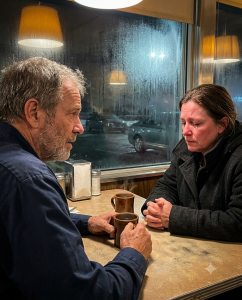
She slid into the booth across from Hank Mercer at the Bluebird Diner with the careful stiffness of someone whose knees hurt in the cold, set her purse beside her, looked down at her hands, and delivered the sentence like she’d practiced it in the car. Not once. A dozen times.
Outside, Main Street was glazed with late-winter ice and the diner windows had started to fog from the difference between the bitter air outside and the fried, coffee-scented warmth inside. Hank had arrived fifteen minutes early because being late made him itchy and blind dates made him feel ridiculous. He had spent those fifteen minutes smoothing the front of a badly ironed shirt and wishing Earl Benton would mind his own business.
Earl drove Route 4 and had somehow decided that Hank’s private life had become a community project.
“You’re not dead, Hank,” Earl had said more than once over the last two years. “You just act like it.”
That was easy for Earl to say. Earl had opinions the way some men had blood pressure.
Hank had ignored him for as long as he could. Then one Thursday evening, after another shift driving Bus 12, after another dinner eaten with a second grader and another round of spelling practice at the kitchen table, he found himself sitting in a diner booth waiting for a woman named Faye Collins.
And the first thing she gave him was an apology.
“I know Earl probably built me up,” she said, still not meeting his eyes. “I’m just a fifty-three-year-old lunch lady with bad knees and a lot of miles on me. If you want to cut this short, I understand. I won’t be hurt. I’m used to it.”
Used to it.
That phrase hit Hank harder than her self-mockery, harder than the awkwardness, harder than the stark honesty of the moment. He was old enough to know what it meant when someone said they were used to being dismissed. It meant they had been dismissed enough times to build a script for it.
And he, of all people, had no right to sit in judgment of anyone’s miles.
He studied her. She had tired eyes, intelligent eyes. A face that would have been called pretty by anyone with sense, though she had clearly stopped thinking in those terms years ago. She looked nervous, but not false. Worn, but not defeated. There was humility in the apology, yes, but also a strange bravery. She had shown up anyway.
So Hank gave her the truest answer he had.
“Faye,” he said, “I’m a sixty-one-year-old bus driver who still burns toast when I’m nervous. My shoulder predicts weather better than the local station. My house always smells faintly like crayons and coffee. And the center of my universe is a seven-year-old boy who thinks I can fix bicycles, bad dreams, and the American education system. You are already more than I had any right to expect.”
She looked up then.
For one startled second, she just stared at him. Then her face crumpled in the smallest possible way, and tears filled her eyes. She looked annoyed with herself for it, which only made the moment more tender.
“Oh, for heaven’s sake,” she muttered, turning her face slightly. “I’m sorry.”
“You don’t get to apologize for crying after opening with an apology,” Hank said, sliding the napkin dispenser toward her.
That earned him a laugh, shaky but real.
The waitress came with coffee. They ordered nothing at first, just sat with mugs warming their hands, and the conversation began to move. Carefully at first, like people stepping onto uncertain ice. Then easier.
Faye worked at Jefferson Elementary. Had for nineteen years. She knew which kids hoarded ketchup packets, which ones swapped fruit cups under the table, which ones only ate their vegetables if nobody looked directly at them. She said children were honest in ways adults forgot how to be. Hank told her he drove Bus 12 on the east route and had done it long enough to know exactly where to slow down for every pothole and every dog that liked to chase tires.
When she asked whether he liked the work, he thought about the answer.
“It’s one of the few jobs where your purpose gets on and off in backpacks,” he said. “Hard to beat that.”
She smiled at that. Not politely. Like she genuinely understood.
Then she asked whether he had children.
For a second, the noise of the diner seemed to recede—the clatter of silverware, the hiss from the grill, the low hum of conversations from other booths. Hank looked at the window, where blurred headlights moved past on Main Street.
“I had a daughter,” he said. “Then I got a grandson.”
Something in her expression changed. It didn’t become pity. Thank God. It became attention.
He told her about Laura.
His daughter had never done anything halfway. As a little girl she’d insisted on riding her bike downhill before she’d mastered brakes. As a teenager she argued with the confidence of someone who assumed the world might be persuaded if she simply made a better case. As a young woman she worked hard, loved badly, forgave too much, and tried to build a life faster than life wanted to be built.
Charlie came when she was twenty-three. His father vanished so efficiently it was as if he’d dissolved. Laura moved back home for “just a few months” that became more than a year. She worked double shifts, studied online at night, and made promises to the future with the reckless certainty of the young.
Then she got sick.
Hank didn’t dress the story up. People did that sometimes, made illness sound poetic because plain language felt too brutal. But there had been nothing poetic about it. First fatigue. Then tests. Then the kind of doctor’s face that rearranges your life before he’s said a word.
Charlie was four when Laura died.
Hank still remembered every impossible detail. The hospital vending machine that kept swallowing dollar bills. The smell of antiseptic on winter coats. The soft, unbearable way Laura had reached for Charlie’s hand even when she no longer had strength for much else. He remembered the funeral, and then the part no one warned you about: the after. The weeks after. When people returned to their lives and your own remained wrecked in the road.
Charlie stayed because there was nowhere else for him to go. But Hank never thought of it as taking him in. It was more like the child and the grief arrived together and set up permanent residence under his roof.
From then on, Hank’s life became organized around one small boy.
Every morning he rose before dawn, made breakfast, packed lunches, checked homework folders, and drove Charlie to school on his route. Charlie always sat in the front seat behind him, a place the other children envied beyond reason. He talked the entire ride. Dinosaurs, astronauts, sea monsters, whether dogs dreamed, whether old people had always been old. Each week he announced a new future profession with full conviction. Paleontologist. Firefighter. Zoo keeper. Ninja. Judge.
Every afternoon they rode home the same way. Then came homework at the kitchen table, the same scarred oak table where Hank had once helped Laura learn fractions. The repetition of it could break a man if he let it—one generation gone, another in the same seat. But it could save him too.
At night, after the dishes were done and the house had gone still, Hank sat on the edge of Charlie’s bed and they did what Charlie had named years earlier: the good thing and the hard thing.
One good thing from the day.
One hard thing spoken aloud so it wouldn’t get bigger in the dark.
Hank invented the ritual after Laura died, because Charlie’s grief had nowhere to go. The boy had been too young for words and too old not to feel the loss. Naming one hard thing each night gave his sadness edges. Gave it a place to sit.
When Hank finished explaining this, Faye was quiet for a while.
“That’s a beautiful thing,” she said softly.
“It was survival,” Hank replied.
“The best things usually are.”
Then she gave him her own history in pieces.
She had married at twenty-two because at twenty-two, attention could look an awful lot like love. Her husband liked applause, excuse-making, and money that wasn’t his. He made grand promises and even grander messes. When things went wrong, he blamed weather, bosses, taxes, fate, and eventually her. He left, came back, left again, came back again, and each return cost more than the last one.
By the third time, she said, there wasn’t much of herself left that hadn’t been negotiated away.
She raised their son, Mason, in the wreckage of that life and did her best not to pass on all the damage. She did anyway. Children inhale what adults think they’re hiding. Mason grew up, moved to Arizona, and loved her in the cautious, long-distance way children often love parents who tried hard but bled on them anyway.
“He calls on holidays,” she said, staring into her coffee. “And once in a while on Sundays. I know he loves me. I just also know I taught him not to need me too much.”
Hank understood that sentence better than he wanted to.
They finally ordered dinner—meatloaf, mashed potatoes, green beans, two ordinary plates for two ordinary people who had run out of interest in pretending they were made for glamorous lives. By then the awkwardness had thinned. Earl became a topic of mutual ridicule. Faye admitted Earl had described Hank as “steady,” which she had not known whether to interpret as praise or warning. Hank confessed Earl had described Faye as “good company and out of your league in emotional intelligence.”
She laughed so hard at that she nearly snorted coffee.
That was the moment something shifted.
Hank was not a man who fell quickly. Whatever parts of him had once rushed toward affection had long ago been cauterized by grief, duty, and time. But sitting across from Faye, watching the tiredness in her face give way to warmth, he felt something he had not expected to feel again.
Relief.
Relief at not having to pretend. Relief at being seen as a man and not only as a caretaker. Relief at hearing another person speak plainly about damage without decorating it.
When they stepped out into the cold parking lot an hour later, the diner sign cast a soft yellow light over the ice. Their breath clouded in front of them.
“I had a nice time,” Faye said, sounding as if she was surprising herself.
“So did I,” Hank answered.
Then she hesitated.
“You should know something before this goes farther.”
The sentence stiffened every muscle in Hank’s neck.
She tucked her hands into her coat pockets and spoke with the blunt honesty he was already learning belonged to her. “I don’t date men with minor children at home anymore.”
He blinked.
“It’s not Charlie,” she said quickly. “I’m sure he’s wonderful. It’s just… I already did the years of being needed every second. The scheduling, the worrying, the money stretching, the constant coming last. I know that sounds selfish. Maybe it is. But I am tired, Hank. Tired in my bones. I can barely keep my own life balanced. I can’t start over in a role that asks for that much of me again. Not even for good people.”
He could not honestly say he was angry. She wasn’t lying. She wasn’t manipulating him. She was naming a limit, and people earned those the hard way.
But still, disappointment moved through him like a draft through old windows.
“I understand,” he said, because he did.
When he got home, Charlie was at the kitchen table with Mrs. Delaney from next door, who watched him on the occasional evening Hank had to be somewhere. Charlie ran to him holding a spelling worksheet.
“I only missed ‘because,’” he announced.
“Most adults miss it emotionally,” Hank said.
Mrs. Delaney laughed, gathered her purse, and left. Hank made lunches for the next day while Charlie chattered about recess and a boy who claimed to have a pet tarantula. At bedtime they did the good thing and the hard thing.
“The good thing is I met someone kind,” Hank said.
Charlie nodded. “The hard thing?”
“She doesn’t think she can be part of our kind of life.”
Charlie was quiet. “Because of me?”
The question landed like a punch.
“No,” Hank said, too fast, too fiercely. Then softer: “No, buddy. Never because of you.”
“But you said our life.”
Hank sat with that. “Sometimes grown-ups are just tired. It doesn’t mean they don’t like someone. It means they know what they can carry.”
Charlie considered that in solemn silence. “Am I heavy?”
Hank had to look away for half a second before he answered. “You are the reason I get up.”
Charlie accepted this with the practical trust of children. Then he offered his own. “My good thing is spelling. My hard thing is Owen said moms can’t die and still be moms.”
There it was. The old ache, still fresh in places.
“What did you say?” Hank asked.
“Nothin’. I shrugged.”
Hank nodded. “Well, your mother is still your mother. Nothing changes that.”
Charlie settled under the blanket, reassured enough to sleep. Hank turned out the light and stood in the doorway a long time afterward.
The next afternoon, he saw Faye at Jefferson Elementary.
She stood outside in a navy cafeteria apron and a hairnet, directing children toward buses with the calm authority of a field general. Charlie waved at her from his seat. She waved back before she seemed to realize what she was doing.
The following day she appeared again. And the next.
By Friday, as Hank opened the bus doors at pickup, Faye stepped onto the first stair holding Charlie’s forgotten lunchbox.
“He left this in the cafeteria,” she said.
“Thank you.”
She handed it over, then added quietly, “The boy with the dinosaur backpack—is that Charlie?”
“It is.”
“He defended another student at lunch today. Bigger kid was making fun of a stutter. Charlie told him there would be consequences from the ‘justice system.’ I thought you should know you’re raising a tiny deputy.”
Hank laughed before he meant to. So did she.
After that came a dozen small crossings.
An extra cookie tucked onto Charlie’s tray on Fridays.
A wave in the dismissal lane.
A brief conversation about whether children ever outgrew hating peas.
One rainy afternoon, chaos hit the bus line when a kindergartner dissolved into tears and could not manage his seat belt. Faye climbed onto Hank’s bus without fuss, crouched carefully despite her knees, and spoke to the child in a low, steady voice until the buckle clicked into place and the crying eased.
Hank watched her move with instinctive gentleness.
She had said she was too tired to be needed, yet there she was, kneeling in a wet apron for a crying child who wasn’t hers.
A week later, Hank found a folded note in Charlie’s lunchbox.
Not addressed to Charlie.
To him.
I may have been wrong about what I’m too tired for.
He read it three times in the driveway before going inside.
Hope, at his age, was not a bright clean thing. It came entangled with caution. It brought memory, responsibility, and the knowledge that one person’s healing could trigger another person’s fear. Still, his hands shook a little as he folded the note and tucked it in his shirt pocket.
That evening, during the good thing and the hard thing, Charlie announced that his good thing was Miss Faye remembering he hated mustard.
Then, almost as an afterthought, he said, “My hard thing is she looked sad after she smiled.”
Children saw what adults stepped around.
The next Monday morning, Faye was waiting beside his parked bus before first route.
She wore her regular coat, not her cafeteria apron. Her face was pale. She held herself too tightly, as if everything in her body had drawn inward.
“I need to tell you something before you hear it from somebody else,” she said.
Hank stepped down from the bus. “What happened?”
“My ex called,” she said.
He frowned. “Mason’s father?”
“No. After him.” Her mouth hardened. “A man I was with years later, when I should’ve known better. He saw me talking to you outside the school. He knows where I work. And he’s decided he’d like another shot at controlling the narrative of my life.”
“Is he dangerous?” Hank asked.
She gave a humorless laugh. “Only in ways polite people underestimate.”
The answer chilled him.
She drew a breath. “I’m telling you because if he shows up near that school, near your bus, or says one word to Charlie, this stops. Whatever this is. I won’t drag that mess into a child’s life.”
There it was again: her instinct to sacrifice possibility before anyone had to ask.
Hank looked at her, really looked. The fear in her wasn’t just of the man. It was of being judged for having one more complication, one more ugly history, one more reason to be considered too much.
Before he could answer, two teachers burst out of the school doors behind her, talking fast and looking rattled. One called Faye’s name.
She turned.
A white envelope peeked from the pocket of her coat. Charlie’s name was written across the front in block letters Hank didn’t recognize.
His stomach dropped.
“Where did that come from?” he asked sharply.
Faye looked down, startled, and for one second guilt flashed across her face. Not guilt exactly. More like dread caught in motion.
“It was on my car this morning,” she said.
“Why didn’t you tell me?”
“Because I hadn’t opened it yet.”
He held out his hand. “Open it now.”
Her fingers shook as she passed it over. There was no stamp, no return address, only Charlie’s name. Inside was a single folded sheet of paper.
Hank opened it.
The message was short.
Tell the boy the truth about his mother before someone else does.
The paper made a dry crackle in his grip.
For a moment he could hear nothing but blood in his ears.
Faye looked at him, all color drained from her face. “I swear to you, I did not know—”
“I know,” Hank said automatically, though he didn’t know anything. Not yet.
The teacher who had called her name reached them breathless. “Faye, there’s a man in the office asking questions about student pickup lists,” she said. “Mrs. Donnelly wants you inside.”
Hank and Faye stared at each other.
“Go,” Hank said.
She hesitated. “Hank—”
“Go.”
He spent the next two hours driving his route on autopilot while the note burned a hole in his pocket. Tell the boy the truth about his mother.
There was no alternate truth about Laura. She had gotten sick. She had died. Charlie knew that in the broad shape children know things. But the note suggested something else. Something buried.
By the time the afternoon route ended, Hank had moved from confusion to anger.
Not at Laura. Never at Laura.
At the possibility that someone from her past, or Faye’s, or some ugly overlap of both, was reaching toward Charlie.
That evening, after Charlie had gone to bed, there was a knock at Hank’s front door.
Faye stood on the porch, shoulders rigid.
“I know who it is,” she said before he could speak. “Or I think I do.”
He stepped aside. She came in and remained standing in the kitchen, too tense to sit.
“Years ago,” she began, “my second ex worked collections for a medical finance company. He wasn’t supposed to have access to patient files the way he did, but rules never impressed him. He used information when it suited him. Sometimes for debt. Sometimes for leverage. Sometimes just because knowing things made him feel powerful.”
A bad feeling sharpened inside Hank.
“Laura had medical debt after her diagnosis,” Faye said quietly. “A lot of it. More than she could ever pay.”
Hank’s jaw tightened.
“I didn’t know her then,” Faye continued. “But I know the company. I know the way they operated. And I know my ex once bragged about women who got ‘forgiven balances’ in exchange for private arrangements. He thought it was funny. He thought desperate people didn’t count as victims because they had choices on paper.”
The room seemed to tilt.
“No,” Hank said. “No.”
“I don’t know if Laura was one of them,” Faye said quickly. “I’m not saying that. I’m saying if he had access to her file, if he knew she was dying, if he knows there’s a child… then this note may be about blackmail. Or cruelty. Or both.”
Hank sat down hard at the kitchen table.
There are moments when rage is so complete it becomes silence. That was what happened to him. He saw Laura at twenty-three, brave and scared, carrying bills she never let him fully see because she had inherited his pride and magnified it. He remembered late phone calls she brushed off. Strange moods. A stretch of weeks when she’d seemed more brittle than ill. He had blamed the illness. The treatments. The fear.
What if there had been more?
Faye crouched slowly beside the table despite her knees. “I should’ve told you about him sooner,” she said. “I didn’t because I was ashamed I ever let someone like that close to me.”
Hank looked at her. “Did you know my daughter?”
“No. But I knew the kind of men who feed on women like her. Women out of time, out of money, out of options.”
The next morning Hank called in a favor with a retired police sergeant who sometimes rode his route after medical appointments. By noon, the man in the office had a name: Russell Vane. Faye’s ex. Former collections supervisor. A complaint history long enough to fill a drawer, but never enough evidence to pin him down.
By evening, there was more.
The retired sergeant called back with one sentence that made Hank grip the counter so hard his hand cramped.
“Your daughter wasn’t the only one.”
Three women had filed sealed complaints over the years. All terminally ill or caring for sick family members. All with debt connected to the same finance network. None had pursued charges to the end. Two had died.
Laura’s name was not among the formal complaints.
But Hank knew then what his heart had already started to fear. Her silence had not been random. It had been the silence of someone trying to survive humiliation while running out of time.
He did not tell Charlie any of this.
Not yet.
He and Faye met at the diner that night, not because it was romantic now but because it was neutral ground. She brought a folder she had kept for years without opening much. Notes. Names. Dates. Fragments of things her ex had said when he’d been drunk enough to brag. One line in her handwriting stood out:
Sick women are easiest. They think nobody will believe them.
Hank read it twice, then closed the folder.
“Why keep this?” he asked.
“Because some part of me always thought a day would come when not keeping it would feel like a sin.”
Together they took everything to the retired sergeant and, through him, to the county prosecutor’s office. It was messy. Slow. Infuriating. But this time there were living witnesses willing to talk, and a paper trail more stubborn than Russell Vane had expected.
When investigators finally confronted him, he did what men like that always did. Denied. Minimized. Smirked. Then bargained.
The decisive turn came from a storage box in a former office slated for disposal. Inside were copied account notes, off-book contact logs, and one file labeled with Laura’s name.
Hank did not open that file himself.
He let the detective summarize it. There had been harassment. Coercive contact. Threats tied to her debt. Suggestions that certain obligations could “disappear” if she cooperated personally. No proof that she had. Proof that she had been targeted anyway.
It was enough.
Russell Vane was charged not with every cruelty he had ever committed—there was no law broad enough for that—but with enough crimes to finally drag his private rot into daylight. Fraud. Illegal access to records. Extortion-related offenses. Witness tampering.
It did not resurrect the women he had cornered.
It did not return Laura.
But it named what had happened. And sometimes naming a thing is the line between carrying poison forever and beginning, at last, to drain it.
Telling Charlie was the hardest part.
Hank waited. Spoke to a child counselor first. Chose his words with ruthless care. One evening at bedtime, he sat on the edge of Charlie’s bed and said there was one more true thing to know about his mother.
“She was brave in ways even I didn’t understand at the time,” he told him. “And when she was very sick, a bad man tried to make her life harder. That was his shame, not hers.”
Charlie listened with his fingers twisted in the blanket.
“Did she do anything wrong?” he asked.
“No,” Hank said. “She got hurt by somebody wrong.”
Charlie took this in with the grave seriousness children reserve for life-altering truths. “Did they catch him?”
“Yes.”
“Good.”
Then, after a pause: “She was still my mom the whole time?”
Hank’s eyes burned. “Every second.”
Charlie nodded. “Okay.”
That night, when they did the good thing and the hard thing, Charlie said his good thing was that bad men did not always win forever. His hard thing was that he wished his mom had gotten more years.
“So do I,” Hank said.
In the months that followed, life did not become magically easy, but it became cleaner.
The school stopped buzzing with rumors once the man behind them was gone. Faye no longer flinched when the office phone rang unexpectedly. Mason started calling more often after Faye finally told him, honestly, why she had spent years apologizing for taking up space. Their conversations were awkward at first, then warmer. Not fixed. Real.
As for Hank and Faye, they did not rush.
They had both rushed before in younger forms of themselves and paid for it.
Instead, they built something by accumulation. Saturday coffee. Shared grocery runs. School concerts. Faye sitting beside Charlie at one of his basketball games, yelling at the referee with a creativity that impressed everyone within three rows. Hank fixing a cabinet door in her kitchen while she stood over him insisting he was using the wrong screwdriver. Charlie, after several months, referring to her by mistake as family and then pretending he hadn’t.
One spring evening, nearly a year after the night at the Bluebird Diner, they sat on Hank’s porch while Charlie chased lightning bugs in the yard.
“You know,” Faye said, “the first thing I ever told you was an apology.”
Hank leaned back in his chair. “I remember.”
“I was so sure I was a disappointment waiting to happen.”
He looked at her profile in the fading light. “You were a rescue waiting to happen,” he said.
She snorted. “That is an aggressively sentimental thing for a bus driver to say.”
“Spend enough years around second graders and it gets into your bloodstream.”
In the yard, Charlie shouted because he had caught one for exactly four seconds before letting it go.
Faye watched him. “I meant what I said that night, you know. About being too tired to be needed.”
“You were.”
“I was.” She smiled faintly. “I just didn’t know there were different kinds of being needed. Some that empty you. Some that hand pieces of you back.”
Hank reached for her hand. Her fingers laced through his without hesitation.
The aftershock of everything never vanished entirely. Some wounds don’t close so much as become part of how you move. Hank still thought of Laura every day. Faye still carried old reflexes from years of expecting trouble. Charlie still asked hard questions at bedtime.
But the house no longer felt shaped only by loss.
It felt lived in.
One night, long after Faye had become a regular fixture at dinner and school pickups and the general management of all emotional emergencies under four feet tall, Hank sat with Charlie for the good thing and the hard thing.
Charlie thought for a moment.
“My good thing,” he said, “is that Miss Faye laughs before she means to.”
Hank smiled. “And the hard thing?”
Charlie rolled onto his side and considered the ceiling. “I think Mom would’ve liked her. And that makes me happy and sad at the same time.”
Hank put a hand gently on his back.
“That,” he said, “is what a lot of love feels like.”
Later, lying awake beside the woman who had once apologized for having too many miles on her, Hank thought about the strange arithmetic of life. How damage could be inherited, but so could tenderness. How shame could travel through generations unless somebody finally stopped and named it a lie. How one honest sentence in a diner could crack open a sealed room inside a person.
Who had been right? The younger versions of themselves who thought love meant endurance at any cost? The older ones who almost refused it entirely? Maybe neither.
Maybe the biggest red flag in life was not weariness or baggage or age.
Maybe it was anyone who taught you to apologize before introducing yourself.