When Maryn Holloway bought forty-seven old breeding sows at the Harwick auction, the laughter started before the ink on the receipt was dry.
Everyone in Durrance had already decided what her life was worth, and it wasn’t much.
She was twenty-seven, unmarried, nearly broke, and stubborn in the dangerous way people only admired after success. Before success, they called it foolishness. Before success, they called it pride. Before success, they stood in warm stores with coffee in their hands and made wagers over whether a woman would lose the only land her parents had left her.
Maryn had grown used to that sound. Laughter was common in a small valley when somebody tried something unfamiliar and did it without a husband, a brother, or a father standing beside her.
At the Harwick yards, the old sows stood in a back pen under a gray sky, broad and heavy and ignored. They had belonged to Delwood Pruitt, who had kept them too long hoping for one more useful litter out of each. By the time he finally admitted defeat, the market had turned cruel. They were too old to breed. Too costly to feed. Too worn to tempt any sensible man who still believed livestock should earn their keep in the usual way.
Auctioneer Cobble tried to move them quickly.
“Four dollars a head.”
Nothing.
“Three.”
Silence.
Then he called, “Two dollars a head for the whole lot. Forty-seven head. Plenty of meat left on them.”
“Meat for the butcher wagon,” someone shouted, and half the yard laughed.
That was when Maryn lifted her hand.
“I’ll take them.”
The yard went still in that sharp, unnatural way a place does when something happens that everybody will be repeating by supper.
Cobble leaned forward. “All forty-seven?”
“Yes.”
“You understand what you’re buying?”
Maryn looked straight at him. “Better than most.”
She had forty-three dollars in her pocket and borrowed money folded inside her glove. The loan came from Calla Birch, who worked behind the Fenwick store counter and had listened without interrupting while Maryn explained her plan in a low, intense voice. Calla had asked only two questions: Did Maryn know what she was doing, and was she prepared for people to laugh first and buy later?
Maryn had answered yes to both, though only one of those answers was certain.
Delwood Pruitt stopped her as she signed.
“These hogs won’t make you piglets,” he said. “They’ll make you hungry.”
“I’m not buying piglets.”
“Then what are you buying?”
Maryn folded the receipt. “Flavor.”
He stared at her like she had spoken in another language.
Maybe she had.
The idea had started months earlier, not in the smokehouse, but at the kitchen table with her father’s old notebooks spread out around a chipped lamp. Since her parents’ deaths, she had kept every paper he had ever written on—weather records, feed notes, fence lists, tobacco-stained numbers in the margins, and recipes hidden where recipes didn’t belong. Her father had never been rich, but he noticed things. He remembered what animals tasted like under different feed. He wrote down how weather changed curing times. He marked which wood smoked sweet and which one turned harsh when the burn ran hot.
One note had caught her attention because it didn’t look like farm bookkeeping. It looked like memory.
Voss ham. Acorn and windfall apple finish. Finest smoke I ever tasted. Too dear to buy regular. Worth every cent.
She could still remember the night that ham came to their table. She had been twelve. Her mother had sliced it thin and then just stood there after tasting it, smiling with quiet disbelief. Maryn remembered the sweetness buried deep in the salt, the softness of the fat, the smoke that stayed in the room long after the plates were empty.
Most of all, she remembered what her mother had said.
“This is how poor people know what they’ve been missing.”
After her parents died, Maryn didn’t have the money to buy delicacies or experiment with fancy stock. What she had was land nobody valued correctly. The hillside beyond her lower pasture was scattered with oak, walnut, and wild apple trees. Most people saw a rough patch of inconvenient forage. Maryn saw acorns, fallen fruit, and slow finish.
She also had the stone smokehouse her father built long ago, thick-walled and drafty in the right places, neglected but sound. Everyone else in the valley used smoke to preserve meat cheaply. Maryn meant to use it to build something rare.
So she bought the animals everyone else had rejected.
Getting them home was nearly enough to break her. The drive up Broken Ridge took four punishing hours. Six sows bolted toward the creek. One dropped in the middle of the road and would not rise until Maryn and the mule together all but dragged her forward by noise and shame. By the time the herd reached the Holloway place, Maryn’s boots were soaked, her back burned, and her last piece of bread was gone.
Still, when she looked over the animals in the lower pasture, she did not see waste.
She saw time.
Through October she worked them carefully. She opened access to the hillside and let the old sows range under the trees, rooting for acorns, nosing through leaves for nuts, chewing bitter windfall apples. In the evenings she supplemented them with whey from Pearl and dried pumpkin mash. It was not the cheapest method and certainly not the quickest. That was exactly the point.
Maryn was not trying to produce more pigs.
She was trying to make exceptional pork.
Word spread quickly because in Durrance all unusual effort became public entertainment. Men rode out on invented errands just to see the spectacle. Garrett Spears, who ran one of the larger cattle outfits in the valley, stopped by under the excuse of borrowing a post-hole digger. He watched the hogs under the trees and asked whether she truly intended to finish them on fallen fruit.
“I intend to let them eat what makes them worth eating,” she said.
He gave a half-smile. “And how long can you afford to wait for worth?”
“As long as it takes to sell something not every fool in the valley already has.”
Garrett left with the digger and a look she knew well—curiosity mixed with doubt, as if some private part of him hoped she might be right but would never say so aloud.
In November, she turned to the smokehouse.
The first weeks were brutal. Old technique was not the same as easy technique. She traded labor for cuts she could practice on and ruined several batches while learning the draft of the chamber and the temperament of the wood. Hickory alone was too aggressive. Applewood alone lacked backbone. Too much salt killed the sweetness. Too much sugar muddied the pork. Temperature shifted everything.
Her father’s notes helped, but they did not save her from failure. Those lessons she had to buy herself.
One evening, after another long curing trial, she opened the smokehouse and stood very still.
There it was.
The scent she had chased all autumn.
Low smoke. Sweet edge. Clean richness. The kind of smell that made the mouth water before hunger had time to ask permission.
She sliced a piece from the test cut and let it cool just enough to taste. The fat softened on her tongue. The smoke sat behind the sweetness instead of crushing it. She closed her eyes.
She had it.
Or close enough that the difference no longer mattered to anyone but her.
Then winter came early and tried to take it all back.
Snow settled over the lower pasture. The creek froze. Her money disappeared into feed, salt, repairs, and debt. Vern Hobbs, delighted by every new hardship, expanded the betting in his store. Three to one that Maryn would fail by March. Better odds if the bank took the land first.
Maryn heard about it all and kept working.
Then one night the barn changed everything.
The wind was so hard against the cabin walls it sounded like a fist dragging over boards. Maryn had just checked the cash box beneath the loose floor plank and confirmed what she already feared: there was no money left. Only receipts. The bank letter. The folded auction paper.
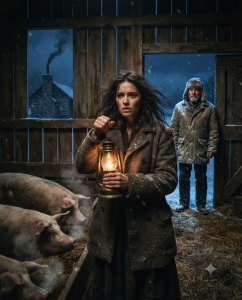
Then came the sound from the barn—a sharp cry, wrong in the dark.
She ran with a lamp and found three sows breathing badly, sides heaving, nostrils steaming. Fear cut straight through her. An outbreak in winter could erase everything. She had no room for losses. No room for contagion. No room for rumor.
When she turned, Garrett Spears was standing in the doorway.
Later she would realize she never asked why he had ridden over in that weather. At the time, she only saw the seriousness on his face and felt the danger of being witnessed.
“If this is what I think it is,” he said, “the whole valley will have the story by morning.”
But Garrett wasn’t there to spread it.
He stepped inside, watched the animals, then asked to see the feed. Maryn led him to the storage corner, muttering that she had checked the grain, checked the water, checked the bedding. When she opened the bin, the truth rose into the air.
Sour dampness.
Mold.
A leak in the roof and a stretch of bad cold had spoiled part of the feed. The sows weren’t falling to a spreading plague. They were reacting to what they had eaten.
Maryn sagged with relief so sharp it almost hurt. Relief lasted only a second before shame replaced it. One mistake. One overlooked patch. One weakness in the roof she hadn’t had money to repair in time.
Garrett looked at the bin and then back at her.
“If Hobbs hears this wrong, he’ll tell people your herd’s tainted,” he said. “Doesn’t matter whether it’s true. By noon nobody buys a thing from you.”
Maryn lifted her chin. “Then Hobbs won’t hear it from us.”
Garrett grabbed the first spoiled sack and hauled it outside without asking permission.
They worked for hours, dragging out every bad bag, opening the barn for air, sorting the sickest animals, and checking the rest. Snow blew in under the door and melted on their boots. Neither talked much. Necessity had a way of making equals out of people, at least for a night.
By dawn the worst danger had passed. The affected animals were weak but not dying. Maryn stood in the pale cold light with straw in her hair and soot on her sleeve, and Garrett, breath clouding in the yard, said what she had already been thinking.
“You can’t wait much longer. Start processing now.”
He was right. Winter was tightening around her operation, and she needed product cured and ready before debt, weather, or gossip caught up with her.
The slaughtering began that morning.
It was hard work, relentless and unsentimental. Maryn moved through it with the focus of somebody who knows hesitation is a luxury. Garrett returned the next day, then the day after, sometimes with a practical excuse and sometimes with none at all. He helped split wood, hang cuts, repair part of the feed-room roof, and haul barrels of brine. He never mentioned the laughter from the auction. He never mentioned the bets.
In town, that silence became its own rumor.
Calla Birch was the first outsider Maryn trusted with a taste. Maryn wrapped slices of cured ham and a strip of smoked belly in cloth and brought them to Fenwick’s store after closing. Calla stood behind the counter, sampled one piece, then another, then stared at Maryn for so long Maryn thought she had failed.
Finally Calla said, “You fool.”
Maryn’s heart dropped.
Calla set the last slice down with exaggerated care. “Do you have any idea what this is?”
Maryn swallowed. “Good?”
“Good?” Calla almost laughed. “This is the kind of thing rich railroad men brag about having shipped from places nobody in Durrance could pronounce.”
Two days later, Calla sold a small packet under the counter to a traveling buyer headed west. The buyer came back before the week was out asking whether more was available.
Then another inquiry came, this time from a hotel cook in Cheyenne who had heard through a supply wagon that someone in Durrance was smoking ham that didn’t taste like every other rough frontier cure. Maryn packed what she could, priced it higher than anyone told her was sensible, and sent it anyway.
The hotel ordered again.
That was the first turn.
The second came when Vern Hobbs, who had mocked her longest and loudest, bought a slice only to prove it was overrated. He tasted it in front of three other men near his feed counter.
He didn’t speak for several seconds.
That silence did more for Maryn than any advertisement ever could.
Within a month, people who had laughed at the auction were riding out to the Holloway place with cash in hand. Some wanted ham. Some wanted bacon. Some wanted to see if the stories were true. Maryn’s old stone smokehouse—once just a relic of her father’s labor—became the busiest place on that road. Wagons lined up outside. Customers waited in the yard breathing woodsmoke and winter air, hoping there might still be cuts left by the time their turn came.
The same men who had called the sows useless began asking where they could get stock like hers.
Maryn did not answer that question directly.
She sold product, not her method.
She learned quickly that success attracted a different kind of attention than failure. People who had once mocked her now wanted to praise her as though they had always understood. Delwood Pruitt claimed he knew from the start she saw something special in those old sows. Auctioneer Cobble joked that Harwick auction should charge a commission on miracles. Vern Hobbs quietly stopped taking bets about the Holloway place.
Maryn paid back Calla first, adding interest Calla had never requested. Then she paid the bank enough to stop the sharpest edge of the debt. She patched the cabin roof properly. Repaired the feed room. Rebuilt part of the lower fence. Bought better salt, better hooks, and more curing barrels.
When spring began to loosen the frozen ground, Garrett came by with no errand at all. He stood near the smokehouse while a line of customers waited in the yard and watched Maryn move through them with a pencil behind her ear, soot on one sleeve, and more confidence than she had worn all winter.
“You look different,” he said when the crowd thinned.
“I smell like hickory and money,” she replied.
That made him laugh.
Then he grew serious. “You were right.”
Maryn wrapped a ham and tied the twine. “About what?”
“Doing what everybody else does gets everybody else’s price.”
She looked at him then, really looked at him. This was the same man who had once worn pity like manners, the same man who had appeared at her barn door ready with a warning, and then stayed to work when he could have ridden back to town with gossip instead.
“You were right, too,” she said.
He waited.
“I couldn’t have fixed that night alone.”
Garrett’s mouth shifted in a way that was not quite a smile. “No. But you still built the whole thing.”
By summer, Maryn Holloway’s smokehouse was known far beyond Durrance. Travelers asked for Holloway ham by name. Buyers came from towns that had once never heard of Broken Ridge. Her products commanded prices that would have sounded insane six months earlier. The old sows no one wanted had given her exactly what she had seen in them: not reproduction, but richness; not quantity, but quality; not quick profit, but something rarer and more durable.
She never forgot the laughter, though.
Not because she wanted revenge, but because memory sharpened judgment. It reminded her how fast people mistook unfamiliar for foolish. How eagerly they turned struggle into entertainment when it belonged to somebody else. How often the thing dismissed as worthless only needed different eyes and more patience.
Some evenings, after the last customer left and the smoke settled low around the yard, Maryn stood by the old stone wall and thought about her parents. About the ham from her childhood. About her father’s notes. About the ridiculous sight she must have made, driving forty-seven worn-out sows home through the laughter of a whole town.
Then she would look at the waiting wagons, the order slips, the repaired fences, the paid-down debt, and the smoke rising exactly the way she had hoped it might.
People called it a miracle.
Maryn knew better.
It was skill. It was memory. It was risk. It was work so relentless that luck had somewhere to land when it finally arrived.
And yet there was still something almost holy in the way shame had turned to triumph so publicly. The valley had watched her walk straight into humiliation, and then watched that humiliation feed her future.
Maybe that was the part people couldn’t stop talking about.
Not that she had succeeded.
But that she had succeeded with the very thing they had laughed at most.
Even now, anyone passing through Durrance could ask ten different people where Maryn Holloway’s smokehouse stood and get ten versions of the same story. The details changed depending on who told it. The wagers grew larger. The snow got deeper. The laughter got crueler. The final crowd at the smokehouse got bigger every time the tale was repeated.
But every version kept the same beginning.
A broke young woman bought forty-seven useless breeding sows.
And everybody thought they knew how that story would end.
That was their mistake.
The harder question—the one still lingering after the smoke cleared and the money changed hands—was whether the valley ever really doubted her, or whether they simply needed her to fail because her courage made their caution look small. And if that was true, then maybe the biggest red flag in the whole story was never the old herd, the spoiled feed, or the debt letter under her floorboards.
Maybe it was how quickly people laugh when someone dares to imagine value where they themselves see none.