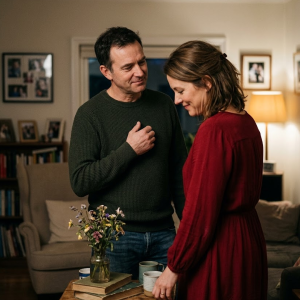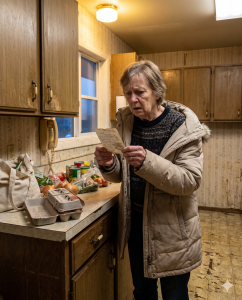
Darlene Weller had forty dollars left to her name that Thursday afternoon, and she knew the exact shape of it before she ever pulled into Miller’s Market.
It looked like one loaf of wheat bread, store-brand oatmeal, a dozen eggs, tea bags, a tub of margarine, canned beans, and the cheapest package of ground turkey she could find. It looked like enough to get an old woman to Monday if she was careful and did not let herself get hungry in any dramatic way. It looked like the end of the month in rural Montana, where distances were long, winters were expensive, and retirement checks stretched only when the people receiving them did.
She parked her Buick beside a pickup with a rusted bumper, buttoned her beige coat against the spring wind, and went inside with a folded list in her purse and a quiet determination not to buy a single thing that was not necessary.
Darlene had lived her whole life in Mercer County. She had sorted and delivered mail for nearly thirty years, driving roads that turned to mud in April and glass in January, learning every family name, every porch step, every dog that barked before she reached the gate. She knew who had fallen behind on payments from the red final notices. She knew who had grandsons in jail and daughters in rehab and husbands too proud to apply for help. She had spent most of her life carrying other people’s news without comment.
Now she was seventy-one, widowed, stiff in the mornings, and living alone in the farmhouse she and Earl had bought when they were young enough to think fixing up old things was romantic.
The house had gone quiet in stages. First when Earl died of a stroke while watching weather reports in his recliner. Then in a more permanent way after Tommy.
Even after twelve years, she still thought of that loss not as a memory but as a soundless explosion that had gone off in the center of her life and never fully stopped echoing.
She did not talk about him much. The town had long ago settled his story into one clean sentence.
A car accident on Brackett Pass Road. Tragic. Instantaneous, they said, though the details had always been hazy. Too much damage. The truck caught fire. Best not to dwell.
People liked clean endings. Darlene had learned that. When grief became inconvenient, communities packaged it neatly and handed it back to the person who had to live with it.
She chose her groceries carefully and stepped into the checkout line, where a young mother stood ahead of her with a baby on one hip and a little girl clinging to the cart.
Darlene noticed details automatically, the way lifelong postal workers noticed things. The woman’s sweatshirt had been washed so many times the fabric looked tired. There was formula in the cart, a pack of diapers, peanut butter, boxed macaroni, cereal, bananas with bruises along the sides, and white bread. Nothing unnecessary. Nothing indulgent. Need, arranged in grocery form.
The little girl had light hair that had not seen a brush that morning. The baby had lost one sock. The woman kept checking her phone like she was waiting for a miracle deposit to land before the cashier finished scanning.
“That’ll be eighty-six twenty,” the cashier said.
The woman blinked. “Can you take off the diapers first?”
The cashier nodded and removed them.
“Seventy-one forty.”
The woman inserted a card. Declined.
She tried again. Same result.
A flush climbed her neck. “Can you take off the formula too?”
The baby fussed instantly, rooting against her sweatshirt. The little girl tugged on the cart and asked in a small voice if they could still get the bananas.
Something in Darlene went tight.
She had seen many versions of this moment during her route years. Mothers hiding final notices under dish towels. Fathers smiling too brightly when certified envelopes arrived. People saying they were fine when the mailbox said otherwise.
Humiliation had a posture. This woman had it.
Before she could think herself out of it, Darlene reached into her purse and laid two twenties on the conveyor.
“I’ve got it,” she said.
The young mother spun toward her, eyes wide. “No, ma’am. Please, you don’t need to—”
“I know I don’t.”
Darlene heard the firmness in her own voice and was surprised by it.
“But I’m going to.”
The cashier, relieved, entered the cash. The little girl looked at Darlene like she had just produced sunshine from her pocket. The young mother’s eyes filled with tears she clearly hated letting anyone see.
“It’s too much,” she whispered.
“It’s groceries,” Darlene said. “Take them home.”
The woman thanked her three times before the receipt even printed. Darlene, embarrassed by gratitude, gathered her own reduced pile of food and headed for the door.
She almost made it to her car.
“Ma’am?”
Darlene turned. The young woman stood a few yards away in the parking lot, the wind pushing loose strands of hair across her face.
“Please let me at least say thank you,” she said.
“You just did.”
The woman looked down, then up again. There was something else in her face now. Not just relief. A hesitation that looked practiced, like she had rehearsed saying something and lost her nerve at the last second.
“You live out on Brackett Road?” she asked.
Darlene’s fingers tightened around the grocery sack. “I do.”
“I thought so.” The woman adjusted the baby on her hip. “I’ve seen you at the cemetery before.”
The words landed oddly.
Mercer County had one cemetery. Plenty of people went there. But strangers did not usually recognize each other from grief.
“Maybe,” Darlene said.
“I’m sorry,” the young woman said quickly. “I didn’t mean to sound strange. I just… recognized you.”
Recognized her from what? Darlene almost asked. But the little girl started whining, the baby made a sharp unhappy sound, and the woman stepped back as though the moment had become too heavy to hold.
“Thank you,” she said one more time.
Darlene nodded, got into her Buick, and drove home with the kind of unsettled feeling that had no clear source.
The road out to her farmhouse ran past open fields and low fencing and the cemetery itself, tucked on a rise where the cottonwoods bent in the wind. She did not look that direction as she passed. She only thought of the woman’s words and the strange way she had said them.
At home, she set her groceries on the kitchen counter and pulled off her coat.
Something in the pocket brushed her fingers.
At first she thought it was a receipt. Instead, she found a small, water-stained prayer card, soft with age and bent through the middle. A saint on the front, nearly faded away. On the back, a name in blue ink.
She stared at it.
It was not the young mother’s name.
It was not a name that meant anything to her at first glance. The first name had blurred slightly with water. The last name looked cramped, written in a rush. Yet something in the lettering tugged at memory hard enough to make her sit down without meaning to.
She turned the card over and over, trying to understand.
A prayer card from a funeral. Slipped silently into her coat pocket by a woman she had just met. A woman who knew where she lived and had seen her at the cemetery.
Her heart began to pound.
She took the card to the window for better light, then back under the lamp. She read the name again and again, sounding it out in a whisper. The ink had bled in one corner, and beneath the name there looked to be more writing, mostly hidden by the stain.
She fetched her reading glasses from the table drawer. Her hands were unsteady by the time she put them on.
That was when recognition hit.
Not cleanly. In fragments.
The shape of the T.
The slant of the y.
A summer night twelve years earlier. A knock at the door after midnight. Sheriff Nolan standing on the porch with his hat in his hands. A plastic evidence bag containing Tommy’s watch. Mumbled phrases about speed, alcohol, loss of control, flames. The recommendation of a closed casket. Darlene too destroyed to ask why no one had seen the body except officials. Too numb to question why every answer sounded pre-packaged.
The prayer card slipped in her damp fingers.
She looked again.
The name on the back was Tommy’s.
Not exactly as it would have been printed in church bulletins or on official forms. It was written the way somebody who knew him had written it quickly, personally, with the familiar shortcut his friends used when they were young.
Her knees gave out.
She hit the kitchen linoleum hard enough to feel the shock in her hips, but she barely noticed. She flattened the card against the floor and bent over it, breathing in shallow little gasps.
Beneath the name, half blurred by water, were three words.
Tell my mother.
Darlene did not know how long she stayed there.
When she finally got up, she was trembling too badly to stand still. She called Miller’s Market and asked the cashier if she knew the young woman with two children and a green sweatshirt.
“Rachel,” the cashier said after a pause. “I think her last name’s Mercer now. Used to be Collins, maybe. Why?”
Darlene barely heard the question.
Rachel.
A face rose out of the old wreckage of memory. Seventeen years old, sitting in the back pew at Tommy’s funeral with red-rimmed eyes and both hands clasped so tightly in her lap they looked painful. Pretty in a nervous way. Quiet. Darlene had not known her well, but she had seen her around town with Tommy once or twice before his death. Not enough to ask questions. Enough to remember later and wonder.
Then headlights swept across Darlene’s front window.
She turned.
A dented sedan sat in her driveway. The engine idled. Rachel was behind the wheel, both hands gripping it like she was trying to hold herself in place.
Darlene opened the door before fear could stop her.
Rachel got out slowly, leaving the children in the backseat. The little girl was asleep, cheek pressed to the window. The baby, now in a car seat, was awake and kicking lightly under a blanket.
Rachel looked worse than she had at the store. Pale. Cornered by whatever she had come to say.
“You should come in,” Darlene said.
Rachel shook her head. “No. I might lose my nerve if I come in.”
Darlene stood on the porch with the prayer card in her hand. “Then say it here.”
Rachel looked at the card and covered her mouth briefly, as if even seeing it out in the open made it too real.
“I didn’t know if you’d remember me,” she said.
“I remember enough.”
The wind moved between them, carrying the smell of dry grass and distant rain.
Rachel exhaled. “Tommy and I were together that summer.”
Darlene felt something inside her pull taut. “I know.”
“No,” Rachel said, shaking her head. “I mean really together.”
The meaning landed with its full weight a second later.
Darlene looked toward the car, toward the sleeping little girl.
Rachel followed her gaze and started crying silently before a single sound came out. “Her name is Ellie.”
Darlene did not speak.
“I was pregnant when he died.”
The words did not feel like words. They felt like the world rearranging itself in one violent movement.
“You never told me.”
“I tried.”
Rachel laughed once, brokenly. “God, I tried. Your husband told me not to come back.”
Darlene stared at her. “Earl?”
Rachel nodded. “I came to the house after the funeral. He met me outside. I told him I needed to speak to you. I told him it was about Tommy. He said you were barely surviving and if I cared about any of you, I’d leave it alone. Then he asked if the baby was definitely Tommy’s. I was seventeen and terrified and ashamed, and I left.”
Darlene pressed one hand to the porch railing.
Earl had never said a word.
“He came to see me later,” Rachel went on, voice shaking. “He said if I wanted to start over, he’d help. He gave me money once. Not much. Enough for a bus to Billings and a month with an aunt. He said the accident was already destroying you and that some truths only buried people deeper.”
Darlene felt anger rise through her grief so suddenly it nearly made her dizzy. Earl, dead six years now, had carried this secret into the ground.
She held up the card. “What is this?”
Rachel looked at it for a long moment. “Tommy gave it to me the night he died.”
Darlene said nothing. She could not.
“We were supposed to leave,” Rachel said. “Not forever. Just drive to Missoula for the weekend. He was going to tell you about me when we got back. About the baby. He had that card because he used to keep it in his wallet after his grandpa’s funeral. He wrote his name on the back while we were parked near the river. He was teasing me because I told him all old ladies in church kept prayer cards like magic shields.” She gave a wet, disbelieving smile. “Then he turned it over again and wrote those words. Tell my mother. He said if things went badly with his dad, at least there’d be one way to prove he meant to tell you.”
Darlene’s throat closed. “Why would things go badly?”
Rachel looked past her into the dark house. “Because Tommy had been fighting with someone.”
A deeper dread moved in.
“Who?”
Rachel swallowed. “Deputy Warren Pike.”
The name hit with a sharp jolt. Pike had worked under Sheriff Nolan back then. He had retired early and moved away, if rumor was true.
“Why?”
“Because Warren was the one supplying pills to some of the boys working oil routes that year. Tommy found out. Not just pills. Stolen auto parts too. Cash deals. He wanted out of something he’d gotten pulled into. He said Warren was dirty and your husband knew it.”
Darlene shook her head immediately, instinctively. “Earl would never—”
“I don’t think he was in on it,” Rachel said quickly. “I think he was scared of what Tommy had touched.”
Rachel stepped closer, lowering her voice as if the night itself might overhear.
“That night, Tommy got a call. He changed the plan and told me to meet him at the old turnout near Mile Marker 14. He said Warren wanted to talk and settle things. Tommy was angry, but he wasn’t drunk. He was nervous. He made me promise to stay in my car if anyone else showed.”
Darlene was gripping the porch post hard enough to hurt.
“I followed later than I meant to because my aunt’s car wouldn’t start at first,” Rachel said. “When I got there, Tommy’s truck was already down the embankment. I could see fire. And Warren’s cruiser was parked up on the road.”
Darlene could not feel her feet.
“I saw him,” Rachel whispered. “I saw Warren standing there. And your husband was there too.”
For a second the entire world seemed to go soundless.
“He saw me before I could back away,” Rachel said. “Warren came toward my car. He told me I hadn’t seen anything. He said Tommy had been drinking, lost control, and if I loved my baby I would keep driving and never tell anyone where I’d been. Your husband looked sick. He didn’t threaten me. He just kept saying, ‘Go home. Please, just go home.’”
Darlene’s face had gone cold.
“You’re telling me Earl watched my son die?”
Rachel’s voice cracked. “I don’t know if Tommy was alive when they got there. I swear I don’t know. I only know the truck was burning and nobody was trying to save him.”
The porch light buzzed overhead.
Darlene thought of the sealed explanations, the hurried funeral, the way Earl had become quieter after Tommy’s death but never once invited questions. She thought of the sheriff’s carefully gentle phrases. She thought of how strongly Earl had insisted that details would only hurt her.
Not details. Truth.
“You should have come to me,” Darlene said, though the words were weak against twelve years.
Rachel nodded through tears. “I know. I was a coward. Then I had Ellie. Then bills. Then I heard Warren had transferred counties for a while, and I told myself maybe I was wrong, maybe grief had twisted what I saw. But I kept the card. Every year I kept it. And last month Warren came back for his brother’s funeral. He saw me outside the church and looked at Ellie too long. Like he was counting years.”
Fear flickered through Darlene’s anger.
“I knew then I wasn’t wrong,” Rachel said. “And today when you helped me in the store… I couldn’t stand there taking kindness from you one more time without telling you.”
The baby began to fuss in the car.
Darlene looked at the little girl sleeping in the backseat, the shape of her nose, the curve of her chin, small features that suddenly rearranged themselves into echoes she knew by heart. Tommy at six. Tommy at twelve. Tommy laughing with one corner of his mouth higher than the other.
She nearly folded under the sight of it.
“That’s his child,” she whispered.
Rachel nodded.
Darlene cried then, not loudly, but with the deep, exhausted grief of someone realizing that a grave had not only taken from her, it had hidden from her. A granddaughter. A truth. Twelve years of stolen history.
When she could finally breathe again, she said, “Come inside.”
This time Rachel did.
The children stayed sleeping while they sat at the kitchen table with untouched groceries still scattered across the counter. Rachel told her everything in order. The pregnancy. Earl turning her away. Warren’s warnings. The move to Billings. The years of scraping by. The card kept inside a Bible in a dresser drawer until she finally drove back to Mercer County after her last job fell through and her aunt died.
Darlene listened without interrupting, each new detail settling into old gaps with sickening precision.
By midnight, anger had replaced shock.
At seven the next morning, Darlene drove Rachel and the children to Sheriff Nolan’s house.
The sheriff who answered the door was older now, one shoulder lower than the other, retired for three years and soft around the middle. He looked confused until he saw the prayer card in Darlene’s hand and Rachel standing beside her.
Then, before either woman said a word, his face changed.
Guilt was an unmistakable thing. Darlene had spent decades reading human faces at mailboxes. She knew it when she saw it.
Nolan let them in without protest.
What followed was not dramatic in the way television lies had taught people to expect. No shouting. No slammed fists. Just a retired lawman sitting at his own dining table, suddenly looking every one of his years, and finally admitting what he should have admitted the week Tommy died.
Warren Pike had been under quiet suspicion for months over stolen evidence, cash skims, and side deals with men he should have arrested. Tommy had done mechanic work for one of those men and stumbled into knowledge he was never meant to have. He tried to step away. Pike panicked.
The official story was that Tommy had been drinking and driving too fast on a bad road. Nolan had accepted it at first because that was what Pike reported. But there were inconsistencies. A second set of tire marks. No proper alcohol confirmation that Nolan himself ever saw. A timeline that shifted when questioned. By the time Nolan began to doubt Pike, Earl had begged him not to tear open what was left of Darlene’s life unless he could prove it in court.
“And I didn’t have enough,” Nolan said, voice rough. “Not then.”
“You had enough to know something was wrong,” Darlene replied.
He bowed his head.
Rachel described what she had seen that night. Nolan did not challenge her. He looked as though each word simply confirmed a weight he had carried too long.
The county reopened the case within a week.
Old evidence, once ignored, did not become clean or easy with time. But time had not erased everything. Financial records tied Pike to men connected to Tommy. A former tow operator admitted Pike had ordered the truck moved before standard documentation. Another retired deputy, faced with the possibility of perjury charges, admitted Pike had leaned on the department to close the file quickly. And then the final crack came from somewhere unexpected: Pike’s own brother, who turned over a lockbox after the funeral containing notes, cash ledgers, and one recording Pike had apparently made while drunk and paranoid years earlier.
In that recording, he never said Tommy’s name directly.
He did not need to.
The references to the road, the fire, the “kid who wouldn’t shut up,” and the sheriff “too soft to finish it right” were more than enough.
Warren Pike was arrested in Wyoming and extradited back to Montana.
He was convicted not only on corruption charges but on homicide-related charges tied to Tommy’s death and the subsequent cover-up. The trial lasted nine days. Darlene attended every one. She wore the same beige coat she had worn into Miller’s Market, as if the day her life split open had become part of the evidence too.
The hardest testimony did not come from Nolan or experts or old deputies.
It came from Rachel.
She sat upright, voice trembling only once, and told the court what she saw on Brackett Pass Road twelve years earlier. She told them about the threats, the fear, the baby she was carrying, and the silence she had hated herself for every day since.
Afterward, outside the courthouse, she apologized to Darlene again.
Darlene looked at her for a long time before answering.
“You were a frightened girl,” she said. “Then you were a mother trying to survive.”
“That doesn’t excuse it.”
“No,” Darlene said. “It doesn’t. But it explains it.”
Some wounds did not close because someone deserved forgiveness. They closed, if they closed at all, because carrying them forever became too heavy.
The greater reckoning came later, and more quietly, in the spaces where no jury could help.
Darlene had to live with what Earl had done.
Not the crime itself, but the concealment. He had looked at a pregnant girl and sent her away. He had chosen silence over truth. Maybe out of fear. Maybe out of misguided protection. Maybe because he thought preserving his wife from one more blow was an act of love.
It did not feel like love to Darlene. It felt like theft.
And yet grief made honest villains rare. Earl had loved Tommy. Of that she had never doubted. Which somehow made his cowardice harder to bear, not easier.
She visited his grave once after the conviction and stood there in the wind for nearly an hour without saying a word. In the end, all she could manage was, “You should have trusted me with my own pain.”
Then she left.
The better part of what remained came from Ellie.
The first time the little girl visited the farmhouse for Sunday supper, she walked straight to the old shelf by the hallway and picked up one of Tommy’s childhood marbles from a dish.
“Can I hold this?” she asked.
Darlene had to sit down before answering.
Children did not know when they were stepping into holy ground. Maybe that was mercy.
Months passed. Rachel found steadier work in town. Darlene began keeping a booster seat in her kitchen and crayons in the junk drawer. The baby, Noah, learned to clap whenever she brought out biscuits. Ellie started calling her Grandma by accident once, then on purpose after Rachel gently told her she did not have to unless she wanted to.
Darlene cried in the pantry the first time she heard it.
The prayer card went into a frame, water stains and all. Darlene kept it on the mantel, not because she wanted to enshrine pain, but because it had done what the living had failed to do. It had carried the truth home.
Sometimes she still thought about the strange chain of events that brought it back to her. The last forty dollars. The checkout line. A hungry family. One small choice that should have left her with less, but instead returned something she had been robbed of for twelve years.
A granddaughter. The truth about her son. A reason to reopen the door she had closed against hope.
People in Mercer County still told the story in simplified ways, because people always did. They said justice had finally caught up. They said secrets had come to light. They said a grieving mother had gotten answers at last.
All of that was true, but not complete.
The fuller truth was harder and more human.
A poor young mother had stayed silent too long because fear can look an awful lot like survival. A husband had hidden the truth because love mixed with cowardice becomes something dangerous. A sheriff had looked away from his own doubt because uncertainty is easier to live with than scandal. And an old woman, down to her last forty dollars, had chosen kindness on the one day kindness opened the exact door grief had nailed shut.
Sometimes Darlene sat at her kitchen table after Rachel and the children had gone home, listening to the house settle around her, and wondered which part of the story should haunt her most.
That Tommy died because he crossed the wrong man.
That Earl let a lie stand.
That Rachel lost twelve years she could never recover.
Or that everything might have stayed buried if a baby had not needed formula and a stranger had not been brave enough, finally, to slip a water-stained card into the pocket of a beige winter coat.
She never settled the question completely.
But she knew this much: the biggest red flag had not been the crime itself. It had been the silence that followed, accepted by too many people who mistook avoidance for mercy.
And when Ellie laughed in Tommy’s old backyard, Darlene understood something else too.
Truth arrives late sometimes. Late enough to ruin what should have been simple. Late enough to expose the people you loved as weaker than you believed. Late enough to make forgiveness feel less like grace and more like labor.
But late was still better than never.